Mud Tires vs. All-Terrain: Choosing the Right Setup for Colorado Trucks
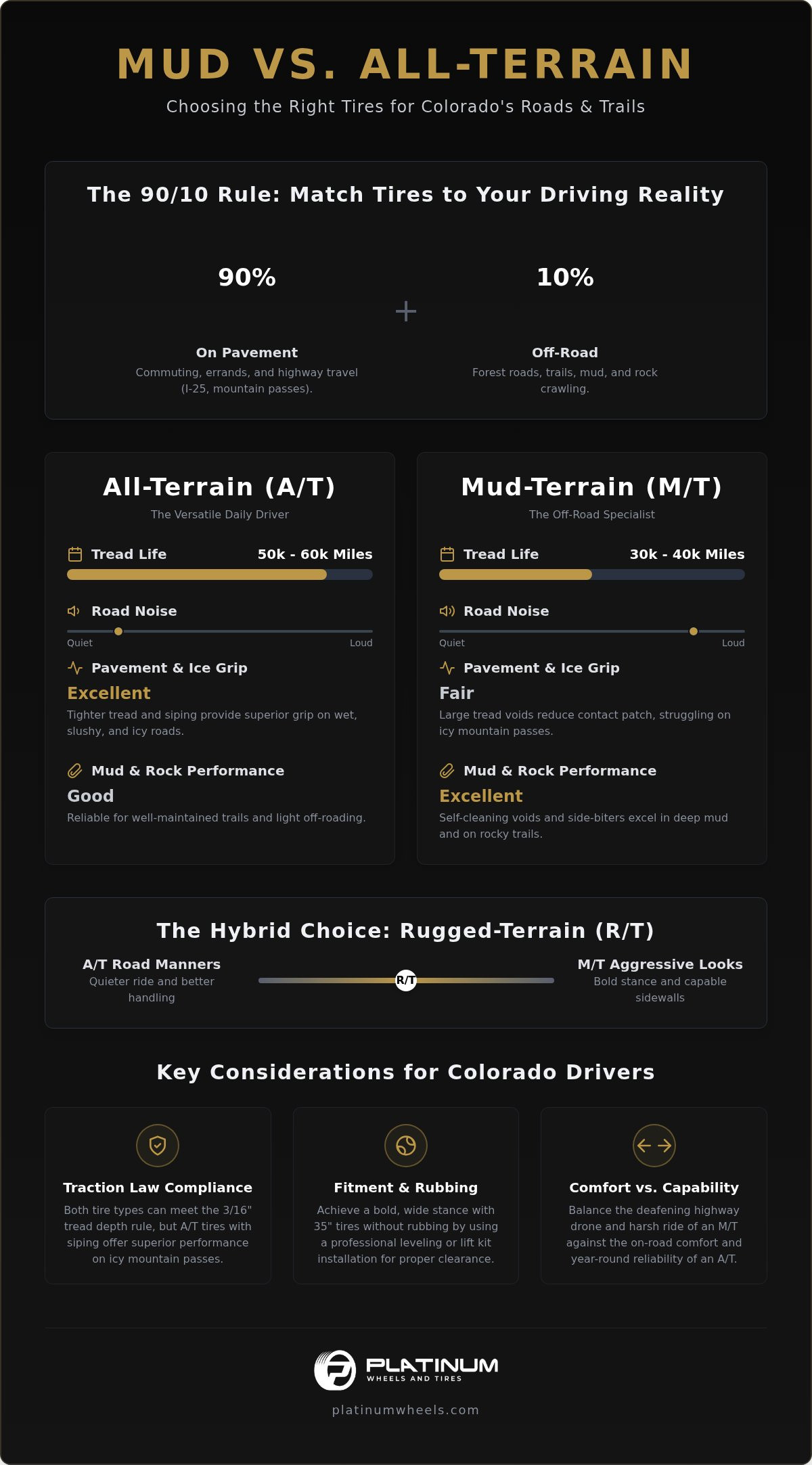
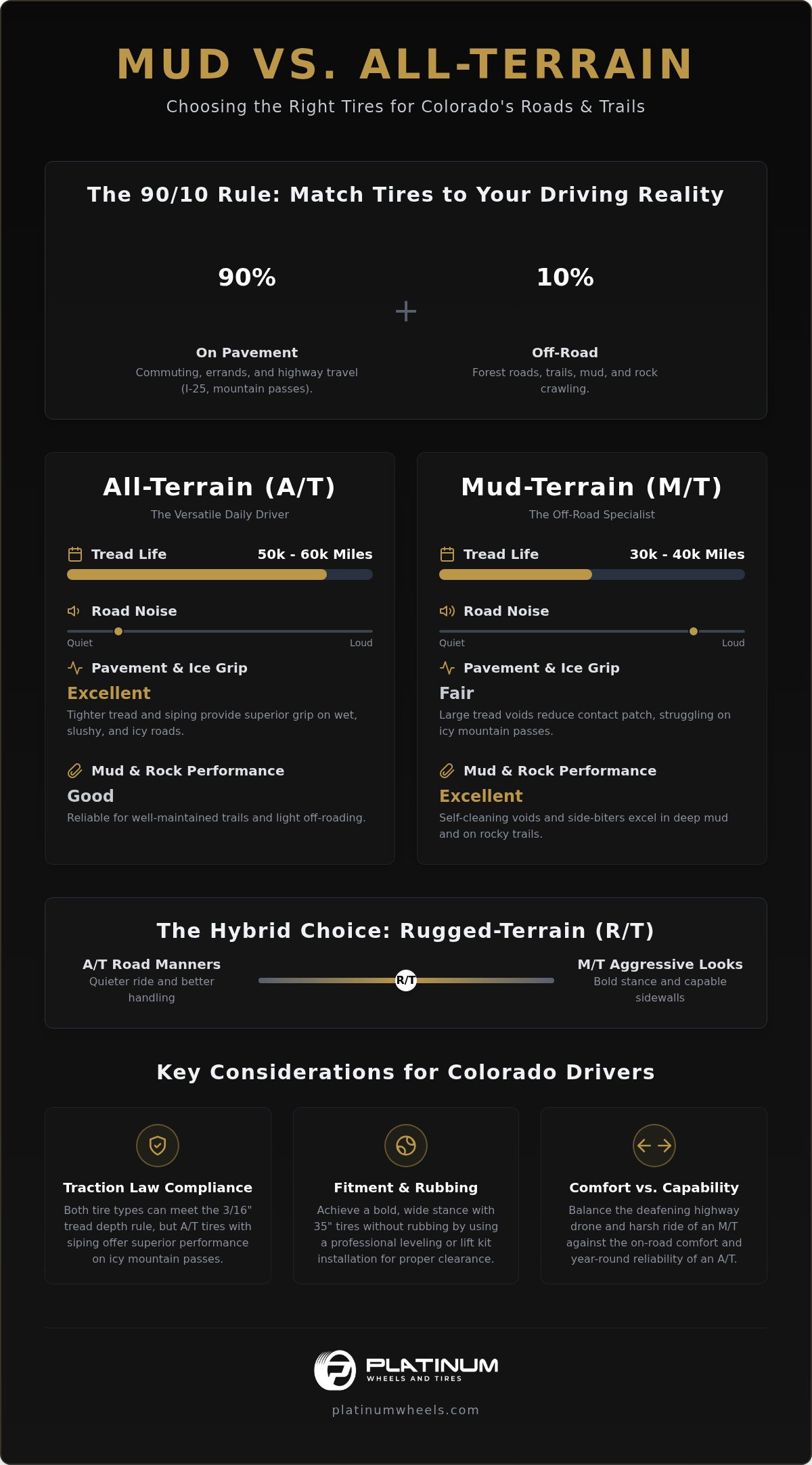
The most aggressive tread pattern in the shop often seems like the obvious choice for a Colorado weekend warrior, but the best tire isn't actually about the trail. It is about the 90% of the time you spend on the pavement. Choosing between mud tires vs all terrain is a high-stakes decision when you consider that over one million motorists will head through the Eisenhower-Johnson Memorial Tunnel this February alone. You want a truck that looks ready for a Moab expedition, but you also need to stay glued to the road when the Denver slush turns to ice.
It's frustrating to invest in a set of 35-inch tires only to realize they rub your wheel wells or create a deafening drone at highway speeds. We know you want a balance of rugged capability and daily reliability. This guide breaks down the technical differences between M/T and A/T setups, from meeting the 3/16-inch tread depth requirements of the Colorado Traction Law to finding the perfect fitment for your lift kit. You'll discover how to achieve that bold, wide stance while maintaining the safety and comfort required for life in the Front Range.
Key Takeaways
- Understand the core trade-offs between mud tires vs all terrain regarding tread longevity and cabin noise during high-speed highway commutes.
- Identify why aggressive mud-terrain patterns often struggle on icy mountain passes and how to choose a setup that meets Colorado Traction Law requirements.
- Master fitment basics to prevent 35-inch tires from rubbing, including how a professional leveling kit installation provides the necessary clearance for oversized rubber.
- Evaluate the "90/10 Rule" to determine if your driving habits favor the off-road grip of an M/T or the versatile, year-round reliability of an A/T.
- Learn how to select a complete wheel and tire package that achieves a bold, wide stance without sacrificing safety in Denver’s unpredictable winter slush.
Defining the Contenders: What Are Mud-Terrain and All-Terrain Tires?
Walk into any off-road shop in Denver, and you'll immediately see the visual divide between the two main categories of truck rubber. The debate over mud tires vs all terrain usually starts with aesthetics, but it quickly moves into the hard science of tread design and rubber compounds. Understanding the technical classification of all-terrain and mud-terrain tires is the first step toward building a rig that actually performs when you leave the pavement behind. While both are designed to handle more than your average highway tire, they solve very different problems for the Colorado driver.
All-terrain (A/T) tires are the versatile "jack-of-all-trades" for the Front Range. They utilize a tighter tread pattern that maximizes the amount of rubber touching the road, which is critical for stability at highway speeds. Mud-terrain (M/T) tires are the heavy-duty specialists. They feature massive, chunky tread blocks and wide channels designed to chew through the deep, loose soil and thick mud found in the backcountry. Recently, a third option has emerged: the Rugged Terrain (R/T) or "hybrid" tire. These hybrids are changing the game for local truck owners by blending the aggressive sidewall look of an M/T with the road manners of an A/T.
Anatomy of an All-Terrain Tire
The secret to an all-terrain tire's success on wet or icy Denver roads is siping. These are the thousands of tiny slits cut into the tread blocks that act like little fingers, biting into slippery surfaces to provide grip. Because the tread blocks are packed closer together, there is less air moving through the tire as it spins. This results in a significantly quieter ride and better fuel economy than more aggressive options. We typically recommend A/Ts for drivers who spend their weekdays commuting on I-25 and their weekends hitting snowy mountain passes or well-maintained forest service roads.
Anatomy of a Mud-Terrain Tire
If you plan on tackling the deep mud of a spring thaw or the loose scree of a high-altitude trail, the M/T is your primary tool. The large tread blocks are engineered to be self-cleaning; as the tire rotates, it uses centrifugal force to eject mud and rocks that would otherwise clog the tread and turn your tire into a "slick." These tires also feature reinforced sidewalls and "side-biters" that provide extra traction and puncture resistance when you air down for rocky trails. Beyond the performance, there is no denying the appeal of the M/T. It is the gold standard for truck aesthetics, giving your vehicle that bold, capable stance that looks right at home in the Rockies.
The Daily Driver Reality: Noise, Longevity, and MPG
Your truck might look like a beast in the driveway, but the true test happens at 75 MPH on I-25. When weighing the pros and cons of all-terrain vs. mud-terrain, the most immediate difference you'll feel is the "hum" factor. While aggressive tread looks great, it often comes with trade-offs in comfort and cost that every Colorado driver should consider. Choosing between mud tires vs all terrain means deciding how much highway noise you can tolerate and how often you want to visit the shop for replacements.
Road Noise and Comfort
Harmonic noise is a common complaint for mud-terrain owners. Those massive tread blocks trap air and release it with a distinct vibration that grows into a loud drone at highway speeds. As M/T tires wear, they often develop "cupping" or uneven wear patterns if not rotated every 3,000 to 5,000 miles. Frequent rotation is non-negotiable. Tire engineers vary the size and shape of the tread blocks, a technique called tread pitch variation, to create competing sound frequencies that cancel each other out and keep the cabin quiet. Additionally, the stiffer sidewalls of a mud tire don't absorb city potholes as well as an all-terrain, leading to a firmer, sometimes harsher ride quality.
The Cost of Ownership Beyond the Sticker Price
Beyond the initial purchase, you have to look at the long-term expenses. Tread life matters. All-terrain tires are built for longevity, with many premium models offering a tread life of 50,000 to 60,000 miles. In contrast, the softer rubber compounds and aggressive patterns of mud-terrain tires typically wear out much faster, often requiring replacement after only 30,000 to 40,000 miles. There is also the fuel economy factor to consider. Heavier mud tires increase rolling resistance and unsprung weight, which forces your engine to work harder. MPG often takes a hit. When you upgrade to these larger sizes, don't forget to recalibrate your TPMS sensors to ensure your safety systems remain accurate. If you aren't sure which trade-off fits your lifestyle, we can help you select a complete wheel and tire package that balances performance with your daily commute.
Colorado Terrain Analysis: Rock, Snow, and Trail Performance
Colorado trails offer a brutal mix of razor-sharp shale and deep powder, but your biggest challenge is often the black ice on the way to the trailhead. When comparing mud tires vs all terrain performance, you have to look past the aggressive tread blocks. Mud-terrain tires excel in the rare deep mud of a spring thaw, yet they often turn into hockey pucks on the packed snow of an I-70 blizzard. Without the dense siping found in all-terrain models, M/T tires struggle to find a purchase on frozen surfaces. This is a critical safety factor when you consider the Colorado Traction Law requires a minimum 3/16-inch tread depth and winter-rated performance for mountain travel.
The 'Three-Peak Mountain Snowflake' (3PMSF) Rating
The 3PMSF symbol on a tire sidewall indicates it has passed specific tests for traction in severe snow conditions. Most premium all-terrain tires carry this rating, making them a legal and safe choice for year-round driving in the High Country. Very few mud-terrain tires earn this badge because their large, solid tread blocks lack the flexibility needed to grip ice. If you want a rig that handles a Denver blizzard as well as a summer trail, choosing the best all-terrain tires is usually the smarter move for total peace of mind.
Off-Roading in the Front Range
True mud is actually quite rare on Front Range trails; you are far more likely to encounter jagged rocks and loose scree. In these conditions, sidewall durability matters more than tread depth. Mud-terrain tires often feature three-ply sidewalls that resist punctures from sharp rocks, providing a significant advantage when you are aired down to 15 PSI. This expert analysis of off-road performance highlights how M/T tires provide superior "self-cleaning" in loose soil, but A/Ts often offer a larger contact patch on dry rock. Airing down an A/T tire allows the tighter tread to wrap around obstacles, providing surprising grip on the technical climbs found near Buena Vista or Moab. Be honest about your trail habits. If you aren't hunting for deep mud pits, the versatility of an all-terrain setup often outweighs the specialized grip of a mud tire.
Fitment and Suspension: Will They Rub?
The most common fear we hear at the shop is the dreaded sound of rubber meeting metal during a tight turn in a Denver parking garage. When you are deciding between mud tires vs all terrain, you have to look at more than just the numbers on the sidewall. Even if two tires are labeled as 35x12.50R20, a mud-terrain tire often measures "larger" in practice. This is because the massive shoulder lugs and aggressive side biters extend further out than the tighter, more rounded profile of an all-terrain tire. This extra geometric width is exactly what catches on your upper control arms or fender liners when you're at full lock.
Your choice of custom wheels and rims plays a massive role in this equation. If you keep your factory wheels with their high positive offset, a wide mud tire will almost certainly rub against your suspension components. Pushing the wheels out with a more neutral or negative offset can solve that internal clearance issue, but it often moves the "rub point" to the outer fender or the body mount. It is a delicate balance of millimeters that requires professional precision to get right.
Leveling Kit vs. Lift Kit for Tire Clearance
For many Colorado truck owners, a 2-inch leveling kit is the perfect middle ground. It provides just enough clearance to fit 33-inch tires comfortably, and on some late-model trucks, it can even accommodate 35-inch all-terrains with minor trimming. However, if you're set on the deep lugs of a mud tire, we often recommend a full lift kit. A 4-inch or 6-inch lift doesn't just look aggressive; it provides the necessary room for your suspension to cycle fully without the tire slamming into the top of the wheel well during off-road articulation. Your truck's suspension height directly dictates the maximum tire size and tread aggressiveness you can safely run without structural interference.
Maximizing Stance with Wheel Packages
Achieving that wide, "planted" stance usually involves negative offset wheels. While this looks incredible on a built rig, it changes your truck's scrub radius. This is the arc the tire travels through as you turn the steering wheel. If the scrub radius is too large, your tires will swing into the back of the wheel well or the front bumper. This is why aftermarket wheel and tire packages are so effective. We don't just pick parts that look good; we calculate the specific offset and tire width to ensure your truck handles safely on the I-25 commute while still looking like a beast. If you're tired of guessing and want a setup that fits perfectly the first time, contact us today for a professional fitment consultation.
The Verdict: Which Tire Should You Buy?
Choosing between mud tires vs all terrain ultimately comes down to the 90/10 rule. Be honest with yourself about where your truck actually spends its miles. If 90% of your driving happens on the I-25 corridor and only 10% occurs on a dirt trailhead, you need a tire that prioritizes pavement safety. However, if your rig is a dedicated weekend warrior built for the most technical trails in the Rockies, the trade-offs of a mud tire become much easier to swallow. It's about finding that sweet spot where your visual goals don't compromise your practical needs.
For many Colorado owners, the Rugged Terrain (R/T) tire has become the secret weapon. These "hybrid" tires are designed to bridge the gap. They feature the aggressive sidewall biters and large shoulder lugs of an M/T, but they utilize the tighter center tread and siping of an A/T. This gives you the mean, wide stance you want for the street without the deafening drone or poor ice traction usually associated with a pure mud tire.
Choose All-Terrain If...
- You use your truck as a daily driver and want to maximize fuel economy.
- You frequently head to world-class ski resorts and need reliable traction on packed snow and black ice.
- You want a tire with a long-lasting compound that can easily hit the 50,000-mile mark.
- You prefer a quiet, comfortable cabin during long mountain road trips.
Choose Mud-Terrain If...
- Your truck is primarily a show vehicle or a dedicated off-road rig.
- You spend significant time in deep mud, loose soil, or extreme rock-crawling environments.
- You prioritize an aggressive, chunky aesthetic over highway comfort.
- You are committed to a strict 3,000-mile rotation schedule to prevent uneven wear.
The Platinum Wheels Advantage
Selecting the right rubber is only half the battle; the other half is expert fitment. Our team in Denver understands the unique demands of Front Range driving. We help you navigate the complexities of offset, backspacing, and clearance to find the perfect offroad tires and wheels for your specific build. We provide custom mounting and high-speed balancing to ensure your truck stays vibration-free, whether you're cruising through downtown or airing down for a trail. Don't settle for a "close enough" fitment that rubs every time you turn the wheel. Contact us today for a personalized quote and a professional consultation to get your truck Rockies-ready.
Dominate the Rockies with the Right Setup
Choosing between mud tires vs all terrain rubber is the most impactful decision you'll make for your truck's performance and safety. You now understand that the "90/10 rule" is your best guide for balancing highway manners with trail capability. While M/T tires provide that iconic aggressive look, remember that a winter-rated A/T often provides the safety you need to navigate a Denver slush storm or a frozen mountain pass without white-knuckling the steering wheel.
Getting the fitment right is just as important as picking the tread. We are specialized in Colorado Front Range fitment and carry premium brands like Nitto and Toyo to ensure your truck is equipped for the specific terrain we live in. From professional lift and leveling kit installations to custom wheel packages, we have the expertise to make sure your oversized tires clear every turn without issue. We're here to help you turn your vision into a rig that's as reliable as it is rugged.
Build Your Dream Truck Setup with Platinum Wheels in Denver and start your next journey with a rig that is truly built for the High Country. We look forward to seeing you at the shop!
Frequently Asked Questions
Are mud tires bad in the snow?
Mud tires are generally poor on packed snow and ice because they lack the siping found in winter-rated tires. While they can chew through deep, unplowed powder, they struggle to grip frozen asphalt. Most M/T models don't meet the Three-Peak Mountain Snowflake standards required for safe mountain travel during a typical Colorado winter storm.
Do mud tires wear out faster than all-terrains?
Yes, mud tires typically wear out faster due to their softer rubber compounds and larger tread voids. You can expect about 30,000 to 40,000 miles from a set of M/Ts, whereas many all-terrain tires are warrantied for 50,000 to 60,000 miles. Frequent rotation every 3,000 to 5,000 miles is essential to prevent the uneven wear that leads to premature replacement.
How much MPG will I lose with mud tires?
Most truck owners see a drop of 1 to 3 miles per gallon when switching to a mud-terrain setup. The increased rolling resistance and heavy unsprung weight of these tires force your engine to work harder to maintain speed. This impact is even more noticeable when climbing the steep grades of the I-70 mountain corridor toward the tunnel.
Can I run mud tires on the highway?
You can run mud tires on the highway, but you'll experience a louder cabin and a firmer ride. High-speed driving causes these tires to generate significant heat, which can accelerate tread wear if your alignment isn't perfect. If your commute involves long stretches of pavement, the mud tires vs all terrain debate usually leans toward the all-terrain for daily comfort.
Do I need a lift kit for 35-inch mud tires?
Most trucks require at least a 2.5-inch leveling kit or a full lift kit to clear 35-inch mud tires without rubbing. Because M/T tires have aggressive shoulder lugs that extend further than A/T tires, they often catch on the upper control arms or inner fender liners. Professional fitment is the only way to ensure your steering remains safe at full lock during tight turns.
Which tire is better for the Colorado Rockies?
All-terrain tires are the better choice for most Colorado drivers because they handle the year-round mix of dry pavement, rain, and black ice. Mud tires are specialized tools for deep soil and technical rock crawling. For the average Front Range resident who balances a weekday commute with weekend trails, the versatility of an A/T tire provides the best safety margin.
Are all-terrain tires noisy?
Modern all-terrain tires are remarkably quiet compared to their predecessors. Manufacturers use variable tread pitch technology to create sound frequencies that cancel out harmonic road noise. While they aren't as silent as a standard passenger tire, they don't produce the heavy drone or floorboard vibration commonly associated with mud-terrain tread patterns at highway speeds.
What is a 'Hybrid' or R/T tire?
A Rugged Terrain (R/T) tire is a middle ground in the mud tires vs all terrain comparison. These tires feature the aggressive sidewalls and shoulder lugs of a mud tire for aesthetics and off-road grip, but they use a tighter center tread for better road manners. They've become the go-to choice for Colorado owners who want the look of an M/T without the highway compromises.