Leveling Kit vs. Lift Kit: The Ultimate 2026 Guide for Colorado Truck Owners
Why does a simple three inch modification often turn a smooth highway cruiser into a bone jarring ride that feels like a tractor? It's a common fear for Denver truck owners who want to eliminate that nose down factory rake but worry about compromising their vehicle's geometry. Deciding on a leveling kit vs lift kit isn't just about how high you want to go; it's about how you plan to use your rig on the steep grades of the Rockies and the busy streets of Aurora.
We understand that you want a setup that looks aggressive and level while maintaining the comfort of your daily commute. This guide will help you master the technical and aesthetic differences between these two suspension paths so you can choose the perfect fit for your lifestyle. You'll learn how to clear 35 inch tires without rubbing, understand the impact on your CV angles, and discover how to build a suspension ecosystem that thrives on Colorado trails.
Key Takeaways
- Understand why trucks are built with a "factory rake" and how correcting this angle creates a more aggressive, balanced profile for your rig.
- Deciding between a leveling kit vs lift kit depends on whether you prioritize a simple stance correction or maximum ground clearance for Colorado’s backcountry trails.
- Learn how suspension lifts provide the necessary room for 35 inch tires and the articulation needed to handle deep snow and rocky terrain safely.
- Discover why wheel offset and backspacing are just as critical as height when you're trying to avoid tire rubbing and poor handling.
- Gain peace of mind by understanding the importance of professional installation for maintaining vehicle geometry and precision on steep mountain passes.
Understanding the Basics: What is the Difference Between a Lift and Leveling Kit?
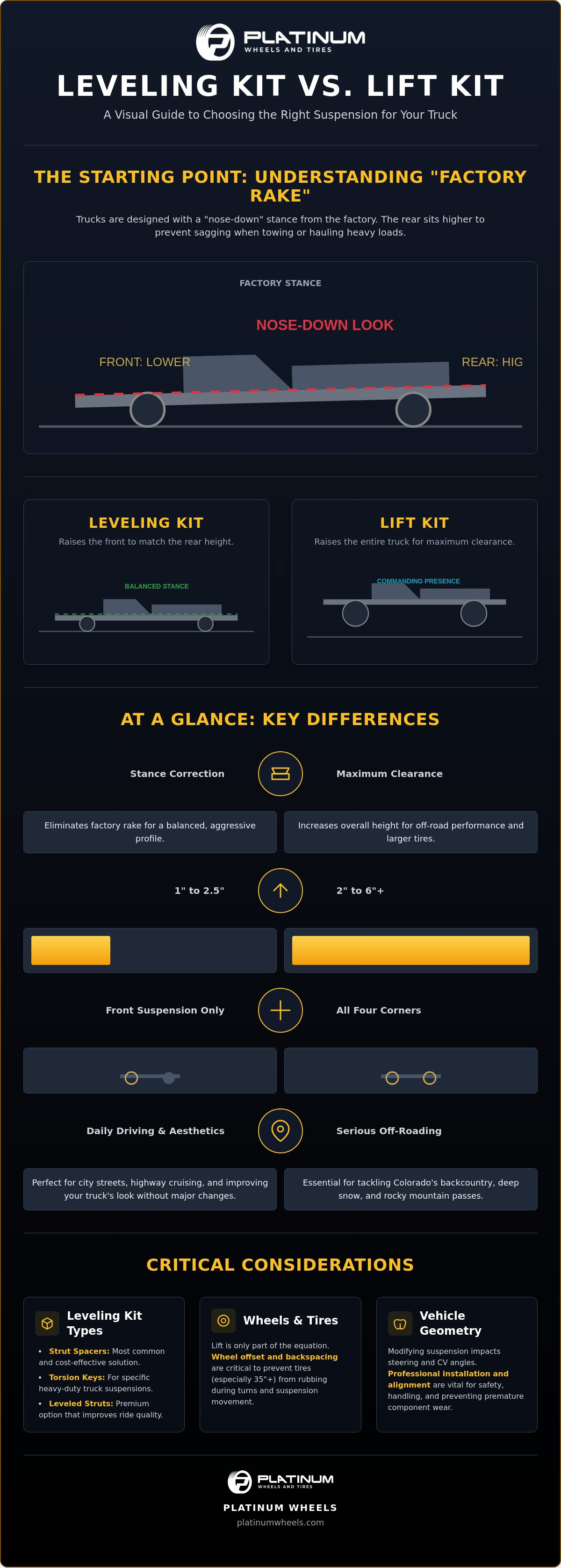
Most truck owners in Denver start their modification journey with a simple question: why does the back of my truck sit so much higher than the front? This isn't a manufacturing mistake; it's a deliberate design choice that leads many to weigh the pros and cons of a leveling kit vs lift kit. Both systems aim to increase ground clearance and improve your vehicle's aesthetics, but they achieve these goals through very different mechanical paths. Choosing the right one depends on whether you're looking for a subtle stance correction or a total transformation of your truck's capabilities.
A leveling kit is a targeted solution for stance correction that raises the front of the vehicle to match the rear height. Conversely, a lift kit is a comprehensive suspension overhaul that increases height across all four corners for enhanced performance and a commanding presence. Outside the garage, this same principle of precision is vital for property maintenance; for instance, Airlift Concrete Experts provides professional polyurethane concrete leveling for those in Arkansas looking to stabilize sinking surfaces.
The Concept of Factory Rake
Manufacturers build trucks with what's known as "factory rake," meaning the rear suspension sits roughly two inches higher than the front. This design assists with towing and hauling by preventing rear-end sag when you've got a heavy load in the bed. While functional for work, this rake creates a "nose-down" look that many owners find unappealing for a daily driver. It prioritizes highway aerodynamics and fuel efficiency over off-road approach angles. If you're hitting rocky trails near Idaho Springs, that lower front end becomes a liability, often scraping against obstacles that the rear would clear with ease.
Quick Comparison: Height and Scope
When comparing the two, scope and height are the main differentiators. Leveling kits are generally limited to 1 to 2.5 inches of lift and only affect the front end. They're the go-to choice for drivers who want a clean, horizontal profile without changing the factory ride quality significantly. What is a Suspension Lift? Unlike a simple level, a full suspension lift can range from 2 inches to over 6 inches. These kits replace major components like shocks, springs, and control arms at all four corners. This extra height is essential if you plan on running larger custom wheels and rims that require more wheel well real estate to avoid rubbing during tight turns or deep suspension articulation.
The Deep Dive on Leveling Kits: Eliminating Factory Rake
Achieving a perfectly horizontal profile is the primary goal for most owners who choose a leveling kit. While we touched on the concept of factory rake earlier, it's important to understand how a level kit acts as a precision tool to fix that specific visual imbalance. By raising the front of your truck by roughly 1 to 2.5 inches, you create a balanced, aggressive stance that looks more natural on the road. When comparing a leveling kit vs lift kit, the leveling option is often the winner for those who prioritize a clean look without the complexity of a full suspension rebuild.
Simplicity is the hallmark of these systems. Because they only modify the front suspension, the installation is faster and more affordable than a full lift. This makes it an ideal entry point for drivers who want their truck to stand out in a crowded Denver parking lot but don't need to clear massive boulders on a weekend trip to the high country. If you're curious about the specific mechanics, you can read our detailed breakdown on What Is a Truck Leveling Kit? to see how these components integrate with your specific make and model.
Types of Leveling Systems
Not all leveling solutions are created equal. The right choice depends on your truck's architecture and your performance goals. Strut spacers are the most common and cost-effective method; they simply bolt onto the top of your factory struts to provide immediate height. For older or heavy duty trucks using torsion bar suspensions, specialized torsion keys allow for a similar height adjustment. If you want to improve your ride quality while gaining height, premium leveled struts or coilovers are the way to go. These replace the factory components entirely, offering better dampening and control on the uneven pavement of the Front Range.
Pros and Cons of Leveling Your Truck
Choosing a leveling kit offers several practical benefits for the everyday driver. You'll maintain a near-factory ride quality and won't have to worry about clearing the height sensors in downtown parking garages. It also provides just enough room to fit slightly larger tires, such as 33s, without major trimming. However, there are limitations to consider. Leveling kits don't increase rear ground clearance, which can be a drawback for serious off-roading. Additionally, because the truck is now level, adding a heavy trailer or a bed full of gear can cause the rear to "squat," making the front end point toward the sky. If you're unsure if a level will meet your needs, our team can help you find the right suspension setup for your specific towing and driving habits.
- Pros: Lower cost, easier garage access, fits 33 inch tires, maintains factory ride.
- Cons: Limited off-road clearance gains, potential for rear squat when towing, no increase in rear height.
Exploring Suspension Lift Kits: Maximum Clearance and Capability
If you find yourself staring down a technical, boulder-strewn trail near Idaho Springs or plowing through a fresh foot of powder in the foothills, a simple front-end adjustment won't be enough. This is where the debate of leveling kit vs lift kit shifts toward maximum capability. A suspension lift kit is a tool for the serious off-roader who needs to clear obstacles that would tear the undercarriage off a stock vehicle. By raising the frame and body away from the axles, you gain the critical ground clearance required to conquer the diverse Colorado landscape without expensive damage.
Mechanical complexity increases significantly when you move into full lift territory. Unlike a level, you're investing in a comprehensive system that often replaces control arms, shocks, and leaf springs. In high-clearance setups exceeding four inches, you may even need to modify driveshafts and brake lines to maintain proper geometry and safety. This investment pays off when you can fit 35-inch or even 37-inch tires. These larger diameters provide a massive footprint for traction and a much smoother ride over the jagged terrain found on trails like Kingston Peak. Professional installation is non-negotiable here; you need to ensure your steering geometry remains precise for those high-altitude descents.
While a lift kit protects your undercarriage from jagged terrain, those same rocky trails often kick up debris that can damage your glass; for those looking to maintain a clear view of the trail, you can explore Windshield Replacement with Pinnacle Auto Glass to understand the professional standards required for off-road vehicle safety.
Suspension Lift vs. Body Lift
It's vital to distinguish between these two methods before you commit. A body lift uses spacers to raise the truck's body away from the frame. It's a cost-effective way to get tire clearance, but it offers zero improvement in actual ground clearance or suspension travel. We focus on suspension lifts because they modify the actual suspension architecture. This ensures your rig performs as good as it looks, providing the articulation and durability required for the rigors of mountain driving. A suspension lift actually changes how your truck interacts with the trail, whereas a body lift is purely for aesthetics.
The Trade-offs of Going Big
Going big comes with a set of responsibilities that every Denver owner should consider. Raising your vehicle shifts the center of gravity higher, which you'll feel when navigating the tight, curvy switchbacks of mountain passes. Handling becomes more deliberate, and increased wind resistance will impact your fuel economy on long stretches of I-70. To mitigate these changes and keep your ride planted, it's essential to pair your new height with high-quality all terrain tires. Choosing the right leveling kit vs lift kit setup means balancing that aggressive "monster" truck look with the practical realities of daily driving in the Front Range.
Leveling Kit vs. Lift Kit: A Side-by-Side Comparison Framework
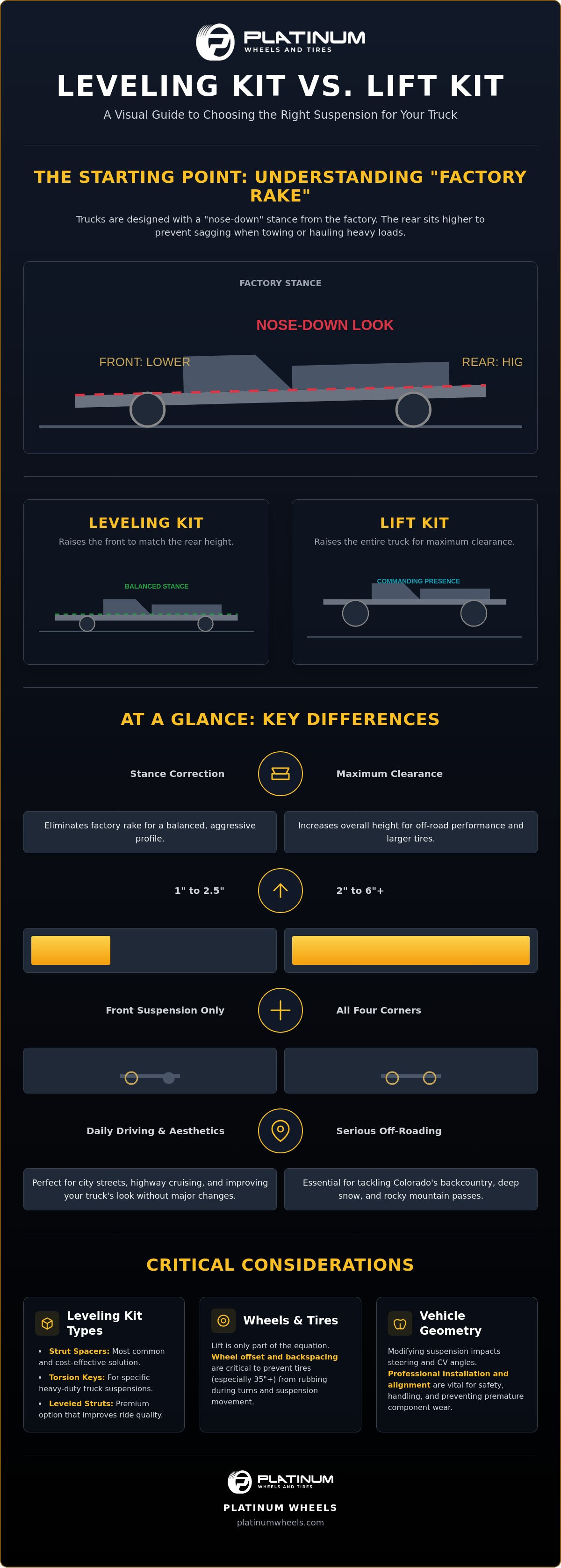
Choosing between a leveling kit vs lift kit requires a clear eyed look at your budget, your truck's primary mission, and your long term maintenance plans. While leveling kits offer an accessible entry point, professional grade suspension lifts represent a more significant financial investment. Beyond the initial purchase, you must account for the ripple effects on your vehicle's electronic systems. Every modification to your height alters your wheel speed and pressure readings, often requiring a TPMS sensor recalibration to keep your dashboard clear of warning lights. Both options also demand an immediate professional alignment to prevent your tires from wearing unevenly on the rough pavement of I-70.
The "Towing Factor" is a critical differentiator that many owners overlook. If you frequently haul a heavy camper or a trailer full of snowmobiles, a lift kit might actually be the superior choice. Because leveling kits eliminate the factory rake, adding a heavy load to the rear can cause the truck to "squat" or sag. This shifts the weight off your front tires, reducing steering control and making your headlights blind oncoming traffic. A lift kit allows you to maintain some of that necessary rake or incorporate stiffer rear springs to handle heavy Colorado hauling without compromising safety.
For truck owners who utilize their vehicles for more than just recreation, you can find out more about how commercial-grade equipment and upfitting services can enhance your rig's functional capabilities.
Which Kit Fits Your Lifestyle?
We see three main categories of owners in the Denver metro area, each with distinct needs. The Daily Driver often finds that leveling is the sweet spot. It provides a clean, aggressive look and fits 33 inch tires while still clearing the height restrictions of downtown parking structures. The Weekend Warrior usually aims for a 3 inch suspension lift. This is the "Goldilocks" zone for Colorado trails, offering enough clearance for 35 inch tires and the articulation needed for moderate off roading. Finally, the Show Truck owner goes for 6 or more inches. This setup creates maximum visual impact on the streets of Aurora but requires the most extensive mechanical modifications to stay road legal and safe; if you're investing in such a high-end build, you should check out Peotter's Auto Spa for specialized surface protection and aesthetic preservation.
For those aiming for such high-profile aesthetics, especially for business use, you can learn more about Yeahgor to see how professional wraps and decals can complement a lifted stance for a complete custom look.
Impact on Vehicle Longevity
Longevity is entirely dependent on the quality of the components and the precision of the install. Extreme lifts can put significant stress on your driveline angles, specifically your CV joints. If these angles aren't corrected during installation, you'll face premature component failure and costly repairs. Professional installation ensures that your suspension geometry remains within safe operating limits even under the stress of mountain driving. If you're ready to transform your ride without compromising its lifespan, you can consult with our experts to find the perfect balance between height and durability for your specific truck.
Choosing Your Setup: Professional Fitment and Installation in Denver
Choosing the right setup for your truck is about more than just picking a height from a catalog. When you're weighing the choice of a leveling kit vs lift kit, the most common question we hear is: "will it fit?" But fitment is a complex equation that involves more than just vertical inches. You have to consider how your wheels and tires interact with the suspension at full lock and during deep articulation. At Platinum Wheels, we specialize in solving these geometry puzzles for drivers across the Denver metro area, from Aurora to Lakewood. We don't just bolt on parts; we consult with you to match your chosen lift or level to your dream wheel and tire package.
Professional installation is non-negotiable when you consider the stakes of Colorado driving. Navigating steep mountain inclines or braking on slushy, snowy roads requires a suspension system that is perfectly aligned and structurally sound. A DIY mistake on a suspension lift can lead to catastrophic failure at highway speeds or on a remote trail. We prioritize your peace of mind by ensuring every component is torqued to spec and every angle is corrected for the specific demands of the Front Range landscape.
Avoiding the Rub: The Role of Wheel Offset
Wheel offset and backspacing are the silent partners in every suspension upgrade. Lifting or leveling your truck changes the clearance inside the wheel well, but the wrong wheel offset can cause significant rubbing even on a six inch lift. If your wheels sit too far inward, they might hit your new control arms or sway bar links. If they stick out too far, they'll catch the fender liner or the bumper when you turn. Our technicians calculate these measurements with precision for your specific truck model. We help you avoid the "rub" by selecting wheels that complement your leveling kit vs lift kit decision, ensuring a clean turn every time.
The Platinum Wheels Advantage in Colorado
We serve the entire Front Range, understanding the specific needs of drivers from Castle Rock to Fort Collins. Our focus is narrow and deep: we stick to suspension, wheels, and tires rather than general mechanical repair. This specialization means we've seen every fitment challenge the industry has to offer and know exactly how to solve it. We value precision and local roots, positioning ourselves as a reliable fixture in the community that understands your lifestyle. Visit our shop in the Denver area for a personalized fitment consultation, and let's build a rig that looks aggressive and performs flawlessly on every Colorado trail.
While we focus on enhancing your driving experience here in Colorado, if your travels take you to the UK, you can enjoy a different type of premium transport with the luxury private tours to historic sites like Chartwell offered by timescapetours.co.uk.
Just as a custom truck is an investment in quality and personal style, choosing the right jeweler is essential for life's biggest moments; Brilliant Diamonds Fine Jewelers provides the expert craftsmanship needed for custom engagement rings and fine jewelry that mirror the precision of a high-end vehicle build.
Elevate Your Colorado Driving Experience
You've explored the mechanical nuances of stance, height, and geometry required to master the diverse terrain of the Front Range. Whether you're hunting for a perfectly level profile for your daily commute or a high clearance suspension for technical trail runs, the decision on a leveling kit vs lift kit ultimately comes down to how you use your rig. Achieving the perfect look requires more than just adding inches; it demands a precise understanding of wheel offset and suspension geometry to prevent rubbing and ensure stability on steep mountain passes.
Our team at Platinum Wheels is here to guide you through every step of this transformation. As a locally owned and operated independent shop, we specialize in premium wheel and tire fitment and provide expert installation for the Denver Front Range. We don't just sell parts; we build functional systems that thrive in the Rockies. Ready to transform your truck? Contact Platinum Wheels for a custom lift or leveling consultation today! We look forward to helping you create a truck that's as capable as it is aggressive.
Frequently Asked Questions
Does a leveling kit or lift kit affect my gas mileage?
Both modifications will likely decrease your fuel economy due to increased wind resistance and the heavier tires typically paired with them. A lift kit usually has a more significant impact than a leveling kit because it exposes more of the undercarriage to airflow. Expect a drop in miles per gallon depending on how aggressive your new tire tread is and how high you've raised the center of gravity.
Will a leveling kit void my truck’s factory warranty?
Installing a suspension modification does not automatically void your entire vehicle warranty. Under the Magnuson-Moss Warranty Act, a dealer must prove that the aftermarket part caused a specific failure to deny coverage for that repair. While the kit itself won't be covered by the manufacturer, your engine and transmission warranties typically remain intact unless the modification directly impacts their operation.
Can I install a leveling kit myself, or do I need a professional?
While a confident home mechanic can install basic spacers, professional installation is highly recommended for safety and precision. Suspension components are under immense tension and require specialized tools for a secure fit. Getting it done by a pro ensures your steering geometry is correct, which is vital when you're navigating the steep grades and sharp turns of Colorado mountain passes.
How much does it cost to install a lift kit vs. a leveling kit in Denver?
Leveling kits are generally more affordable because they require fewer parts and less labor time than a full suspension overhaul. A lift kit involves a higher investment in both premium components and the hours required for a complex four corner installation. We recommend focusing on the long term value of a professional setup that matches your specific driving needs in the Denver metro area.
Do I need new shocks if I install a leveling kit?
You don't always need new shocks for a basic leveling kit, but upgrading them can drastically improve your ride quality. Many entry level kits use spacers with your factory shocks, which can sometimes limit suspension travel. Premium leveling systems often include tuned struts or shocks designed to handle the new height, providing a much smoother experience on the washboard roads of the high country.
What is the largest tire size I can fit with a 2-inch leveling kit?
A 2 inch leveling kit typically allows you to fit 33 inch tires on most modern half ton trucks without significant rubbing. While some owners attempt to squeeze in 35s, this often requires aggressive trimming of the inner fender liners or very specific wheel offsets. Sticking with 33s ensures you maintain full steering range and suspension articulation during your off road adventures.
Will my truck still be able to tow a trailer after a lift or level?
Your truck will still be able to tow, but you'll likely need a drop hitch to keep the trailer tongue level. If you've chosen a leveling kit vs lift kit, keep in mind that a level truck may "squat" more visibly when a heavy trailer is attached. This can affect your headlight aim and front end traction, so consider adding helper springs or airbags if you plan on heavy hauling.
How often do I need an alignment after upgrading my suspension?
You must get a professional alignment immediately after any suspension modification is performed. Changing the ride height alters your toe, camber, and caster angles, which can lead to rapid tire wear and unpredictable handling. Beyond the initial setup, it's a good idea to have your alignment checked regularly or after any particularly rough weekend on the trails. During these maintenance checks, it is also important to inspect your windshield for chips or cracks; you can learn more about Auto Glass Ottawa to see how professional glass services contribute to overall vehicle safety and longevity.