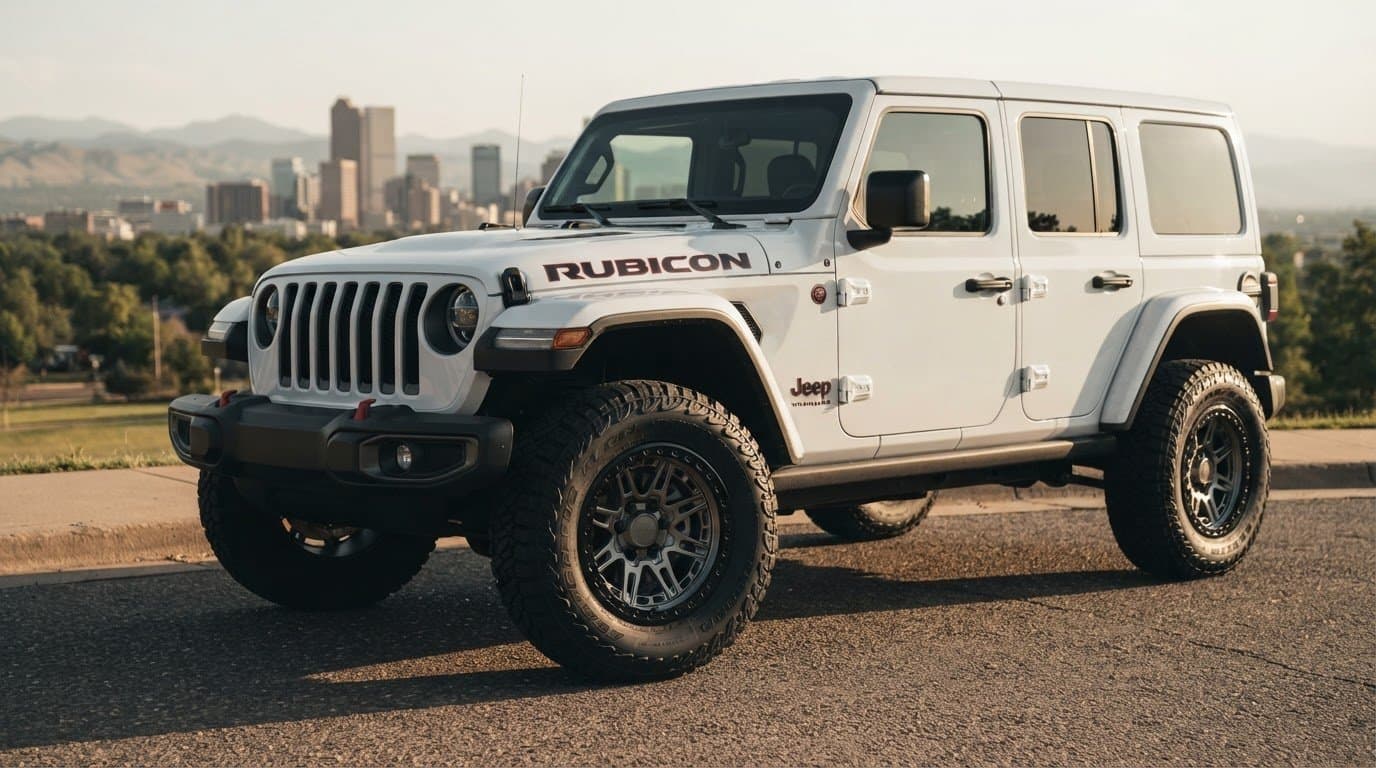
Best Jeep Wrangler Rims in Denver: Off-Road Ready Wheels
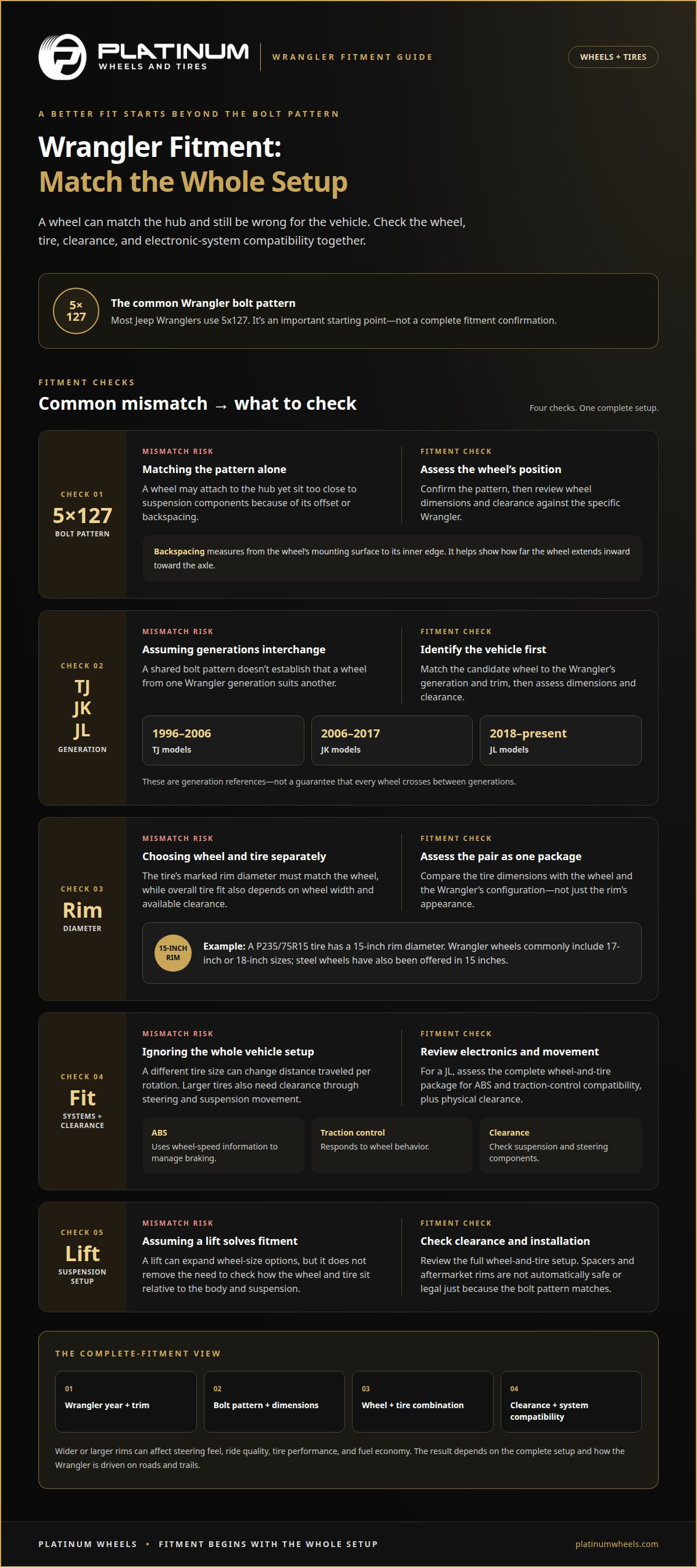
A great-looking set of Wrangler rims still need to fit the Jeep’s hub, suspension, and electronic systems. Most Jeep Wranglers use a 5x127 bolt pattern, but the right wheel also depends on model year, trim, wheel size, and tire setup.
When choosing Wrangler rims, style and off-road capability matter, but fitment matters just as much. A professional checks the bolt pattern and clearance, then confirms that the wheel-and-tire combination suits the vehicle’s ABS and traction-control systems. This guide explains the key fitment checks, common wheel-size considerations, and how a lift or leveling kit affects your options.
Whether your Wrangler is built for Denver streets, mountain trails, or both, the goal is a setup that looks right and works as intended. Here are the main factors to consider when selecting Wrangler rims and tires.
Key Takeaways
- Choose wheels based on your Wrangler’s model year, trim, intended use, and tire setup, not appearance alone.
- Most Jeep Wranglers use a 5x127 bolt pattern, but fitment involves more than matching the bolt pattern.
- A professional fitment check considers wheel and tire clearance alongside ABS and traction control compatibility.
- Lift or leveling changes the fitment picture; learn how a complete wheel-and-tire setup can support your build.
What are good wheels for a Jeep Wrangler?
The right wheels depend on your Wrangler’s year and trim, tire choice, and intended use. For a Jeep Wrangler JL, evaluate the complete wheel-and-tire setup rather than choosing by rim appearance alone.
Aftermarket Wheel and Tire Packages
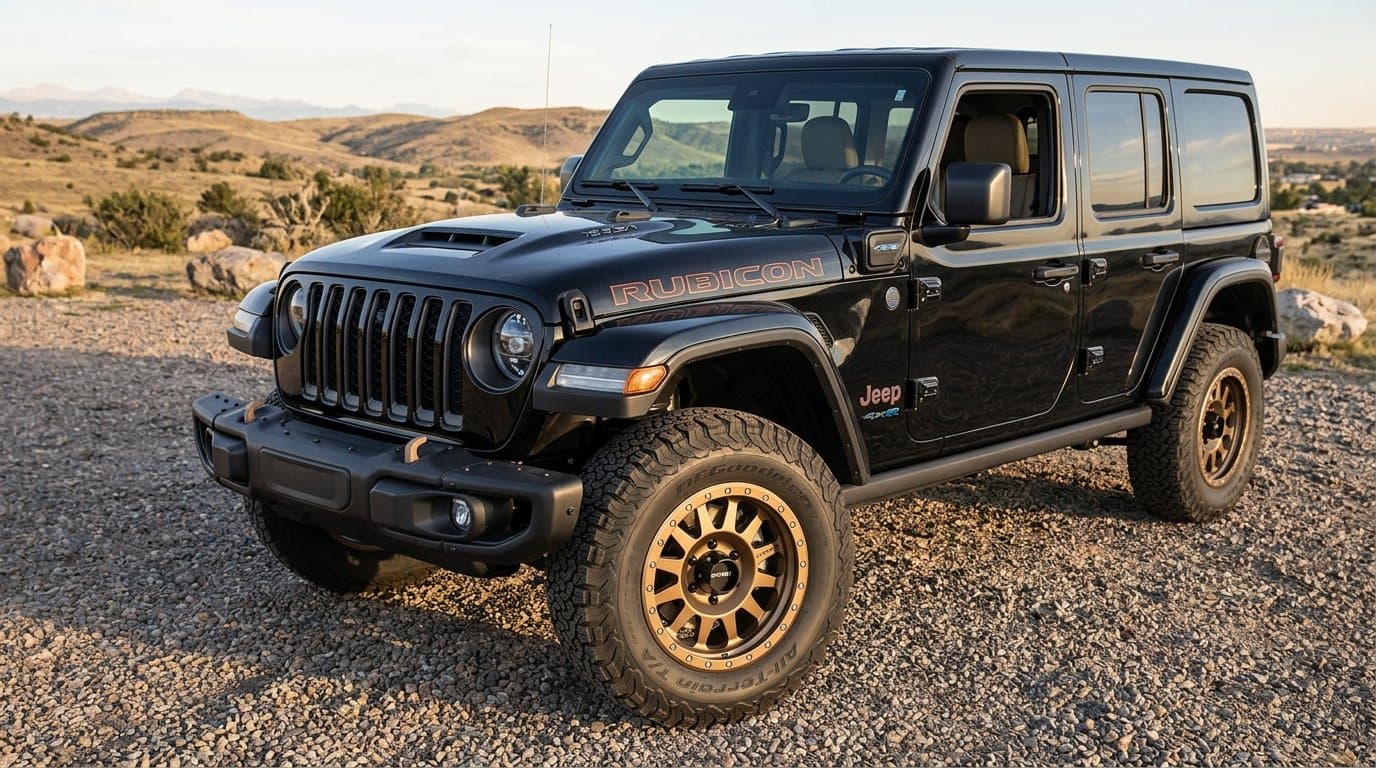
Aftermarket JL packages pair wheels with tires, making tire diameter and wheel fitment part of one decision. JL fitment is listed for 2018 to the present, while aftermarket designs include options such as the Fuel Zephyr and Black Rhino Reno. Chrome alloy is another style example: the described Wrangler rim measures 18 inches and has seven spokes.
OEM listings also show 17-inch Rubicon wheels and 20-inch High Altitude wheels, offered in sets of four or five. Compare the wheel’s diameter and design with the Wrangler’s configuration and the intended tire, rather than choosing by appearance alone.
Fitment for Lifted Wranglers
A lift can expand your wheel-size options, but it doesn’t eliminate the need to check clearance. Fitment depends on how the wheel and tire sit relative to the suspension and body. Backspacing, the distance from the wheel’s mounting surface to its inner edge, helps show how far the wheel extends inward toward the axle and whether it may interfere with suspension components.
Aftermarket rims and wheel spacers aren’t automatically safe or legal just because they match the bolt pattern. Safe fitment also requires adequate clearance and secure installation. Legal requirements depend on applicable local rules.
Wheel and Tire Size Compatibility
Most Wranglers come with stock 17-inch or 18-inch wheels; steel wheels have also been offered in 15 inches. Fitment references cover TJ models from 1996 through 2006, JK models from 2006 through 2017, and JL models from 2018 to the present. Match the candidate wheel to the vehicle’s generation and trim.
The tire’s marked rim diameter must match the wheel diameter. For example, a P235/75R15 tire has a 15-inch rim diameter. Tire size beyond that depends on wheel width, vehicle setup, and available clearance, so a tire-and-wheel combination should be assessed together.
Effects of Wider or Larger Rims
A wider or larger rim can affect steering feel, ride quality, and tire performance. The result depends on the whole setup, including tire dimensions, wheel fitment, and vehicle configuration. The tire must also be compatible with the rim and provide sufficient clearance through steering movement and suspension travel.
Fuel economy and acceleration may vary with the selected wheel-and-tire combination, particularly when upgrading to heavier setups. For drivers seeking to restore power or recalibrate vehicle dynamics after modifying their setup, automotive specialists like Max Redline offer performance parts and tuning services. Consider how you drive on roads and trails alongside the look you want, and use a professional fitment review to weigh handling, comfort, clearance, and tire choice as parts of one package.
Bolt pattern
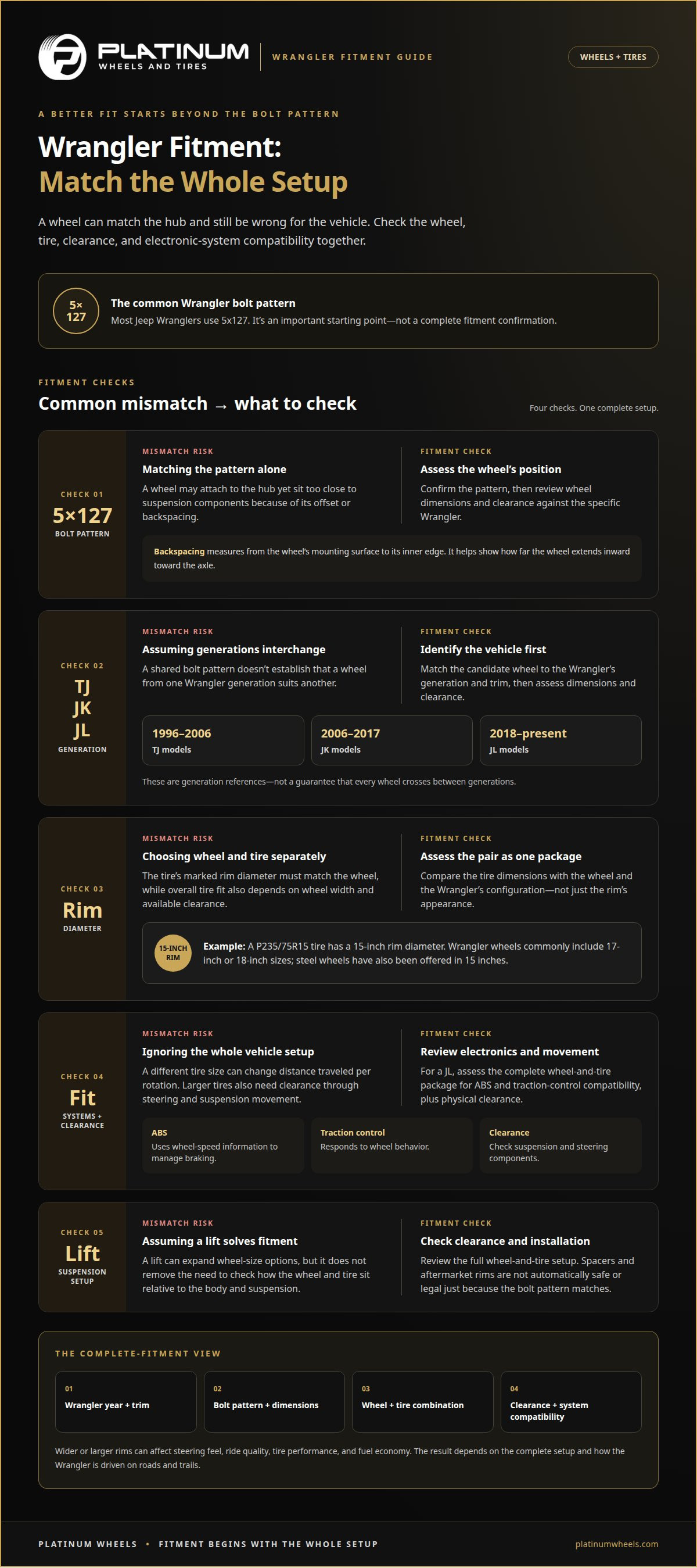
Most Jeep Wranglers use a 5x127 bolt pattern, but that measurement is only one part of wheel fitment. A professional checks the complete wheel against the specific vehicle before treating a set of Wrangler rims as compatible.
Bolt Pattern Details
The 5x127 designation identifies the lug arrangement and its measured circle. A wheel with a different pattern won’t match the Wrangler’s hub correctly, even if its diameter and styling seem suitable. The professional fitment process begins by matching the pattern to the vehicle, then considers the wheel’s other dimensions and how it will sit.
For example, a 5x127 wheel may still be unsuitable if its offset or backspacing places it too close to suspension components. Those measurements affect the wheel’s position, so they matter alongside the lug layout. The goal is to assess the full fitment rather than rely on one specification when selecting Wrangler rims.
Wheel Interchange Between Generations
Can wheels from one Jeep Wrangler generation fit another? Sometimes, but a shared bolt pattern alone doesn’t confirm compatibility. Wheel dimensions and clearance must also suit the receiving vehicle’s suspension and tire setup.
Generation references help identify the right fitment range: TJ models are listed for 1996 through 2006, JK models for 2006 through 2017, and JL models for 2018 to the present. These ranges distinguish generations; they don’t mean every wheel crosses between them. For instance, a wheel listed for a JL still needs a dimensional fitment assessment before use on a TJ.
A useful fitment review therefore matches the Wrangler’s generation and bolt pattern, then assesses dimensions and clearance. That approach helps distinguish a wheel that attaches from one suited to the vehicle’s overall setup. A wheel fitment option can account for the Wrangler, its intended tires, and the clearance needed around nearby components.
Compatibility with ABS and traction control
Changing wheels and tires affects more than appearance: the complete setup must suit the Jeep Wrangler’s electronic systems. For a JL, choose a package sized to work with ABS and traction control.
ABS uses wheel-speed information to manage braking, while traction control responds to wheel behavior. A different tire size can change the distance the vehicle travels with each rotation, so tire compatibility belongs in the fitment decision from the start, not as an afterthought.
A professional begins with the Wrangler’s model year and current setup, then evaluates the proposed wheel and tire together. This includes wheel dimensions, tire size, and physical clearance. A larger tire, for example, needs to be assessed against the vehicle’s fitment, not just its bolt pattern.
JL wheel-and-tire packages are available in combinations intended to work with ABS and traction control. That’s a useful starting point, but the package still needs to match the specific Wrangler configuration. Check that the wheel and tire fit the vehicle without interfering during steering or suspension movement.
When comparing options, focus on these details:
- Vehicle generation: Confirm whether the Wrangler is a JL, JK, or TJ.
- Complete package: Assess the wheel and tire as a matched setup.
- Physical fit: Consider clearance around suspension and steering components.
- Electronic compatibility: Select a JL combination intended for ABS and traction control operation.
A professional fitment review brings these checks together before installation. It helps distinguish a wheel that simply mounts from a complete setup suited to the Wrangler’s configuration and intended use. For a JL, keep ABS and traction-control compatibility in mind when narrowing down wheel-and-tire combinations.
What wheel sizes fit a Jeep Wrangler by model year and trim?
Start with the Wrangler’s generation, model year, and trim before selecting a wheel diameter. Stock wheels commonly measure 17 or 18 inches, while 15-inch steel wheels have also been offered.
Fitment references divide the generations by year: TJ, 1996 through 2006; JK, 2006 through 2017; and JL, 2018 to the present. These ranges help narrow the search, but the model year alone doesn’t identify every wheel that suits a specific trim. The professional selection process matches the exact Wrangler configuration to the wheel dimensions and tire choice.
Trim matters because Wrangler versions can differ in original equipment and intended setup. An OEM wheel listed for a Rubicon, for example, shouldn’t be assumed to fit every Wrangler trim. Start with the vehicle’s generation and trim, then consider diameter, width, offset, and clearance. Together, these factors determine how the wheel sits and whether the selected tire fits.
A lifted Wrangler may offer more wheel-size choices, but every option still needs careful fitment. The lift, tire diameter, and wheel position affect one another. A wheel that clears one setup may not clear another, so evaluate the complete combination rather than relying on a wheel-size label alone.
Use this sequence to narrow the options:
- Identify the Wrangler’s generation, model year, and trim.
- Compare the proposed wheel diameter with the vehicle’s existing configuration.
- Assess wheel width, offset, and backspace alongside the intended tire.
- Check clearance for the actual suspension and tire setup.
For a Wrangler that needs a coordinated selection, explore wheel-and-tire packages suited to the intended build. A complete fitment review connects model details, wheel dimensions, and tire choice before installation.
Platinum Wheels: Custom Truck Wheels & Off-Road Rims
Platinum Wheels helps Wrangler owners coordinate their wheel-and-tire choices with their vehicle’s fitment. Custom Truck Wheels & Off-Road Rims and Wheel & Tire Packages serve drivers looking for a setup suited to street use, trail driving, or both.
Choose All-Terrain or Mud-Terrain Tires based on how you plan to drive. If your build calls for a different stance, Lift Kits & Leveling Kits can be part of the setup. Include the Wrangler’s model year, trim, and current configuration in the selection process to keep wheel dimensions, tire choice, and clearance aligned.
For professional help choosing a setup for your Jeep, contact Platinum Wheels.
Plan Your Wrangler’s Next Setup
Before choosing a wheel design, consider how you’ll use your Jeep most often. A daily driver may have different priorities from a Wrangler built for rough trails. Your intended use helps guide the balance among appearance, tire style, and overall fitment.
Platinum Wheels offers Custom Truck Wheels & Off-Road Rims, Wheel & Tire Packages, and All-Terrain & Mud-Terrain Tires. Start with how you drive and the look you want, then consider fitment as part of the complete build. The right Wrangler rims are more than a style choice.
Contact Platinum Wheels for fitment help and take the next step toward a setup that suits your Jeep and the roads ahead.
Frequently Asked Questions
What is the bolt pattern and hub bore for Jeep Wrangler wheels?
Most Jeep Wranglers use a 5x127 bolt pattern; hub bore fitment must also match the vehicle. The bolt pattern describes the lug layout, while the hub bore is the opening that centers the wheel on the hub. A professional checks both against the specific Wrangler’s year and configuration, since matching lug positions alone doesn’t establish a centered, compatible fit.
What wheel offset and backspacing are recommended for a Jeep Wrangler?
There’s no single offset or backspacing recommendation for every Wrangler. The right measurements depend on wheel dimensions, tire choice, suspension setup, and the desired position in the wheel well. Backspacing measures how far the wheel extends inward toward the axle. A professional evaluates these factors together to balance the intended stance with clearance around suspension and steering components.
What are the best aftermarket rims for a Jeep Wrangler?
The best aftermarket rims are those suited to your Wrangler’s configuration and intended use, not just their appearance. A daily-driven Jeep and a trail-focused build may need different wheel-and-tire combinations. Compare construction and design along with diameter, width, offset, and tire compatibility. A matched package can make selection easier by treating the wheel and tire as one setup.
How much do Jeep Wrangler rims cost, including OEM and aftermarket options?
OEM and aftermarket wheels don’t all have one price: listings can differ by condition, set size, design, and whether tires are included. Buying a replacement rim is different from choosing a complete wheel-and-tire package. For a useful comparison, decide whether you need one wheel or a full set, and check whether tires are included. Whichever option you choose, confirm that it fits your Wrangler.
What should you check when buying used Jeep Wrangler rims?
Match the rims to your Wrangler’s generation, model year, trim, and 5x127 bolt pattern. Check diameter, width, offset, backspace, tire compatibility, and clearance around suspension and steering components; verify the complete setup is compatible with ABS and traction control.