Choosing the Best All-Terrain Tires for Colorado: The Complete 2026 Guide
Imagine you're white-knuckling the steering wheel on I-70 near Silverthorne while a sudden mountain storm turns the asphalt into a slushy mess. You want the aggressive, rugged look of a trail-ready rig, but you also need to know your all terrain tires won't leave you sliding toward the guardrail or humming loudly enough to drown out your music on the highway. Most Colorado drivers share this exact frustration. You need a setup that's tough enough for weekend adventures in the Rockies but refined enough for the daily commute through Denver.
Choosing the right rubber is about more than just picking a brand; it's about matching tread designs to our state's wild temperature swings and strict Traction Law requirements. This guide simplifies that process. You'll discover how to balance ride comfort with off-road durability while ensuring your vehicle meets the mandatory 3/16-inch tread depth for winter safety. We're breaking down the top 2026 models and decoding confusing specs like 3PMSF ratings and load capacities. Get ready to find a tire that offers a quiet highway ride and the confidence to tackle any storm with precision.
Key Takeaways
- Identify your specific driving ratio to determine if a 70/30 or 60/40 hybrid design best fits your mix of Denver commuting and weekend trail runs.
- Decode the science of tread blocks and siping to ensure your all terrain tires provide biting edges on ice while staying silent on the asphalt.
- Evaluate the "hum" factor and fuel economy impacts when choosing between aggressive mud-terrain looks and daily-driver practicality.
- Protect your investment by understanding how Colorado de-icing chemicals affect rubber compounds and wheel finishes over time.
- Master the "rub factor" by exploring how leveling kits and specific wheel offsets create the perfect clearance for larger tire setups.
What are All-Terrain Tires and Why Do You Need Them?
All-terrain tires act as the ultimate hybrid bridge for Colorado drivers. They provide a sophisticated balance between the quiet, smooth ride required for a weekday commute on I-25 and the aggressive grip needed for weekend trail runs near Buena Vista. Think of them as the automotive version of a high-end multitool. To understand the engineering behind these designs, it’s helpful to look at what are all-terrain tires and how they differ from standard street rubber. They aren't just for show; they're built to survive the jagged rocks and sharp debris that would easily puncture a standard highway tire.
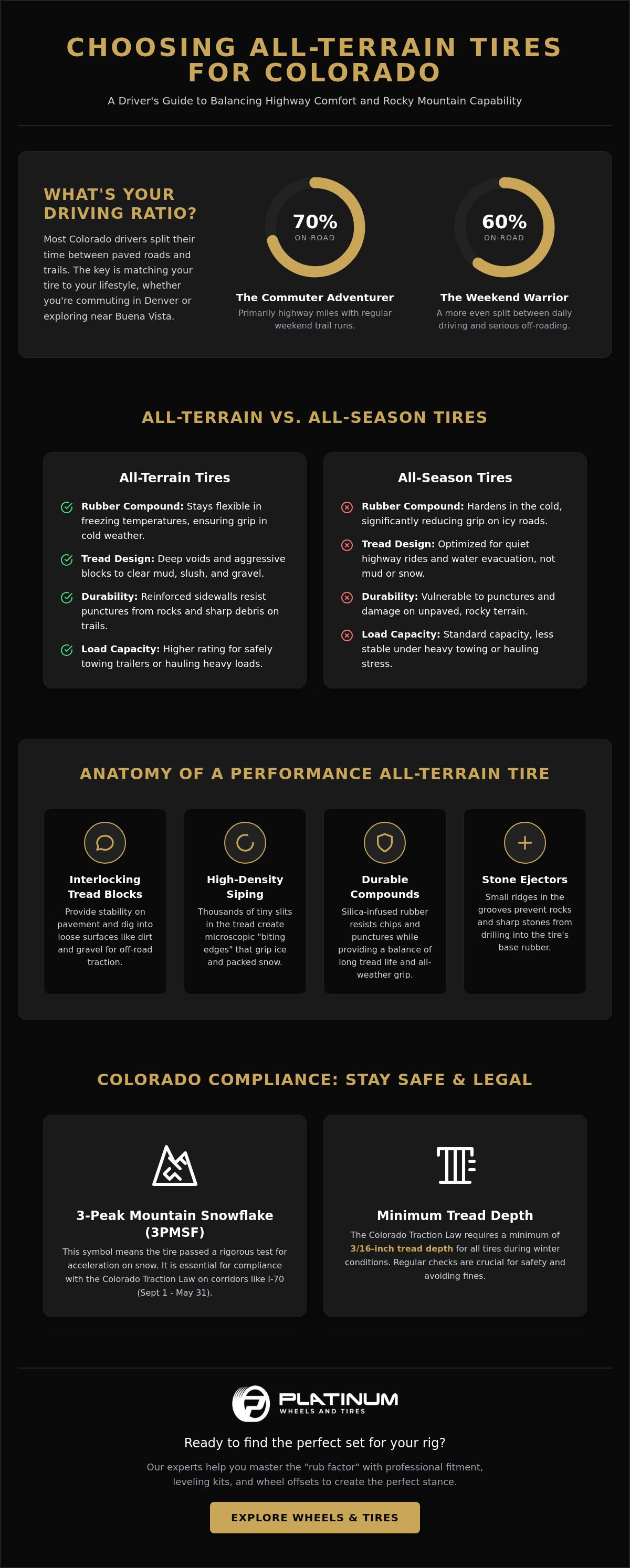
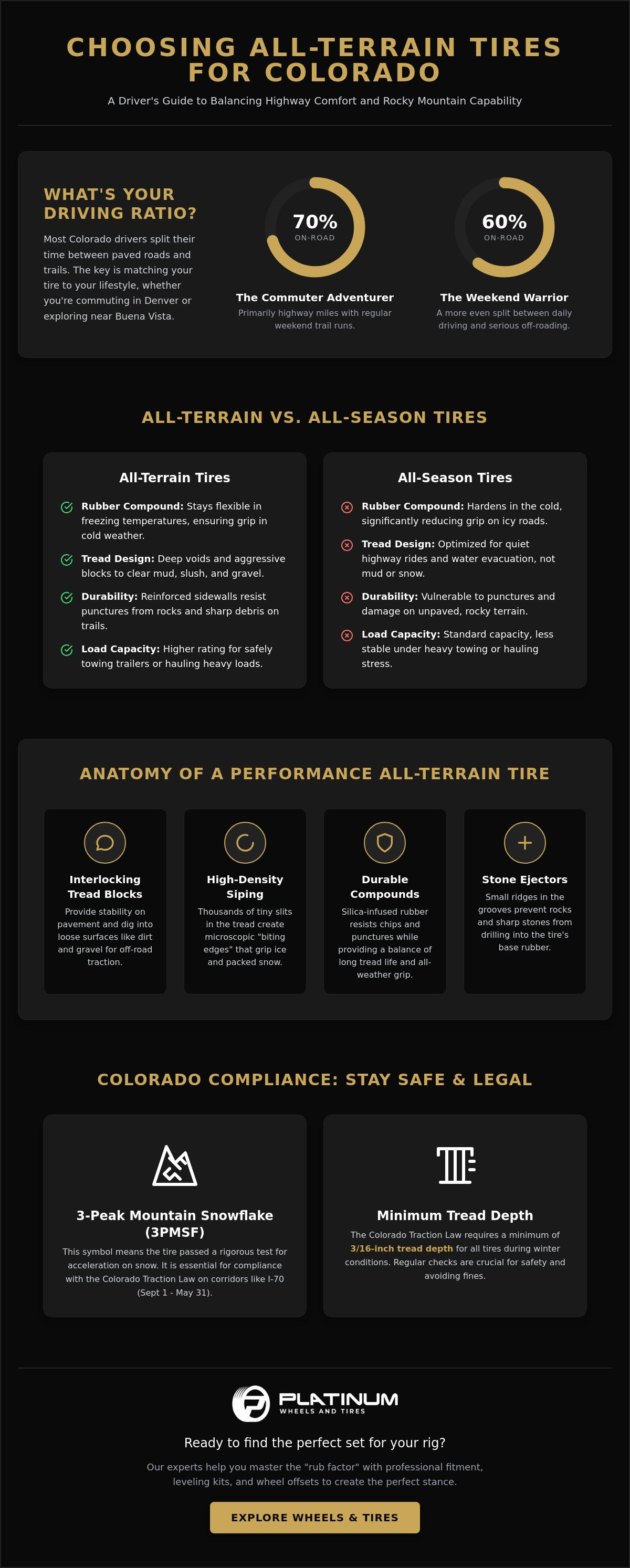
Most of our local customers fall into the 70/30 or 60/40 category. This means you spend roughly 70 percent of your time on paved roads but want zero compromises when that remaining 30 percent takes you onto gravel, dirt, or snow. Beyond the performance, there is the undeniable visual upgrade. Mounting a set of all terrain tires with an aggressive sidewall pattern completely transforms a truck’s stance. It gives your vehicle a capable, ready-for-anything look that matches the Rocky Mountain lifestyle. It’s a smart move for anyone who wants their rig to look as tough as the trails it's capable of tackling.
Safety remains the primary driver for this upgrade. In Denver, many drivers are moving away from owning two separate sets of tires. Instead of swapping between summer and winter sets, they're choosing high-quality all-terrain options that handle year-round conditions. These tires offer the durability needed for summer heat and the specialized tread patterns required for winter safety. They provide a reliable solution that keeps you moving forward, whether you're navigating a dry highway or a muddy mountain pass.
The 3-Peak Mountain Snowflake (3PMSF) Rating
Look for the tiny mountain and snowflake icon on the sidewall. This symbol isn't just marketing; it indicates the tire passed a rigorous ASTM test for acceleration on medium-packed snow. Traditional M+S (Mud and Snow) ratings are based mostly on tread geometry, but the 3PMSF rating measures actual winter performance. For anyone driving the I-70 corridor between Dotsero and Morrison from September 1st to May 31st, this rating is essential. It ensures you stay in compliance with the Colorado Traction Law while providing the biting edges needed for icy inclines.
All-Terrain vs. All-Season: Knowing the Difference
Colorado weather is famous for 40-degree temperature swings in a single afternoon. Standard all-season tires use rubber that hardens in the cold, losing grip just when you need it most. In contrast, all terrain tires use specialized compounds that remain flexible in freezing temperatures while offering deeper tread blocks to clear out slush and mud. They also provide a higher load capacity. This makes them the superior choice if you're frequently hauling a camper or towing a trailer into the backcountry. You'll get more stability and a longer-lasting tread when putting your truck to work on uneven ground.
Anatomy of a Performance All-Terrain Tire
Understanding the engineering under your wheel wells is the best way to ensure you don't over-buy or under-perform. High-quality all terrain tires rely on a delicate balance of tread geometry and material science to handle the diverse surfaces of the Front Range. While a highway tire is mostly flat for maximum contact, an AT tire features deep voids and chunky blocks. These voids allow the tire to "dig" into loose soil or snow, while the flat tops of the blocks maintain enough surface area to keep you stable at 75 mph on the interstate. Many expert-tested all-terrain tires now utilize advanced computer modeling to place these blocks in a way that cancels out road noise, solving the "hum" problem that used to plague older designs.
The secret to winter confidence lies in siping. These are the thousands of tiny slits cut into the tread blocks. When the tire rolls over ice, these slits open up, creating microscopic "biting edges" that grip the slippery surface. Without siping, even the most aggressive-looking tire will act like a hockey puck on a frozen Denver side street. However, the rubber compound itself is just as vital. Manufacturers must choose between "sticky" compounds that grab rocks but wear out quickly, and harder compounds that last 60,000 miles but feel stiff in the cold. Modern premium options often use silica-infused rubber to get the best of both worlds.
Tread Pattern Design
- Interlocking tread blocks: These blocks fit together like puzzle pieces, preventing the rubber from "squirming" or bending during high-speed cornering on dry pavement.
- Staggered shoulder lugs: These are the blocks that wrap around the side of the tire. They act like paddles to help you climb out of deep muddy ruts or thick snow banks.
- Stone ejectors: Small ridges at the bottom of the tread grooves push out pebbles before they can "drill" into the tire casing and cause a slow leak.
Durability and Casing
Rocks in the Rockies aren't forgiving. Most standard tires use a 2-ply sidewall, but many heavy-duty all terrain tires feature a 3-ply construction for significantly higher puncture resistance. This extra layer is your insurance policy when airing down for a trail run. Underneath the rubber, high-tensile steel belts provide a flat, stable footprint. This ensures your tires wear evenly over time rather than balding in the center or on the edges. Many modern designs also include integrated rim protectors, which are thick ribs of rubber that extend past the wheel flange to guard your custom off-road rims from unsightly rock rash. In the context of modern E-rated tires, the ply rating is a measure of the tire's load-carrying capacity and internal strength rather than the literal number of physical layers found in the carcass.
All-Terrain vs. Mud-Terrain: Solving the Great Debate
Everyone loves the visual impact of a Mud-Terrain (MT) tire. They look mean and purposeful, but for most Colorado drivers, they come with a high cost of ownership regarding daily comfort. All terrain tires are specifically engineered to bridge this gap. While MT tires feature massive tread voids designed to clean out thick, heavy mud, those same gaps create a loud, rhythmic hum on the highway. If you spend your time cruising I-70 to reach a trailhead, that constant noise becomes exhausting over a long drive. Modern AT designs use computer-optimized pitch sequences to cancel out that drone, keeping your cabin quiet enough for a normal conversation.
Consider the impact of unsprung weight on your vehicle's performance. MT tires are significantly heavier than their AT counterparts because of their dense rubber lugs and reinforced carcasses. This extra mass forces your engine to work harder just to get the wheels spinning, which directly lowers your fuel economy. It also increases your braking distance, a critical factor when you're navigating heavy traffic in Lakewood or Aurora. For a daily driver, the nimbler handling and lighter weight of high-performance all terrain tires offer a much more responsive and economical experience.
Tread life is another major win for the AT category. Because these tires have more rubber in actual contact with the road, they distribute heat and friction more evenly across the surface. You can typically expect a set of quality AT tires to last 15,000 to 20,000 miles longer than a comparable MT set. Don't worry about the "mall crawler" look, either. Many of the best all-terrain tires of 2026 feature aggressive, wrap-around shoulder lugs and textured sidewalls. They provide that rugged, off-road stance without the harsh ride quality of a dedicated mud tire.
When to Choose Mud-Terrains Instead
MTs are specialized tools for extreme environments. If your weekends involve deep mud bogs or technical rock crawling where you need maximum "chunking" resistance, an MT is the right tool for the job. However, keep in mind that MT tires often struggle on packed snow and ice. Their lack of siping means they can't grip frozen pavement as effectively as an AT. If you want a compromise, look at the Rugged Terrain (RT) category that has gained massive popularity in 2026. These tires offer an MT look with a tread compound that behaves better on the street.
The Performance Trade-offs
Safety during sudden Denver rainstorms is a hidden benefit of the AT design. The tighter tread patterns are far more effective at channeling water away from the center of the tire, which significantly reduces the risk of hydroplaning. Think about your daily commute. The vibration and stiffness of a heavy MT tire can turn a minor pothole into a bone-jarring event. Choosing an AT tire preserves your vehicle's factory ride quality while giving you the freedom to explore the backcountry without hesitation.
The Colorado Factor: Selecting Tires for the Front Range
Driving in Colorado requires a tire that pivots as fast as the weather. On the I-70 corridor, it is common to leave Denver in 60-degree sunshine and hit 5mph slush near the Eisenhower Tunnel just an hour later. This volatility is exactly why your choice in all terrain tires is so critical. Beyond the shifting skies, our roads are treated heavily with magnesium chloride. This de-icing chemical is notoriously harsh. It can accelerate the dry-rotting of lower-quality rubber compounds and pit the finish on your rims. To protect your investment, check out our Custom Wheels and Rims: The Ultimate Denver Truck Owner’s Guide (2026) for tips on maintaining your setup against Colorado’s road salts.
Altitude also plays a silent role in tire performance. As you climb from the Mile High City to over 11,000 feet, the atmospheric pressure drops. This causes the air inside your tires to exert more relative pressure, effectively increasing your PSI. It is vital to monitor your TPMS sensors during these elevation gains to maintain a proper footprint. Whether you are navigating the jagged volcanic rock of the San Juans or airing down for the soft slopes of the Great Sand Dunes, your tire needs to adapt to both the terrain and the air density changes.
Winter Driving in the Rockies
The Colorado Passenger Vehicle Traction Law is a serious matter for mountain travelers. From September 1st through May 31st, you are required to have a minimum tread depth of 3/16-inch. If you are caught in a storm without the proper 3PMSF or M+S rating, you could face a $67 fine; if you block the roadway because of inadequate tires, that fine jumps to $650. High-performance all terrain tires keep you legal and safe. The siping we discussed earlier becomes your best friend on the black ice that hides in the shadows of the foothills, providing the micro-grip needed to stay in your lane.
Summer Heat and Long-Distance Towing
While we focus on snow, Denver’s 100-degree summer days are equally demanding. Heat is the primary enemy of rubber. Soft off-road compounds can wear prematurely if they aren't designed for high-speed heat dissipation during long highway stretches. If you are towing a heavy camper to Rocky Mountain National Park, pay close attention to the load index. An E-rated tire provides the reinforced sidewall stability needed to prevent "trailer sway" on winding mountain passes. Choosing a tire that balances winter flexibility with summer heat resistance is the only way to ensure year-round reliability. Browse our current inventory of all-terrain tires to find the perfect match for your next Colorado adventure.
Professional Fitment: Wheels, Lifts, and Leveling
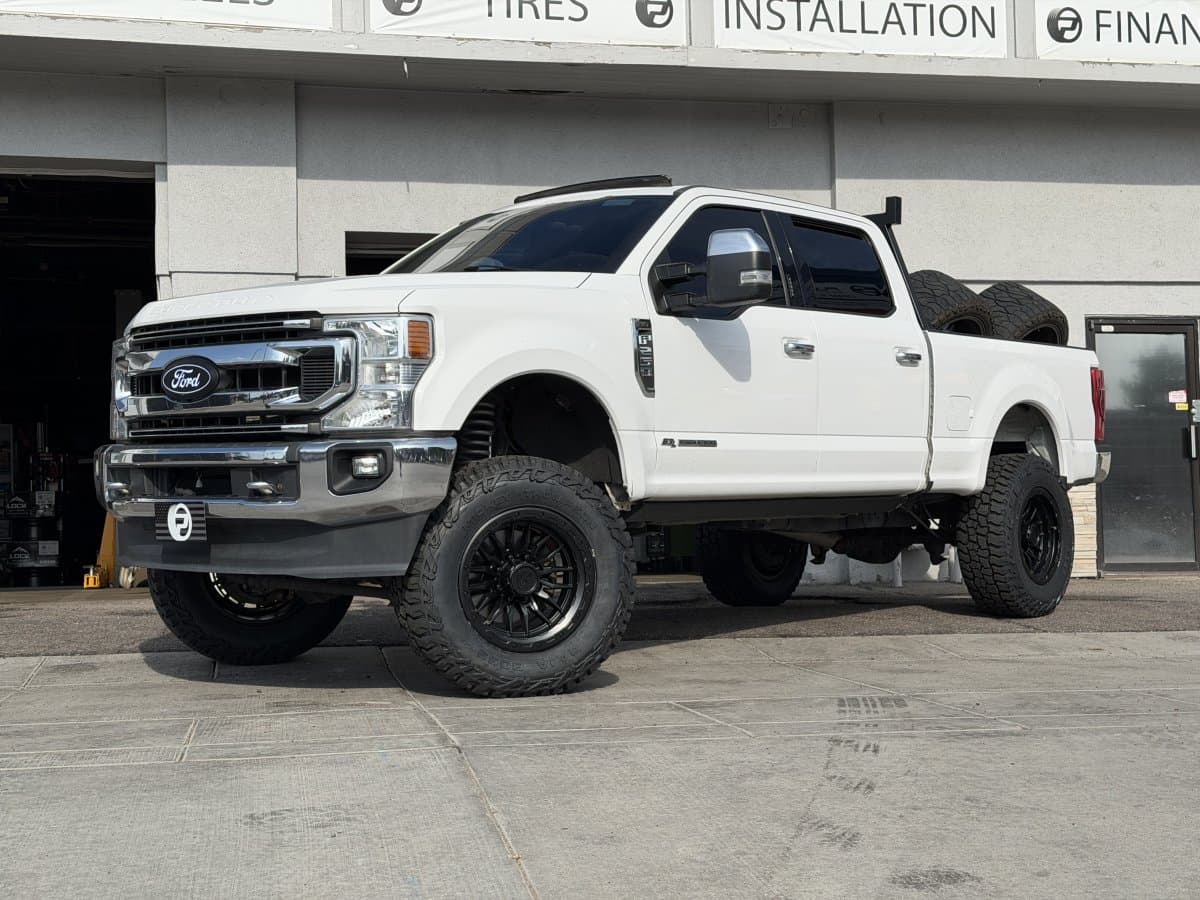
Choosing the right all terrain tires is only half the battle. If your new setup rubs the inner fender liner or hits a control arm every time you pull into a parking spot, the upgrade becomes a headache rather than a benefit. This is where professional fitment becomes critical. Most factory trucks are designed with a "rake," meaning the front end sits lower than the rear to account for heavy loads in the bed. This nose-down stance severely limits the size of the tire you can run without interference. Leveling kits are the most popular suspension modification on the Front Range because they fix this imbalance, creating the necessary clearance to step up to 33-inch or even 35-inch tires without aggressive trimming.
The relationship between your wheel and your suspension is defined by offset and backspacing. These two measurements determine how far the wheel sticks out or tucks in. A negative offset pushes the wheel outward for that wide, aggressive stance, but it also increases the arc of the tire when you turn the steering wheel. This often leads to the "rub factor" on the bumper or the frame. We use precision calculations to ensure your wheel and tire package fits perfectly, allowing for full lock-to-lock turning and suspension articulation when you're navigating uneven trails.
Coordinating Your Suspension and Tires
Upgrading your tire diameter changes more than just the look of your rig. Since a larger tire has a greater circumference, your vehicle's computer will think you're traveling slower than you actually are. This speedometer inaccuracy can also affect your transmission shift points. Beyond electronics, a professional alignment is non-negotiable immediately after installing new all terrain tires or a leveling kit. Changing the ride height alters your toe and camber angles. If these aren't corrected, you'll scrub away your expensive new tread in a matter of months.
The Platinum Wheels Difference
We believe in a consultative approach that goes beyond a simple transaction. We don't just sell rubber; we build vehicle stances that perform as well as they look. From Denver to Castle Rock, our team provides specialized truck expertise to help you navigate the technical side of TPMS sensors and road-force balancing. While standard spin balancing works for most cars, road-force balancing simulates the weight of the vehicle on the tire to eliminate high-speed steering wheel shimmy. We take the time to get these details right so you can drive with total peace of mind. Get a custom quote for your wheel and tire package today!
Conquer the Rockies with Absolute Confidence
Your journey through the Colorado high country shouldn't be limited by your equipment. We've explored how the right set of all terrain tires balances the quiet comfort of a Denver commute with the rugged durability required for the San Juan trails. Remember that meeting the 3/16-inch tread depth for the Traction Law is a safety necessity, not just a suggestion. By integrating the correct leveling kit and ensuring precision road-force balancing, you can achieve that aggressive stance without sacrificing the smooth ride quality you expect from a modern truck.
At Platinum Wheels, we specialize in lift and leveling kit integration to ensure every fitment is perfect for Denver truck owners. We offer a premium selection of top-tier brands and have the technical expertise to handle your TPMS sensors and wheel offsets with precision. Don't settle for a generic setup when you can have a tailored solution built by local experts who know these mountains as well as you do. It's time to stop worrying about the "rub factor" and start enjoying the view from the summit.
Build Your Perfect Wheel and Tire Package today and get ready to tackle the trails with total peace of mind. We're here to help you get the stance and performance your truck deserves.
Frequently Asked Questions
How long do all-terrain tires typically last?
Most premium all terrain tires last between 40,000 and 60,000 miles. This lifespan depends heavily on your driving habits and how often you venture onto jagged rock or gravel. Softer rubber compounds provide better off-road grip but tend to wear down quicker on hot summer pavement. Regular rotations and keeping your alignment in check are the best ways to ensure you get the maximum value from your investment.
Are all-terrain tires noisy on the highway?
Modern all-terrain designs are significantly quieter than their predecessors. While they produce more noise than a standard highway tire due to the larger tread voids, engineers now use computer-optimized pitch sequences to cancel out much of the road drone. You'll notice a slight hum at 75 mph, but it won't drown out your radio or make conversation difficult. It’s a small trade-off for the massive gain in trail capability.
Do all-terrain tires get worse gas mileage?
You will likely see a slight decrease in fuel economy, typically ranging from 1 to 3 miles per gallon. This happens because all-terrain models are heavier and have higher rolling resistance than smooth street tires. If you choose a heavy-duty E-rated tire for towing, the added weight will impact your MPG more than a standard-load version. The trade-off is superior puncture resistance and stability on loose Colorado terrain.
Can I use all-terrain tires in the snow?
Yes, all terrain tires are excellent for Colorado winters if they carry the Three-Peak Mountain Snowflake (3PMSF) symbol. This rating confirms the tire meets specific snow traction standards required for the I-70 Traction Law. The deep grooves and specialized siping allow the rubber to grip slush and packed snow far better than an all-season tire. They provide a reliable, year-round solution for drivers who don't want to swap sets every season.
Do I need a lift kit to install all-terrain tires?
You don't need a lift kit if you stay with your vehicle's factory tire size. However, if you want the aggressive look of a larger 33-inch or 35-inch tire, a lift or leveling kit is usually necessary to prevent the rubber from rubbing against your wheel wells or suspension components. A simple 2-inch leveling kit is often enough to clear a larger set of all terrain tires while maintaining your truck's factory ride quality.
What is the difference between AT and RT tires?
RT tires are a hybrid category that sits between a traditional All-Terrain and a Mud-Terrain. They feature the aggressive sidewall and large shoulder lugs of a mud tire but use a tighter center tread pattern for better highway stability and reduced noise. They are perfect for drivers who want a meaner look without the harsh vibrations and rapid wear associated with dedicated off-road tires. They offer a great middle ground for the modern enthusiast.
How often should I rotate my all-terrain tires?
Rotate your tires every 3,000 to 5,000 miles to prevent uneven wear. The aggressive tread blocks on these tires are more susceptible to "cupping" or "feathering" if they aren't moved to different corners of the vehicle frequently. Regular rotations help maintain a quiet ride and extend the life of the tread. We recommend checking your alignment at the same time, especially if you spend significant time on bumpy mountain roads.
Are all-terrain tires good for towing?
All-terrain tires are an excellent choice for towing campers or trailers through the mountains. Look for "Light Truck" (LT) rated models with a high load index, as these feature reinforced sidewalls that reduce trailer sway and handle heavy tongue weights more effectively. The stiffer construction provides a stable, confident feel when navigating winding passes, making them a favorite for local owners who frequent Rocky Mountain National Park or other high-altitude destinations.