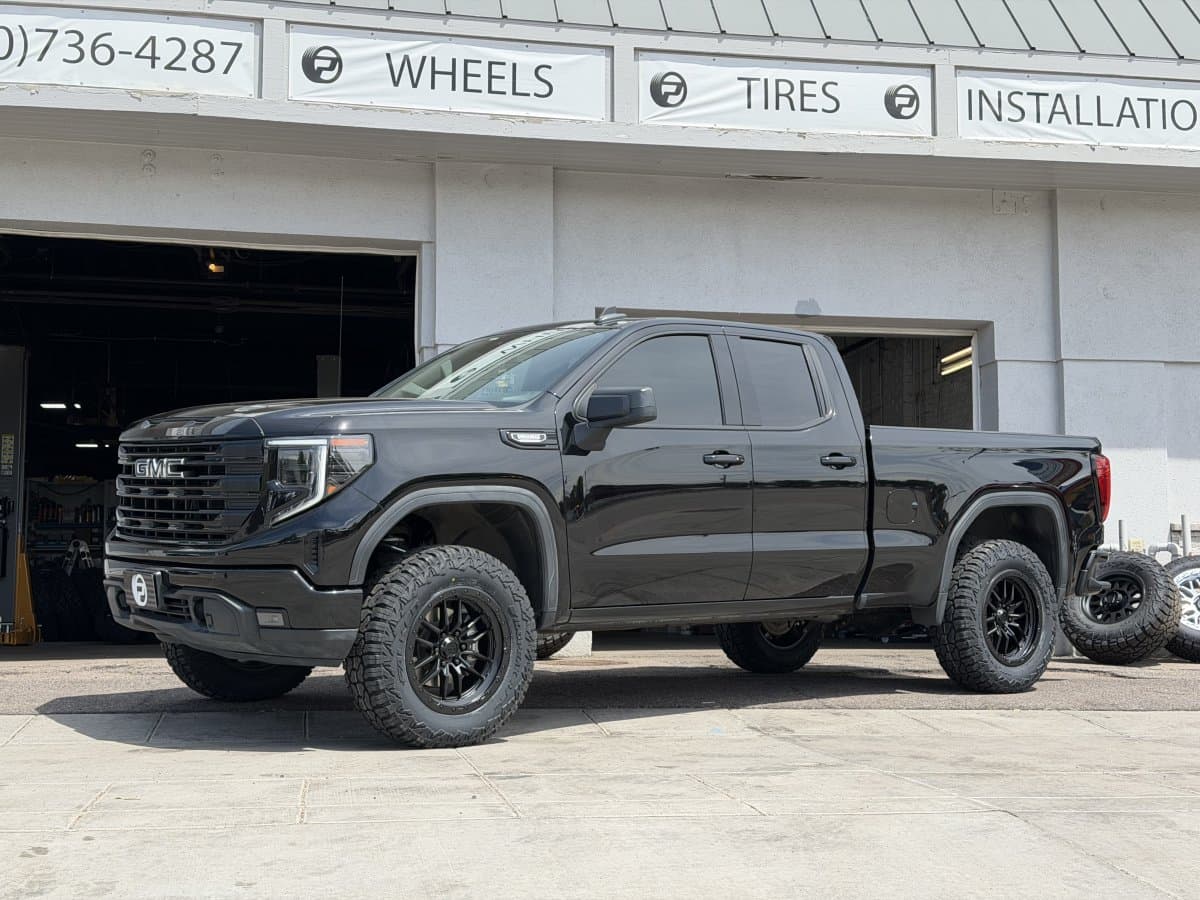
Custom Wheels and Rims: The Ultimate Denver Truck Owner’s Guide (2026)
Your truck's factory wheels aren't just holding you back aesthetically; they're likely compromising your performance on the I-70 corridor and the rugged trails of the Front Range. Choosing the right custom wheels and rims is often the most stressful upgrade a Denver truck owner can make. You want that aggressive, head-turning stance, but the fear of buying expensive gear that rubs against your wheel wells or corrodes after one salty Colorado winter is a legitimate concern. It's easy to get lost in the technical jargon of offset and backspacing while trying to find a style that actually fits your vision.
We understand that a wheel is a functional suspension component, not just a cosmetic accessory. This guide will help you master the technical and aesthetic world of aftermarket fitment so you can achieve the perfect balance of form and function. We'll cover everything from 2026's trending satin finishes to the critical Colorado Traction Law requirements that keep you legal on the mountain passes. You're going to learn exactly how to spec a professional setup that survives the elements and delivers the off-road performance your truck was built for.
Key Takeaways
- Learn how reducing unsprung weight with high-quality aftermarket wheels improves your truck's handling and braking response on winding mountain roads.
- Demystify complex technical specs like offset and backspacing to achieve an aggressive stance while ensuring your setup clears every corner.
- Identify the best materials and finishes for custom wheels and rims to protect your investment from Colorado’s corrosive magnesium chloride and road salt.
- Understand the "suspension synergy" required when upsizing, including how leveling kits correct factory rake to prevent tire rub.
- Discover the benefits of a professional local consultation to ensure 100% fitment accuracy before you commit to a major upgrade.
Defining Custom Wheels and Rims for the Modern Truck Owner
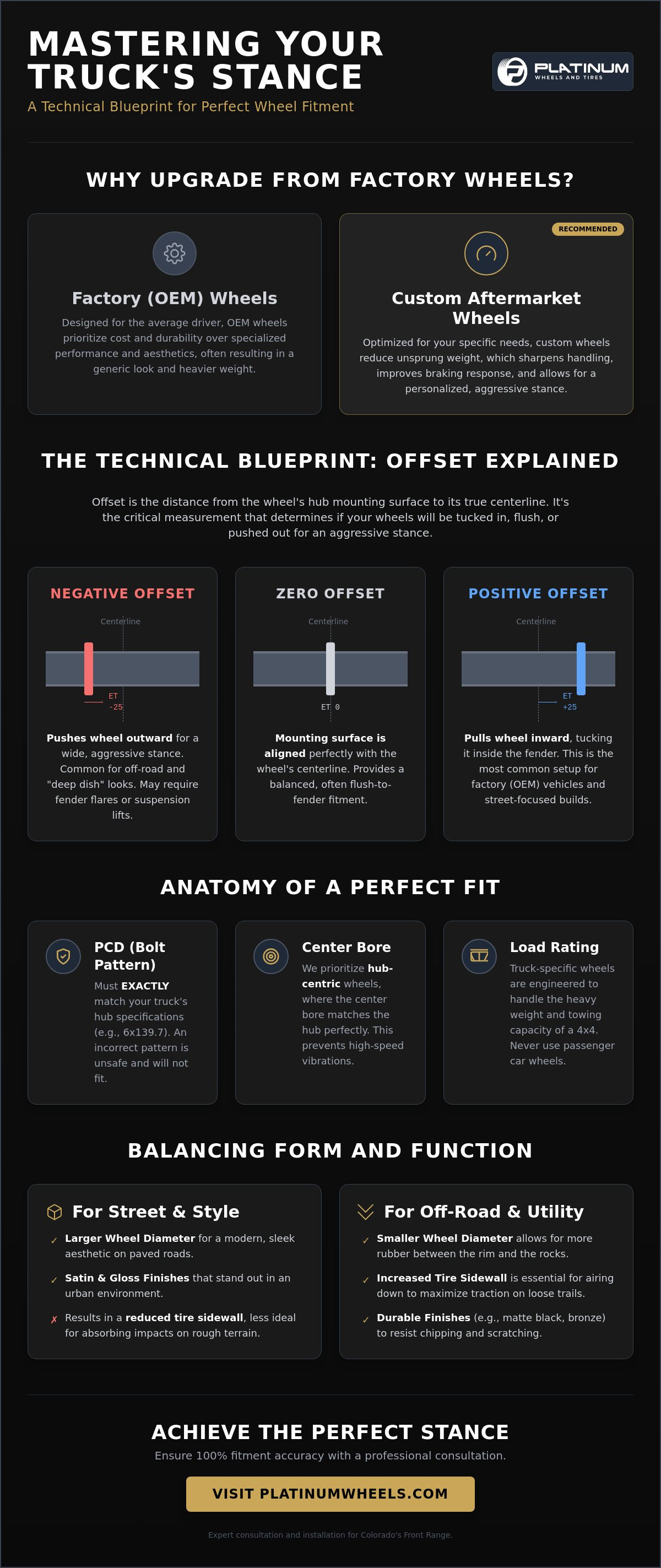
Your truck left the factory with wheels designed for the average driver in an average environment. While OEM (Original Equipment Manufacturer) wheels are durable, they often lack the personality and specialized performance needed for the Colorado lifestyle. Upgrading to custom wheels and rims isn't just about changing the look; it's about optimizing your vehicle for the specific demands of the Front Range. For a foundational look at how these components evolved, you can see how Custom Wheels Defined the automotive aftermarket by prioritizing both style and structural integrity.
Performance enthusiasts prioritize this upgrade to reduce unsprung weight. This refers to the mass of the vehicle components not supported by the suspension, such as the wheels, tires, and brakes. By installing lighter alloy wheels, you reduce the workload on your suspension system. This leads to sharper handling, faster acceleration, and improved braking response. These improvements are vital when you're descending a steep mountain pass or navigating heavy traffic on I-25. Beyond the technical gains, a customized profile increases the resale value of your truck. A well-executed stance makes your vehicle stand out in a crowded market, signaling to future buyers that the truck was owned by an enthusiast who cared about precision and quality.
Aesthetics vs. Utility: Finding the Balance
Choosing the right setup requires a honest look at how you use your vehicle. A larger wheel diameter provides a modern, sleek aesthetic that looks incredible on Denver's paved streets, but it reduces the available tire sidewall. For those focused on Overland functionality, a smaller wheel diameter is often better. It allows for more rubber between the rim and the rocks. This extra sidewall is essential for airing down your tires to increase traction on loose trails. Additionally, the width of the wheel must be precisely matched to your tire size. This ensures the tire bead seats securely, which prevents leaks and failures during low-pressure off-roading sessions.
Common Terminology for New Buyers
The industry uses specific terms that can be confusing if you're new to the hobby. While many people use the terms interchangeably, the rim is technically just the outer edge of the wheel. Professionals look at several critical specs for a perfect fit:
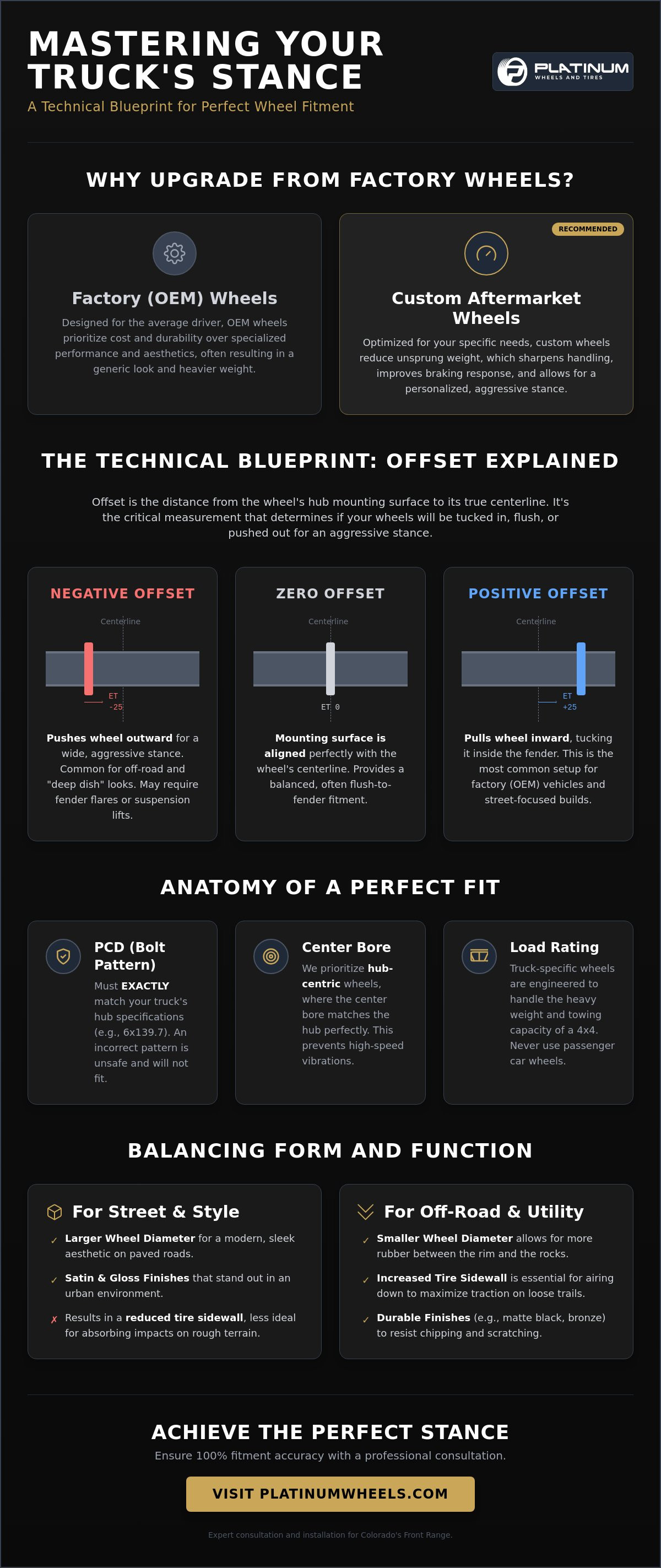
- PCD (Pitch Circle Diameter): This is your bolt pattern. It's vehicle-specific and must match exactly for the wheel to mount to your hub.
- Center-Bore: This is the hole in the middle of the wheel. We prioritize hub-centric wheels where the center-bore matches your truck's hub perfectly to prevent high-speed vibrations.
- Load Rating: Truck-specific wheels are engineered to handle the heavy weight and towing capacity of a 4x4, unlike generic passenger car wheels.
The Technical Blueprint: Offset, Backspacing, and Bolt Patterns Explained
Wheel offset is the measurement from the hub mounting surface to the wheel’s true centerline. This specific figure determines exactly where your custom wheels and rims will sit in relation to your truck's fenders. When you opt for a negative offset, you're moving the mounting surface toward the back of the wheel. This pushes the entire assembly outward, creating that aggressive, wide stance that many Denver owners crave for their off-road builds. On the other hand, a positive offset keeps the wheel tucked neatly inside the wheel well, which is often the standard for factory setups and street-focused SUVs.
Precision is the difference between a perfect build and a mechanical nightmare. Bolt patterns are a prime example of why you can't just pick any wheel that looks good. Your Ford F-150 utilizes a specific Pitch Circle Diameter (PCD) that is fundamentally different from a Chevy Silverado. Even if both trucks have six lugs, the spacing won't match. Attempting to "make it work" isn't just impossible; it's dangerous. Because these components are under immense stress, we always adhere to Professional Wheel Service Safety Standards during every installation to ensure your setup is secure for the long haul.
Negative vs. Positive Offset: Which is Right for You?
Negative offset is the king of the "deep dish" aesthetic. It widens your truck's footprint, which can offer better stability when you're navigating off-camber sections of a trail. Positive offset is more conservative, often used to maintain factory steering geometry and prevent rock chips on your door panels. Zero offset is the neutral point where the mounting surface is perfectly centered. If you want to see how these different configurations look on your specific make and model, you can explore our local gallery of truck builds for inspiration.
Measuring for Success
Backspacing is the distance from the mounting surface to the innermost edge of the rim. If your backspacing is too high, the wheel will sit too deep and likely interfere with your brake calipers or control arms. This leads to the dreaded "frame rub" that can ruin a set of tires in miles. We also account for the relationship between wheel width and tire sidewall bulge. A wider wheel might look great, but it requires more clearance during full-lock turns. Taking the time to measure these variables properly prevents the frustration of paying for return shipping on a set of wheels that simply won't fit your rig.
Built for the Front Range: Selecting Rims for Colorado’s Terrain
Colorado driving isn't like driving in the Midwest or the coastal states. Between the steep grades of the Rockies and the corrosive chemicals used on Denver streets, your choice of custom wheels and rims must be based on durability. Most modern truck owners prefer aluminum alloy over traditional steel for several reasons. While steel is affordable, it's heavy and prone to surface rust once the paint chips. Alloy wheels provide superior heat dissipation during long descents down Floyd Hill, which helps prevent brake fade. Lighter wheels also help offset the natural power loss many engines experience at high altitudes by reducing the rotational mass the drivetrain has to turn.
Don't overlook your TPMS sensors during the upgrade process. Colorado’s temperature swings are legendary. You might start a morning in Denver at 50 degrees and reach a mountain trailhead where it's 15 degrees. These rapid changes cause tire pressure to fluctuate significantly. Functioning sensors are critical to ensure your tires maintain the correct contact patch for traction on icy roads. We always recommend installing new sensors with a wheel and tire package to ensure the system remains calibrated for our extreme climate.
Finish Protection in the Rockies
Magnesium chloride and road salt are standard on Colorado highways, but they're brutal on wheel finishes. Traditional chrome often pits and peels after just one season of exposure to these chemicals. For year-round use, we recommend PVD chrome or matte powder coats. These finishes are engineered to withstand the chemical assault of winter road treatments. Clear-coated machined finishes also offer a great balance of style and protection. To keep your investment looking new, wash your wheels thoroughly after every mountain trip to remove abrasive mud and salt deposits before they can bond to the surface.
Strength Ratings and Load Capacity
When you're towing a camper or hauling heavy gear up I-70, wheel strength is non-negotiable. It's important to verify that your new wheels meet SAE J2530 safety standards, which ensure they can handle the radial and cornering loads of a heavy truck. Cast wheels are the most common and affordable option, but they can be brittle under extreme stress. For the ultimate in strength, forged wheels are carved from a single block of aluminum. They're incredibly tough and can survive the nasty potholes that form during the spring freeze-thaw cycle. Flow-formed wheels offer a middle ground, providing a lighter and stronger rim than standard casting without the premium price tag of a fully forged set.
Engineering the Stance: Why Custom Wheels Require Suspension Synergy
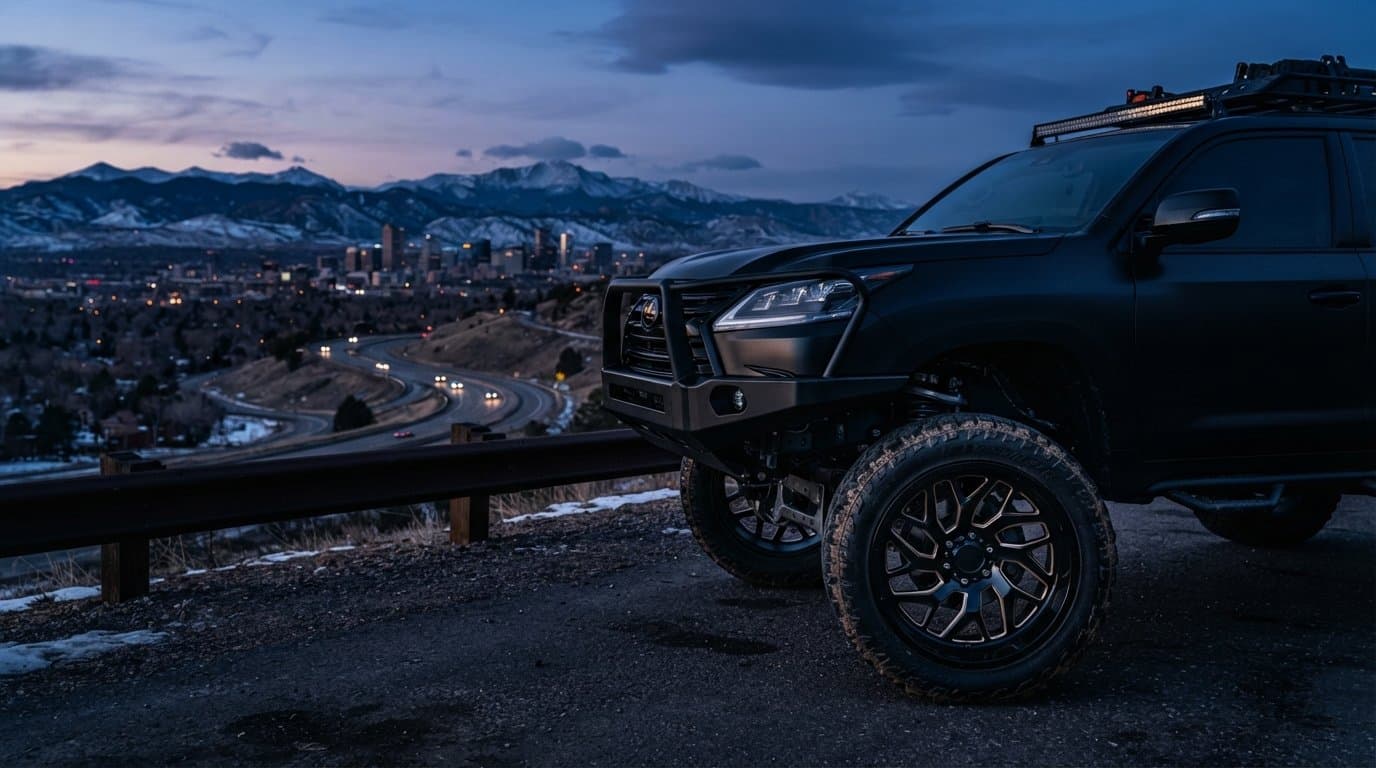
Achieving a perfect stance is a balancing act between your chosen custom wheels and rims and your truck's suspension geometry. If you simply slap a set of oversized tires onto a stock rig, you'll quickly encounter the "Rub Zone." This is the area where the tire makes contact with the inner fender liner or the frame during sharp turns. To avoid this, most Denver truck owners look toward suspension modifications to create the necessary clearance. Modern trucks are typically built with a "nose-down" factory rake to help with aerodynamics and towing, but this leaves very little room for larger aftermarket wheels in the front.
Lifting your truck doesn't just provide vertical space; it fundamentally changes the required wheel offset. As the suspension moves through its travel, the arc of the wheel changes. A wheel that fits perfectly at stock height might cause interference once a lift is installed. Additionally, increasing your wheel and tire diameter impacts your performance. Larger tires effectively change your gear ratio, making your truck feel slower off the line. It also throws off your speedometer calibration. If you're unsure which height matches your vision, check out our lift and leveling kit options to see what fits your specific truck model.
Leveling Kit vs. Lift Kit for Wheel Clearance
Leveling kits are the most cost-effective solution for fitting 33-inch tires. By raising the front of the truck to match the rear, you gain enough clearance for a more aggressive wheel without a massive investment. However, if your goal is to clear 35-inch or 37-inch rubber for serious off-roading, a full suspension lift kit is required. Some owners try to avoid lifts by trimming their fenders or plastic liners. We generally advise against excessive cutting, as a properly sized lift maintains your truck's structural integrity and provides better ground clearance for the trails.
The Complete Wheel and Tire Package
We highly recommend purchasing a wheel and tire package rather than buying components separately. This ensures that your tires are professionally mounted and balanced using specialized equipment that won't mar your new rims. We also match your all-terrain tires with the correct rim width to ensure the tread sits flat on the road for optimal traction. To finish the build, we use high-quality lug nuts and hub-centric rings. These small components are vital for ride smoothness, as they ensure the wheel is perfectly centered on the hub, eliminating the "highway shake" common with poorly installed aftermarket setups.
The Platinum Experience: Professional Custom Wheels Near Me
Ordering your setup online might seem convenient until the boxes arrive and the wheels don't clear your brake calipers. "Blind" online ordering lacks the critical human element required for complex truck fitment. When you choose a local expert, you're investing in a consultative approach that prioritizes your peace of mind. We measure twice so you buy once. Our technicians physically inspect your truck's hub, suspension clearance, and fender depth before a single bolt is turned. This hands-on verification is the only way to guarantee that your custom wheels and rims perform as well as they look on the showroom floor.
Precision installation goes beyond just mounting a tire. We provide on-site TPMS sensor programming to ensure your vehicle's safety systems communicate perfectly with your new gear. We also utilize high-speed balancing technology to eliminate the vibrations that often plague larger off-road setups at highway speeds. Supporting a local, independent Colorado business means you're not just a transaction number in a database. You're a neighbor. From Aurora to Castle Rock, we've built our reputation on being a reliable fixture in the community that understands the specific environmental demands of the Rockies.
Our Local Service Area
We're proud to serve truck owners across the entire Front Range, including Denver, Lakewood, and Littleton. It's common for enthusiasts to drive from Fort Collins or Colorado Springs specifically for our fitment expertise. They know that a few extra miles of driving is worth the security of a local warranty and face-to-face support. If you encounter a finish issue or a balance weight shifts after a weekend on the trails, you don't have to deal with a shipping claim. You just drive back to the shop, and we make it right.
Start Your Build Today
Transforming your truck starts with a conversation about your goals. Whether you're looking for sleek performance tires for the city or aggressive off-road rims for the backcountry, our inventory is curated for the Colorado lifestyle. We specialize in the seamless integration of lift kits and wheel packages, ensuring your suspension and rolling stock work in perfect harmony. Don't leave your truck's safety and stance to chance with a generic website. Ready for a transformation? Visit Platinum Wheels in Denver for a custom quote.
Elevate Your Truck's Potential on the Front Range
Upgrading your vehicle is a significant investment that requires more than just picking a style from a digital catalog. You've now mastered the technical blueprint of offset and backspacing, which is the only way to avoid the "Rub Zone" while achieving that wide, aggressive stance. Protecting your rig from Colorado's harsh winter chemicals requires choosing the right finishes for your custom wheels and rims, ensuring they withstand the Front Range's unique terrain for years to come. By prioritizing suspension synergy, you ensure your truck handles the I-70 corridor with precision and safety.
We're here to turn your vision into a reality with a specialized focus on truck and SUV suspension and fitment. As an authorized dealer for premium off-road wheel brands, we provide expert local installation right here in the Denver Metro area. We take the guesswork out of the process so you can drive away with total confidence in your vehicle's performance. Build Your Dream Truck: Browse Custom Wheel and Tire Packages today and get ready to conquer the Rockies with a setup that's built to last.
Frequently Asked Questions
What is the difference between wheel offset and backspacing?
Wheel offset measures the distance from the hub mounting surface to the wheel’s true centerline, while backspacing measures from that same mounting surface to the innermost edge of the rim. Offset determines the overall stance and how far the wheel sticks out from the fender. Backspacing is the critical measurement used to ensure the wheel doesn't interfere with your brake calipers or internal suspension components.
Will installing custom wheels and rims void my truck’s factory warranty?
Installing custom wheels and rims does not automatically void your vehicle's factory warranty. Under the Magnuson-Moss Warranty Act, a manufacturer can only deny a warranty claim if they can prove that the aftermarket part directly caused the mechanical failure. We recommend choosing professional installation to ensure your setup meets all safety standards, which helps protect your standing with the dealership if a claim arises.
Do I need a lift kit to install 35-inch tires on my Ford or Chevy?
Most modern Ford and Chevy half-ton trucks require at least a 2.5-inch to 4-inch lift kit to clear 35-inch tires without significant rubbing. While some heavy-duty models might fit them with just a leveling kit, the wider offset of aftermarket wheels often pushes the tire into the fender liner during turns. We always measure your specific combination to ensure you maintain a full steering range on the trail.
How do I know what bolt pattern my truck uses?
You can find your bolt pattern by checking your vehicle's owner's manual or looking for a stamp on the back of your factory wheels. Bolt patterns, also known as Pitch Circle Diameter (PCD), are specific to your make and model. For example, a Ford F-150 typically uses a 6x135mm pattern, while a Chevy Silverado uses 6x139.7mm. Our team verifies this using professional fitment databases before every order.
Should I get a leveling kit or a full suspension lift for my new wheels?
Choose a leveling kit if you want to correct the factory rake and fit 33-inch tires for a cleaner street look. If your goal involves serious off-roading or fitting 35-inch tires, a full suspension lift is the better choice. Full lifts provide superior ground clearance and maintain better suspension travel, which is essential for navigating rocky trails in the Front Range without bottoming out your rig.
What are TPMS sensors and do I need new ones for my custom rims?
TPMS sensors monitor your tire pressure and alert you to leaks, which is vital during Colorado's extreme temperature shifts. We highly recommend installing new TPMS sensors with your custom wheels and rims. This prevents the need to dismount your old wheels to retrieve the original sensors and ensures the new set is calibrated correctly for your truck's computer system from the moment you leave the shop.
Can I use my factory tires on new aftermarket wheels?
You can only use factory tires if the new wheel diameter and width are perfectly compatible with the tire's specifications. Most aftermarket wheels are wider than factory rims, which can cause the tire sidewall to stretch excessively and compromise your safety. We usually suggest a complete wheel and tire package to ensure the components are matched correctly for your truck's weight and load rating.
How do I maintain the finish on my custom rims during Colorado winters?
Frequent washing is the best way to protect your rims from Colorado's corrosive magnesium chloride and road salt. Avoid using acidic wheel cleaners that can damage the clear coat or powder finish. Applying a high-quality wax or a ceramic sealant before the winter season provides a protective barrier. This makes it much easier to rinse off road grime after a snowy drive through the Denver Metro area.