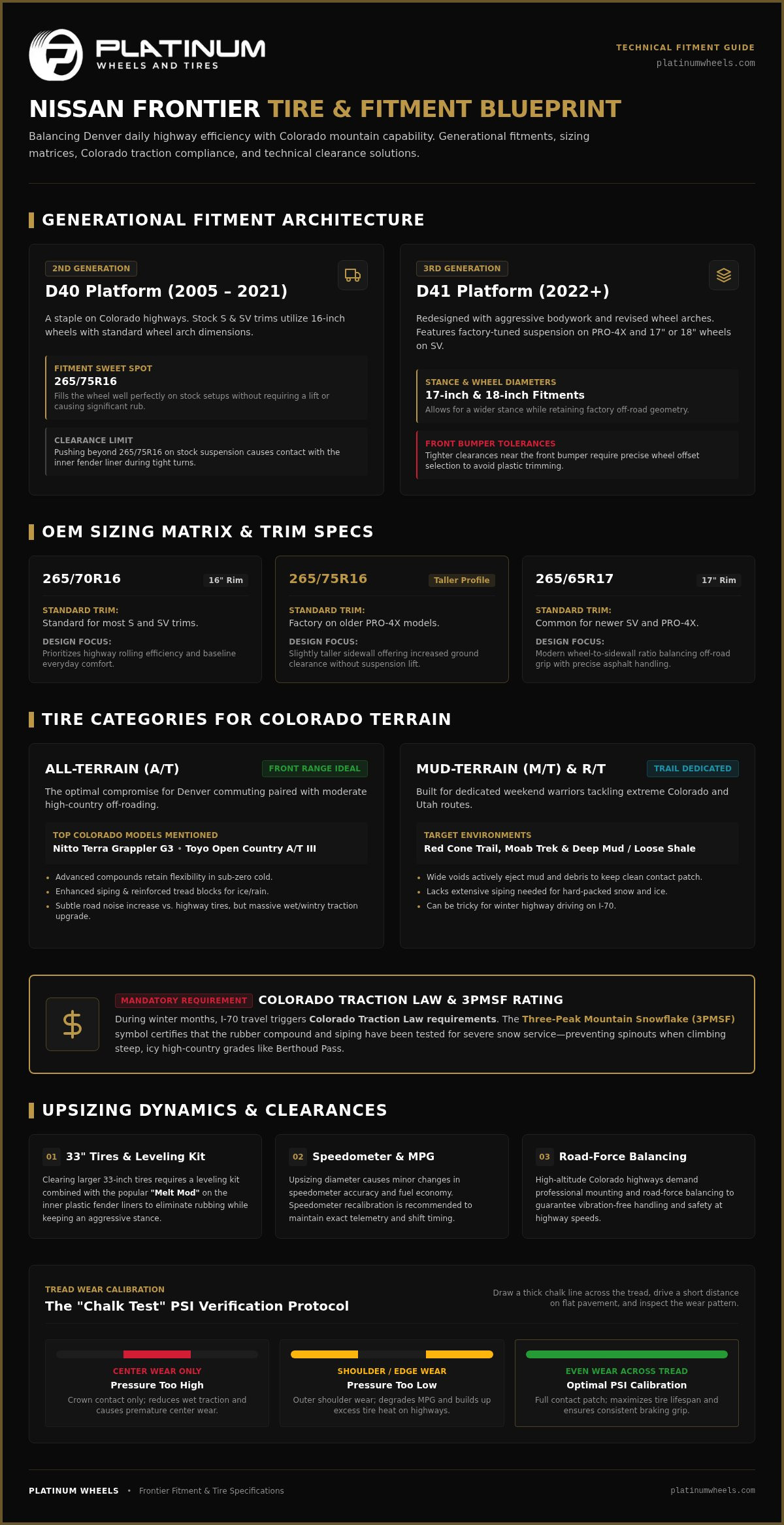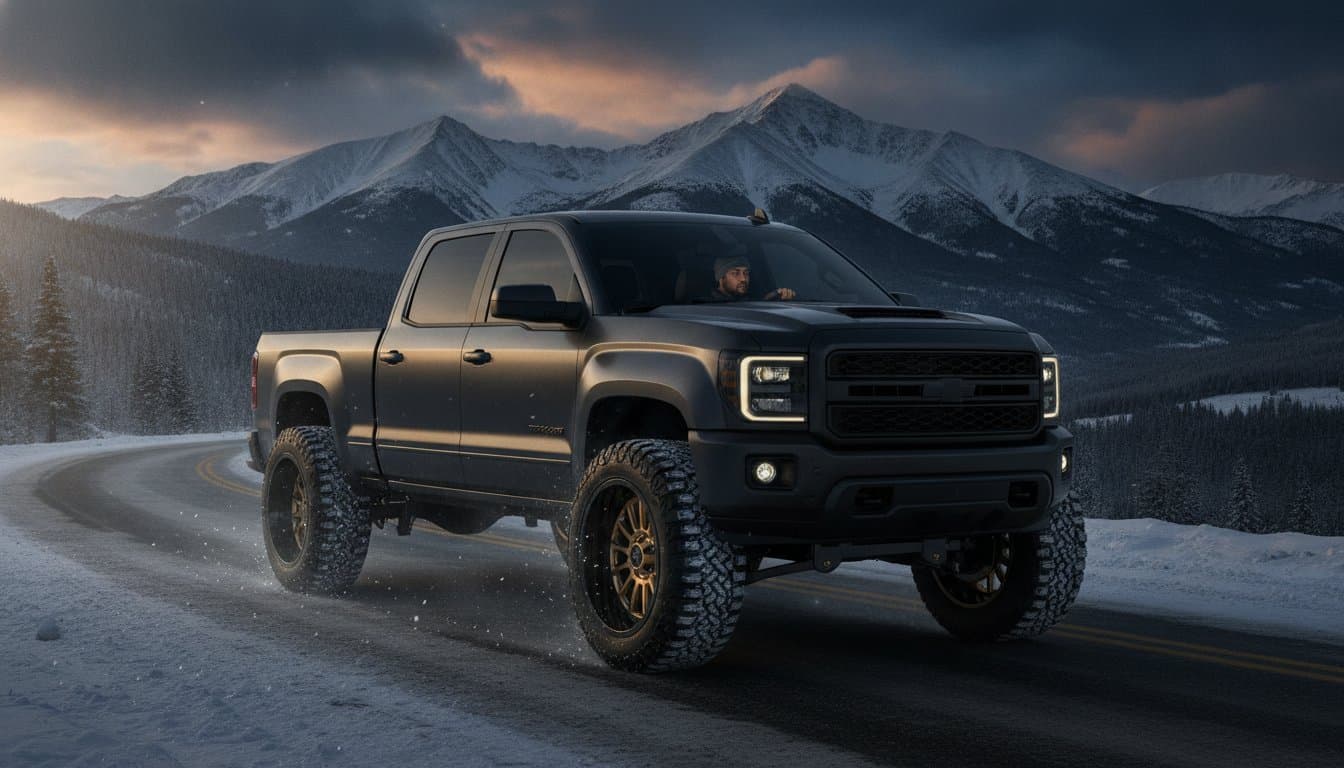
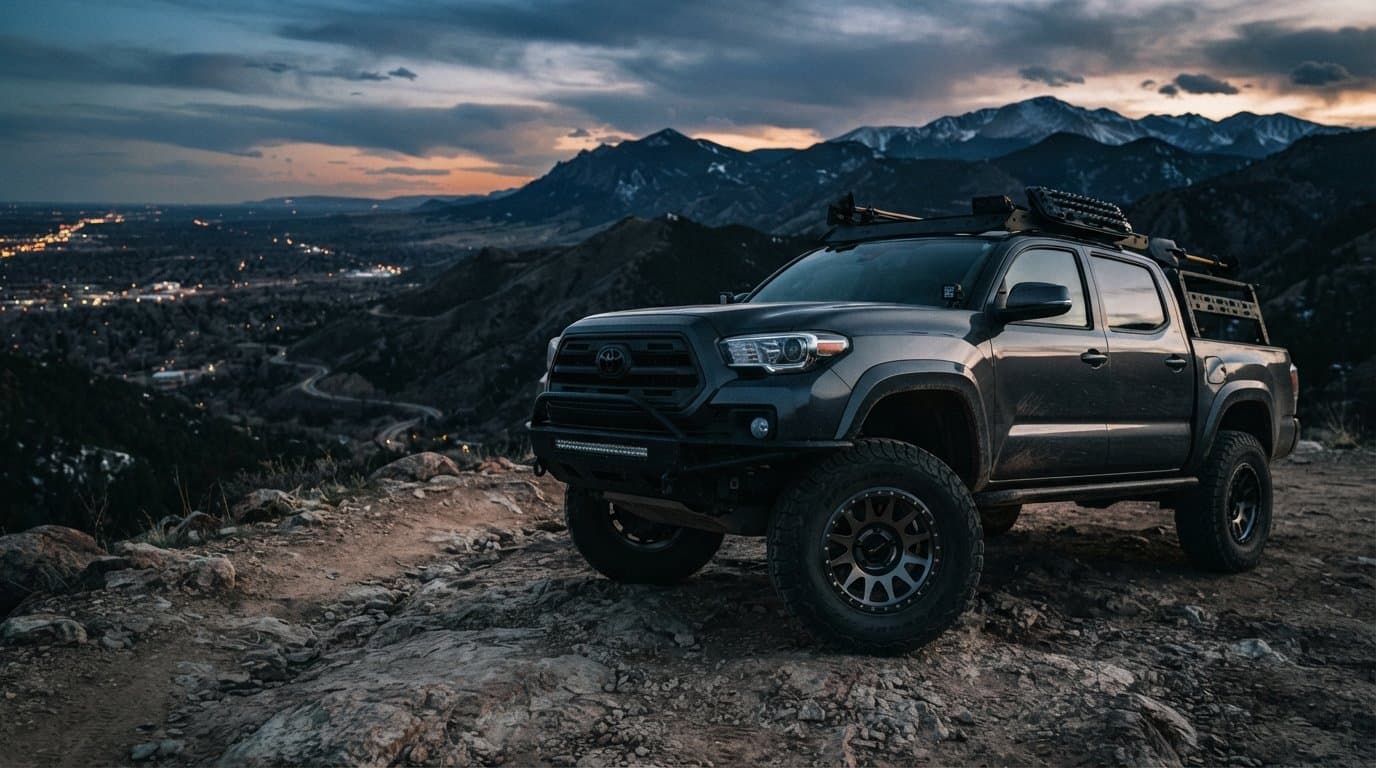
Best Nissan Frontier Tires for Denver & Front Range Roads
Your stock Nissan Frontier tires might be rated for "all seasons," but they weren't designed with a slushy climb up I-70 in mind. It's a common frustration for Colorado drivers who find that factory rubber lacks the bite needed for a sudden October snowstorm or a rocky weekend trail. You need a setup that balances smooth highway efficiency in Denver with the rugged durability required for the high country. Choosing the right nissan frontier tires is the most significant upgrade you can make to ensure your truck performs as well as it looks.
We know the headache of guessing which tire size fits your specific generation or worrying about annoying fender rub after you've bolted on a leveling kit. You deserve a truck that feels planted on icy mountain passes and looks sharp when you're back in the city. This article promises to clear up the confusion by matching the right rubber to your Frontier's trim and your personal lifestyle. We'll dive into the best all-terrain and mud-terrain picks, explain fitment nuances for the newest models, and help you build a wheel and tire package that's ready for any Colorado adventure.
Key Takeaways
- Identify the specific fitment needs for your D40 or D41 generation to choose the ideal nissan frontier tires for your trim level.
- Evaluate the performance differences between All-Terrain and Mud-Terrain categories to find the best balance for Denver commuting and weekend trail runs.
- Learn how a leveling kit and the "Melt Mod" can help you clear larger 33-inch tires while maintaining a clean, aggressive stance.
- Prepare for technical adjustments, such as speedometer recalibration and minor fuel economy changes, that come with upsizing your rubber.
- Realize the benefits of professional mounting and road-force balancing to ensure your truck handles high-altitude Colorado roads with precision and safety.
Understanding Nissan Frontier Tire Sizes & Generations
The Nissan Frontier has a legendary reputation for longevity; however, choosing the right rubber depends entirely on which era of truck you're driving. The transition from the long-running D40 platform to the modern D41 redesign changed more than just the bodywork. Reviewing the Nissan Frontier generational specs reveals how wheel arch dimensions and factory suspension heights evolved, directly impacting your clearance for larger tires. Whether you're cruising Speer Boulevard or climbing toward Berthoud Pass, understanding your specific trim's baseline is the first step in a successful build.
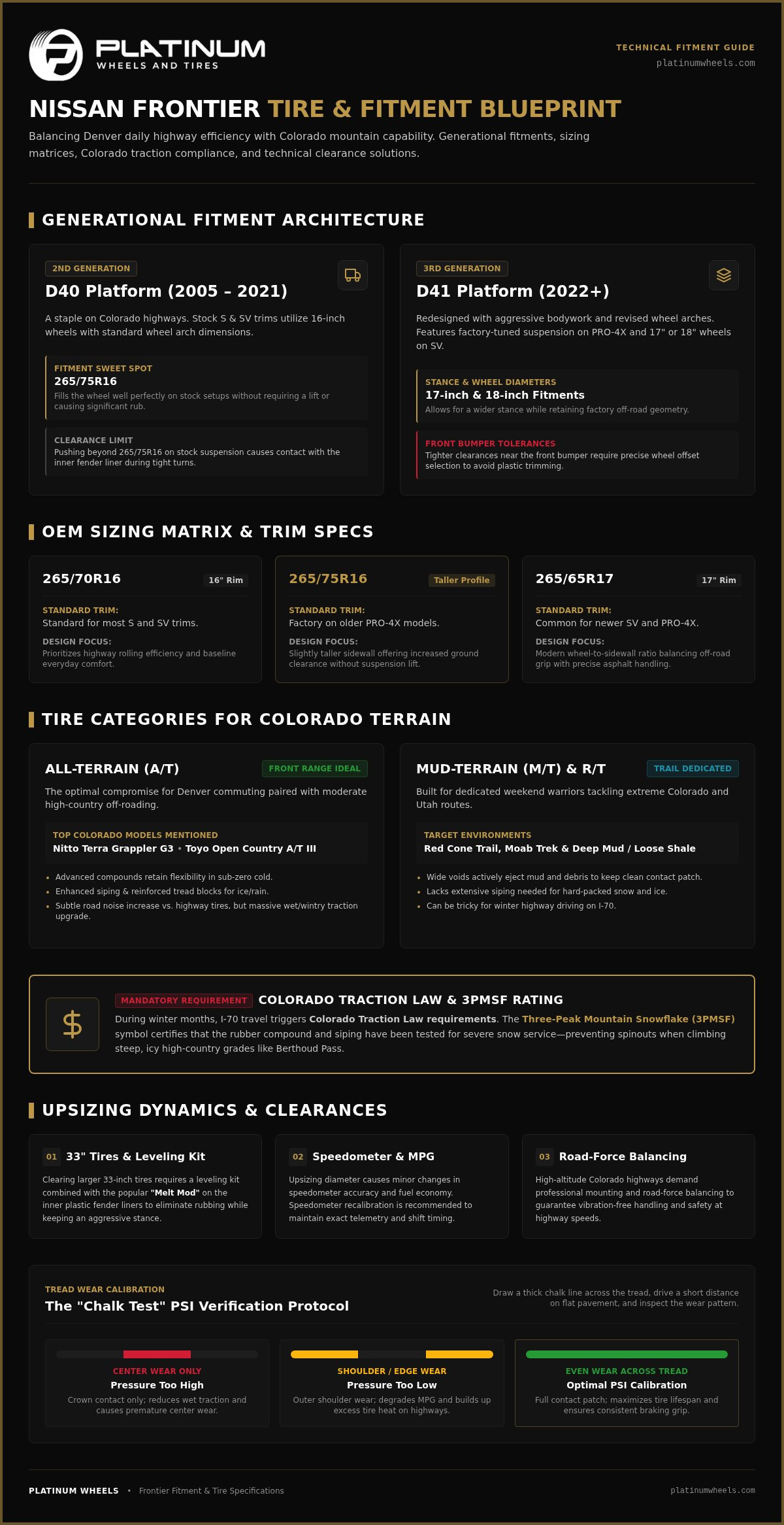
Nissan typically ships these trucks with a few standard sizes depending on the year and package. Your trim level dictates your starting point. The S and SV trims prioritize efficiency, while the PRO-4X offers a slightly more aggressive stance right from the dealership. Common OEM sizes include:
- 265/70R16: The standard for most S and SV trims with 16-inch wheels.
- 265/75R16: Found on older PRO-4X models; it's a slightly taller tire that offers better ground clearance.
- 265/65R17: A common size for newer SV and PRO-4X models equipped with 17-inch wheels.
Tire Sizes for the 2nd Gen Frontier (D40)
Produced from 2005 through 2021, the D40 generation is a staple on Colorado roads. If you're running a stock S or SV trim, you likely have 16-inch wheels. Many owners find the 265/75R16 to be the absolute "sweet spot." It fills out the wheel well perfectly without requiring a lift or causing significant rubbing. Pushing beyond this size on a stock setup often leads to contact with the inner fender liner during tight turns.
Fitment for the 3rd Gen Frontier (D41)
The 2022+ D41 models brought a more aggressive look and slightly revised wheel arches. While the PRO-4X remains the off-road flagship with its factory-tuned suspension, the SV trim often comes with 17-inch or even 18-inch wheels. Upgrading nissan frontier tires on these newer trucks allows for a wider stance; however, the tighter tolerances near the front bumper mean you'll need to be precise with your offset to avoid trimming plastic.
Once you've installed your new nissan frontier tires, especially if you've moved to a wider aftermarket setup, use the "Chalk Test" to find the right PSI. Draw a thick line of chalk across the tire tread and drive a short distance on a flat surface. If the chalk wears off only in the center, your pressure is too high. If it wears on the edges, it's too low. This simple trick ensures your expensive new rubber lasts through years of Front Range commuting and weekend trail runs.
Best Tire Categories for Colorado Frontiers
Selecting nissan frontier tires involves more than just picking an aggressive tread pattern. You have to consider how those tires will perform during a surprise April blizzard or a long haul to the Western Slope. In Colorado, your choice is often dictated by safety mandates. During the winter season, I-70 travel frequently triggers Colorado Traction Law requirements, making the Three-Peak Mountain Snowflake (3PMSF) rating a non-negotiable feature for most local drivers. This symbol indicates the tire has been tested for severe snow service, providing the grip needed to climb steep, icy grades without spinning out.
All-Terrain Tires: Balance for the Front Range
For the vast majority of Frontier owners, all terrain tires represent the perfect compromise. These tires are designed to handle Denver's daily commute while remaining capable enough for moderate off-roading. The Nitto Terra Grappler G3 and Toyo Open Country A/T III are top-tier choices that fit both the D40 and D41 generations beautifully. These models utilize advanced rubber compounds that stay flexible in sub-zero temperatures, ensuring you don't lose traction when the mercury drops. While you might notice a subtle increase in road noise compared to factory highway tires, the enhanced siping and reinforced tread blocks provide a massive upgrade in wet and wintry conditions.
Mud Terrain & Rugged Terrain for the Trail Enthusiast
When your Frontier is a dedicated weekend warrior tackling trails like Red Cone or making the trek to Moab, Mud-Terrain (M/T) tires become a viable option. These tires excel in deep mud and loose shale, featuring wide voids that naturally eject debris to maintain a clean contact patch. However, M/T tires typically lack the siping required for packed snow and ice; this can make them tricky for winter highway driving.
Rugged Terrain (R/T) tires have emerged as a popular hybrid middle ground. They offer the aggressive, chunky sidewalls of a mud tire to protect your rims from rock rash, but they maintain a tighter center tread pattern for better road manners. This category is ideal for the enthusiast who wants a bold truck stance without the excessive drone of a traditional mud tire. If you're ready to transform your truck's capability, consider looking at our all-terrain and mud-terrain tires to find the right fit for your next excursion.
Upsizing Tires: Leveling Kits and Clearance
Many owners want to ditch the factory "rake" and move to a beefier set of nissan frontier tires. A leveling kit is the most common way to achieve this. By raising the front end about 2 inches, you create the necessary clearance to fit 33-inch tires without a full suspension overhaul. However, simply adding height isn't always enough to prevent rubbing during full-lock turns or heavy suspension compression. You need a strategy that accounts for both vertical space and the horizontal swing of the tire.
Fitting 33-Inch Tires on a Frontier
Running a 285/70R17 or 285/75R16 setup is the gold standard for many Frontier enthusiasts. While a 2-inch leveling kit provides the vertical space, you'll likely encounter interference with the plastic fender liner. This is where the "Melt Mod" comes in. By carefully heating the plastic liner and pushing it back while it's pliable, you can gain just enough room to clear those wider treads. It's a much cleaner solution than cutting metal. Deciding between a leveling kit vs lift kit depends on your budget and how much trail clearance you actually need for Colorado's rockier routes.
The Impact of Wheel Offset
Wheel geometry is just as critical as tire diameter. The factory Nissan wheel has a high positive offset, which keeps the tire tucked inside the wheel well. When you upgrade to custom wheels and rims, changing the offset affects your scrub radius. A zero or slightly negative offset pushes the tires out for a wider "poke" stance, but it also increases the arc the tire travels when steering. This can cause rubbing on the back of the wheel well or the frame that a stock-offset wheel would never touch.
Don't forget that upsizing often means moving to a Load Range E tire. These are significantly heavier than factory P-metric rubber, which increases unsprung weight and can lengthen your braking distances. Following NHTSA tire safety and TPMS guidelines is essential during this transition. You'll need to ensure your TPMS sensors are correctly installed in your new wheels and that you're aware of how the extra mass affects your truck's handling on winding mountain descents. Selecting the right nissan frontier tires requires balancing these technical trade-offs to ensure your truck remains safe, capable, and stylish.
Performance Factors: MPG, Speedo, and TPMS
Upgrading your nissan frontier tires changes the fundamental physics of your truck. While the visual improvement is immediate, the mechanical impact on your daily drive requires some adjustment. When you move from a factory 31-inch tire to a beefier 33-inch setup, your speedometer will no longer provide an accurate reading. Since the larger tire covers more ground per revolution, your actual speed will be higher than what's displayed on the dash. Typically, this results in a 6% to 7% error; if your speedometer reads 65 mph, you're likely traveling closer to 70 mph. This discrepancy can lead to unexpected speeding tickets on the downhill stretches of I-70 if you aren't careful.
Fuel economy is another factor where reality often bites. Heavier, aggressive tires increase rolling resistance and unsprung weight. Frontier owners should expect a 1-3 MPG drop depending on the tread pattern and weight of the tire. Additionally, the extra mass of E-rated tires increases the momentum your truck carries. You might find that your braking distances feel longer, especially when navigating heavy Denver traffic. Some enthusiasts choose to upgrade their brake pads shortly after installing larger tires to regain that crisp, responsive stopping power.
Speedometer and Gearing Adjustments
The modern 9-speed automatic transmission in the D41 generation is highly efficient, but it relies on accurate speed data to manage shift points. Using an aftermarket programmer can recalibrate your computer to the new tire diameter, ensuring the transmission doesn't "hunt" for gears on mountain inclines. While re-gearing the differentials is a significant investment, it usually isn't necessary for the Frontier until you cross the 35-inch tire threshold. For most 33-inch builds, a simple software calibration is enough to maintain smooth performance and correct your effective gear ratio.
Managing Your TPMS and Safety Systems
Safety systems like ABS and Vehicle Dynamic Control (VDC) also rely on accurate wheel speed data. Ensuring your sensors are functioning perfectly is critical for maintaining traction on icy Front Range roads. When you invest in new aftermarket wheel and tire packages, it's highly recommended to install fresh sensors rather than swapping old, brittle ones from your stock rims. Following a comprehensive tpms sensor guide will help you avoid the dreaded dash light and ensure compatibility with Nissan’s Easy-Fill Tire Alert system.
Ready to upgrade without the guesswork? Browse our selection of nissan frontier tires and wheel packages to find a setup that's professionally balanced and ready for the Colorado high country.
Expert Frontier Tire Installation in Denver
Choosing the right nissan frontier tires is only half the battle; the installation process determines how those tires actually feel on the road. A general tire chain might handle a standard sedan with ease, but they often lack the specialized equipment and experience needed for oversized off-road rubber. Truck-specific fitment requires an understanding of suspension geometry, wheel offset, and the unique demands of the Colorado Front Range. At Platinum Wheels, we understand that a truck built for the mountains needs more than just a quick mount and balance.
High-altitude driving in Colorado exposes every minor imperfection in a wheel and tire setup. We use road-force balancing to simulate the weight of the vehicle on the tire while it spins. This process identifies "hard spots" or uniformities that a traditional spin balancer misses. It’s the difference between a smooth ride up to the Eisenhower Tunnel and a steering wheel that vibrates every time you hit 65 mph. When you're navigating steep grades and sharp turns, that precision isn't just about comfort; it's about maintaining consistent contact with the road surface.
The Platinum Wheels Advantage
We position ourselves as your local consultative partner rather than a traditional retailer. We don't just sell you a set of tires; we advise you on the best setup for your specific Frontier trim and lifestyle. Whether you're commuting from Lakewood or heading out for a trail run near Aurora, our team ensures your fitment is precise. We specialize in precision mounting for oversized tires and the professional installation of TPMS sensors to keep your safety systems functioning exactly as Nissan intended. Supporting the Denver truck community means providing honest advice that prioritizes your truck's performance and your peace of mind.
Ready to Upgrade Your Frontier?
Starting your custom build shouldn't be a stressful experience. By combining our expertise in offroad tires and wheels with a professional leveling kit installation, we provide a "ready-to-drive" experience. We handle the technical details, from calculating scrub radius to ensuring your road-force balance is perfect, so you can focus on the adventure ahead. We take pride in building complete packages that include wheels, tires, and suspension components designed to work in harmony.
Don't settle for a generic installation that leaves you with rubbing or vibrations. Visit Platinum Wheels today for a custom quote on your next set of nissan frontier tires and see why we are the trusted choice for the Denver truck community. Our goal is to give you a truck that performs with precision on the pavement and dominates the dirt.
Build Your Ultimate Front Range Frontier
Choosing the right nissan frontier tires is about more than just aggressive looks; it's about engineering a truck that handles the I-70 corridor and high-altitude trails with equal confidence. You've learned how to navigate the technical differences between D40 and D41 generations, the importance of 3PMSF ratings for winter safety, and how a professional leveling kit can unlock the clearance needed for beefier 33-inch rubber. Balancing these performance factors ensures your truck remains a capable daily driver in Denver while dominating the weekend trails.
At Platinum Wheels, we've been serving the Front Range community since 2026 with expert truck fitment knowledge and professional lift and leveling kit installation. We take the guesswork out of wheel offset and TPMS recalibration to ensure your truck is ready to drive the moment it leaves our shop. Whether you're aiming for a flush stance or a wide off-road poke, we have the tools to make it happen with precision and care.
Get a Custom Nissan Frontier Tire Quote from Platinum Wheels and start your build today. Your truck was designed for the rugged beauty of the West. Give it the traction it deserves to explore every mile of it.
Frequently Asked Questions
What is the largest tire I can fit on a stock Nissan Frontier?
On a stock second-generation D40 Frontier, the largest size you can typically fit without significant rubbing is a 265/75R16. For the newer third-generation D41 models, a 265/70R17 usually clears the factory wheel arches. While some owners squeeze in slightly larger rubber, you'll likely experience contact with the fender liners during tight turns or when the suspension compresses on rough Front Range trails. Upgrading to a leveling kit is the best way to safely increase your tire diameter.
Will 33-inch tires rub on my Nissan Frontier with a leveling kit?
Even with a 2-inch leveling kit, 33-inch tires often rub against the plastic inner fender liners. This usually happens at "full lock" when the steering wheel is turned all the way. The degree of rubbing depends heavily on your wheel offset; a wider stance pushes the tire into the fender arc. Most local enthusiasts solve this with minor plastic trimming or the "Melt Mod" to ensure clear rotation when navigating rocky Colorado terrain or tight parking spots in Lakewood.
Does the Nissan Frontier require special TPMS sensors for aftermarket wheels?
While you can technically swap your factory sensors, we highly recommend installing new TPMS sensors when building nissan frontier tires and wheel packages. Older sensors often become brittle and fail during the transfer process. Fresh sensors ensure your Nissan’s Easy-Fill Tire Alert remains functional, which is a lifesaver when adjusting pressures for winter driving in Denver. Using high-quality aftermarket sensors prevents the frustration of a persistent tire pressure warning light on your dashboard.
How do All-Terrain tires affect the Nissan Frontier’s gas mileage?
Switching to aggressive All-Terrain tires typically results in a fuel economy drop of 1 to 3 MPG. The heavier construction and increased rolling resistance of off-road tread patterns require more energy to move. While this is a trade-off for significantly better traction on icy mountain passes, choosing a lighter C-rated tire over a heavy E-rated version can help minimize the impact. For many Denver drivers, the added safety in snow outweighs the slight increase in weekly fuel costs.
What is the best tire pressure for off-roading a Frontier in Colorado?
For most Colorado trails, airing down to 18-22 PSI provides the best balance of traction and rim protection. This lower pressure allows the tire to "wrap" around rocks and loose shale, significantly increasing your footprint. However, never go below 15 PSI without beadlock wheels, as you risk popping the tire off the rim. Always carry a portable compressor to air back up to factory specifications before you jump back on the highway for the drive home to the city.
Can I use my factory Nissan wheels with wider 285mm tires?
You can technically mount 285mm tires on factory wheels, but it isn't the ideal setup for long-term performance. Most stock Frontier rims are only 7 or 7.5 inches wide, which "pinches" the sidewalls of a 285/70R17 tire. This can cause the center of the tread to wear out prematurely and may lead to less stable handling during high-speed cornering. Upgrading to an 8.5-inch wide aftermarket wheel provides a much better contact patch and a more aggressive stance.
Do I need to re-gear my Frontier for 33-inch tires?
Re-gearing is generally not required when moving to 33-inch nissan frontier tires, especially on the newer 9-speed automatic models. The transmission has enough range to handle the slightly taller diameter without feeling sluggish. However, your shift points might feel a bit different, and your speedometer will be off by about 6%. We recommend using a software programmer to recalibrate the computer. Re-gearing typically only becomes a necessity once you move up to 35-inch tires or add significant heavy armor.
What is the "Melt Mod" for Nissan Frontier tire clearance?
The "Melt Mod" is a popular DIY technique used to gain tire clearance without cutting into your truck's body. It involves using a heat gun to soften the plastic inner fender liner behind the front wheels. Once the plastic is pliable, you push it back away from the tire and hold it in place until it cools and hardens in the new position. This simple modification is often the final step needed to clear 33-inch tires on leveled Frontiers without experiencing annoying plastic rub.