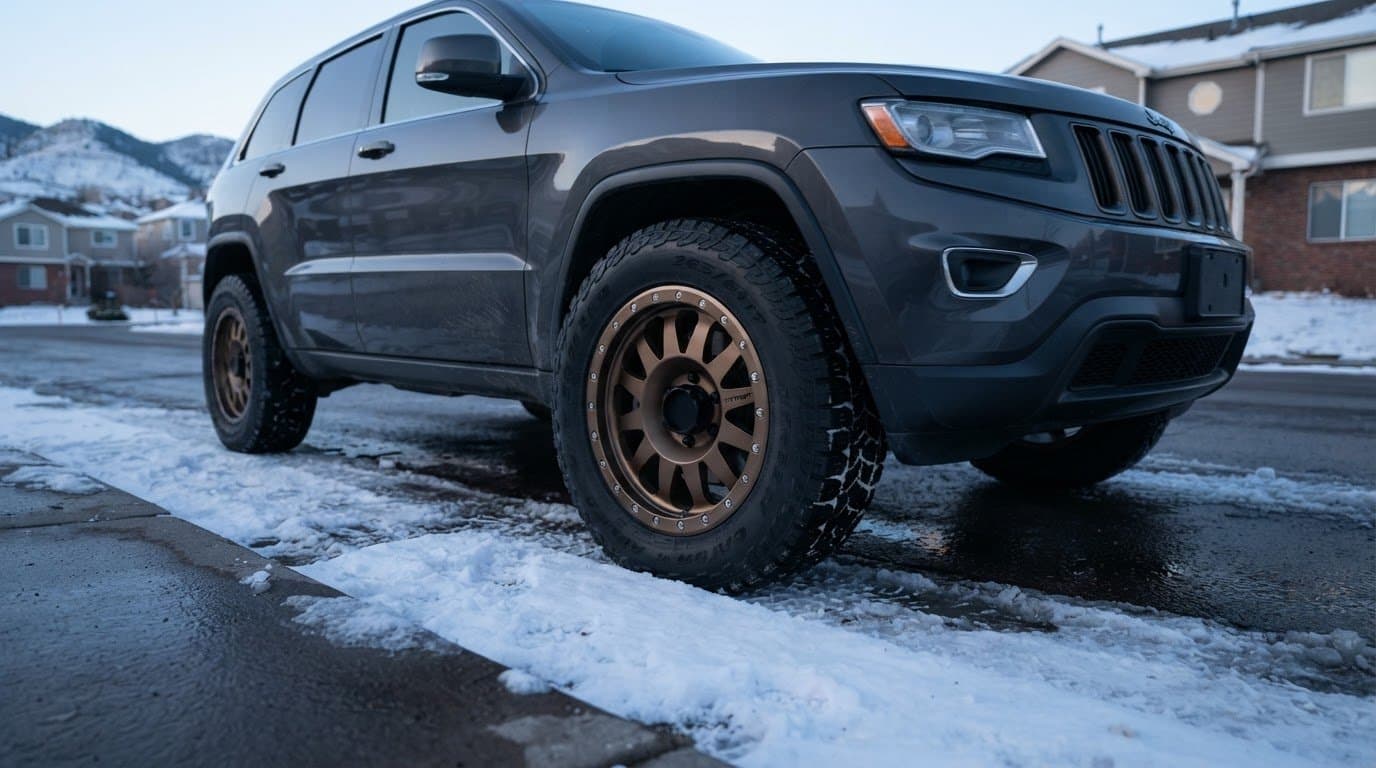
Best Jeep All-Terrain Tires for Denver Off-Roading
The most aggressive tire isn’t always the best choice for a Jeep that spends plenty of time on pavement. All-terrain tires for a Jeep suit many daily drivers because they balance highway handling with traction on dirt roads, gravel, mud, and light snow. Compared with highway tires, expect somewhat more road noise and a possible fuel-economy tradeoff. Compared with mud-terrain tires, all-terrains are generally more comfortable on paved roads.
That balance matters around Denver, where a Jeep may handle weekday commutes as well as unpaved routes. This guide explains how all-terrain and mud-terrain tires differ, what to consider for routine winter driving, and how tire size, wheels, and lift or leveling kits affect fitment. You’ll get a clearer picture of which setup suits your everyday driving and off-road plans.
Key Takeaways
- Learn how tread design affects traction on rocky trails, loose surfaces, and deep mud, and why that matters when choosing between tire types.
- Understand what to look for in an all-terrain tire for routine winter driving, including the difference between common snow markings.
- See how tire dimensions and vehicle clearance influence fitment, and when a lift or leveling kit may be part of a custom setup.
- Explore how a professional can match tires, wheels, and fitment upgrades to your Jeep’s everyday use and off-road plans.
What is the difference between all-terrain and mud-terrain tires?
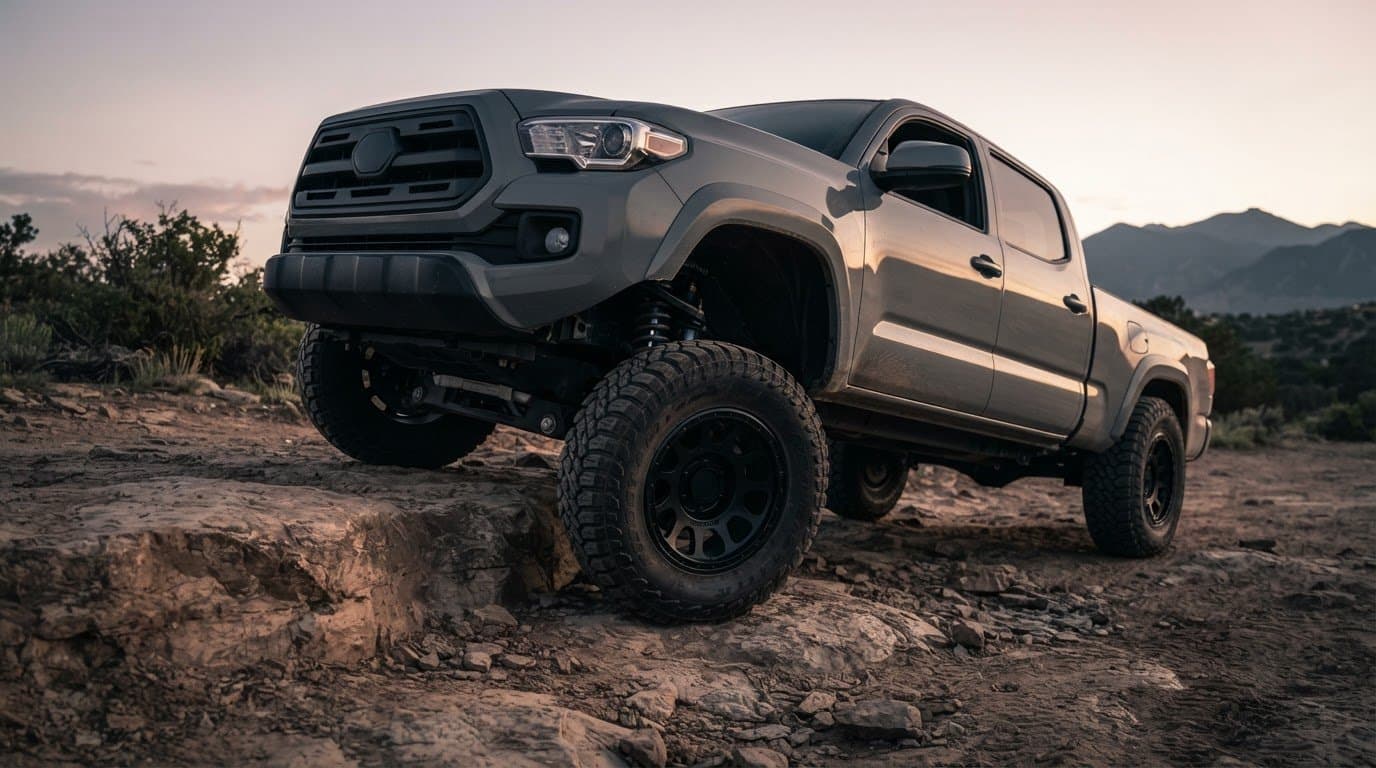
All-terrain tires balance pavement comfort with traction on dirt roads, gravel, mud, and light snow. Their moderate-depth tread blocks, siping, and wider voids than highway tires help them handle mixed surfaces. Mud-terrain tires are built for deep mud and rugged terrain. Their more aggressive tread favors off-road grip but tends to bring more noise and a firmer ride on paved roads. For a Jeep driven to Denver trails and around town, the right balance depends on how often it encounters challenging terrain.
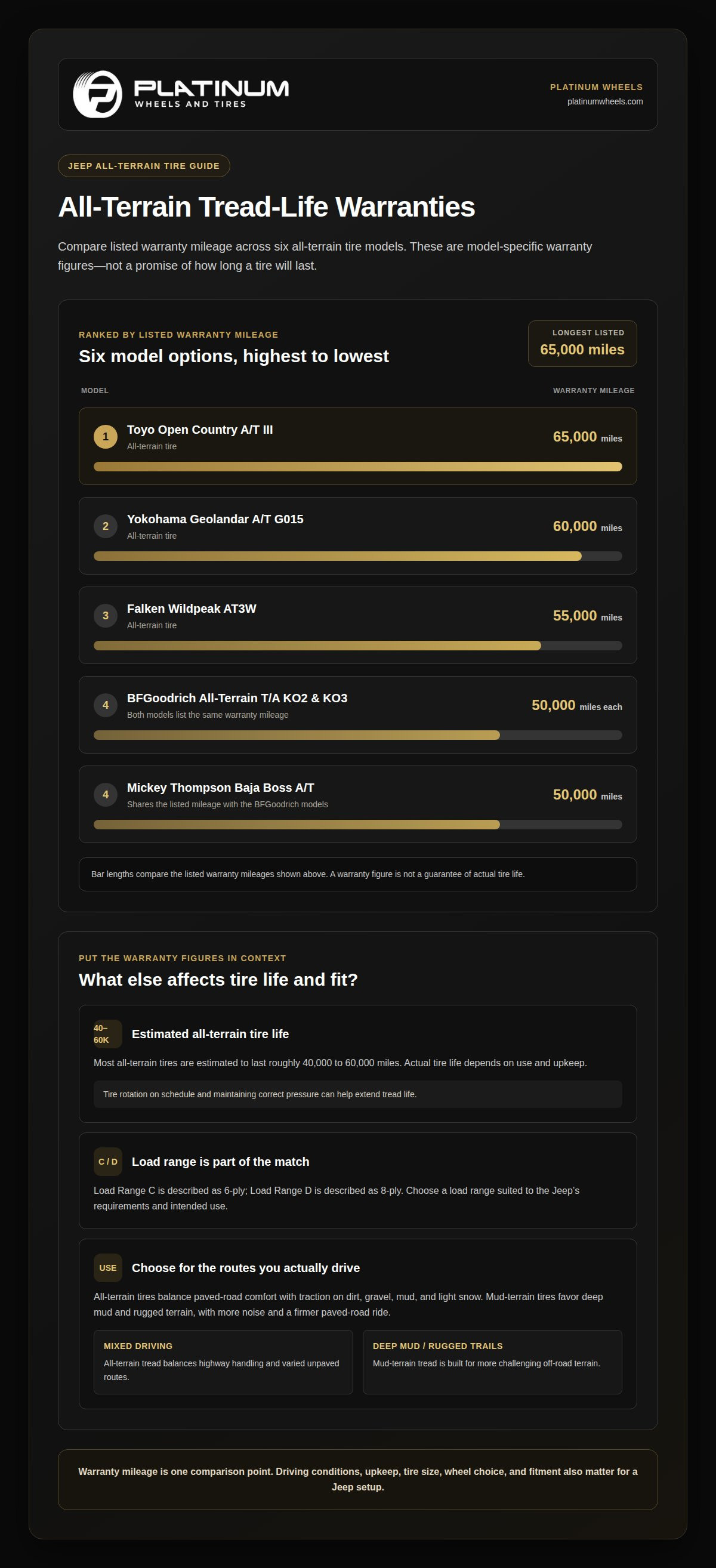
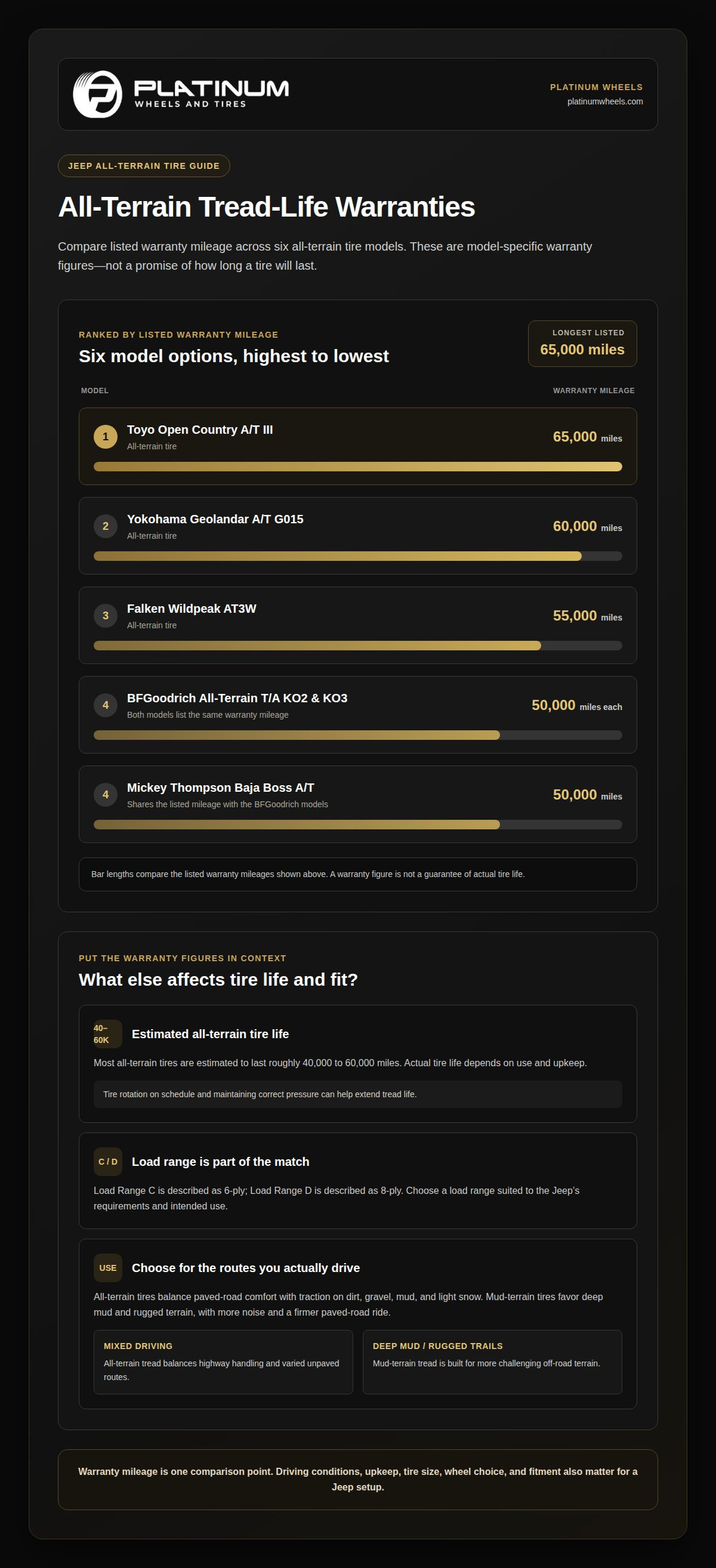
Model comparisons offer useful reference points. The BFGoodrich All-Terrain T/A KO2 and KO3 each carry a 50,000-mile tread life warranty, while the Yokohama Geolandar A/T G015 lists 60,000 miles. Other options include the Mickey Thompson Baja Boss A/T at 50,000 miles, Falken Wildpeak AT3W at 55,000 miles, and Toyo Open Country A/T III at 65,000 miles. These are model-specific warranty figures, not a promise of actual tire life.
Most all-terrain tires are estimated to last roughly 40,000 to 60,000 miles. Tire life depends on use and upkeep; rotating tires on schedule and maintaining correct pressure can help extend tread life. Load range also affects the comparison: Load Range C is described as 6-ply, while Load Range D is 8-ply. A tire’s load range should suit the Jeep’s requirements and intended use.
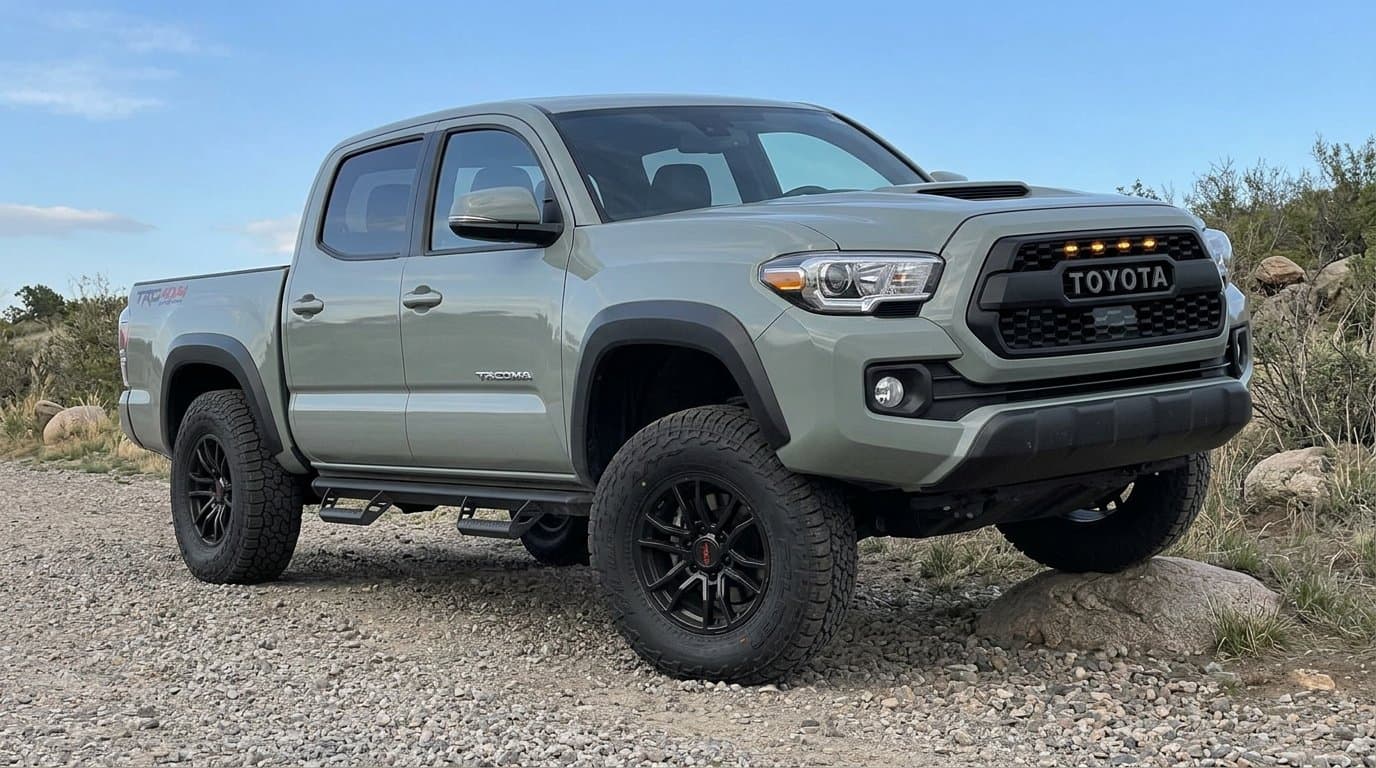
A popular comparison size is 33x12.50R17LT or its nearest equivalent. For an installed setup, the main factors are tire size, wheel selection, and any fitment changes included in the package. A wheel-and-tire package brings those choices together, while custom off-road rims let drivers tailor the wheel setup to their Jeep. The right all-terrain tires for a Jeep prioritize the routes it actually drives, rather than the most aggressive-looking tread.
Are all-terrain tires good for daily driving?
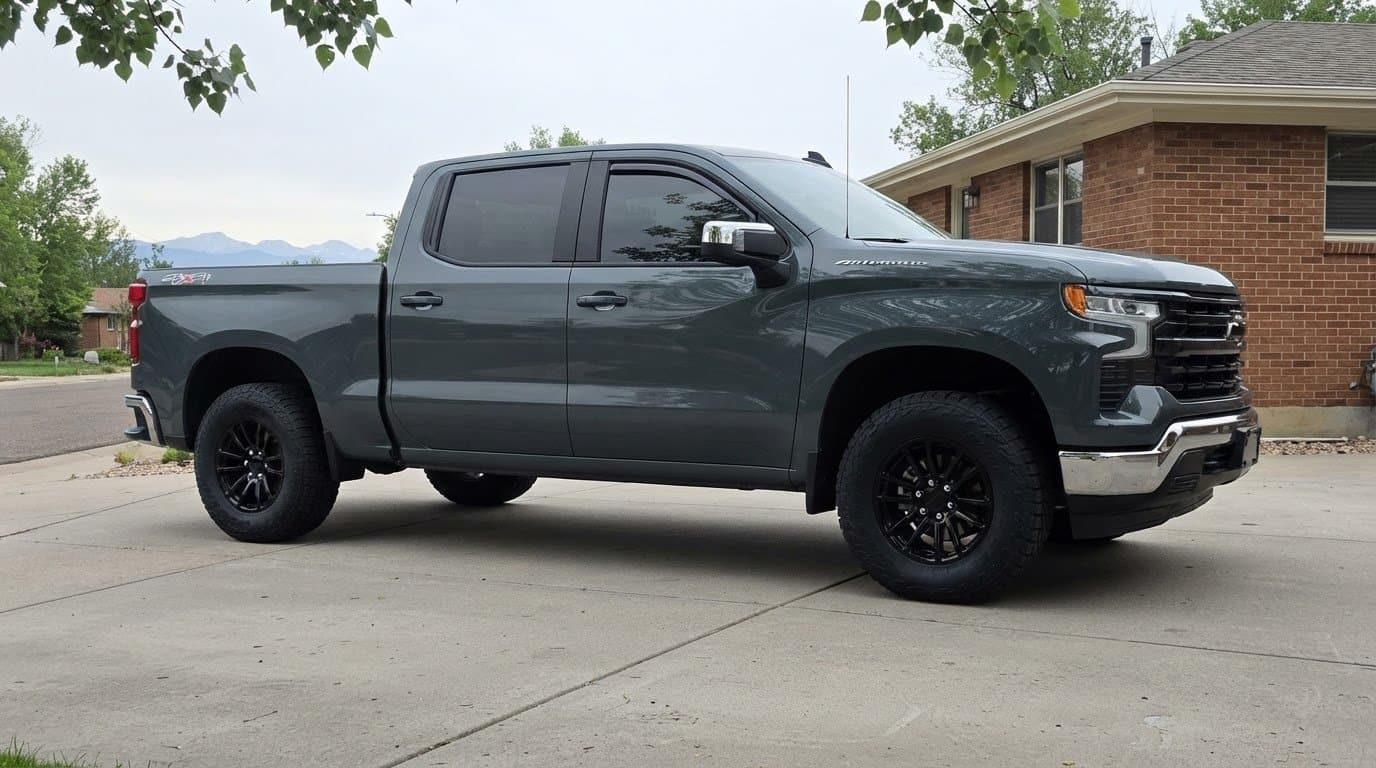
Yes, all-terrain tires suit many Jeep drivers who split their time between pavement and unpaved routes. They balance highway handling with traction on dirt roads, gravel, mud, and light snow. Modern all-terrain designs can offer wet-road traction, while highway tires are generally quieter. Off-road, all-terrain tread helps on mixed surfaces, though deep mud favors a mud-terrain design.
For routine winter driving around Denver, choose an all-terrain tire with the Three-Peak Mountain Snowflake (3PMSF) rating. M+S is a tread-geometry marking, distinct from the 3PMSF severe-snow rating. That difference matters: an M+S marking alone doesn’t indicate the severe-snow rating. A professional can weigh winter use alongside your Jeep’s regular routes when recommending a tread type.
Daily comfort involves tradeoffs. All-terrain tires generally produce slightly more road noise and a minor fuel-economy penalty than highway tires. The estimated reduction is 1 to 3 mpg compared with highway tires. For a Jeep used mostly on pavement, a less aggressive all-terrain tread can prioritize highway manners while retaining capability for gravel roads and occasional trail access. If off-road trips are frequent, a more aggressive all-terrain pattern can give traction on rougher routes, with added noise as a potential compromise.
Match the recommendation to the driving mix, not just the Jeep’s appearance. A mostly pavement-driven Wrangler that sees occasional dirt roads calls for an all-terrain option suited to routine road use. A Jeep regularly tackling muddy or rugged trails may benefit from a more aggressive tread, while still considering the daily commute. A selection of all-terrain tire options can help frame that choice around winter driving, road comfort, and trail conditions rather than looks alone.
How can a professional customize your vehicle's tire and wheel sizes?
A professional begins with the Wrangler’s generation, trim, current tire size, wheel fitment, and available clearance. Most stock JK and JL Wranglers fit 31-inch tires without modification. A 32-inch tire typically fits either generation with minimal trimming. These starting points help narrow the choices, but the full setup still needs to account for wheel and suspension clearance.
For a JL Wrangler, 285/70R17 tires measure approximately 32.8 inches and typically fit stock or with minor trimming. On a JK Wrangler, 285/75R16 tires are also approximately 32.8 inches and typically fit stock or with minor trimming. A 33-inch tire on a JK typically requires a 2- to 2.5-inch lift. Most Wranglers need a 2.5- to 3.5-inch lift for 35-inch tires.
Going larger can create fitment problems if a tire contacts a fender or another component while steering or moving through suspension travel. Tire diameter also affects speedometer accuracy: a larger tire travels farther per rotation, so the displayed speed can differ from actual road speed. The difference depends on the size change. A tire size calculator helps compare dimensions, while a professional fitment assessment considers clearance and the intended wheel-and-tire combination.
Lift kits and leveling kits can create room for larger tires, but the right fit depends on the Wrangler and its setup. A professional considers tire width and diameter alongside wheel fitment, then selects a combination that balances clearance with the desired stance. For example, moving from a stock 31-inch tire to a 32-inch option is a different fitment decision from building around 35-inch tires. Matching the wheel and tire sizes together helps avoid choosing a tire that clears in one position but rubs during a turn or suspension movement.
All-terrain tires for daily driving
For a Jeep that commutes across Denver before heading onto gravel, daily suitability depends on the balance between road use and trail demands. Start with the routes the vehicle actually takes: paved streets, wet roads, maintained dirt, or rougher off-road tracks. All-terrain tires can suit mixed driving, but no tread design eliminates the tradeoffs between pavement comfort and off-road grip. Choose for the Jeep’s regular use, not just an occasional destination.
Consider how often the tires encounter each surface. A Wrangler used mainly on pavement needs an all-terrain tread suited to regular road miles, with occasional gravel-road capability. A Jeep that frequently reaches rough trails has a stronger reason to prioritize off-road traction. For routine winter driving, the 3PMSF severe-snow rating is a useful selection criterion; the M+S marking is different and doesn’t indicate that rating.
- Mostly paved routes: prioritize road-focused all-terrain characteristics for a Jeep that rarely leaves asphalt.
- Mixed commuting and gravel: choose a balance suited to both Denver streets and unpaved access roads.
- Frequent trail use: give greater weight to tread suited to rough terrain, while accounting for regular highway driving.
A professional can use those driving patterns to narrow the tire choice, then consider how the selected size and wheel setup suit the Jeep. That matters because a daily driver must work on ordinary pavement as well as the trail named in the owner’s plans. Discussing commute conditions, winter use, and off-road frequency gives the recommendation practical context. For a setup centered on regular driving with occasional dirt-road trips, explore all-terrain tire options that fit that balance.
Platinum Wheels: All-Terrain & Mud-Terrain Tires
Platinum Wheels helps match tire and wheel choices to your Jeep’s daily routes and off-road plans. If you’re deciding between all-terrain and mud-terrain tread, start by considering how often you drive on pavement, gravel, or rough trails. A wheel and tire package brings those components together, while custom truck wheels and off-road rims help tailor the setup.
For a larger tire fitment, lift kits and leveling kits can be part of the plan. The Jeep’s generation, current setup, desired tire size, and clearance all shape the combination. Bringing those details into the discussion helps focus the options on your driving needs, rather than appearance alone.
Contact Platinum Wheels to discuss an all-terrain or mud-terrain tire setup for your Jeep.
Choose a Setup That Fits Your Jeep’s Everyday Life
Use your Jeep’s regular routine to guide the final choice. Think about the roads it travels most, the trails you plan to explore, and the ride character you want on the way there. This gives your tire choice a practical foundation instead of letting appearance alone drive the decision. The best all-terrain tires for your Jeep should support how you use it now and fit your off-road goals.
Then consider the whole setup together. Platinum Wheels offers all-terrain and mud-terrain tires, wheel and tire packages, and custom truck wheels and off-road rims. Connecting tire choice with wheel style helps shape a cohesive setup for your Jeep, whether your priority is everyday use, trail capability, or a balance between them.
Bring your driving priorities into the conversation and take the next step at your pace. Contact Platinum Wheels for tire advice, and move toward a setup that feels right for your Jeep.
Frequently Asked Questions
Do All-Terrain Tires Affect Gas Mileage?
Yes, all-terrain tires can affect fuel use compared with highway tires. Tread design, tire size, and the Jeep’s regular driving conditions all contribute to the difference. A driver who mainly commutes on pavement may notice the tradeoff more than someone who often drives on dirt roads. Matching tire choice to actual use helps avoid choosing a more aggressive setup than needed.
Load Range: C, D, or E?
Choose a load range that suits the Jeep’s requirements and intended use, rather than treating a higher letter as an automatic upgrade. Load range reflects a tire’s construction and capacity, so the right choice depends on the vehicle and how it’s used. A professional can compare the tire’s load information with the Jeep’s specifications and planned wheel-and-tire setup to help determine fit.
What Is the Best All-Terrain Tire for a Jeep Wrangler?
There isn’t one best all-terrain tire for every Wrangler. A Jeep driven mostly on pavement needs a different balance from one regularly used on rugged trails. Start with the Wrangler’s generation and trim, then consider tire size, winter use, and the ride comfort you want. A professional fitment assessment helps narrow the options to tires that suit your driving patterns and vehicle setup.
What Is the Highest Rated All-Terrain Tire?
No single model is highest-rated across every test, tire size, and driver priority. A rating for wet-road handling may differ from one focused on winter traction or off-road performance. Compare tires using the criteria that matter to your Jeep, such as daily comfort, snow use, or trail conditions. Treat a rating as one selection factor, not a universal ranking.
What are the best all-terrain tires for trucks and SUVs?
The best option depends on the vehicle’s tire fitment, load needs, and typical routes. A truck that carries equipment has different priorities from an SUV used mainly for commuting and occasional gravel roads. Begin with the vehicle’s specifications, then weigh pavement comfort, winter driving, and off-road frequency. Matching those needs helps identify a suitable tread and size without choosing based only on appearance.
What are the best all-terrain tires for a Jeep Wrangler in 2026?
For 2026, choose based on the Wrangler’s exact trim, intended tire size, and most common driving conditions rather than a one-size-fits-all ranking. A daily driver may prioritize road comfort and winter suitability, while frequent trail use can favor a more off-road-focused tread. A professional can assess fitment alongside those priorities, helping you compare current options for your Jeep’s use.