Best Nissan Titan Tires for Denver: Off-Road & All-Season
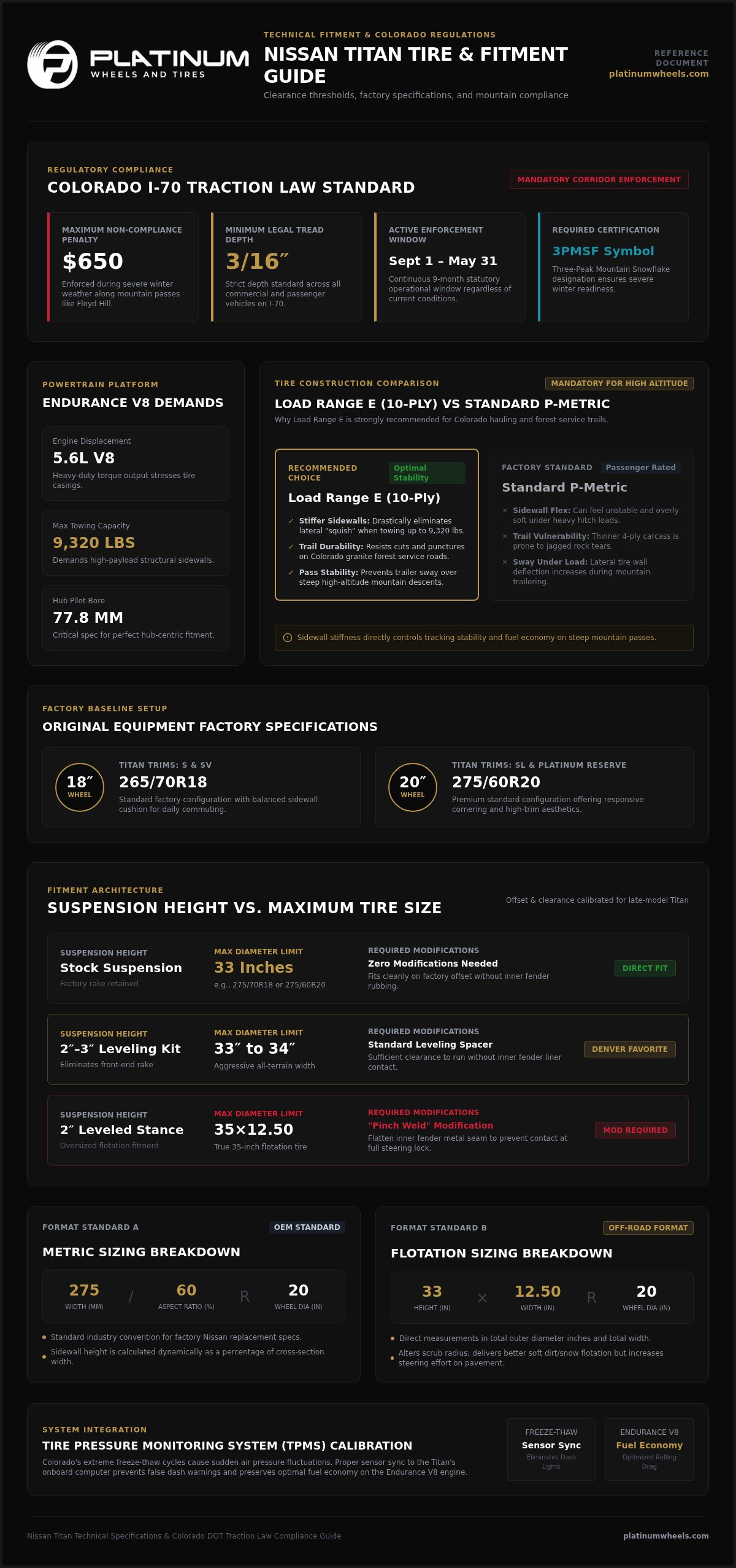
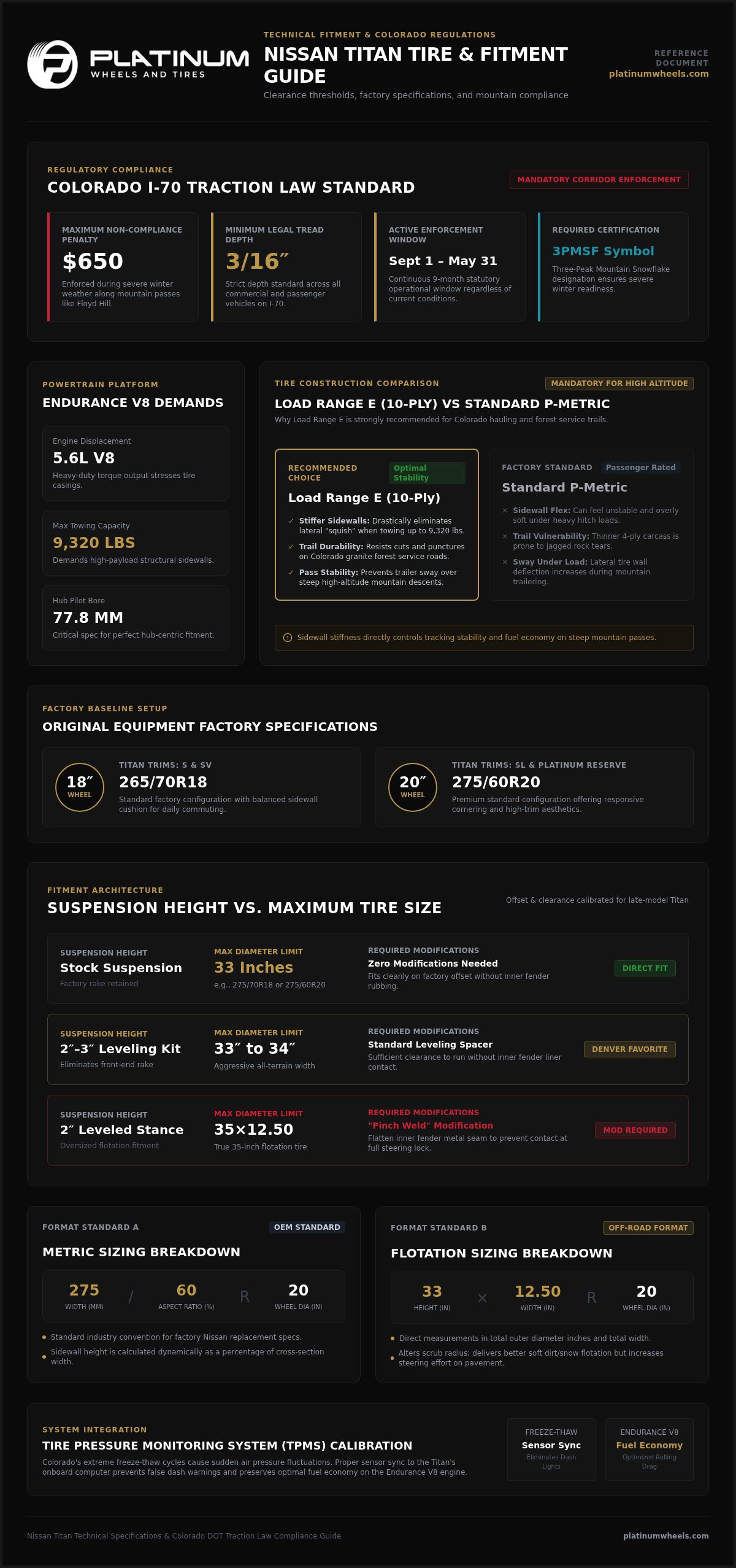
A $650 fine is a steep price to pay for the wrong nissan titan tires when the snow starts falling on Floyd Hill. It's frustrating when you want that aggressive, wide-track look but worry about tires rubbing your inner fender or making your daily commute sound like a jet engine. We understand that Colorado demands more from your truck than just good looks. You need a setup that clears the 77.8 mm hub bore perfectly while meeting the strict 3/16-inch tread depth requirements of the I-70 Traction Law, which stays in effect from September 1 through May 31.
In this guide, we'll show you how to balance rugged off-road capability with the high-altitude highway manners required for the Front Range. You'll learn exactly which sizes fit your stock or leveled Titan, the difference between metric and flotation sizing, and which next-gen all-terrain tires provide the best grip for our unpredictable freeze-thaw cycles. We're diving into expert fitment secrets that give you that bold stance without sacrificing mechanical reliability or your peace of mind.
Key Takeaways
- Identify the precise factory specifications for 18-inch and 20-inch wheels, including why Load Range E tires are a mandatory upgrade for high-altitude towing.
- Discover the exact fitment limits for your truck, including how a 2-inch leveling kit creates enough clearance to run aggressive 33-inch or 35-inch nissan titan tires without fender rub.
- Compare top-rated all-terrain and mud-terrain tread patterns to find the perfect balance between quiet I-25 commuting and technical trail performance.
- Learn how sidewall stiffness and optimized tire pressure directly impact your fuel economy and stability when hauling heavy trailers over steep mountain passes.
- Understand the benefits of a complete wheel and tire package, including professional mounting and TPMS sensor integration for a vibration-free driving experience.
Understanding Nissan Titan Tire Specifications and Sizing
Choosing the right nissan titan tires starts with understanding what your truck was built to handle from the factory. Most late-model Titans arrive with either 18-inch or 20-inch wheels. Standard S and SV trims typically roll on 265/70R18 rubber, while the premium SL and Platinum Reserve models step up to a 275/60R20 setup. These Nissan Titan specifications reflect a vehicle designed for heavy-duty work, meaning your tire choice shouldn't just fit the rim; it must support the truck's weight and power.
The Titan is a heavy-duty half-ton with a massive 5.6L V8, which creates significant demand on your tires. We strongly recommend opting for Load Range E (10-ply) tires. While standard P-metric tires might offer a slightly softer ride, they often feel unstable or "squishy" when you're utilizing the Titan's 9,320-pound towing capacity. Stiffer sidewalls reduce tire sway and provide the durability needed for Colorado's granite-heavy forest service roads.
Reading your tire sidewall is simpler than it looks. The first number represents the width in millimeters, the second is the aspect ratio (height as a percentage of width), and the "R" indicates radial construction. For Denver drivers, the most critical markings are often the load index and the Three-Peak Mountain Snowflake (3PMSF) symbol. This symbol ensures your truck remains legal on I-70 during traction law activations between September and May.
Metric vs. Flotation Sizing Explained
You'll encounter two different sizing systems when shopping for upgrades. Metric sizes, like 275/60R20, are the industry standard for factory replacements. However, if you're looking for a wider off-road footprint, you might switch to flotation sizing, such as 33x12.50R20. These numbers are more intuitive; the first is the total height in inches and the second is the width. Increasing your tire width alters the scrub radius, which directly impacts how your Titan tracks through corners and returns to center after a turn. Wider tires provide better flotation over soft dirt and snow but can increase steering effort on dry pavement.
The Role of TPMS in Your New Tire Setup
Upgrading your nissan titan tires involves more than just rubber and rims. Your truck relies on a Tire Pressure Monitoring System to keep you safe and efficient. When you install new tires, your tpms sensor must be properly synced to the vehicle's computer. This step is vital to avoid the annoying dash light that often pops up during Colorado's extreme temperature swings. A correctly calibrated system ensures your safety and helps maintain the fuel economy of that Endurance V8 engine.
Stock vs. Lifted: Finding the Maximum Tire Size for Your Titan
Achieving the perfect stance for your truck involves more than just picking a tread pattern. If you're keeping your suspension stock, you can generally fit up to a 33-inch tire on factory wheels without issue. This includes popular sizes like 275/70R18 or 275/60R20. However, pushing into 34-inch or 35-inch territory requires more room. Finding the right balance for your nissan titan tires means matching your tire diameter to your specific suspension height and wheel offset.
Installing a 2-inch leveling kit is the most common path for Denver truck owners. This modification levels the truck's factory rake and creates space for larger nissan titan tires. If you're determined to run true 35x12.50 tires on a leveled setup, be prepared for the "pinch weld" modification. This involves flattening the metal weld inside the rear of the front fender well to prevent the tire from catching at full steering lock. Remember, regardless of your lift height, your tires must comply with Colorado Traction Law requirements, specifically the 3/16-inch tread depth rule on I-70.
Titan Tire Fitment Chart (2026 Guide)
Use the chart below to determine which setup fits your goals. If you're debating between a simple front-end level or a full suspension overhaul, check out our guide on leveling kit vs lift kit options for local drivers.
| Suspension Height | Max Tire Diameter | Required Modifications |
|---|---|---|
| Stock Suspension | 33 inches | None (on factory offset) |
| 2-3" Leveling Kit | 33-34 inches | Minor plastic air dam trimming |
| 6" Lift Kit | 35+ inches | Minimal trimming |
Common Fitment Issues and How to Avoid Them
Wheel offset is the "secret sauce" that determines if your tires sit flush or poke out. A negative offset pushes the wheel away from the truck, providing that wide, aggressive look. The trade-off is a larger scrub radius, which often leads to rubbing on the front bumper or fender liner. If you're staying on stock wheels, avoid going too wide to prevent contact with the Upper Control Arm (UCA). To ensure your setup is both functional and reliable, consult with our fitment experts to get it right the first time.
Best All-Terrain and Mud-Terrain Tires for Colorado Titans
Selecting the right nissan titan tires for Denver requires a strategic look at how you use your truck. While fitment determines what clears the wheel well, the tread compound determines if you'll actually stop on an icy I-25 off-ramp. In Colorado, the Three-Peak Mountain Snowflake (3PMSF) rating is non-negotiable for year-round safety. Traditional all-season tires often lose their mechanical grip when temperatures dip below 45°F, a common occurrence during Denver's rapid "Blue Norther" cold fronts. Following NHTSA tire safety ratings and guidelines ensures you choose a tire with the proper load capacity and temperature resistance for our high-altitude environment.
Hybrid tires have become the "goldilocks" solution for many Front Range drivers. These designs, often labeled as R/T or Rugged Terrain, bridge the gap between civil highway manners and aggressive trail performance. They offer the large shoulder blocks needed for deep snow and mud while utilizing specialized tread pitch sequences to keep the V8's cabin quiet. For a truck as heavy as the Titan, finding a tire that doesn't "squirm" on dry pavement while still biting into loose scree is the ultimate goal.
Top All-Terrain Picks for Versatility
For most Titan owners, a high-quality All-Terrain (A/T) tire offers the best balance for daily commuting and weekend mountain runs. We frequently recommend brands like Nitto and Toyo because they offer specific sizing that complements the Titan's heavy front-end weight. The latest generation tires, like the Falken Wildpeak A/T4W, provide deep 3D canyon siping that excels in packed snow while maintaining a quiet cabin on the drive from Denver to Vail. These tires prioritize longevity, often carrying warranties up to 65,000 miles, making them a cost-effective choice for high-mileage drivers. If you want to dive deeper into specific brands, read our guide on all terrain tires for Colorado.
Rugged Mud-Terrain Options for Trail Enthusiasts
If your weekends involve technical trails like Red Cone or Yankee Hill, a Mud-Terrain (M/T) tire is essential. These tires feature reinforced sidewalls to resist cuts from sharp Colorado granite. While pure M/T tires offer maximum traction in spring mud season, they can produce a significant hum during the drive from Aurora to the high country. To mitigate this, many Titan owners are moving toward hybrid designs like the Nitto Ridge Grappler. These options provide the aggressive self-cleaning shoulder blocks of a mud tire but use a variable pitch tread pattern to keep road noise at a minimum on the highway. This setup ensures your nissan titan tires can handle a rock crawl on Saturday and a smooth office commute on Monday.
Maximizing Performance: Hauling, Towing, and Off-Roading
Performance isn't just about speed. It's about how your nissan titan tires handle 400 horsepower and 413 lb-ft of torque when you're climbing Floyd Hill or braking for a sudden elk crossing. Heavier tires, common in aggressive off-road setups, increase unsprung weight. This additional mass requires more energy to stop, potentially lengthening your braking distance on slick Denver roads. Balancing this weight with the right compound is the key to maintaining the Titan's natural agility.
Finding the "sweet spot" for tire pressure is essential for both daily driving and weekend adventures. On the highway, maintaining factory-recommended PSI ensures optimal fuel economy and even tread wear. However, when you hit technical trails, airing down to 18-20 PSI increases the tire's footprint. This allows the rubber to wrap around obstacles for maximum traction. Just remember to air back up before hitting the pavement to prevent sidewall damage.
Towing with the Titan
When you're pulling a 9,000+ lb trailer, sidewall stiffness matters more than the tread pattern. Standard load tires often suffer from excessive heat buildup during long mountain descents, which can lead to premature failure. Load Range E tires use reinforced internal structures to dissipate this heat more efficiently. As the trailer's tongue weight increases, "squat" can alter the tire's contact patch, reducing steering precision if the sidewalls aren't rigid enough to maintain their shape. High-quality nissan titan tires ensure that your contact patch remains consistent even under heavy loads.
Off-Road Capability and Durability
Puncture resistance is a priority for the sharp rocks found on trails like Red Cone or Switzerland Trail. Choosing a 3-ply sidewall over a standard 2-ply version provides a critical layer of protection against jagged granite trail debris. Many modern off-road tires also feature a "rim guard," which is a raised rubber ridge near the bead that helps protect your custom wheels from curb rash or rock scrapes.
Keep in mind that significantly larger tires change your truck's final drive ratio. This can cause the transmission to "hunt" for gears on steep grades, especially with the 9-speed automatic found in newer models. Using a speedometer recalibration tool helps maintain accurate shift logic at high altitudes. If you want a setup that handles the weight and the terrain without compromise, explore our high-performance tire packages for your Titan today.
Professional Nissan Titan Tire Packages in Denver
Choosing the right nissan titan tires is only half the battle. The real magic happens during the installation process. Many owners are tempted by "shipped-to-home" deals, but wrestling a 35-inch tire and a custom wheel into a residential garage is a recipe for frustration. Professional mounting and balancing are non-negotiable for a truck this size. When you opt for a complete wheel and tire package, you're not just buying rubber and metal; you're investing in a vibration-free ride on I-25 and the peace of mind that your TPMS sensors are correctly synced and calibrated.
At Platinum Wheels, we specialize in these complex setups. We understand that a Titan isn't just a commuter; it's a tool for exploring the Rockies. Our local expertise ensures that your offset is perfect and your clearance is verified before you ever pull out of the shop. Buying locally means you have a partner in the community who understands the specific demands of the Front Range. If a fitment issue arises, we're here to solve it immediately rather than leaving you to deal with a return shipping nightmare.
The Platinum Wheels Installation Experience
Our process goes beyond just slapping rubber on rims. We use precision balancing techniques specifically designed for oversized off-road setups. This is critical because even a tiny weight discrepancy can lead to significant steering wheel shimmy at highway speeds. Every installation includes a thorough post-install test drive. We check for rubbing at full lock and under suspension compression, ensuring that any air dam or fender modifications were executed perfectly. From Lakewood to Castle Rock, we bring a level of technical discipline that big-box retailers simply can't match.
Ready for an Upgrade?
Consulting with our team allows you to dial in the exact stance you want for your truck. We take a consultative approach, asking about your typical weekend trails and towing needs to recommend the best aftermarket wheel and tire packages. Many of our customers choose to combine their new nissan titan tires with a professional leveling kit during the same visit. This one-stop-shop approach ensures that your suspension and tire geometry work in total harmony. You won't have to worry about mismatched parts or unexpected mechanical issues. We're here to help you build a Titan that looks aggressive, handles Denver winters with ease, and performs reliably on every mountain pass.
Ready to Transform Your Titan for the Rockies?
Choosing the right nissan titan tires doesn't have to be a solo mission. You now understand how to balance factory load requirements with the aggressive stance you've always wanted. Whether you're fitting 35-inch tires with a professional leveling kit or selecting the perfect hybrid tread for the I-70 commute, the right setup ensures your truck performs as well as it looks. Local expertise is the difference between a smooth mountain drive and a frustrating weekend of fender rubbing.
Our team of expert off-road fitment specialists is dedicated to serving the entire Colorado Front Range. We specialize in complete truck suspension and wheel packages built to handle our unique climate and terrain. Don't settle for generic advice when you can have a consultative experience tailored to your specific driving habits and goals. Upgrade your Nissan Titan at Platinum Wheels in Denver today! We look forward to seeing your truck on the trail or the highway with a setup you can trust.
Frequently Asked Questions
What is the biggest tire I can put on a stock Nissan Titan?
You can typically fit up to a 33-inch tire on a stock Nissan Titan without experiencing significant rubbing. Common metric sizes like 275/70R18 or 275/60R20 work well with factory wheel offsets. If you're driving in Aurora or Lakewood, this setup provides a balanced look without requiring suspension modifications. Keep in mind that wider flotation sizes might require minor trimming of the plastic air dam to ensure full clearance during tight turns.
Do I need a leveling kit to fit 33-inch tires on my Titan?
You don't strictly need a leveling kit for 33-inch tires, but many Denver owners choose one to eliminate the factory rake. While 33s fit on stock suspension, a 2-inch leveling kit provides extra breathing room for more aggressive tread patterns. This upgrade is especially popular for those frequenting technical trails near Golden or Boulder. It ensures your new nissan titan tires have the clearance needed for both highway stability and off-road articulation.
Are All-Terrain tires good for Colorado winters?
All-Terrain tires are excellent for Colorado winters provided they carry the Three-Peak Mountain Snowflake (3PMSF) symbol. This rating ensures the rubber compound remains flexible in Denver's sub-freezing temperatures. Specific nissan titan tires like the Falken Wildpeak or Nitto Ridge Grappler provide the biting edges necessary for icy I-70 mountain passes. They are a great year-round solution for Front Range drivers who want to avoid the hassle of switching to dedicated winter tires every season.
How much does a Nissan Titan tire and wheel package cost in Denver?
The cost of a Nissan Titan wheel and tire package depends on your choice of rim style, tire brand, and whether you include TPMS sensors. We offer a consultative approach to help you find a setup that fits your budget and performance goals. Factors like Load Range E ratings for towing and specialized off-road tread patterns will influence the final package price. Visit our shop in the Denver metro area for a personalized quote.
Will 35-inch tires rub on my Nissan Titan with a 2-inch level?
Yes, 35-inch tires will likely rub on a Nissan Titan with only a 2-inch leveling kit. To make this setup work, you'll generally need to perform the "pinch weld modification" and trim the front plastic air dam. This is a common project for our technicians serving the Highlands Ranch and Castle Rock areas. If you want to avoid cutting or metal work, we recommend sticking with a 33-inch or 34-inch tire for leveled trucks.
How long do off-road tires typically last on a Titan?
Most high-quality all-terrain tires for the Titan last between 40,000 and 65,000 miles with proper maintenance. Heavy towing or frequent off-roading on sharp Colorado granite can shorten this lifespan. We recommend regular rotations and alignments to maximize your investment. Since the Titan is a heavy truck, keeping your nissan titan tires properly inflated is crucial for preventing uneven wear during long commutes between Thornton and Colorado Springs.
Do I need to recalibrate my speedometer after getting larger tires?
You should recalibrate your speedometer when stepping up to 34-inch or 35-inch tires. Larger diameters cause your speedometer to read slower than your actual speed, which can lead to unwanted tickets on I-25. Recalibration ensures your Titan's transmission maintains correct shift points. This is vital for maintaining performance and fuel efficiency when climbing steep mountain grades. We can guide you on the best calibration tools for your specific model year.
Can Platinum Wheels install a lift kit and tires at the same time?
We absolutely install lift kits, leveling kits, and tire packages during the same appointment. Combining these services ensures that your suspension geometry and tire fitment are perfectly synchronized. Our team serves the entire Front Range, from Fort Collins down to Parker, providing professional installation that eliminates guesswork. This one-stop approach saves you time and ensures your truck is trail-ready the moment it leaves our shop in the Denver area.