Best Jeep Wrangler Tires for Denver Off-Roading & Trails
The most aggressive mud-terrain tire on the market is a liability if it can't keep you on the road during a sudden I-25 whiteout. Choosing the right tires for your Jeep Wrangler in Colorado requires more than just picking the biggest lugs you can find. It's a delicate science of balancing off-road traction with the reality of a daily commute through the Front Range. You want a rig that looks the part at a trailhead but doesn't punish your ears with road noise or leave you white-knuckled when the pavement gets slick.
We know the struggle of wanting a 35-inch stance without the "death wobble" or the annoying rub that comes with poor fitment. This guide helps you navigate those trade-offs with confidence. We'll break down the best tread patterns for our rocky terrain, explain the 2026 Colorado Traction Law requirements like the 3/16-inch minimum tread depth, and show you how to achieve the perfect stance. From understanding how tire size impacts your Jeep’s center of gravity to finding a reliable local shop for professional installation, you'll get the technical insight needed for a ready-to-drive experience.
Key Takeaways
- Match your tread pattern to your specific driving habits to balance trail dominance with a quiet, fuel-efficient daily commute.
- Discover how to choose the best tires for jeep wrangler builds, balancing the need for massive 35-inch traction with daily drivability.
- Stay legal and safe on I-70 by looking for the 3-Peak Mountain Snowflake rating and required tread depths for Colorado winters.
- Compare load ranges to find the ideal sidewall stiffness that provides off-road puncture resistance without sacrificing your ride quality.
- Learn why specialized high-speed balancing and integrated TPMS sensors are critical for a vibration-free, ready-to-drive experience.
The Wrangler Tire Dilemma: Balancing Daily Commutes with Colorado Trails
Owning a Jeep in Denver is a unique experience. You need a vehicle that handles the stop-and-go traffic of Speer Boulevard and the jagged rocks of the San Juan Mountains with equal poise. Unlike a standard SUV, the Wrangler’s solid axle suspension and short wheelbase make it sensitive to every change in rubber. Selecting the right tires for jeep wrangler setups involves more than just looking at a spec sheet; it's about understanding how a specific tread handles the weight transfer and steering geometry of a high-clearance rig.
Many owners fall into the trap of buying the most aggressive mud-terrain possible for the rugged aesthetic. While those deep lugs look incredible in a parking lot, they often come with a heavy noise penalty on the highway. Aggressive treads can also drop your fuel economy and, if not properly balanced, lead to premature wear on your steering components. Heavy, oversized tires put extra strain on ball joints and tie rod ends, which can eventually lead to the dreaded "death wobble" if your suspension isn't maintained.
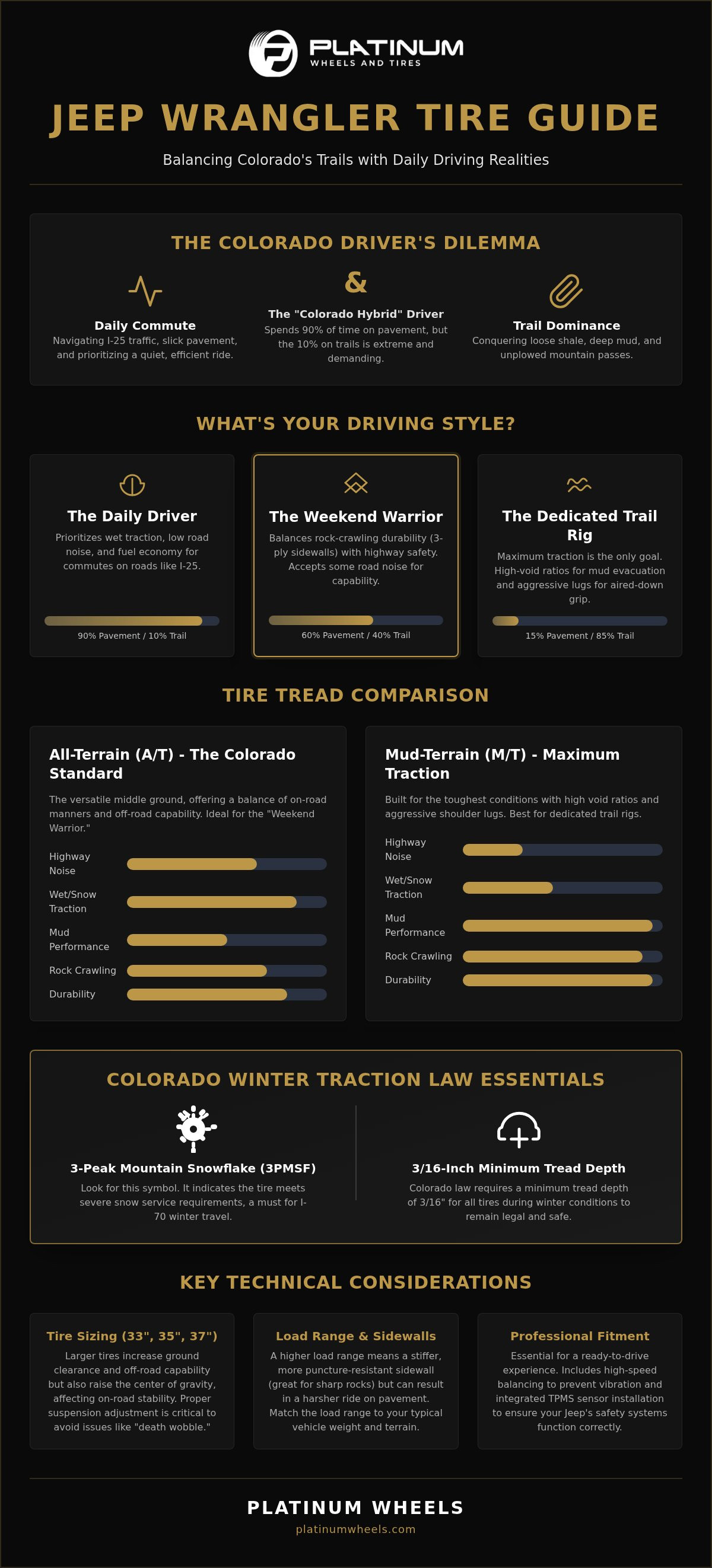
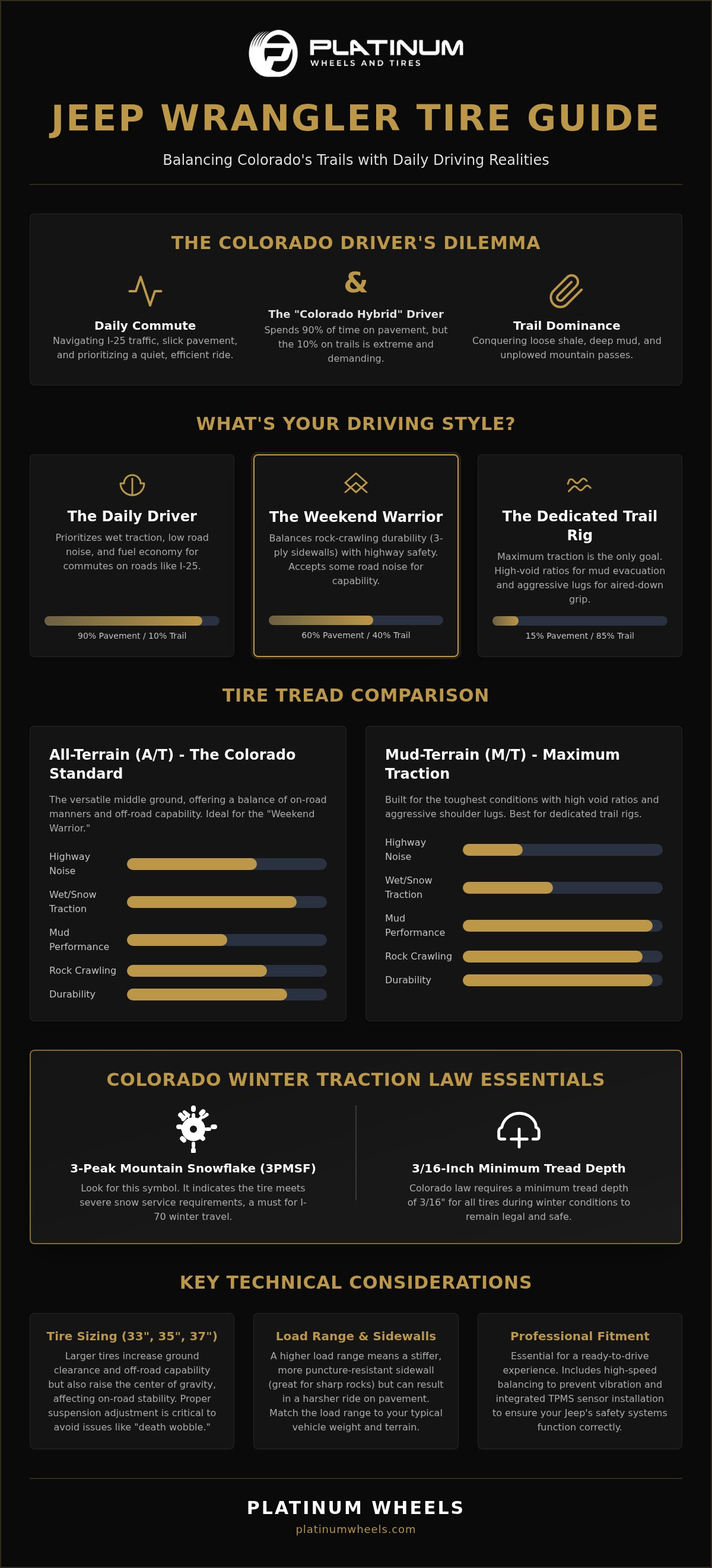
We often call the typical Denver owner the "Colorado Hybrid" driver. You likely spend 90% of your time on pavement, but that 10% on the trail is extreme. You're traversing loose shale, deep mud, or unplowed mountain passes. Your tires must be a "jack of all trades" to keep you safe in both environments without making your Monday morning commute a chore.
Defining Your Driving Style
Identifying your primary use case is the first step toward a successful upgrade. Most Jeepers fall into one of three categories:
- The Daily Driver: You prioritize wet traction and a low road hum. You need a tire that handles I-25 blizzards safely while maintaining decent gas mileage.
- The Weekend Warrior: You need a balance of rock crawling durability and highway safety. You’re willing to accept a little more noise in exchange for 3-ply sidewalls that won't puncture on sharp mountain rocks.
- The Dedicated Trail Rig: Maximum traction is your only goal. You want high-void ratios for mud evacuation and aggressive shoulder lugs for aired-down grip on technical obstacles.
Why Stock Tires Often Fall Short in the Rockies
Factory-equipped tires are designed for a broad, national audience, not the specific demands of the Front Range. While they work fine on dry pavement, they often lack the sidewall strength needed to resist punctures from loose shale or the siping required for icy mountain passes. All-terrain tires serve as the versatile middle ground for 2026 Jeep owners, blending aggressive tread blocks with specialized rubber compounds that stay flexible in freezing mountain temperatures.
All-Terrain, Mud-Terrain, or Hybrid? Choosing Your Tread Pattern
Choosing the right tread pattern for your Jeep is where technical fitment meets the reality of the trail. The primary difference between these categories lies in the void ratio, which is the amount of open space between the tread blocks. A high void ratio allows the tire to self-clean by ejecting mud and snow as it spins. Conversely, a lower void ratio provides more rubber-to-road contact, improving stability on dry pavement. When selecting tires for jeep wrangler builds, your decision should align with the most difficult terrain you plan to conquer.
All-Terrain Tires: The Colorado Standard
For many local owners, A/T tires are the best all terrain tires for mountain driving because they offer a balanced performance profile. These tires feature siping, which are small slits in the tread blocks that provide extra biting edges for ice and packed snow. This is a critical feature for surviving a Denver winter. Models like the BFGoodrich KO3 or the Falken Wildpeak AT3W are staples in the Front Range for their ability to handle both dirt and sleet.
Mud-Terrain Tires: When You Need Maximum Traction
If your weekends involve the deep mud of spring runoff or technical rock crawling, M/T tires are the gold standard. They feature massive, reinforced shoulder lugs that provide bite when aired down. However, there's a trade-off. On the highway, the large gaps between tread blocks create a rhythmic drone or hum. Additionally, the lack of siping on many M/T models can lead to longer braking distances on wet asphalt. If you're ready to commit to the look and capability, we can help you choose All-Terrain & Mud-Terrain Tires that fit your specific lift height.
Hybrid tires, often labeled as R/T (Rugged Terrain), have become a dominant trend in 2026. They combine the quiet inner tread of an A/T with the aggressive sidewalls of an M/T. Options like the Nitto Ridge Grappler or the Toyo Open Country R/T provide a capable solution for those who want the aggressive look without the ear-splitting highway noise. These hybrid tires for jeep wrangler setups offer the best of both worlds for the Colorado lifestyle.
Sizing Up: How 33s, 35s, and 37s Affect Your Jeep’s Performance
Size matters when you're picking tires for jeep wrangler builds, but bigger isn't always better for every driver. The "Golden Rule" for most late-model Wranglers is that 33-inch tires will fit with little to no modification, though you might experience slight rubbing at full suspension flex. Moving up to 35-inch tires is widely considered the "sweet spot" for Colorado. This size provides the ground clearance needed to clear mid-sized boulders on trails like those in the Tarryall Mountains without making the vehicle feel unstable on the highway.
If you're eyeing 37-inch tires, you're entering the realm of serious mechanical commitment. Beyond the look, 37s require significant axle reinforcement and re-gearing to maintain highway speeds and off-road torque. Without these upgrades, your Jeep will feel sluggish, and you'll likely snap a factory axle shaft on a technical climb. Don't forget that any increase in tire diameter will throw off your speedometer and odometer. A 35-inch tire rotates fewer times per mile than a stock 32, meaning your dashboard might show 65 MPH when you're actually doing closer to 72 MPH.
The Relationship Between Tires and Suspension
Clearance is about more than just height; it's about movement. When you upgrade your rubber, you have to decide between a leveling kit vs lift kit to ensure the tires don't chew up your fender flares during a turn. Full lock-to-lock steering clearance is vital for tight maneuvers in the Rockies. We often recommend adjusting your bump stops alongside a lift to prevent the tire from smashing into the wheel well when the suspension fully compresses on a trail.
Backspacing and Offset Explained
Most Jeep owners realize too late that factory wheels often have too much "backspacing" for wider aftermarket tires. This causes the inner sidewall to rub against the control arms or sway bar links when you turn the wheel. To fix this, you need wheels with a negative offset, which pushes the tire further out from the vehicle's body. This creates the wider, more aggressive stance that Denver Jeepers love while protecting your steering components. Consulting a professional at a custom wheel and rim shop is the safest way to ensure your offset, backspacing, and tire width work together without interference.
The Technical Side: TPMS, Load Ratings, and Winter Traction
Selecting the right tires for jeep wrangler builds involves looking past the aggressive tread blocks and into the technical specifications that dictate your safety. In Colorado, these specs aren't just suggestions; they are the difference between a confident drive and a fine on the highway. Understanding load ratings and winter certifications ensures your rig remains compliant with local laws while providing a comfortable ride on the drive home from the trailhead.
Winter Performance in the Front Range
Colorado’s weather is notoriously unpredictable. A sunny afternoon in Denver can turn into a blizzard by the time you hit Georgetown. This is why the 3-Peak Mountain Snowflake (3PMSF) rating is essential. While "All-Season" tires are designed for light rain and moderate temperatures, 3PMSF-rated tires feature rubber compounds that stay pliable at sub-zero temperatures. These specialized compounds allow the tread to grip ice rather than becoming hard and slick like a hockey puck. 3PMSF-rated tires meet the traction law requirements in Colorado, which are strictly enforced on the I-70 mountain corridor from September 1st to May 31st. During these months, you must maintain a minimum tread depth of 3/16-inch to stay legal and safe.
Managing Tire Pressure Off-Road
Altitude and temperature swings in the Rockies play havoc with your tire pressure. For every 10-degree drop in temperature, you can lose about one PSI of pressure. This makes a functional TPMS sensor a critical tool for monitoring your Jeep’s health. When you're off-roading, "airing down" to 15-20 PSI increases your tire’s footprint, providing significantly more traction on loose rocks. However, you must be able to detect slow leaks or rim seal issues immediately once you air back up for the highway. Reliable sensors prevent the headache of a surprise flat in the middle of a mountain pass.
Your choice of load rating also impacts how your Jeep feels on the road. Most Wranglers are relatively light compared to heavy-duty pickups. Choosing a Load Range E tire, which is designed for 1-ton trucks, often results in a harsh, jarring ride because the sidewalls are too stiff. A Load Range C tire is typically the better choice for a Jeep, offering enough puncture resistance for the trail while maintaining the "pliancy" needed to soak up bumps on the pavement. If you need help choosing the right balance for your setup, browse our selection of TPMS sensors and off-road tires to find the perfect fit for your specific model year.
Professional Fitment: Why Your Jeep Wrangler Tires Need a Specialist
Large off-road rubber carries significant weight, and even a tiny imbalance becomes a violent vibration at 70 MPH. High-volume tire centers often rush through the mounting process, but a specialist understands that modified tires for jeep wrangler setups require a more methodical approach. When you're dealing with 35-inch or 37-inch tires, standard balancing isn't enough. We utilize high-speed balancing techniques to ensure your rig remains smooth on the drive out to trails in Aurora or Arvada. This precision prevents the premature wear of your steering components and keeps the "death wobble" at bay.
Opting for "Wheel and Tire Packages" is often the most cost-effective way to upgrade your Jeep. Instead of paying for multiple mounting and balancing sessions over time, you get a ready-to-drive setup that has been engineered to work together. At Platinum Wheels, we provide a specialized focus on off-road fitment that goes beyond just slapping rubber on a rim. We understand the specific conditions of the Colorado Front Range, from the sharp rocks of Central City to the slushy streets of Denver. Our team ensures that your suspension alignment is dialed in to account for the new height and weight of your tires.
The Value of an Expert Eye
A specialist looks for the small details that high-volume shops might miss. We check for clearance issues at full lock-to-lock steering, ensuring your tires won't snag a brake line or rub against a control arm. Proper lug nut torque is another critical factor; Jeep-specific wheels often require different specifications than a standard passenger car. We also handle the technical side of TPMS calibration, so you don't leave the shop with a persistent dash light. This consultative approach ensures your build goals are met with safety and precision.
Ready to Upgrade Your Jeep in Denver?
Starting your build doesn't have to be overwhelming. You can begin by exploring a custom aftermarket wheel and tire package designed specifically for the unique demands of the Rockies. We serve the entire Front Range community, from the foothills of Golden to the neighborhoods of Highlands Ranch. If you're ready to master the balance between highway comfort and off-road dominance, visit us in the Denver area for a professional fitment consultation. We'll help you choose the right tires for jeep wrangler performance that fits your lifestyle and your budget.
Ready Your Jeep for the Colorado Front Range
Choosing the right tires for jeep wrangler builds is a decision that impacts your safety on I-70 and your success on technical trails. You've learned that the ideal setup balances tread aggressiveness with winter-rated rubber compounds and proper suspension clearance. Whether you're upgrading to 35-inch hybrids or sticking with a versatile all-terrain setup, the technical details like load ratings and TPMS calibration are what ensure a smooth, worry-free experience.
Don't leave your fitment to chance at a high-volume shop. Our specialized off-road technicians understand the nuances of expert lift kit integration and high-speed balancing. We proudly serve the entire Front Range community, including Denver and Aurora, with a focus on precision and reliability. To get started on your transformation, Build Your Custom Jeep Wheel and Tire Package at Platinum Wheels today. Your next adventure in the Rockies is waiting, and we're here to make sure your rig is ready to handle every mile with confidence.
Frequently Asked Questions
What is the largest tire size I can put on a stock Jeep Wrangler?
You can typically fit a 33-inch tire on a stock late-model Jeep Wrangler without a lift. While this size clears the fenders on level pavement, you might experience slight rubbing against the inner liners during full suspension articulation or tight turns. For those with a Rubicon trim, 35-inch tires might fit for street use, but off-roading will almost certainly require modifications to prevent fender damage and ensure proper clearance.
Do I need a lift kit to run 35-inch tires on my Wrangler?
Most Wrangler models require at least a 2 to 2.5-inch lift kit to run 35-inch tires safely. Without this added clearance, the tires will rub against the fender flares and suspension components when you encounter bumps or uneven trails. A lift also allows for the necessary suspension travel needed for Colorado off-roading. Always pair the lift with properly backspaced wheels to ensure the wider tires clear your steering links and control arms.
How much louder are mud-terrain tires compared to all-terrains?
Mud-terrain tires are significantly louder than all-terrains due to their high void ratio and massive tread blocks. On the highway, M/Ts produce a distinct, rhythmic drone that increases with speed and as the tread wears down over time. All-terrain tires use a more tightly packed tread design that minimizes air turbulence, resulting in a much quieter ride that is comparable to factory-equipped tires, making them ideal for long Denver commutes.
Will upgrading to larger tires void my Jeep Wrangler warranty?
Upgrading to larger tires for jeep wrangler builds won't void your entire vehicle warranty, but it can affect coverage for related components. Under the Magnuson-Moss Warranty Act, a dealer must prove that the aftermarket part caused the specific failure to deny a claim. For example, if an oversized tire causes a ball joint to fail prematurely, that specific repair likely won't be covered, though your engine or electronics warranty would remain intact.
What is the best tire pressure for driving a Jeep Wrangler on the highway?
The best highway tire pressure for a stock Jeep Wrangler is usually found on the driver-side door placard, typically ranging from 35 to 37 PSI. However, if you've upgraded to a larger, Load Range E tire, you might need to perform a "chalk test" to find the ideal pressure for even tread wear. Running oversized tires at the factory-recommended high pressure can often lead to a jarring ride and center-tread wear.
How long do off-road tires typically last on a daily-driven Jeep?
All-terrain tires typically last between 40,000 and 50,000 miles on a daily-driven Jeep if rotated every 5,000 miles. Mud-terrain tires use softer rubber compounds for better grip on rocks, which often results in a shorter lifespan of 30,000 to 40,000 miles. Driving frequently on hot Colorado pavement and neglecting rotations will accelerate tread wear, especially on the aggressive outer lugs of a mud-terrain tire, leading to increased vibration and noise.
Does my Jeep need an alignment after installing new tires?
Yes, you should always get a professional alignment after installing new tires to ensure even wear and predictable handling. Changing tire size or weight can alter your Jeep’s steering geometry, leading to a "pull" or an off-center steering wheel. A proper alignment at a specialist shop protects your investment by preventing the rapid, uneven tread wear that often occurs when the toe or caster settings are slightly out of spec.
What does the 3-Peak Mountain Snowflake rating mean for Colorado drivers?
The 3-Peak Mountain Snowflake (3PMSF) rating indicates that a tire has been tested to provide superior traction in severe snow conditions. For those choosing tires for jeep wrangler setups in Colorado, this symbol is a vital indicator that the tire meets state traction law requirements. Unlike standard M+S ratings, 3PMSF tires use specialized rubber that stays soft in freezing temperatures, providing much better grip on the icy roads found throughout the Front Range.