Top Jeep Rubicon Tires in Denver: Off-Road Performance
If you think your factory rubber is enough to handle a January whiteout on I-70 after a weekend conquering Black Bear Pass, you might be in for a $500 fine and a very long slide toward the guardrail. It's a frustrating reality for many local owners: the aggressive jeep rubicon tires that look great on the trail often fail miserably when Colorado's unpredictable weather turns the highway into a skating rink. You want that bold, 35-inch stance, but you shouldn't have to sacrifice fuel economy or endure a deafening highway hum just to look the part.
We're here to help you master the technical details of tire fitment so you can find a set that balances trail-rated toughness with daily-driver safety. You deserve total confidence in your setup, knowing your rubber won't rub during full articulation or leave you stranded during a mountain commute. This guide explores the best options for our unique terrain, covering everything from hybrid-terrain performance to the strict 3/16-inch tread depth requirements of the Colorado Traction Law. We'll look at how to maintain your Rubicon's legendary capability while ensuring you stay legal and planted on the road all year long.
Key Takeaways
- Master the technical fitment requirements for jeep rubicon tires to ensure your 35s or 37s clear the fenders without rubbing during full trail articulation.
- Compare all-terrain and mud-terrain patterns to find the ideal balance between aggressive rock crawling and quiet highway commutes.
- Understand how Colorado temperature swings and Traction Law requirements affect your choice of rubber compounds for year-round Front Range driving.
- Learn how specific wheel offsets and lift heights work together to maintain your Rubicon’s handling and safety on steep mountain passes.
- See why professional mounting and TPMS integration are critical for heavy off-road assemblies to prevent vibration and maintain vital safety systems.
Why the Jeep Rubicon Needs Specialized Tire Upgrades
The Rubicon isn't your average SUV; it's a purpose-built machine designed for technical terrain right off the showroom floor. Unlike a standard Jeep Wrangler, the Rubicon comes equipped with heavy-duty Dana 44 axles and 4.10 gearing. These mechanical advantages provide the structural integrity and torque needed to turn larger, more aggressive rubber. However, factory jeep rubicon tires are often a compromise. Manufacturers must balance off-road capability with federal fuel economy standards and the average driver's tolerance for highway noise. This results in a tire that's "good enough" for most, but often falls short when you're staring down the steep, loose shale of a Colorado mountain pass.
Upgrading your tires allows you to unlock the full potential of the Rock-Trac 4x4 system and its 4:1 low-range transfer case. Without maximum traction, that incredible crawl ratio just results in spinning wheels. Choosing the right aftermarket set ensures that every bit of torque is converted into forward momentum. It also helps protect your investment. Heavier tires increase unsprung mass, but a high-quality, well-balanced set minimizes the stress on your ball joints and steering components compared to cheap, poorly constructed alternatives.
Stock vs. Aftermarket: The Performance Gap
While the factory Falken or BFGoodrich tires are respectable, they often lack the reinforced sidewalls required for the sharp rocks found on trails like Holy Cross or Chinaman Gulch. Unsprung weight refers to the mass of the vehicle's components not supported by the suspension, such as the wheels and tires, which directly influences how quickly the suspension can react to bumps. Adding too much weight without considering construction can make your Jeep feel sluggish. We recommend looking for tires with higher ply ratings, often 10-ply or Load Range E, to provide the puncture resistance necessary for Colorado's jagged shale and hidden roots. This extra layer of protection gives you peace of mind when you're aired down in the middle of nowhere.
Gearing and Torque Considerations for Rubicon Owners
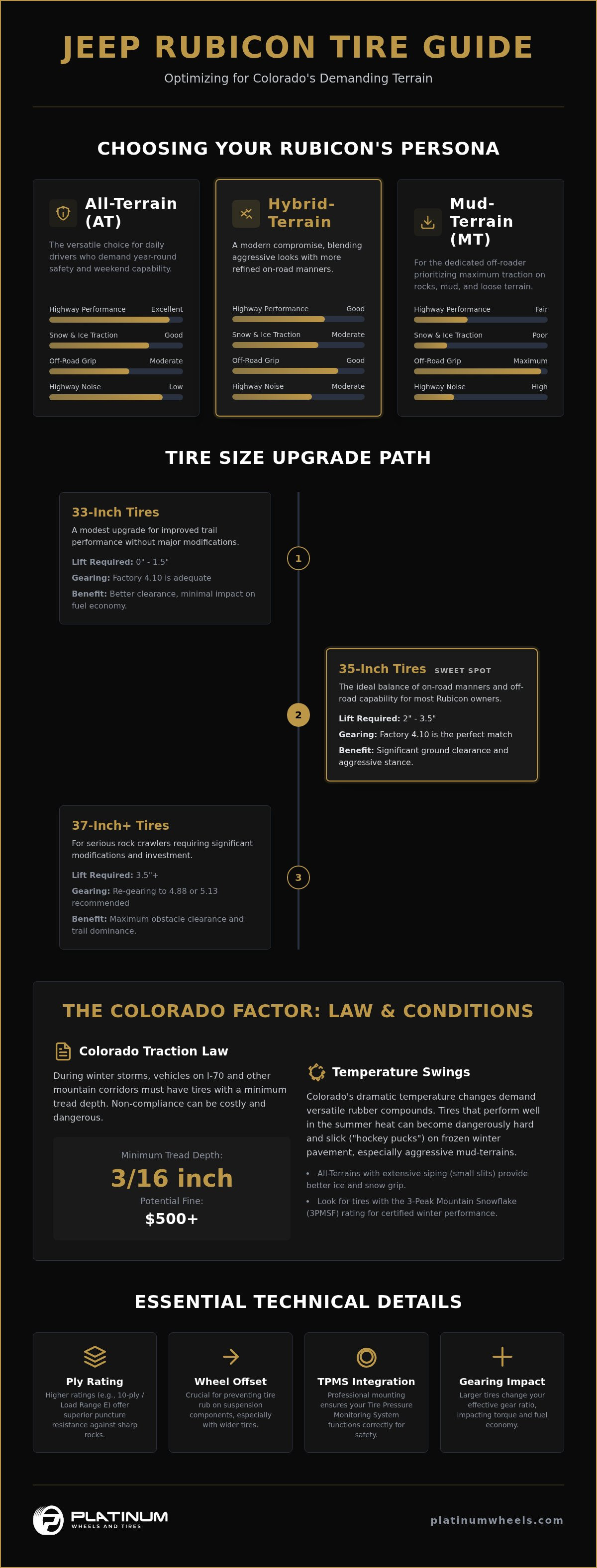
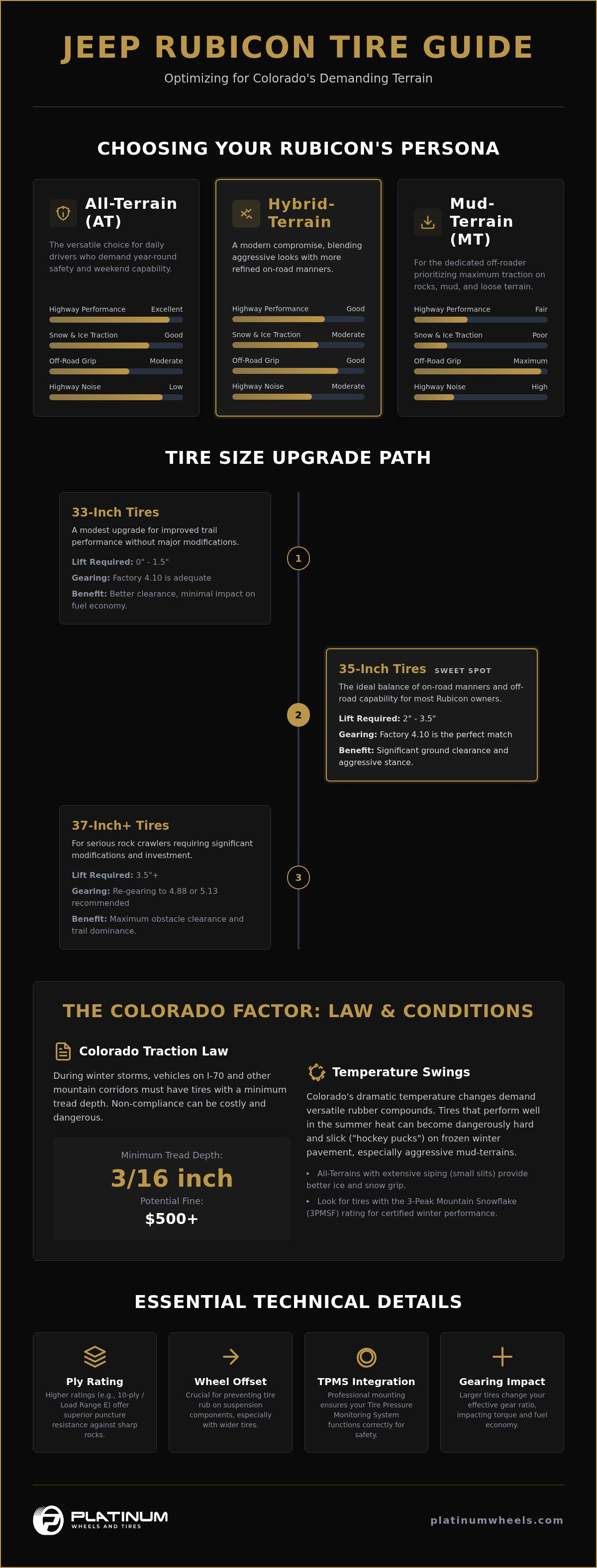
Changing your tire diameter directly impacts your effective gear ratio. When you move to a larger tire, the engine has to work harder to complete one full rotation of the wheel. For most Denver owners, 35-inch jeep rubicon tires represent the "sweet spot" for the factory 4.10 gears. This combination maintains plenty of pep for merging onto C-470 while providing significantly more ground clearance for the trail. If you decide to push into 37-inch or 40-inch territory, you'll likely need to consider regearing to 4.88 or 5.13 to regain your lost torque and keep your transmission from constantly hunting for gears on mountain climbs.
All-Terrain vs. Mud-Terrain: Choosing Your Rubicon's Persona
Deciding between an all-terrain (AT) and a mud-terrain (MT) pattern is the most significant choice you'll make for your rig. It defines whether your Jeep is a refined mountain commuter or a dedicated rock-crawling beast. For many in the Front Range, the emerging 'hybrid' tire category offers a compelling middle ground. These tires combine the aggressive shoulder lugs of a mud-terrain with a tighter center tread block typical of all-terrains. This design reduces the notorious highway drone while maintaining the 'bite' needed for weekend adventures. When selecting jeep rubicon tires, look closely at the void ratio. A high void ratio means more space between tread blocks, which allows the tire to self-clean in deep mud or loose scree. Conversely, a lower void ratio provides more surface area for the rubber to grip onto the sharp granite found throughout the Rockies.
The All-Terrain Advantage for Colorado Commuters
If your Rubicon spends five days a week on I-70 or the Denver metro streets, an all-terrain tire is often the smarter play. The secret lies in the siping. These tiny slits in the tread blocks create extra biting edges that are critical for traction on ice and packed snow. While aggressive mud tires might look tougher, they often turn into hockey pucks on frozen pavement. High-quality AT options provide superior braking distances and lateral stability during those sudden October blizzards. For a deeper dive into specific models, check out our guide on choosing the best all-terrain tires for Colorado. These tires offer the durability to survive trail days while keeping your daily drive comfortable and safe.
Mud-Terrain Mastery for Dedicated Trail Rigs
For the enthusiast who prioritizes weekend trail runs over highway comfort, mud-terrain tires remain the gold standard. They offer maximum traction in deep mud, slushy snow, and the loose scree found on high-altitude passes. However, the trade-offs are real. You'll experience increased road noise, slightly longer braking distances on wet asphalt, and generally faster tread wear. It's also vital to stay compliant with Colorado off-highway vehicle regulations and state traction laws. Many modern MTs now carry the 3-Peak Mountain Snowflake (3PMSF) rating, which confirms they meet specific snow traction standards. Always verify this rating if you plan to drive mountain passes during the winter months. If you're unsure which tread pattern fits your specific needs, consider looking at our custom wheel and tire packages to find a balanced solution that doesn't compromise on performance.
Fitment Guide: 33s, 35s, and 37s on the Wrangler Rubicon
Fitting larger jeep rubicon tires is the most popular upgrade for Denver owners, but success lies in the technical details of clearance and articulation. The Rubicon platform offers a significant head start thanks to its factory high-line fender flares, which sit roughly two inches higher than standard Wrangler flares. This extra vertical space allows for larger tires with less lift, but you still have to account for horizontal clearance. When you're turning at full lock or flexed out on a trail like Bill Moore Lake, the width of the tire becomes just as important as the height. Proper wheel offset and backspacing are essential to prevent the inner sidewall from rubbing against your control arms or frame rails.
Don't forget the weight factor. A 35-inch or 37-inch tire is significantly heavier than the stock 33-inch rubber. This added mass puts extra strain on your tailgate hinges and spare tire carrier. If you're jumping up in size, we always recommend checking your carrier's weight rating. Over time, the vibration from washboard roads can cause the factory mount to fatigue or even crack if it isn't reinforced to handle the heavier assembly.
Fitting 35-Inch Tires: The Rubicon Standard
For many JL and JK owners, 35s are the perfect balance of capability and daily drivability. On a modern JL Rubicon, you can technically fit 35-inch jeep rubicon tires at stock height for street use, but you'll experience significant rubbing as soon as you disconnect your sway bars off-road. Deciding between a leveling kit vs lift kit often comes down to whether you want a simple aesthetic upgrade or the full suspension travel needed for technical Colorado trails. To clear 35s properly without rubbing at full steering lock, we suggest wheels with 4.5 to 4.75 inches of backspacing, which pushes the tire slightly outward for a wider, more stable stance.
Stepping Up to 37s: Suspension and Steering Requirements
Moving to 37-inch tires is a serious commitment that requires more than just fender clearance. To achieve full articulation without destroying your high-line flares, a 2.5-inch to 3.5-inch suspension lift is generally mandatory. The increased rotational mass also makes your steering feel vague and can lead to the dreaded "death wobble" if your components aren't up to the task. Upgrading to a heavy-duty steering stabilizer and reinforcing your tailgate with a spare tire relocation bracket are critical steps. These modifications ensure your rig remains safe on the climb up to the Eisenhower Tunnel while providing the massive footprint needed to crawl over the obstacles on Black Bear Pass.
The Colorado Factor: Tires for the Front Range and Beyond
Colorado's terrain is uniquely demanding on rubber. While the slickrock in Moab rewards soft, sticky compounds, the jagged shale found on Front Range trails like Red Cone or Kingston Peak will shred a weak sidewall in minutes. This is why local experts almost always recommend Load Range E (10-ply) jeep rubicon tires. These tires feature reinforced carcasses that resist punctures from sharp rocks while supporting the weight of a fully loaded rig on high-altitude expeditions. Beyond the trails, our extreme temperature swings, ranging from 90°F in the valley to -10°F on the mountain passes, dictate how your rubber behaves. A tire that grips well in the summer heat might turn into a hard, slippery puck during a midnight blizzard. Compliance is also a legal necessity; Colorado's Traction Law requires a 3/16-inch tread depth and specific winter ratings on I-70 from September through May.
High-Altitude Performance and Airing Down
When you head into the high country, airing down your jeep rubicon tires to 12 or 15 PSI is the best way to increase your footprint and climb over loose obstacles. However, running low pressure requires a tire with excellent bead grip to prevent the rubber from spinning on the rim or popping off entirely. It is also a scientific fact that altitude affects your tire pressure readings. As you climb toward 11,000 feet, the lower atmospheric pressure makes your tire gauge read higher than it did in Denver, even though the amount of air inside hasn't changed. To ensure a safe drive back to the city, we recommend carrying a reliable on-board air solution or a high-volume portable compressor to bring your pressures back up to street levels before hitting the pavement.
Winter Safety on the I-70 Corridor
Many drivers assume that a 'Mud + Snow' (M+S) rating is enough for a Colorado winter, but experienced mountain commuters know better. For true safety on ice-slicked passes, you need tires with heavy siping that can trap snow and create friction against the road. If you don't want to swap your rubber every six months, a set of high-quality all season tires with the 3-Peak Mountain Snowflake (3PMSF) rating is the way to go. These models are designed to stay pliable in sub-zero temperatures while still providing the durability needed for summer trail runs. If you're ready to prep your rig for the next mountain storm, explore our Jeep-specific wheel and tire packages to find a set that handles everything the Front Range throws your way.
Professional Installation: Why Your Rubicon Deserves More Than a DIY Swap
Precision is everything when you're dealing with the massive rotational mass of 35-inch or 37-inch assemblies. A standard balance often isn't enough to prevent the highway vibrations that plague many modified rigs. Professional mounting ensures that your heavy jeep rubicon tires are seated perfectly on the rim to prevent air leaks during trail use. We utilize specialized balancing equipment that accounts for the natural inconsistencies in large-lugged tread patterns, providing a smooth ride even at highway speeds. Beyond the balance, a post-installation alignment is non-negotiable. Increasing your tire diameter alters your Jeep's center of gravity and steering geometry. Without a professional alignment, you risk accelerated tread wear and a rig that wanders across the lane on your way to the trailhead. For a truly streamlined experience, many owners opt for aftermarket wheel and tire packages that arrive ready for a perfect fit.
TPMS and Speedometer Calibration
Correcting the digital brain of your Jeep is just as vital as the mechanical swap. We prioritize expert TPMS sensor programming to ensure your safety systems function exactly as intended and your dashboard remains free of warning lights. When you move to larger jeep rubicon tires, your speedometer and odometer will read incorrectly because the tire's circumference has changed. This doesn't just affect your speed; it confuses your transmission's shift points and can lead to sluggish performance on steep grades. Professional calibration adjusts these electronic parameters, protecting your transmission from unnecessary stress and ensuring your engine stays in its optimal power band during mountain climbs. This precision is what separates a professional build from a simple tire swap.
The Platinum Wheels Experience in Denver
Our team at Platinum Wheels takes a consultative approach to every build we handle in the shop. We don't just sell rubber; we help you navigate the specific technical requirements of the Colorado Front Range. Whether you're driving the tight streets of Lakewood or commuting through the open highways of Aurora, we ensure your setup is safe and efficient. We live and breathe the off-road lifestyle, so we understand the peace of mind that comes with a perfectly executed installation. We serve the entire Denver metro area with a commitment to speed and accuracy, getting you back on the trail as quickly as possible. Book your consultation today to start your custom Jeep transformation with a team that values precision as much as you do.
Master the Trail with the Right Setup
Choosing the perfect set of jeep rubicon tires is about more than just aggressive looks. It's about ensuring your rig can handle a sudden October blizzard on I-70 while maintaining the durability to conquer the sharp shale of the San Juan Mountains. You've learned how critical proper offset is for clearance and why electronic calibration is the only way to protect your transmission after a size upgrade. Balancing these technical details ensures your Rubicon remains a capable, safe, and reliable partner for every mile of Colorado terrain.
At Platinum Wheels, we provide the expert Denver-based installation and specialized off-road suspension knowledge you need for a flawless transformation. Our team handles everything from precision mounting to complete TPMS and calibration services, so your Jeep is ready for the trail the moment you leave our shop. Build your custom Jeep Rubicon wheel and tire package at Platinum Wheels today! We're passionate about helping our local community explore the high country with total peace of mind. We look forward to seeing your rig out on the trails soon.
Frequently Asked Questions
What is the biggest tire I can fit on a stock Jeep Rubicon?
35-inch tires are the largest you can fit on a stock JL Rubicon for street use, though you'll likely experience rubbing at full steering lock or during off-road articulation. For the JK generation, 33-inch tires are the standard limit without modifications. Upgrading to 35s on a stock setup often requires removing the plastic air dam or adjusting steering stops. Professional installers often suggest a small leveling kit to provide the necessary clearance for technical trails.
Do I need to regear my Rubicon for 35-inch tires?
You don't necessarily need to regear for 35-inch jeep rubicon tires because the factory 4.10 gears handle the increased diameter reasonably well. You'll notice a slight decrease in fuel economy and eighth-gear usage on the highway, but the performance remains acceptable for Denver driving. If you frequently tow or live at higher altitudes where oxygen is thin, moving to 4.56 or 4.88 gears can help regain that lost low-end torque.
Will 37-inch tires void my Jeep Wrangler warranty?
Installing 37-inch tires won't void your entire vehicle warranty, but it can lead to the denial of claims related to the drivetrain or suspension. Under the Magnuson-Moss Warranty Act, a dealer must prove that the larger tires caused the specific failure to deny coverage. Because 37s place significant stress on ball joints and steering components, those parts are rarely covered once you move beyond factory specifications.
What is the difference between C-rated and E-rated tires for a Jeep?
The primary difference lies in the ply rating and sidewall stiffness. C-rated tires are 6-ply and offer a softer, more comfortable ride that's well-suited for lighter two-door Jeeps. E-rated tires are 10-ply and provide the puncture resistance and load capacity required for heavy four-door rigs tackling sharp Colorado shale. While E-rated tires are tougher on the trail, they often feel firmer on the pavement during your daily commute.
How do I calibrate my speedometer after getting bigger tires?
You can calibrate your speedometer using an electronic programmer or a flash tool that plugs into your Jeep's OBD-II port. This adjustment is vital because it corrects your shift points and ensures your odometer remains accurate. Professional installation shops can handle this for you during the mounting process, ensuring your transmission doesn't hunt for gears when you're climbing mountain passes or merging onto the highway.
Can I use my factory Rubicon wheels with 35-inch tires?
You can use factory wheels with 35s, but you'll likely need wheel spacers to prevent the wider tires from rubbing against the inner suspension components. Factory Rubicon wheels have a high positive offset, which tucks the tire deep into the wheel well. Adding a 1.5-inch spacer or choosing aftermarket wheels with less backspacing provides the necessary clearance for full steering movement and maximum off-road flex.
What tire pressure should I run in my Jeep Rubicon for daily driving?
Most owners find that 28 to 32 PSI is the "sweet spot" for 35-inch or 37-inch jeep rubicon tires on the road. While the door jamb sticker might suggest 37 PSI, that number is intended for the factory tire size and maximum load. Running a slightly lower pressure allows for a larger contact patch and a much smoother ride over Denver's potholes without triggering your TPMS warning light.
How often should I rotate my off-road tires?
Rotate your off-road tires every 3,000 to 5,000 miles to prevent the uneven "cupping" common in aggressive tread patterns. We recommend a 5-tire rotation that includes your full-size spare. This practice ensures all five tires wear at the same rate, which is critical for maintaining your 4WD system's health. Regular rotations also help keep road noise at a manageable level as the tires age and the tread blocks wear down.