Best Jeep Wrangler Tires for Denver Off-Roading & Trails
What if the aggressive mud-terrains giving your Jeep that iconic stance are the same reason you're sliding sideways on I-70 during a January squall? Most Denver drivers want a rugged look, but nobody enjoys the deafening hum on a daily commute or the white-knuckle feel of black ice. You need a setup that handles the sharp granite slabs of local trails just as easily as the slushy mess on I-25. Finding the best tires for jeep wrangler owners in Colorado means balancing off-road durability with the strict requirements of the state's Traction Law, which mandates at least 3/16-inch tread depth from September through May.
We'll help you discover the top-rated tires that offer maximum grip on rocky inclines without sacrificing your peace of mind during a blizzard. You'll learn how to achieve that aggressive "Jeep look" while maintaining a smooth ride and meeting all local safety standards. This guide breaks down the latest hybrid and all-terrain options, evaluates performance on unpredictable Front Range roads, and explains why expert fitment is the key to a mountain-ready rig.
Key Takeaways
- Determine if your lifestyle requires the highway manners of an All-Terrain tire or the aggressive grip of a Mud-Terrain for weekend rock crawling.
- Compare the latest 2026 tire models to find the best tires for jeep wrangler setups that satisfy Colorado Traction Law requirements.
- Evaluate how 33-inch and 35-inch tire sizes affect your clearance and whether a lift or leveling kit is necessary for your specific build.
- Ensure long-term reliability with professional installation that covers precision mounting, balancing, and full TPMS sensor integration.
The Wrangler Dilemma: Daily Driver vs. Weekend Warrior
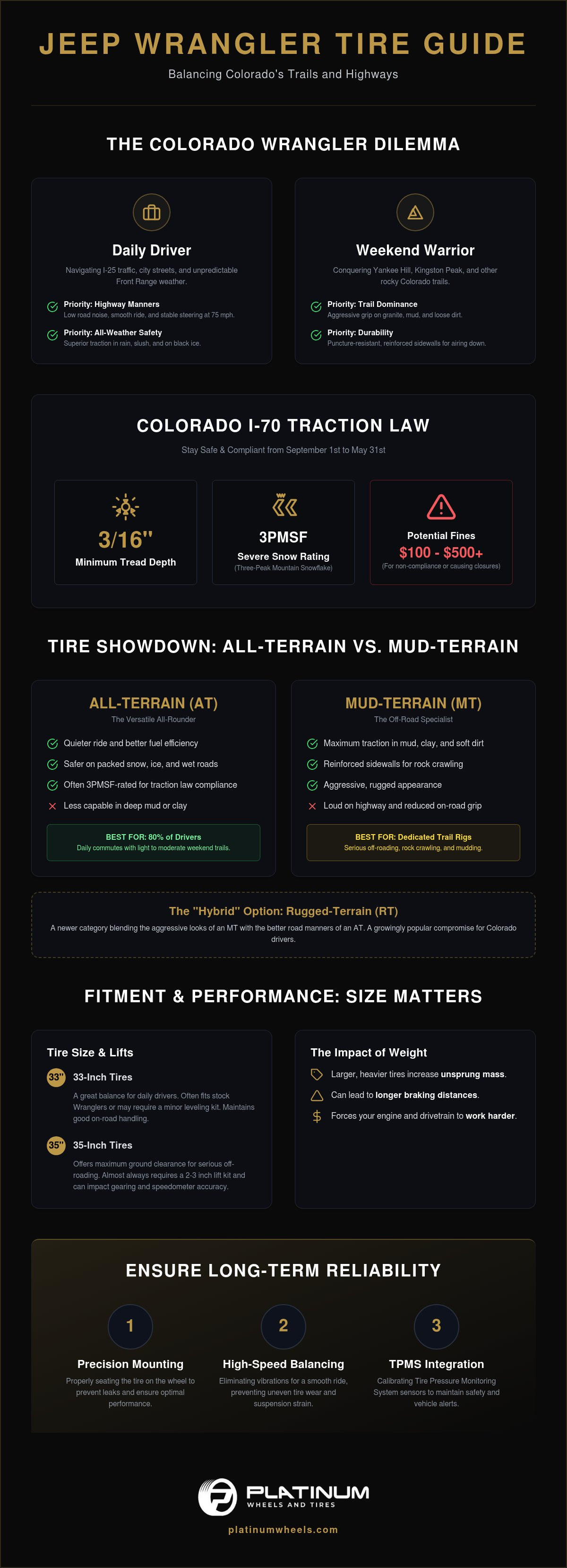
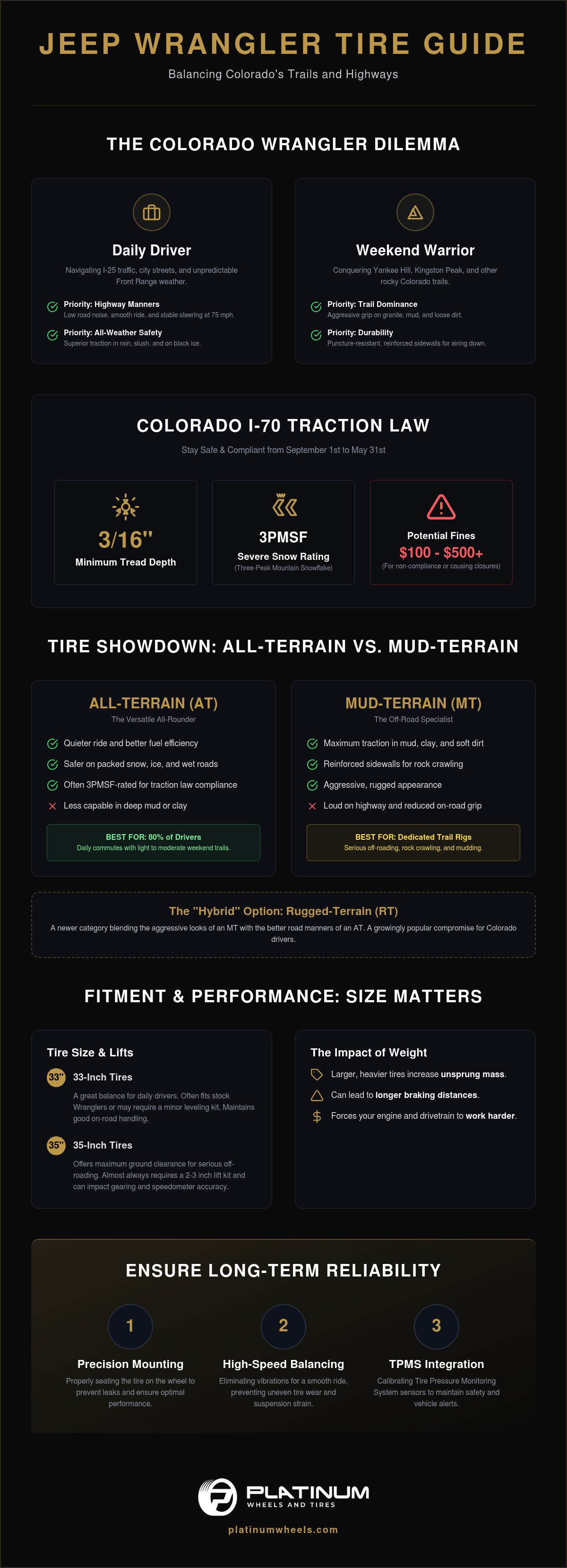
Owning a Wrangler in Denver means making a calculated choice between highway manners and trail dominance. The Jeep's short wheelbase is its greatest asset on tight switchbacks, but it can make the vehicle feel "twitchy" at 75 mph on I-25. Choosing the best tires for jeep wrangler builds requires understanding this mechanical reality. A tire with a soft sidewall or overly aggressive lugs can amplify steering wander, making long drives to the mountains exhausting rather than exciting.
Weight is another critical factor often overlooked by enthusiasts. Jumping from a factory tire to a heavy Mud-Terrain adds significant unsprung mass to each corner. This extra weight forces your engine to work harder and extends your braking distance. Before diving into specific brands, understanding Off-road tire basics helps you distinguish between carcass strength and tread void ratios. You must analyze your driving split; if 90% of your miles are spent commuting, a heavy, unrefined tire will quickly become a liability.
Understanding Your Terrain Requirements
Your daily route dictates your priorities. If you spend your mornings fighting traffic on I-25, you'll value low road noise and superior wet traction to handle sudden downpours. However, the High Country demands something tougher. Colorado trails are notorious for sharp shale and jagged granite that can slice through standard passenger tires. You need reinforced sidewalls that can withstand lower air pressures when you're aired down for traction. Standard "All-Season" tires simply don't have the puncture resistance or the self-cleaning tread blocks required for a Saturday trip to Yankee Hill or Kingston Peak.
The I-70 Traction Law and Your Jeep
Colorado's weather shifts are legendary, and the state has strict rules to keep traffic moving. From September 1st through May 31st, the I-70 Traction Law is in effect for the mountain corridor. To stay compliant and safe, your tires should feature the Three-Peak Mountain Snowflake (3PMSF) rating. This symbol indicates the tire has been tested for severe snow performance, going far beyond the basic Mud and Snow (M+S) designation.
Safety isn't just about the rating; it's also about the depth. Colorado law requires a minimum tread depth of 3/16-inch during Traction Law activations. If you're caught with bald or inadequate tires during a storm, you could face a $100 fine. If your lack of traction causes a lane closure, that fine jumps to over $500. Selecting the best tires for jeep wrangler use means finding a model that stays pliable in freezing temperatures while offering enough tread life to survive several seasons of Denver heat.
All-Terrain vs. Mud-Terrain: Which Fits Your Jeep?
Choosing between an All-Terrain (AT) and a Mud-Terrain (MT) tire used to be a simple choice between highway comfort and off-road grip. In 2026, the lines have blurred with the rise of the Rugged-Terrain (RT) or "Hybrid" category. For 80% of Wrangler owners in the Denver Metro area, the AT remains the most logical choice because it handles the high-speed vibrations of I-25 without sacrificing weekend capability. However, if your weekends involve the deep mud of spring runoff or the loose dirt of technical canyon climbs, the MT's aggressive architecture is hard to beat. Selecting the best tires for jeep wrangler builds starts with an honest assessment of where your rubber actually meets the road.
Pros and Cons of All-Terrain Tires
All-terrain tires are engineered to be the ultimate multi-tool for the Front Range. They feature denser tread patterns with more siping, which are small slits in the tread blocks that provide extra "bite" on slippery surfaces. This design makes them significantly safer on packed snow and black ice compared to their mud-focused counterparts. Because they have more contact with the pavement, they offer a quieter ride and better fuel efficiency. For the Colorado daily driver, an All-Terrain tire provides a reliable balance of year-round safety and light-to-moderate trail capability in a single package. Most high-quality AT tires now carry the Three-Peak Mountain Snowflake (3PMSF) rating, ensuring you stay compliant with mountain corridor regulations.
When to Choose Mud-Terrain Tires
Mud-terrain tires prioritize maximum traction in soft, unstable environments. Their massive tread blocks and wide "void ratios" allow the tire to eject thick clay and debris, preventing the tread from becoming a slick surface. These tires also feature reinforced, thicker sidewalls designed to be "aired down" to low pressures. This increases the tire's footprint, allowing it to wrap around jagged rocks and obstacles. The trade-off is a louder hum on the highway and reduced grip on icy roads, as the large blocks lack the siping needed to hold onto frozen pavement. Following NHTSA tire safety guidelines is especially important when running MTs, as their specialized design can change the braking and handling characteristics of your Jeep on wet asphalt.
The Rugged-Terrain (RT) Hybrid Trend
If you love the "beefy" look of a mud tire but hate the road noise, the RT category is your solution. These hybrid tires combine the tight center tread of an AT tire for better road manners with the aggressive, jagged shoulder lugs of an MT tire for off-road aesthetics and performance. They typically offer a middle ground for tread life expectancy. While a dedicated AT tire might last 55,000 miles and a soft MT might only see 35,000 miles, an RT often lands right in the 45,000-mile range. If you aren't sure which category matches your specific build, you can always consult with our Denver fitment experts to find the right balance for your lifestyle.
Top 5 Tires for Jeep Wranglers in 2026
Selecting the best tires for jeep wrangler builds in 2026 means looking beyond the legacy models that dominated five years ago. Tire technology has moved quickly. Manufacturers have updated their compounds to handle the increased weight of modern overlanding builds and the extreme temperature swings we see in the Front Range. At Platinum Wheels, we've seen these new models perform firsthand on everything from the I-25 corridor to high-alpine passes. The following five options represent the current pinnacle of performance for Colorado drivers.
Best All-Around: BFGoodrich KO3
The BFGoodrich All-Terrain T/A KO3 is the official successor to the legendary KO2. It has quickly become our go-to recommendation for custom wheels and rims packages. This new version features a redesigned tread pattern that specifically addresses the KO2’s weaknesses in wet braking and mud evacuation. The updated CoreGard technology provides even greater sidewall protection against the sharp, decomposed granite found on local trails. It maintains the classic "Jeep look" while offering a much more refined experience during your Monday morning commute.
Best for Snow: Falken Wildpeak A/T4W
The Falken Wildpeak A/T4W is the 2026 update to the popular A/T3W, and it has already claimed the title of "Winter King" in our shop. It features some of the deepest siping in the all-terrain category, which is essential for biting into the black ice often found on the climb to the Eisenhower Tunnel. This tire also incorporates heat diffuser technology in the lower sidewall. This keeps the internal components cool when you're towing a camper or carrying a heavy load of ski gear. If your Wrangler is a dedicated mountain shuttle, the A/T4W provides the confidence you need during a white-out blizzard.
Rounding Out the Top 5
While BFG and Falken lead the pack, three other tires offer specialized benefits for specific driving styles:
- Nitto Ridge Grappler: This remains the hybrid favorite. It uses a dual-sidewall design that allows you to choose between two different aggressive looks. It's an RT tire that provides the quiet ride of an AT with the "beefy" lugs of an MT.
- Toyo Open Country A/T III: Known for its incredible tread life and value. It's a lightweight option that helps preserve fuel economy and braking performance on stock Wranglers.
- Goodyear Wrangler Boulder MT: This is the maximum traction pick for the serious rock crawler. It uses a three-ply Durawall construction to resist punctures when you're navigating the most technical trails in the High Country.
Choosing the best tires for jeep wrangler setups often comes down to your specific trail-to-highway ratio. Whether you prioritize longevity or pure off-road grip, these 2026 models ensure you aren't compromising on safety or style.
Fitment and Performance: Lifts, Leveling, and TPMS
Selecting the best tires for jeep wrangler builds is only half the battle. You must also ensure they actually fit and function without compromising your suspension or safety. While most late-model Wranglers can accommodate 33-inch tires with stock suspension, the jump to 35-inch or 37-inch rubber requires a more calculated approach. Wheel offset plays a massive role here. A wheel with the wrong backspacing will cause your new tires to rub against the control arms or frame during tight turns, even if you have plenty of vertical clearance.
The decision between a leveling kit vs lift kit is fundamentally tied to your intended tire size and trail goals. A leveling kit is often enough to clear 33s and fix the factory "rake," but serious off-roading usually demands a full suspension lift. Without it, you'll likely experience rubbing when the suspension fully articulates on rocky terrain. Proper fitment ensures your "stance" looks aggressive without sacrificing the vehicle's mechanical integrity.
Do You Need a Lift Kit for 35-inch Tires?
Trim levels matter significantly. A stock Rubicon sits higher and has higher fender flares than a Sport or Sahara, allowing it to "fit" 35-inch tires for street driving. However, fitting for a commute is different than performing on a trail. For full off-road articulation, professional truck lift kits are essential to prevent the tire from smashing into the fender liner when the suspension is compressed. Beyond clearance, a professional install ensures your suspension geometry remains correct. This is critical for avoiding the dreaded "death wobble," a violent steering vibration often caused by poorly installed components after upgrading to larger, heavier tires.
Calibrating Your Jeep for Larger Tires
Once your new tires are mounted, your Jeep's computer needs to know about the change. Larger diameters throw off your speedometer and change the shift points on automatic transmissions, which can make the vehicle feel sluggish. If you're moving to 37-inch setups, you should also consider re-gearing your axles to maintain power and fuel economy. Finally, don't overlook your tpms sensor functionality. Calibrating your TPMS to work with your new tire pressure requirements is non-negotiable for safety, as it ensures you're alerted to a slow leak before it becomes a trailside emergency. If you're ready to build a mountain-ready rig, schedule your professional Jeep tire and lift installation with our expert Denver team today.
Professional Jeep Tire Installation in Denver
Even if you've selected the best tires for jeep wrangler builds, a poor installation can ruin the entire experience. Oversized off-road tires are heavy and difficult to balance. If a shop doesn't have specialized high-speed balancing equipment, you'll feel every ounce of that weight through the steering wheel at highway speeds. At Platinum Wheels, we treat every Jeep like it’s our own, ensuring that your investment in performance rubber is matched by precision craftsmanship. We understand that for a Colorado driver, a tire isn't just an accessory; it's a vital piece of safety equipment.
Many owners find that the most efficient way to upgrade is through aftermarket wheel and tire packages. This approach ensures that the wheel offset, tire width, and TPMS sensors are all compatible from day one. We handle the technical details of fitment so you don't have to worry about rubbing or dash lights. Our shop is equipped with touchless mounting machines that protect your custom rims from scratches, which is a common issue at high-volume general repair shops that aren't used to handling premium off-road gear.
The Platinum Wheels Advantage
We've built our reputation as the Front Range authority on Jeep fitment by focusing on the specific needs of local drivers. We know that a Jeep in Denver needs to handle a 100-degree summer day and a sub-zero mountain pass in the same week. Our technicians understand the nuances of suspension geometry and how different tire compounds react to local trail conditions. We provide a consultative experience where we listen to your goals before recommending a setup. Whether you're a hardcore crawler or a weekend camper, we ensure your rig is mountain-ready before it leaves our bay.
Start Your Jeep Transformation Today
Transforming your Wrangler shouldn't be a stressful process. We offer comprehensive services that cover everything from the initial fitment consultation to the final TPMS calibration. We serve the entire corridor from Fort Collins down to Colorado Springs, making us a convenient hub for all your off-road needs. You can visit our Denver shop to see wheel styles in person and discuss the best tires for jeep wrangler applications with a fellow enthusiast who speaks your language. If you're ready to take the next step, Build your dream Jeep setup with Platinum Wheels by requesting a custom quote today.
Conquer the Front Range with Confidence
Your Jeep is engineered for adventure, but its ultimate performance depends entirely on the rubber meeting the road. Finding the best tires for jeep wrangler builds in Denver means more than just choosing an aggressive tread. It requires a strategic balance between daily I-25 reliability and weekend trail dominance. You've learned how the latest 2026 tire compounds handle Colorado's unpredictable weather and why proper suspension geometry is the only way to avoid mechanical headaches after an upgrade.
As Denver’s local off-road experts, we're here to help you evaluate these technical choices with transparency and precision. We provide full suspension and leveling kit integration alongside precision mounting and balancing for 35-inch plus tires to ensure your rig is safe and capable. We don't just sell parts; we build mountain-ready machines that reflect your lifestyle and handle the unique demands of the High Country. Get a Custom Quote for Your Jeep Wheel and Tire Package today and start your next transformation with a team that speaks your language. We'll see you on the trails.
Frequently Asked Questions
What is the largest tire I can put on a stock Jeep Wrangler JL?
A 33-inch tire is generally the largest size that fits a stock Wrangler JL without significant rubbing. Rubicon trims have higher fender flares and can often fit 35-inch tires for street use; however, you'll likely experience interference during off-road articulation. For a truly mountain-ready setup, we recommend a leveling kit or a small lift to ensure your tires clear the suspension components when the trail gets rough.
Are mud-terrain tires dangerous on Colorado winter roads?
Mud-terrain tires aren't necessarily dangerous, but they require more caution on icy Colorado roads. Their large tread blocks lack the dense siping found on all-terrain models, which reduces grip on packed snow and black ice. They excel in deep, unplowed snow where they can dig for traction. If you frequently drive through mountain passes, choosing the best tires for jeep wrangler use with a 3PMSF rating is a safer bet.
How long do all-terrain tires typically last on a Wrangler?
Expect a set of high-quality all-terrain tires to last between 45,000 and 55,000 miles. Your specific lifespan depends on how often you're airing down for trails or carrying heavy overlanding gear. Regular five-tire rotations are essential for Wranglers to ensure even wear across the set. Keeping your suspension in alignment will also prevent the cupping and feathering that can lead to premature tire failure on Front Range roads.
Do I need to replace my TPMS sensors when getting new tires?
You don't need to replace TPMS sensors if they're still functioning and the batteries are relatively new. Sensors usually last between 5 and 10 years. However, if you're investing in a new wheel and tire package, installing fresh sensors is a smart move. This prevents the headache of a dead battery a year later, which would require dismounting the tire and rebalancing the wheel just to swap a sensor.
What is the best tire pressure for Jeep Wranglers on the highway vs. off-road?
For highway driving, most Wrangler owners find 32 to 36 PSI provides the best balance of fuel economy and ride quality. When you transition to the dirt, airing down to 18 to 22 PSI significantly improves traction and comfort on washboard roads. If you're tackling technical rock crawling, you might go even lower. Just ensure you have a reliable way to air back up before hitting the asphalt again.
Will 35-inch tires void my Jeep Wrangler warranty?
Upgrading to 35-inch tires won't void your entire vehicle warranty. However, the manufacturer can deny claims for specific components if they prove the larger tires caused the failure. This usually applies to parts like ball joints, wheel bearings, or axle shafts. Many local Denver dealerships are enthusiast-friendly and will work with you; but it's always wise to understand the potential impact on your drivetrain coverage before making the switch.
Which Jeep tires are the quietest for highway driving?
The quietest options for highway driving are almost always all-terrain tires. Modern designs like the BFGoodrich KO3 use specialized tread patterns to minimize the "hum" at high speeds. These are the best tires for jeep wrangler owners who value a conversation-friendly cabin during long mountain drives. You'll enjoy a smooth ride on the pavement while still having plenty of capability when you finally reach the trailhead.
What is the difference between C, D, and E load ratings for Jeeps?
Load ratings tell you about the tire's strength and stiffness. C-rated tires provide a plush ride similar to stock, while E-rated tires are 10-ply monsters built for heavy towing and extreme puncture resistance. For most Colorado Wranglers, a D-rated tire is the sweet spot. It offers enough sidewall protection for sharp granite trails without making your daily commute feel like you're riding in a heavy-duty dump truck.