Best Jeep Wrangler Tires for Denver & Colorado Trails
You're heading home from a weekend in Silverthorne when a sudden storm turns I-70 into a sheet of ice. If you've ever felt your steering wheel vibrate or your backend kick out on a slushy curve, you know that choosing the wrong jeep wrangler tires is more than just a cosmetic mistake; it's a safety risk. We understand the desire for an aggressive, trail-ready stance that doesn't sacrifice your peace of mind during a blizzard or a high-speed merge onto I-25.
Finding that sweet spot between off-road grip and highway comfort often feels like a guessing game, especially when you're caught between the look of 35-inch treads and the practicalities of a stock suspension. You deserve a setup that handles the rocks at Chinaman Gulch as easily as the commute to the Denver Tech Center. This guide provides the framework you need to choose the right rubber for your specific Colorado lifestyle. We'll demystify the technical requirements for 33-inch and 35-inch fitments, explain the critical 3/16-inch tread depth needed for Colorado Traction Laws, and show you exactly how to achieve a bold look without triggering the "death wobble."
Key Takeaways
- Learn how to decode tire sidewalls and choose the right load range to keep your daily commute comfortable while maintaining trail durability.
- Discover why hybrid all-terrain jeep wrangler tires are the ideal solution for Denver drivers who need reliable traction on icy mountain passes and rocky weekend trails.
- Identify the specific clearance and lift requirements for 33-inch, 35-inch, and 37-inch tires to ensure your setup looks aggressive without compromising safety.
- Understand the vital role of speedometer recalibration and TPMS sensor installation in protecting your transmission and maintaining fuel efficiency.
- See how local expert fitment and complete wheel packages provide a streamlined, ready-to-drive upgrade tailored for the Front Range terrain.
Understanding Jeep Wrangler Tire Basics: Sizes, Plies, and Ratings
Most factory jeep wrangler tires are designed for the average driver, meaning they prioritize low road noise and fuel economy over rugged trail performance. In Colorado, that compromise doesn't always work. The sharp shale of the San Juan Mountains or the deep snow on Berthoud Pass demands more than a standard street tread. Because the Wrangler has a relatively short wheelbase, your tire choice directly impacts stability. A tire that's too stiff can make the Jeep feel skittish on washboard roads, while a tire that's too soft might feel vague during mountain highway maneuvers. Understanding Off-road tire basics helps you grasp how carcass construction affects your ride quality and safety.
Decoding Metric vs. Flotation Sizing
You'll see two different numbering systems when shopping for new rubber. Metric sizes, like 285/70R17, use a ratio to determine height and width. Flotation sizes, such as 33x12.50R17, are more direct. They tell you the tire is 33 inches tall and 12.5 inches wide. When choosing aftermarket wheel and tire packages, flotation sizing is often easier for visualizing fitment and ground clearance. Don't be surprised if your "35-inch" tire doesn't measure exactly 35 inches when mounted. Most actually sit closer to 34.25 or 34.5 inches once they're supporting the weight of the vehicle.
Load Ratings and Why They Matter for Jeeps
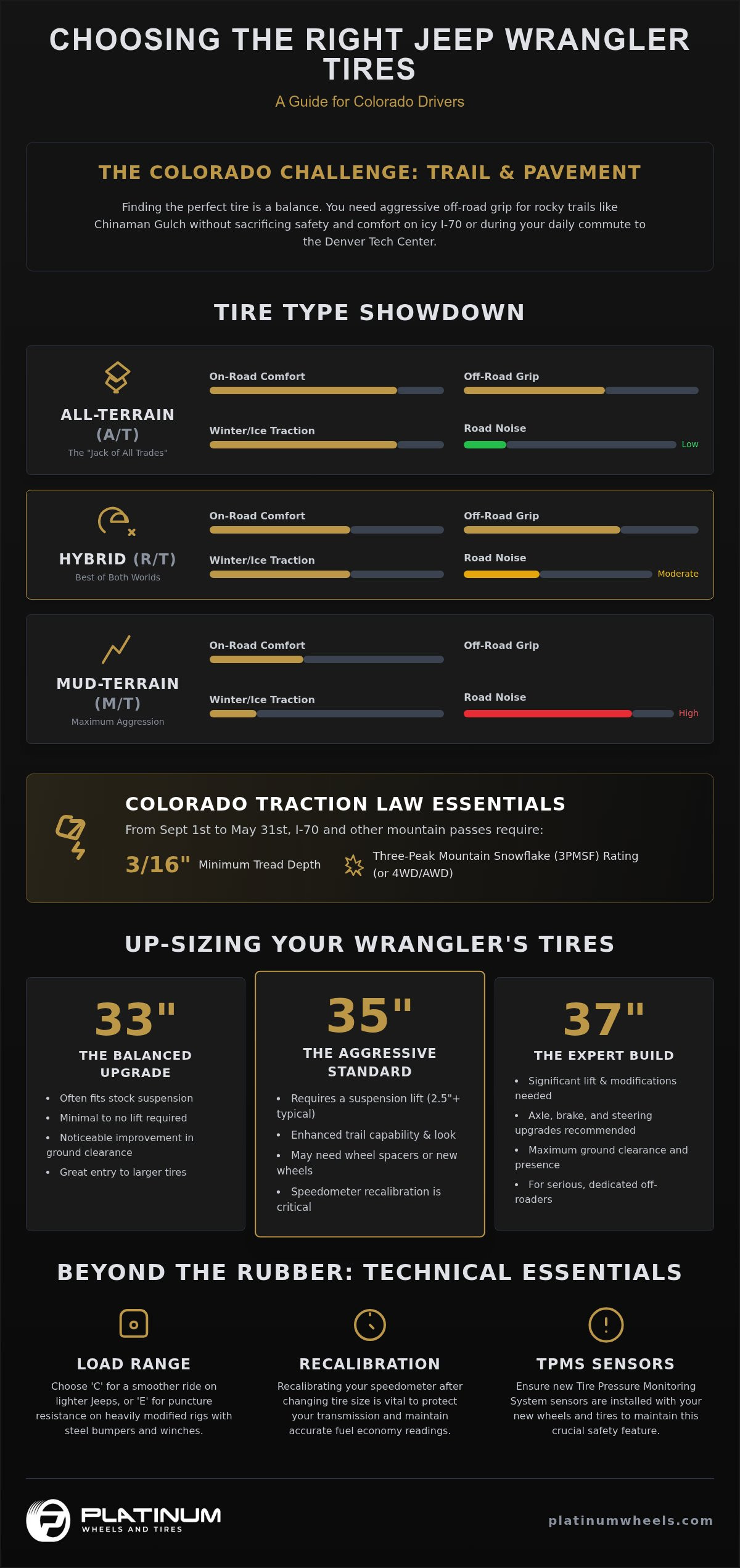
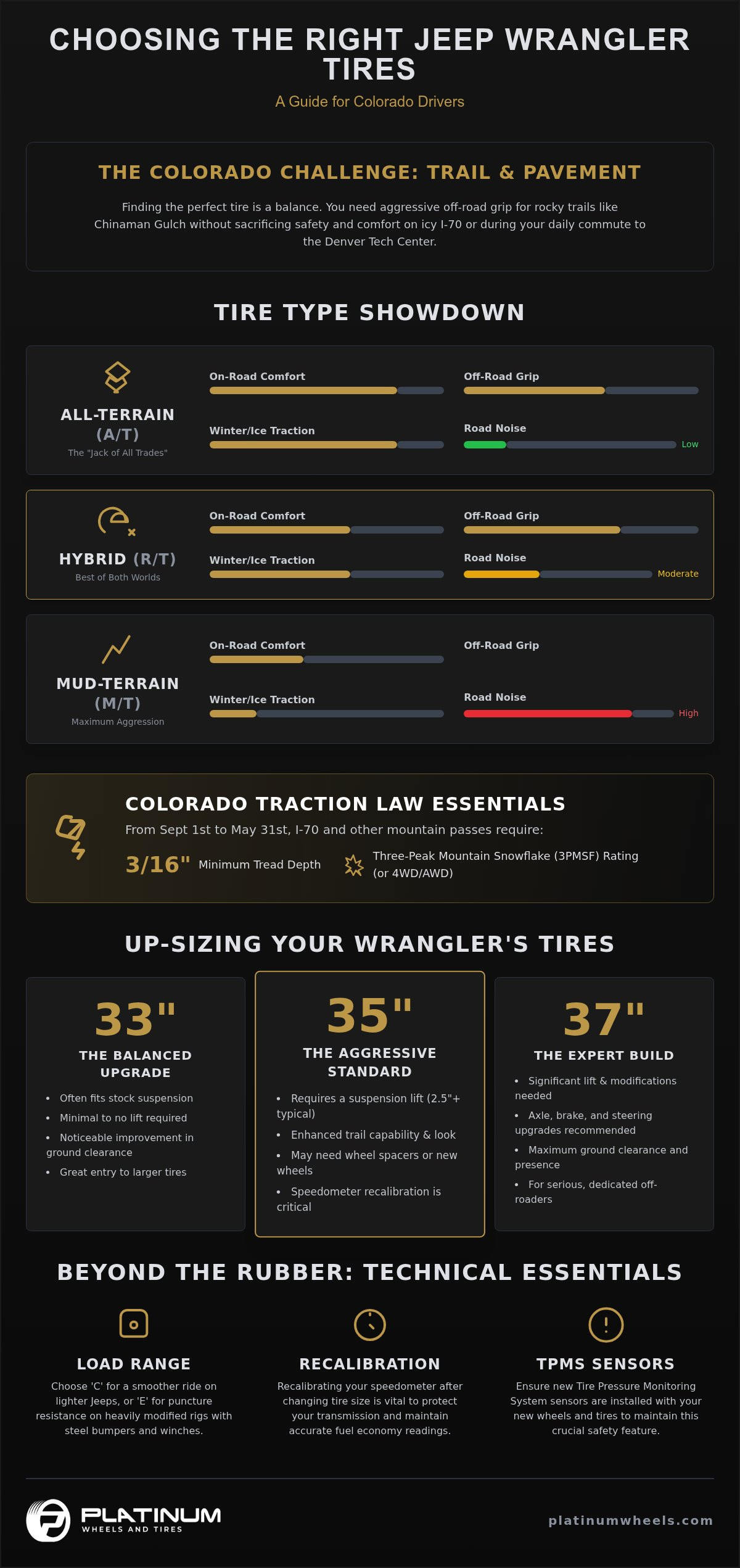
Load ratings indicate how much weight a tire can safely carry and at what pressure. Most jeep wrangler tires come in Load Range C or E. Load Range C is generally preferred for lighter, two-door Wranglers because the more flexible sidewall provides better traction on trails and a smoother ride on pavement. If you've added heavy steel bumpers, a winch, and a roof rack, you'll likely need the added structural integrity of Load Range E. These tires feature a sturdier sidewall that resists punctures from jagged rocks and prevents the tire from "rolling" during hard cornering on the street. Load Range effectively measures the tire's internal strength and its ability to withstand the extreme stresses of low-pressure off-roading without sustaining sidewall damage.
All-Terrain vs. Mud-Terrain: Which is Best for Colorado Trails?
Choosing the right jeep wrangler tires in Colorado is a balancing act between trail dominance and highway survival. You need a tread that can handle 75 mph on I-70 without sounding like a jet engine, yet still provide enough bite to climb over wet granite in the high country. For most Denver drivers, the choice comes down to how much time they actually spend in the dirt versus sitting in traffic on Speer Boulevard. Reviewing NHTSA tire safety ratings can help you understand how different tread compounds hold up under heat and stress, but local terrain adds its own set of rules.
For many, high-quality all terrain tires represent the ideal compromise. These "Jack of all trades" options feature interlocking tread blocks that provide a quiet ride and excellent longevity. Mud-terrain (M/T) tires offer that iconic, aggressive look with deep lugs for self-cleaning in heavy muck. However, those large blocks often struggle on wet pavement. If you want the best of both worlds, hybrid tires (often labeled R/T for Rugged Terrain) are a fast-growing category. They combine the tight center tread of an A/T for on-road stability with the beefy shoulders of an M/T for off-road grip.
The Colorado Winter Factor
Winter performance is non-negotiable in the Rockies. From September 1st to May 31st, the I-70 traction law requires vehicles to have a minimum 3/16-inch tread depth and either 4WD or a Three-Peak Mountain Snowflake (3PMSF) rating. Many aggressive mud tires lack the "siping"-small slits in the tread blocks-needed to grip ice. On a frozen highway, those big mud lugs can act like hockey pucks. A dedicated winter-rated A/T or hybrid tire is usually the safer, more capable choice for a Colorado year-round daily driver. If you're unsure which tread pattern fits your specific commute, our team can help you find the right balance for your Jeep.
Trail Performance: Rock Crawling to Sand
Your trail performance is largely dictated by the "void ratio," which is the amount of open space between your tread blocks. High-void tires, like mud-terrains, excel at ejecting debris and grabbing onto jagged rock edges. When you're airing down for a weekend in Moab, you'll also rely on "sidewall biters"-extra rubber lugs on the side of the tire-to provide traction when the tire is compressed. To keep these aggressive patterns from "cupping" or wearing unevenly, you should rotate your tires every 3,000 to 5,000 miles. This simple maintenance step ensures your investment lasts through multiple seasons of Colorado adventure.
Wrangler Tire Fitment: 33s, 35s, and the Road to 37-Inch Tires
Sizing up your jeep wrangler tires is the most transformative upgrade you can make. However, the "right" size depends heavily on your Jeep's generation and your intended use. While an older TJ might struggle to clear 33s without significant work, a modern JL or JT Gladiator can often handle them with minimal changes. The goal is to maximize ground clearance for Colorado trails without turning your daily commute into a chore. Understanding the physical limits of your wheel wells is the first step toward a build that actually performs.
33-inch tires are the perfect entry point for many owners. They offer a taller profile than most stock setups but usually don't require heavy modifications. If you drive a newer JL, you might even fit these with a simple factory suspension. For JK owners, a small boost is often necessary to avoid rubbing. These provide a great balance of look and performance without tanking your fuel economy on the way to the trail. They are a logical step for those who want a more aggressive stance while keeping the Jeep's road manners intact.
35-inch tires are widely considered the gold standard for Colorado off-roading. They provide the extra height needed to clear mid-sized boulders and deep ruts on trails like Kingston Peak. Stepping up to 37s is a different story entirely. This jump usually requires re-gearing your differentials to maintain power and upgrading to heavy-duty axles to handle the increased rotational mass. Following tire care and safety essentials becomes even more critical at this size, as larger tires put significantly more stress on your steering components and ball joints.
Lift and Leveling Requirements
Deciding between a leveling kit vs lift kit is your first technical hurdle. A leveling kit essentially raises the front of the Jeep to match the rear, which is often enough to clear 33s or even 35s on some JL models. If you plan on technical rock crawling, a full suspension lift is better. It provides more room for the axle to move, ensuring your tires don't jam into the fenders when the suspension is fully compressed. Proper wheel offset and backspacing are also required to keep the tire from hitting the frame or control arms during tight maneuvers.
The Rub Test: Articulation and Clearance
Just because a tire fits while you're parked in the driveway doesn't mean it's trail-ready. "The Rub Test" happens when your suspension flexes over an obstacle. You might need to trim factory fenders or increase your bump stops to prevent the tread from catching on the bodywork during full articulation. Wheel offset is the #1 factor in tire clearance because it determines the physical distance between the inner sidewall and your suspension components during a full lock turn. Getting this geometry right ensures your Jeep remains as capable on the trail as it looks in the parking lot.
The Technical Side: TPMS, Calibration, and Alignment
Upgrading your jeep wrangler tires changes more than just your ground clearance; it alters the fundamental data your vehicle uses to operate. When you move to a larger diameter tire, the wheel covers more distance with every single revolution. This means your speedometer will read slower than your actual speed, which is a recipe for a ticket on a downhill stretch of I-70. Beyond speed readings, this discrepancy affects your odometer and your transmission's logic. If the computer doesn't know the true tire size, it cannot calculate the correct shift points, often leading to a sluggish feel or gear hunting on mountain inclines.
A professional alignment is mandatory after any tire or suspension change. Many owners fear the "Death Wobble" after moving to aggressive treads. While larger tires can amplify existing issues, that violent shaking is usually the result of improper caster settings or poor balancing rather than the tires themselves. Precision alignment ensures your Jeep tracks straight and your expensive new rubber wears evenly over thousands of miles. If you want to ensure your setup is dialed in perfectly, schedule a professional fitment consultation with our team today.
TPMS Sensor Integration
Modern Jeeps rely on a Tire Pressure Monitoring System to keep you safe. You should never skip a TPMS sensor replacement when building a new wheel and tire package. Larger tires often require different PSI thresholds than factory tires. High-quality sensors allow you to monitor your pressures accurately, which is vital when you're airing down for traction on a rocky trail. Using reliable hardware prevents the dreaded dash light headache that plagues so many modified rigs in the Denver area.
Calibration Tools and Solutions
Correcting your Jeep’s computer is a straightforward process with the right calibration tools. Professional installers use programmers to update the tire height and gear ratio in the vehicle’s Engine Control Module (ECM). This simple digital fix restores your accurate speedometer readings and brings your fuel economy calculations back to reality. It also ensures that safety features like Electronic Stability Control (ESC) function as intended. We handle the technical heavy lifting so that your Jeep handles as safely as it did the day it left the showroom floor, regardless of how much larger your new jeep wrangler tires are.
Ready for the Rocks: Custom Jeep Tire Packages in Denver
Choosing the right jeep wrangler tires is only half the battle; the other half is ensuring they are mounted, balanced, and programmed correctly for your specific rig. Buying a complete wheel and tire package from a specialized shop saves you the logistical nightmare of hauling five massive tires to a separate installer in the back of a different vehicle. We provide a "ready-to-drive" experience where every component is verified for fitment before it ever touches your Jeep. Our team handles the technical heavy lifting, including precision mounting and the high-speed balancing required for smooth highway travel at Colorado speeds.
Serving the entire Front Range means we understand the transition from the pavement of Denver to the rocky inclines of Golden and the high-altitude demands of Colorado Springs. We don't just sell parts; we provide a consultative approach to help you navigate the hundreds of options available. This ensures your Jeep isn't just a collection of expensive upgrades, but a cohesive machine built for the unique challenges of the Rockies. Whether you're building a weekend warrior or a dedicated rock crawler, our local expertise ensures the job is done right the first time.
The Local Expert Advantage
An online warehouse can ship you a tire, but it can't tell you how that specific tread will perform on the wet shale of a local trail. A local shop understands the nuanced demands of Front Range driving, from the slushy winter commutes to the summer rock crawling sessions. We help you navigate custom wheels and rims selection to ensure your offset and backspacing are perfect for your specific lift height. Supporting a local Denver business also means you have a dedicated partner for long-term support, rotations, and future upgrades as your build evolves.
Your Next Steps to a Better Build
Ready to transform your ride? The best way to start is by scheduling a fitment consultation with our expert technicians. When you visit us, bring your Jeep model details, a clear idea of your intended use (daily driver vs. dedicated trail rig), and your target budget. We'll walk you through our inventory of jeep wrangler tires and find the setup that matches your performance goals. Visit Platinum Wheels today to browse our Jeep-ready tire inventory and take the first step toward a more capable, aggressive build.
Elevate Your Colorado Trail Experience
Choosing the right jeep wrangler tires is about more than just a rugged look; it's about matching your vehicle's capability to the unique demands of the Front Range. You now have the tools to decide between all-terrain versatility for icy I-70 commutes or mud-terrain traction for technical rock crawling. A successful build requires attention to the technical details, such as proper speedometer calibration and TPMS integration, to keep your Jeep handling safely on and off the pavement.
At Platinum Wheels, we bring years of specialized expertise to every project. As local fitment experts serving the Denver metro area, we handle the entire process from consultative sizing to professional mounting and balancing. We ensure your tires fit perfectly and your sensors are dialed in before you hit the trail. Build Your Perfect Jeep Wheel and Tire Package at Platinum Wheels.
We're excited to help you build a Jeep that's ready for any adventure the Rockies can throw at it.
Frequently Asked Questions
What is the largest tire size I can put on a stock Jeep Wrangler JL?
You can typically fit 33-inch tires on a stock Jeep Wrangler JL without any rubbing or modifications. While Rubicon models have higher fenders that can technically house 35-inch tires for street driving, you'll experience significant contact during trail articulation. For a truly functional off-road setup that doesn't damage your bodywork, 33s are the maximum safe limit for a stock suspension.
Will 35-inch tires fit on my Jeep without a lift kit?
No, 35-inch tires will almost certainly rub against your fenders and suspension components without a lift kit. You generally need at least a 2.5-inch suspension lift to provide the necessary clearance for off-road travel. Even if they appear to fit while parked, the first rock you crawl over will push the tire into the fender flare, potentially causing expensive damage to your rig.
How do larger tires affect my Jeep Wranglers gas mileage?
Upgrading your jeep wrangler tires to a larger size increases both the weight and the rolling resistance of your vehicle. You can expect to lose between 1 and 3 miles per gallon depending on the tread pattern and size you choose. The engine has to work much harder to rotate the increased mass, especially during stop-and-go traffic in downtown Denver or when climbing mountain passes.
What is the best tire for driving my Jeep on snowy Colorado roads?
The most effective option for snowy Colorado roads is an all-terrain tire featuring the Three-Peak Mountain Snowflake (3PMSF) symbol. These tires use a specialized rubber compound that remains flexible in freezing temperatures and includes dense siping to grip icy surfaces. While mud tires look tough, their large, flat lugs often act like skates on ice, making them less safe for winter driving on I-70.
Do I need to re-gear my Jeep Wrangler if I upgrade to 37-inch tires?
Re-gearing is essential when stepping up to 37-inch tires to maintain your Jeep's performance and fuel efficiency. The added weight and diameter of 37s put immense strain on the factory drivetrain, making the vehicle feel underpowered. By changing the gear ratio in your differentials, you bring the engine back into its optimal power band, which protects your transmission from premature wear and improves your crawling capability.
What is the difference between an All-Terrain and a Mud-Terrain tire for Jeeps?
All-terrain tires are designed for a 70/30 split between street comfort and trail capability, offering a quieter ride and better wet-weather traction. Mud-terrain tires prioritize off-road grip with deep, open lugs that eject mud and grab onto rocks. While mud tires look aggressive, they tend to be noisier on the highway and have a shorter tread life when driven primarily on paved Colorado roads.
Why is my Jeep speedometer wrong after I bought new tires?
Your speedometer calculates speed based on how many times your tires rotate per mile. Because larger jeep wrangler tires have a greater circumference, they travel further with each revolution than the factory units. This means your Jeep is actually moving faster than what is displayed on your dashboard. You'll need to use a calibration tool to update the vehicle's computer so it recognizes the new tire height.
How often should I rotate aggressive off-road tires to prevent uneven wear?
You should rotate aggressive off-road tires every 3,000 to 5,000 miles to ensure even tread wear. Large tread blocks are prone to "cupping" or "feathering" if they aren't moved to different positions on the vehicle regularly. This frequent maintenance schedule is the best way to prevent excessive road noise and vibration while maximizing the lifespan of your expensive new tire and wheel package.