Best Jeep Wrangler Wheels for Denver's Rugged Terrain
Could a single measurement be the difference between a head-turning stance and a terrifying case of "death wobble" on I-70? We know the feeling of staring at a catalog of jeep wrangler wheels and wondering if that aggressive offset will actually clear your fenders when things get articulated on the trail. It's frustrating when you want a bold look but worry about your rig's stability on the steep grades of the Rockies. You aren't alone in wanting a setup that looks as good as it performs while handling the unique demands of our Colorado landscape.
This guide is designed to help you master the technical specs and style choices required for a perfect Denver build. We'll demystify the confusion between offset and backspacing, ensuring your new setup provides the clearance needed for those jagged local trails. From understanding the standard 5x5 bolt pattern to choosing wheels that help you stay compliant with the 2026 Colorado Traction Law, you'll gain the confidence to build a rig that survives the high country. We're diving into everything from the durability of alloy versus steel to the best finishes for our salty winter roads, giving you a clear path to a stance that stops traffic and conquers the peaks.
Key Takeaways
- Learn how transitioning from narrow factory rims to wider aftermarket footprints increases your rig's stability and improves tire bead seating on rocky trails.
- Master the critical measurements of offset and backspacing to ensure your new jeep wrangler wheels clear suspension components and avoid fender rubbing.
- Discover the performance differences between lightweight alloy, durable steel, and trail-ready beadlock wheels to match your specific driving style.
- Identify the unique fitment requirements for JL and JK models, including adjustments for larger brakes and wider axles.
- Understand the advantages of professional wheel and tire packages that include expert mounting, balancing, and integrated TPMS sensors for a trail-ready build.
Why Upgrade Your Jeep Wrangler Wheels?
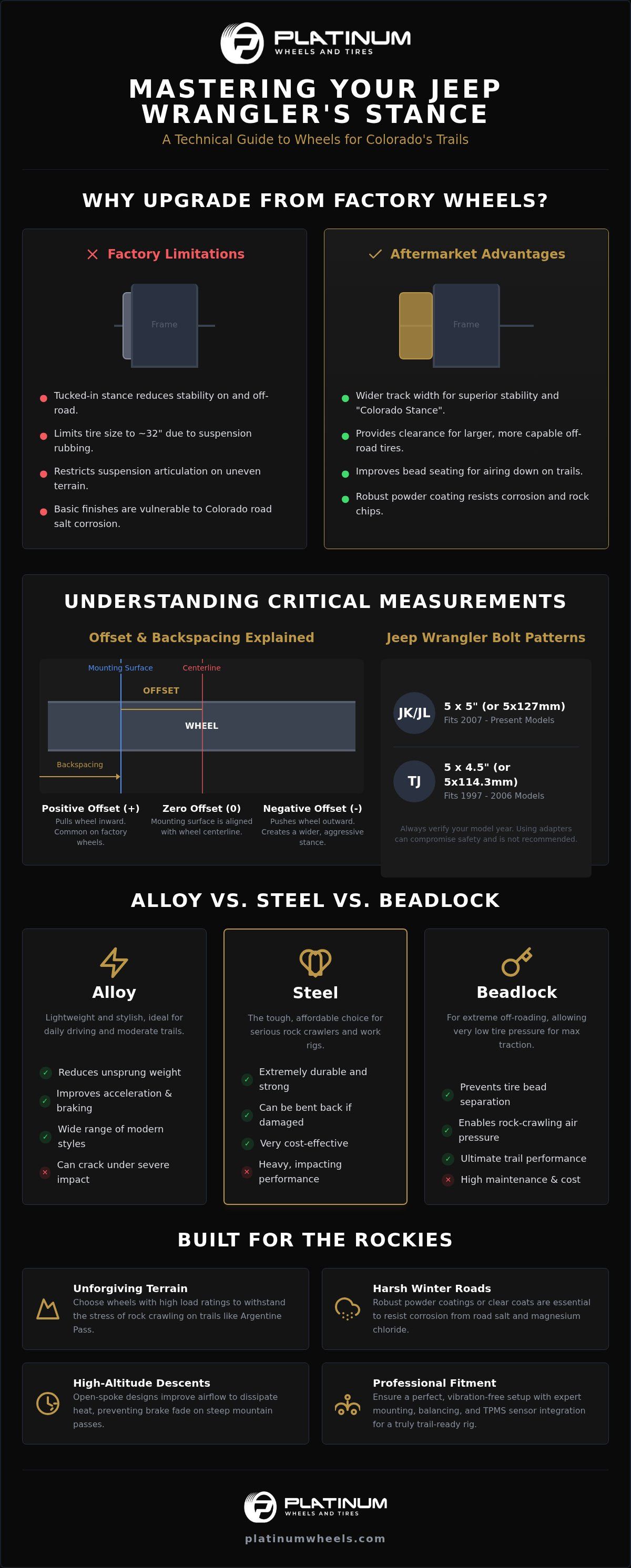
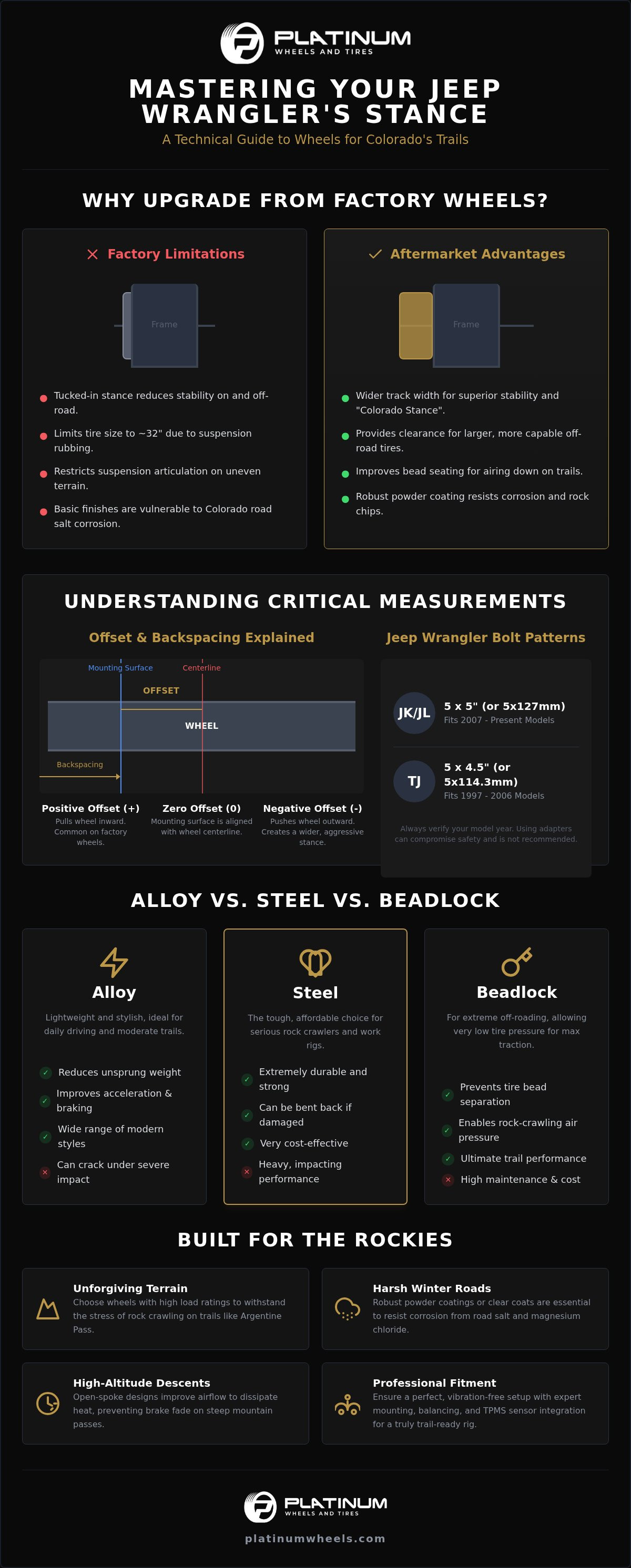
Upgrading your jeep wrangler wheels is often the first step in transforming a stock vehicle into a mountain-ready machine. While factory wheels serve a purpose for highway commuting, they struggle to keep up with the technical demands of the Front Range. Swapping to aftermarket options provides a wider footprint, which significantly increases your track width and overall stability. This extra width is essential when you're side-hilling on a narrow trail or navigating the gusty winds of the I-70 corridor.
Performance isn't just about width. It's about how the wheel interacts with the tire and the terrain. High-quality aftermarket rims often feature better bead seating, allowing you to air down safely for maximum traction on loose scree. Choosing lightweight alloy options also reduces unsprung weight. This reduction helps your Wrangler accelerate quicker and, more importantly, allows your brakes to stop the vehicle more efficiently during steep mountain descents. Achieving the "Colorado Stance" means finding that perfect balance between a wide, aggressive look and functional trail geometry.
Overcoming Factory Limitations
Stock wheels usually have high positive offsets that keep the tires tucked deep inside the wheel wells. While this works for aerodynamics, it severely limits your ability to run tires larger than 32 inches without rubbing on the control arms or frame. This "tucked" look also hinders articulation, as the tire hits the inner fender before the suspension fully cycles. Scrub radius is the distance between the steering axis and the center of the tire's contact patch, and it directly dictates how much feedback or "kickback" you feel through the steering wheel when hitting bumps. By selecting the right jeep wrangler wheels for various Jeep Wrangler generations, you can push the tires out to clear larger rubber while maintaining predictable steering feel.
Durability for the Rockies
The terrain around Denver is unforgiving on equipment. If you're tackling rocky sections on trails like Argentine Pass, you need a wheel that won't crack or bend under pressure. Aftermarket wheels are engineered with higher load ratings to handle the stress of rock crawling and heavy gear loads. Beyond the trails, our local environment presents chemical challenges. The magnesium chloride and road salt used on Denver streets and mountain passes can quickly eat through cheap finishes. We recommend wheels with robust powder coatings or clear coats to resist corrosion. Additionally, many off-road designs prioritize airflow; larger wheel vents help dissipate heat from your rotors, preventing brake fade when you're coming down from 12,000 feet.
Understanding Offset, Backspacing, and Bolt Patterns
Choosing jeep wrangler wheels involves more than picking a style that looks good at the trailhead. You need to understand the geometry that keeps your tires from shredding against your sway bars or control arms. Wheel offset refers to the distance from the mounting surface to the center line of the wheel. A positive offset pulls the wheel inward toward the frame, while a negative offset pushes it outward, creating that wide, stable stance. If you get this wrong, your tires will rub during tight turns or when your suspension fully compresses on a rocky trail. Proper fitment ensures your vehicle remains within NHTSA tire safety guidelines, maintaining the structural integrity of your steering components.
Bolt patterns are another non-negotiable technical detail. Modern Jeep Wrangler JK and JL models (2007 to present) utilize a 5x5 bolt pattern, also known as 5x127mm. If you're building an older TJ model, you're looking for a 5x4.5 pattern. Ordering the wrong pattern is a common mistake that stalls builds, so always verify your generation before clicking buy. Getting these numbers right prevents the "tucked" look and ensures your wheels actually bolt up to your hubs without expensive adapters that can compromise safety.
The Math of the Perfect Stance
Calculating the ideal setup often depends on your tire width. For those running a popular 12.5-inch wide tire, a negative offset is usually required to push the rubber away from the inner wheel well. However, zero offset is often the sweet spot for daily-driven Wranglers; it provides a broader look without putting excessive stress on your steering linkage. If you are unsure of your current specs, check out our guide on how to find wheel offset for a deeper dive into measuring your rig.
Suspension Geometry and Scrub Radius
Pushing your wheels out too far can accelerate wheel bearing wear by changing the leverage applied to the hub. You also have to consider the relationship between wheel width and tire sidewall "bulge," as a wheel that is too narrow for a wide tire can cause poor handling. Backspacing is the preferred measurement for off-roaders because it provides a direct physical value for clearing inner suspension components like sway bars and control arms. If you want to avoid the guesswork, our team at Platinum Wheels can help you calculate the exact specs for your specific lift height and tire choice.
Alloy vs. Steel vs. Beadlock: Which is Right for You?
Selecting the right material for your jeep wrangler wheels depends on where you spend most of your time. Most Denver owners opt for aluminum alloy wheels because they offer a superior balance of weight, strength, and style. By reducing unsprung mass, alloys allow your suspension to react faster to bumps and dips. Steel wheels are the traditional choice for budget-conscious builds or dedicated rock crawlers. While they are significantly heavier, they possess a unique advantage: you can often hammer a bent rim lip back into place on the trail, whereas an alloy wheel might simply crack under the same impact.
Durability in the Rockies isn't just about impact resistance. It's also about surviving the corrosive environment of a Colorado winter. Magnesium chloride and road salt are relentless. Whether you choose alloy or steel, the quality of the finish is what determines if your wheels will look pitted and worn after a single season. We recommend high-quality powder coatings for those who frequent the high country during ski season.
Performance Benefits of Modern Alloys
Modern alloys aren't just for show. They excel at heat dissipation, which is a massive safety benefit when you are riding the brakes down a 6% grade on I-70. Because they are manufactured to tighter tolerances than steel, alloys are also much easier to balance. This precision significantly reduces highway vibrations, making your trek from Denver to the trailhead far more comfortable. You can explore the specific trade-offs in our guide on alloy rim wheels vs steel to see which fits your driving habits best.
The Beadlock Debate
True beadlock wheels use a physical ring and bolts to clamp the tire bead to the rim. This allows you to run ultra-low tire pressures, sometimes below 10 PSI, for incredible traction on technical obstacles. However, many beadlocks are not DOT-approved for highway use. They also require high maintenance, including frequent bolt torque checks to ensure they haven't loosened during temperature swings. For most Denver drivers, simulation beadlocks (often called street-locks) provide the rugged look of a trail rig without the legal headaches or the weekly maintenance requirements. If you choose real beadlocks for a dedicated trail rig, stay diligent with your inspections to ensure your jeep wrangler wheels remain safe and secure.
Fitment Guide by Wrangler Generation
Fitment isn't universal across the Jeep lineup. A wheel that worked perfectly on an older rig might cause significant mechanical interference on a newer model. Understanding these generational shifts is the only way to ensure your jeep wrangler wheels perform as intended without damaging your suspension or braking systems. As you move from the classic TJ to the modern JL, the factory components have grown larger and more complex, requiring more precise wheel specifications to maintain safety and performance.
The JL and JT (Gladiator) Nuances
If you're driving a 2018 or newer JL or a JT Gladiator, you're dealing with much larger brake calipers than previous generations. Because of this, 17-inch wheels are generally the minimum size required to clear the brakes on most trims. You also have to account for the wider axles found on these models, which change how the tire sits relative to the fender flare. Don't forget the technology integrated into the rear of the vehicle; aftermarket spare wheels must accommodate the factory backup camera housed in the center of the spare tire mount. To see how these changes affect your overall rig height and stance, check out our comparison of a leveling kit vs lift kit for your specific model.
The JK generation (2007-2018) remains the most popular platform for 17-inch wheel upgrades. It offers a massive amount of aftermarket support, but you still need to be mindful of the 5x5 bolt pattern. If you're building an older TJ (1997-2006), you're likely navigating the transition between 15-inch and 16-inch wheels. TJs use a different 5x4.5 bolt pattern, so double-check your specs before ordering to avoid a frustrating fitment delay.
Fitting 35s and 37s in Denver
Achieving a reliable setup for 35-inch or 37-inch tires requires a methodical approach. Follow these steps to ensure your rig is trail-ready:
- Step 1: Determine your desired tire height and width. A 12.5-inch wide tire is the standard for Denver trails but requires specific wheel geometry to clear the frame.
- Step 2: Select a wheel with the correct backspacing. For most lifted Wranglers, a backspacing of 4.5" to 4.75" is the "sweet spot" to prevent rubbing on the sway bars.
- Step 3: Confirm fender clearance. High-articulation trails like those in the Front Range will reveal rubbing issues that aren't apparent on flat pavement.
- Step 4: Install new TPMS sensors. Modern Jeeps rely on these for safety and dashboard alerts, and it's best to install fresh ones during your wheel swap.
Whether you're prepping for a weekend at Moab or just want a better look for your daily commute, getting the fitment right is essential. If you want to ensure your build is done correctly the first time, visit Platinum Wheels for expert advice and professional installation tailored to your specific Jeep generation.
Professional Installation & Packages at Platinum Wheels
Selecting the right components is only half the battle. To truly unlock the performance of your build, you need an installation that accounts for the specific stresses of off-roading. A general mechanic might understand the basics of a tire swap, but they often lack the specialized equipment and experience required for high-clearance builds. At Platinum Wheels, we specialize in the nuances of jeep wrangler wheels, ensuring that your offset, backspacing, and suspension components work in perfect harmony. We don't just bolt parts on; we verify that your rig is ready for the technical challenges of the Rockies.
Our consultative fitment sessions take the guesswork out of your transformation. We sit down with you to discuss your typical trail usage, desired tire size, and budget. This neighborly approach ensures you don't end up with a setup that looks great but rubs every time you hit a bump in the high country. Whether you're coming to us from Aurora, Fort Collins, or Colorado Springs, we provide the expert guidance needed to build a rig with total peace of mind.
Expert Mounting and Road Force Balancing
Large off-road tires present unique balancing challenges that standard machines often can't handle. We utilize Road Force Balancing to simulate the pressure of the road, identifying inconsistencies that cause highway vibrations at 75 mph. This precision is vital for maintaining comfort during your drive to the trailhead. Our technicians take extra care to protect your new rims during the mounting process, using touchless equipment to prevent scratches. We also ensure your TPMS sensors are correctly installed and synced to your Jeep’s computer, so you never have to deal with annoying dashboard alerts while you're aired down on the trail.
Your Local Denver Jeep Experts
We invite you to visit our shop to get a hands-on look at the latest off-road styles and finishes. Seeing the difference between a matte black and a bronze finish in person can make all the difference in your final decision. Beyond wheels, we specialize in pairing your new setup with custom suspension and leveling kits to achieve that perfect "Colorado Stance" we discussed earlier. You can learn more about the specific advantages of our bundled services by reading our guide on aftermarket wheel and tire packages. When you're ready to take the next step, you can browse our Jeep wheel and tire packages at Platinum Wheels and start your journey toward a more capable, head-turning Wrangler.
Build Your Ultimate Colorado Rig
Transforming your rig from a highway commuter to a trail-conquering beast requires more than just picking a style. The secret to a successful build lies in the technical details. Getting your offset and backspacing right ensures you clear those 35-inch tires without rubbing on the sway bars; choosing high-quality alloy or steel materials keeps you moving through the harshest Colorado winters. Whether you're navigating a late-model JL or a classic TJ, understanding these generational nuances prevents costly fitment errors and keeps your steering precise.
At Platinum Wheels, we're proud to serve the entire Front Range with professional lift kit and wheel installation. Our team provides expert fitment advice tailored to your specific goals, ensuring your new jeep wrangler wheels perform as good as they look. We take the stress out of the process with comprehensive packages that include mounting, balancing, and TPMS syncing. Ready to take your Jeep to the next level? Get a custom quote for your Jeep Wrangler wheel package today! The peaks are calling; it's time to make sure your Jeep is ready to answer.
Frequently Asked Questions
What is the best wheel size for a Jeep Wrangler?
17-inch wheels are widely considered the gold standard for off-road performance. This size provides the perfect balance of brake clearance for modern JL models while allowing for a taller tire sidewall. When you air down for trails like Webster Pass, that extra rubber helps the tire conform to rocks and absorb impacts. While 20-inch rims are popular for street builds, they limit your traction and comfort when things get rugged.
Will 35-inch tires fit on my stock Jeep Wrangler wheels?
You generally cannot fit 35-inch tires on factory jeep wrangler wheels without significant rubbing issues. Stock rims typically have a high positive offset that keeps the tire tucked inward, causing the rubber to hit your sway bar or control arms during tight turns. To run 35s safely, you usually need aftermarket wheels with less backspacing to push the tires out for proper clearance and a full range of motion.
Do I need a lift kit to install aftermarket wheels on my Jeep?
You don't need a lift kit just to change your wheels, but you will likely need one if you plan on running larger tires. Most aftermarket wheels are designed to accommodate 33-inch or 35-inch tires which require extra fender space. If you stay with a stock tire size, you can install new rims immediately to improve your stance and offset without modifying your suspension or affecting your factory ride height.
What is the bolt pattern for a Jeep Wrangler JL?
The bolt pattern for the Jeep Wrangler JL is 5x5, which is also referred to as 5x127mm. This has been the standard for all Wranglers since the introduction of the JK in 2007. It's vital to confirm this measurement before purchasing, as older Jeep models like the TJ used a 5x4.5 pattern. Using the correct pattern ensures a safe, hub-centric fitment without the need for adapters that can compromise safety.
How does wheel offset affect my Jeeps handling?
Offset directly changes your rig's center of gravity and scrub radius. A negative offset pushes the wheels outward, which increases stability on side-tilts and gives you a wider footprint. However, pushing them out too far can increase steering kickback and put additional stress on your wheel bearings. Finding a balanced offset is the key to maintaining a comfortable ride on Denver highways while gaining the trail capability you need for the mountains.
Can I use my factory TPMS sensors with new aftermarket wheels?
You can technically swap your old sensors, but we recommend installing new TPMS sensors with your new wheel and tire package. Transferring old sensors involves breaking the bead on your original tires and risks damaging the delicate seals or stems. Starting fresh ensures the batteries are new and the sensors are perfectly synced to your Jeep’s computer for reliable pressure monitoring in our fluctuating Colorado temperatures and high-altitude environments.
Are steel wheels better than alloy wheels for off-roading in Colorado?
Steel wheels are preferred by hardcore rock crawlers because they can be hammered back into shape if they bend on a jagged rock. However, alloy jeep wrangler wheels are generally better for most Colorado drivers. Alloys are lighter, which helps with braking on mountain descents, and they dissipate heat much faster than steel. They also resist the corrosive road salts used in Denver much better than painted steel options.
How much does it cost to have Jeep wheels installed in Denver?
Installation costs depend on several factors, including the wheel size, whether you are reusing sensors, and if the tires require Road Force balancing. While labor rates fluctuate across the Front Range, investing in a professional shop ensures your wheels are torqued correctly and balanced for high-altitude driving. Most enthusiasts find that purchasing a complete package is the most efficient way to manage the overall investment while ensuring a trail-ready result.