Best Jeep Grand Cherokee Tires for Denver Roads & Trails
The most aggressive-looking tire is often the worst choice for your daily commute through Denver. While a deep, mud-ready tread looks the part, it can transform your smooth Jeep Grand Cherokee ride into a vibrating, noisy chore on I-25. Finding the right jeep grand cherokee tires means mastering the Colorado hybrid lifestyle. You need a setup that conquers icy mountain passes but stays silent on the way to the office.
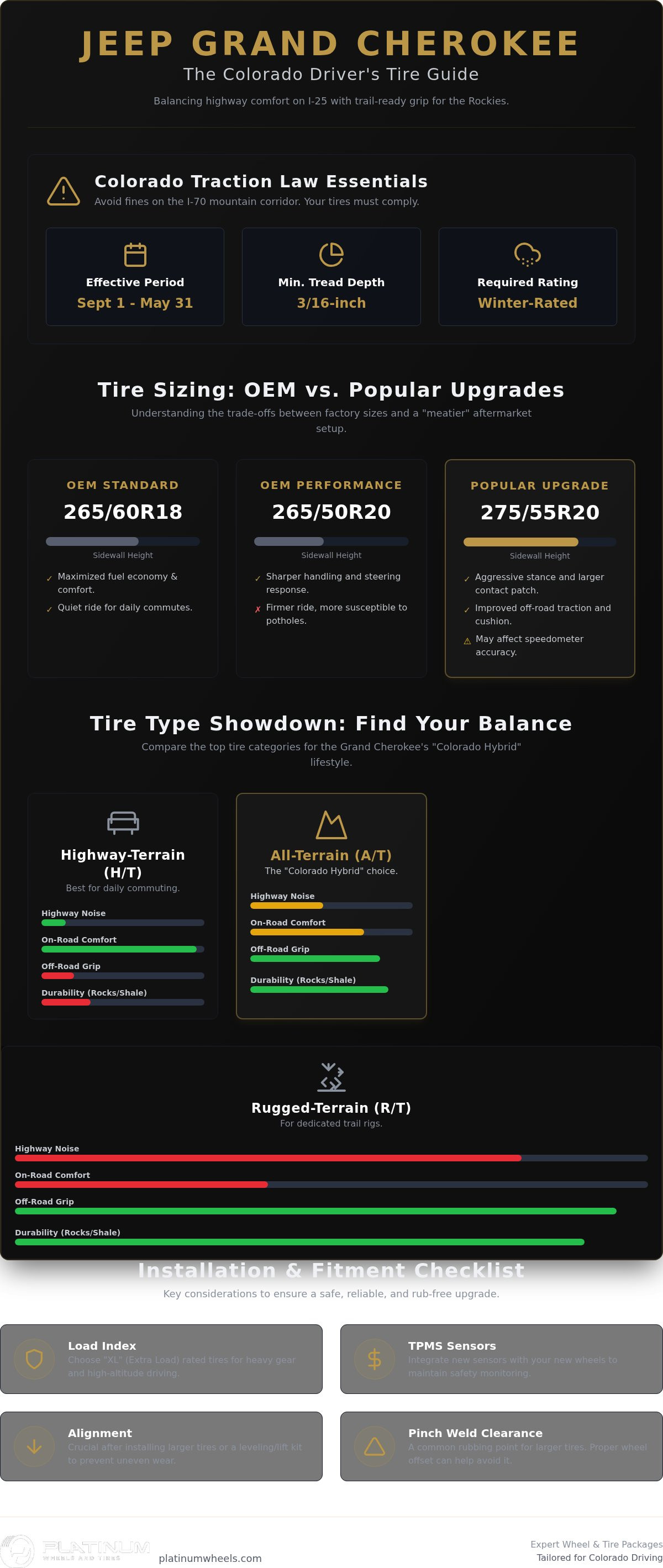
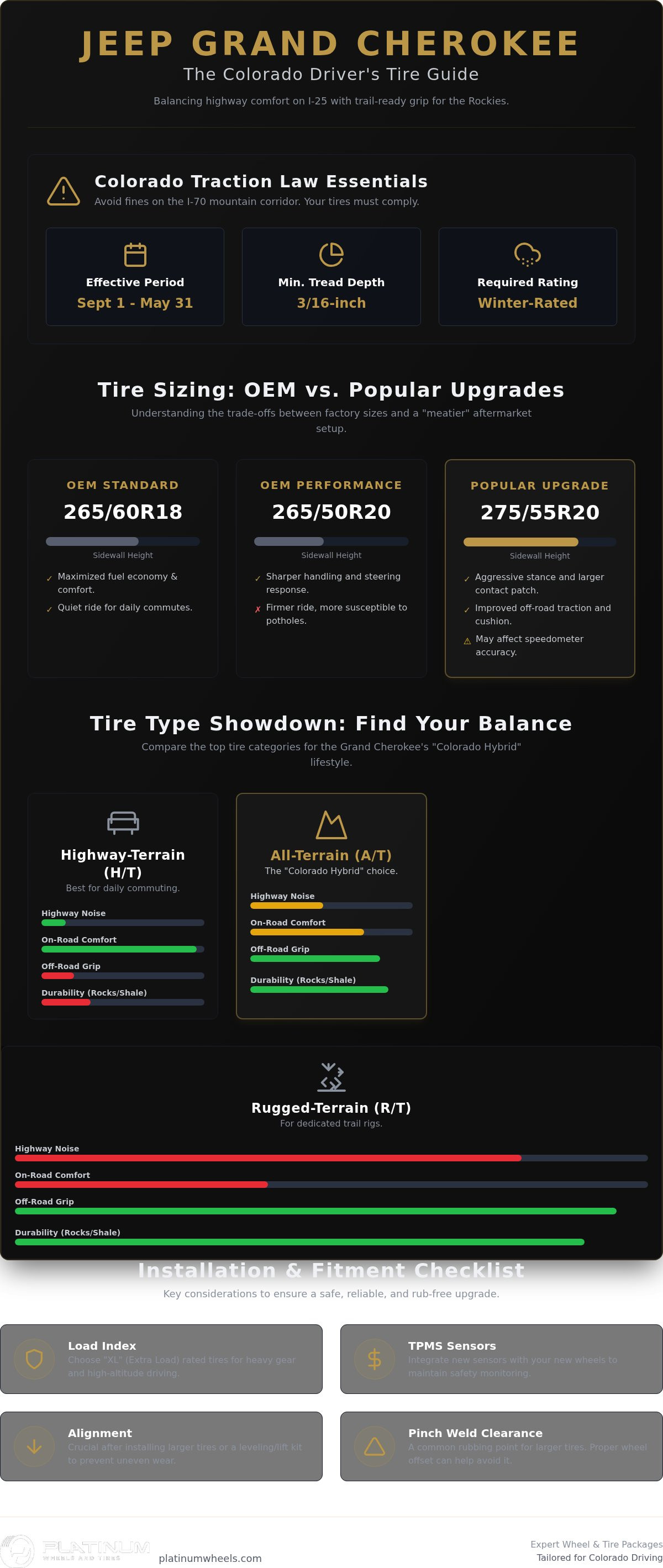
We know the struggle of staring at a wall of rubber and wondering if those new rims will actually clear your wheel wells. You want that bold, off-road stance without sacrificing the luxury feel of your cabin or worrying about the Colorado Traction Law requirements. Between September 1 and May 31, your tires must meet specific 3/16-inch tread depth and winter-rating standards to avoid heavy fines on the I-70 mountain corridor. This guide helps you discover the perfect balance of highway comfort and trail-ready grip. We will break down the top-rated tires for our unique climate, explain how to nail the perfect fitment for custom wheels, and ensure your Jeep is ready for every season the Front Range throws its way.
Key Takeaways
- Understand why the Grand Cherokee requires a specific load index and how its platform evolution from the WK2 to the WL impacts your tire choices.
- Navigate the technical side of fitment, including how wheel offset and pinch weld clearance affect your ability to run larger setups without rubbing.
- Identify the best jeep grand cherokee tires for your driving style by comparing the quiet comfort of highway treads against the aggressive capability of the Rugged Terrain category.
- Ensure long-term reliability and safety by integrating new TPMS sensors and professional alignment when installing a leveling or lift kit.
- Save time and guarantee perfect fitment by opting for a complete wheel and tire package tailored specifically for Colorado's unique driving conditions.
Understanding Jeep Grand Cherokee Tire Requirements
Selecting the right jeep grand cherokee tires requires a deep understanding of how this vehicle has evolved. For over thirty years, the platform has balanced premium road manners with legitimate trail credentials. Whether you are driving a classic model or the latest fifth-generation WL, the tire requirements are more demanding than those of a standard crossover. You can explore the detailed Jeep Grand Cherokee history and specifications to see how the vehicle's weight and suspension geometry have shifted over time, necessitating specific rubber compounds and construction.
Most factory tires are chosen by the manufacturer to maximize fuel economy and minimize cabin noise. While this works for a test drive in the flatlands, it often fails the "Colorado Hybrid" test. We define a Colorado Hybrid tire as one that can maintain 75 mph stability on the I-70 climb while offering enough bite to handle a muddy trailhead. When shopping for jeep grand cherokee tires in Denver, you need to look beyond the basic all-season tread. Factory options often lack the sidewall reinforcement needed for our sharp Rocky Mountain shale, leading to punctures that could have been avoided with a more robust tire selection.
OEM Sizes vs. Popular Upgrades
Jeep typically equips the Grand Cherokee with three primary sizes: 265/60R18, 265/50R20, and the larger 275/45R21 found on high-altitude or Summit trims. While these sizes offer a balanced ride, many Denver owners prefer a "meatier" look. A very common upgrade is moving to a 275/55R20. This swap increases the sidewall height, providing more cushion against potholes and a larger contact patch for off-road traction. Keep in mind that increasing your tire diameter will slightly affect your speedometer accuracy; a taller tire travels further per revolution, meaning you might be going faster than your dash indicates.
Load Ratings and Speed Ratings for Jeeps
The Grand Cherokee is a heavy vehicle, especially when loaded with camping gear or towing a trailer. This is why paying attention to the load index is non-negotiable. We often recommend "XL" (Extra Load) rated tires for Jeep owners who frequently head into the high country. These tires feature reinforced internal structures that handle the stress of heavy payloads and high-altitude heat better than standard tires. Additionally, ensure your speed rating matches or exceeds the vehicle's original equipment. Even if you don't drive at track speeds, a higher speed rating often correlates with better heat dissipation and sharper handling during emergency maneuvers on the highway.
Grand Cherokee Tire Sizing and Fitment Guide
Achieving the perfect stance for your Jeep requires more than just picking a tread pattern. You have to understand how wheel offset and backspacing work together to determine where your tire actually sits in the wheel well. Offset measures the distance from the wheel's mounting surface to its centerline. If you move toward a more aggressive, lower offset with custom wheels and rims, the tire pushes outward. This looks great and improves stability, but it also changes the scrub radius, which can lead to rubbing on the outer fender or the inner liner during sharp turns.
Backspacing is the hidden metric that many owners overlook. It measures the distance from the mounting hub to the back edge of the wheel. If your backspacing is too deep, your new jeep grand cherokee tires might contact the suspension components, like the upper control arm. This is especially risky when moving to a wider tire. When pushing the limits of fitment, remember that safety remains the priority. Following NHTSA tire safety guidelines ensures that your chosen setup maintains proper load capacity and inflation standards for Colorado roads. Balancing aesthetics with mechanical clearance is what separates a professional build from a problematic one.
The "pinch weld" concern is a classic hurdle for anyone going larger than stock. This metal seam sits behind the plastic liner at the rear of the front wheel well. As you increase tire diameter, the tire can catch on this weld when you are turning or when the suspension compresses over a bump. While some owners choose to trim or fold the pinch weld, selecting a wheel with the correct offset can often provide the clearance you need to avoid permanent modifications. If you are unsure about the math, our team can help you find the perfect fitment for your specific year and trim.
Fitment for the WK2 (2011-2022)
The WK2 generation has a relatively tight wheel well that limits how far you can go without a lift. 18-inch wheels are the gold standard for off-roaders because they allow for more sidewall flex, while 20-inch setups are popular for a street-heavy "Colorado Hybrid" look. The largest tire you can safely run on a stock WK2 without trimming or rubbing is generally a 32-inch diameter, such as a 275/55R20 or 265/65R18.
Fitment for the WL (2021-Present)
The newer WL chassis, including the 3-row Grand Cherokee L, offers a bit more breathing room in the wheel wells. However, the Quadra-Lift air suspension adds a layer of complexity. Because the Jeep lowers itself into "Aero" mode at highway speeds, a tire that clears perfectly in "Normal" mode might rub when you are cruising down I-70. We always recommend checking clearance at the lowest suspension setting to ensure your wider footprint doesn't cause damage when the air bags drop.
All-Terrain vs. Highway-Terrain: Finding Your Balance
Finding the right balance for your jeep grand cherokee tires often feels like a tug-of-war between daily comfort and weekend adventure. Most owners start by evaluating their actual mileage. If 90% of your driving happens on paved roads, a Highway-Terrain tire offers the quietest ride and the best fuel economy. However, Colorado presents a unique challenge. Our roads aren't just dry or wet; they are often covered in a greasy layer of magnesium chloride or deep slush that can overwhelm a standard street tire. This environment has led to the rise of the "Rugged Terrain" (RT) category. These tires provide the aggressive, blocky aesthetic of a mud tire but use a specialized rubber compound to keep road noise at a manageable level during high-speed highway cruising.
Regardless of the category you choose, the Three-Peak Mountain Snowflake (3PMSF) rating is a non-negotiable requirement for the Front Range. While many tires carry an "M+S" (Mud and Snow) stamp, the 3PMSF symbol indicates the tire has passed rigorous testing in actual snow conditions. With the Colorado Traction Law in effect for nine months of the year on the I-70 mountain corridor, having this rating ensures you stay compliant and confident when a sudden storm hits the Continental Divide. Choosing a tire that masters these diverse conditions is the key to enjoying your Jeep year-round.
The Case for Highway-Terrain (HT)
For the Jeep owner who primarily commutes from Denver to Colorado Springs, Highway-Terrain tires are the most logical choice. These tires are engineered with a focus on hydroplaning resistance and superior wet traction, which is vital during our intense spring rainstorms. You will notice a significant improvement in miles per gallon compared to heavier off-road alternatives. Because HT tires feature a denser tread pattern with more siping, they offer a stable, vibration-free experience that preserves the premium feel of the Grand Cherokee's interior. They are the ideal solution for those who want maximum longevity and a peaceful cabin on long stretches of asphalt.
The Case for All-Terrain (AT)
Switching to all terrain tires is the gold standard for anyone who views their Jeep as a gateway to the high country. These tires feature self-cleaning tread patterns that eject mud and stones, preventing the "slick" effect that happens when treads get packed with debris. They are built with tougher sidewalls to resist punctures from the sharp shale and jagged rocks common on local trails. Before you head out, review these U.S. Forest Service off-roading tips to ensure your new jeep grand cherokee tires are prepared for the terrain. This category offers the perfect mix of durability for the trail and enough civility to keep your morning commute enjoyable.
Maximizing Tire Life: TPMS, Alignment, and Leveling Kits
Investing in new jeep grand cherokee tires is a significant commitment to your vehicle's performance and safety. To get the most mileage out of that rubber, you must address the supporting hardware that keeps those tires pointing in the right direction. A common mistake is skipping the alignment after a tire swap. When you change your tire diameter or move to a wider footprint, you alter the suspension geometry. Correcting the camber and toe is vital for preventing uneven shoulder wear, especially given the high lateral forces your Jeep faces while cornering on steep mountain grades.
High-altitude driving in Colorado puts unique stresses on your tires. Our extreme temperature swings can cause pressure fluctuations that trigger constant alerts. This is where a reliable tpms sensor becomes essential. If you are upgrading your setup, we recommend a professional tire and wheel consultation to ensure your alignment and sensors are perfectly calibrated for the road ahead.
TPMS Integration for Jeep Systems
Modern Grand Cherokees use a sophisticated auto-learn system that tracks sensor IDs as you drive. However, this system is notoriously sensitive. We've seen many owners face a persistent dash light after installing cheap universal sensors that fail to communicate with the Jeep's receiver. For the 2026 WL Grand Cherokee models, it's critical to verify sensor compatibility, as the communication protocols continue to evolve. Replacing your sensors during a tire install is the most efficient way to avoid future labor costs and ensure your safety systems remain active during seasonal swaps.
Leveling Kits for Better Tire Clearance
Most Grand Cherokees come from the factory with a "rake," meaning the front sits slightly lower than the rear. While this helps with aerodynamics, it limits your tire size. Understanding the difference between a leveling kit vs lift kit is key to choosing your upgrade path. A 2-inch front leveling kit is often the sweet spot for Jeep owners. It levels the stance and opens up enough clearance to run those meatier 32-inch tires without rubbing. Professional installation is safer than a DIY spacer kit because it ensures the struts are properly clocked and the suspension retains its factory-engineered safety margins on rugged terrain.
Expert Jeep Tire Installation in Denver and the Front Range
Choosing the right jeep grand cherokee tires is only half the battle. The quality of the installation determines whether your Jeep drives like a refined luxury SUV or a vibrating mess on I-25. At Platinum Wheels, we focus on precision mounting and road-force balancing. This level of detail is essential for the oversized, aggressive tires common in the Front Range. We serve the entire metro area, from the busy streets of Aurora to the winding roads of Castle Rock. Our goal is to ensure every local owner gets a setup built for our unique terrain, providing peace of mind whether you are merging into traffic or climbing a steep grade.
Many owners find that purchasing aftermarket wheel and tire packages is the smartest way to upgrade. These bundles arrive pre-mounted and balanced, which saves you significant time and reduces the overall cost compared to buying components separately. It also guarantees that your new tires and rims are perfectly compatible from day one. By choosing a package tailored for your specific Grand Cherokee model, you eliminate the guesswork of fitment. You get a professional-grade setup that looks aggressive and performs flawlessly across every mile of Colorado asphalt.
Custom Tailored Jeep Solutions
We don't believe in a one-size-fits-all approach. Our consultative process starts with listening to how you actually use your vehicle. Do you spend your weekends at 12,000 feet, or is your Jeep a dedicated city commuter? We use specialized equipment designed to handle heavy, oversized off-road tires without scratching your custom rims. Our technicians take the time to ensure every lug nut is torqued to spec and every sensor is calibrated. Our service is fast and purposeful because we know you'd rather be out exploring the Rockies than sitting in a waiting room. We treat your vehicle with the same precision and enthusiasm we'd use on our own rigs.
Visit Platinum Wheels Today
Our technicians speak the "Jeep language" fluently. We understand the nuances of the WK2 and WL platforms, from Quadra-Lift air suspension quirks to specific alignment needs for high-altitude driving. We invite you to visit our Denver-area shop to see the difference that expert craftsmanship and local roots make. Whether you are ready for a full transformation with a leveling kit and rims or just need a reliable set of winter-rated rubber, we are here to guide you. Get a custom quote for your Jeep Grand Cherokee today! and let's get your rig ready for the next adventure.
Get Your Jeep Ready for the High Country
Selecting the ideal jeep grand cherokee tires transforms your driving experience from a daily commute into a true Colorado adventure. You now understand how to balance the quiet refinement of a highway tread with the rugged durability required for our rocky mountain passes. By focusing on correct fitment, proper load ratings, and the essential Three-Peak Mountain Snowflake symbol, you ensure your Jeep remains safe and capable through every season the Front Range delivers.
As Denver’s highest-rated off-road fitment experts, we’re proud to be your local Colorado independent shop. We specialize in precision mounting for oversized tires and custom offsets that guarantee a perfect stance without the headache of rubbing. Our team of professional enthusiasts is ready to help you navigate the technical details of offset and backspacing to create a setup that performs as good as it looks. Stop by our shop today to see why precision matters. Build Your Custom Jeep Wheel and Tire Package and start exploring the Rockies with total confidence in your traction.
Frequently Asked Questions
What is the largest tire size I can fit on a stock Jeep Grand Cherokee?
A 32-inch tire is typically the maximum size for a stock setup. For the WK2 generation, this translates to a 265/65R18 or a 275/55R20. Going any larger will cause the rubber to rub against the wheel well liners or the suspension components during sharp turns. If you want a more aggressive stance without modifications, staying within these dimensions ensures a rub-free experience on Denver streets.
Do I need to recalibrate my speedometer after getting bigger tires?
Recalibration is necessary if your new tire diameter is more than 3% different from the factory size. Because a taller tire travels further with each rotation, your speedometer will display a speed lower than your actual velocity. This can lead to unexpected speeding tickets on the Front Range. You can easily fix this using a handheld programmer to update the vehicle's tire size setting in the computer.
Are all-terrain tires too noisy for highway driving in Colorado?
Not necessarily, as tire technology has improved significantly. Many modern all-terrain jeep grand cherokee tires use variable-pitch tread blocks to cancel out road harmonics. While they aren't as silent as a dedicated highway tire, the difference is often negligible inside the Grand Cherokee's well-insulated cabin. It's a small trade-off for the massive increase in traction you get on snowy or unpaved Colorado roads.
What is the difference between P-metric and LT-rated tires for a Jeep?
P-metric tires prioritize a soft ride and lower rolling resistance for better fuel economy. In contrast, LT-rated tires feature reinforced sidewalls and a higher load index. We recommend LT-rated jeep grand cherokee tires for owners who frequently carry heavy camping gear or drive on sharp, rocky trails. The added durability provides essential protection against sidewall punctures that can leave you stranded in the high country.
How often should I rotate the tires on my 4WD Grand Cherokee?
Aim to rotate your tires every 5,000 to 8,000 miles to maintain even tread depth. This is especially important for the Grand Cherokee's 4WD system, which relies on consistent tire diameters to prevent mechanical strain. Regular rotations also give our technicians a chance to inspect your brakes and suspension components, ensuring your Jeep stays trail-ready and safe for your next mountain excursion.
Will 33-inch tires fit on a Grand Cherokee with a leveling kit?
Fitting a true 33-inch tire is a challenge that usually requires more than a simple leveling kit. Even with a 2-inch front level, you will likely encounter rubbing at full steering lock or under suspension compression. To make 33s work, you often need to perform a "pinch weld mod" and select wheels with a specific offset to push the tire away from the inner suspension and frame.
Can I reuse my factory TPMS sensors with new aftermarket wheels?
You can move your existing sensors to new rims, but we generally advise against it if your sensors are several years old. The internal batteries aren't replaceable, so it's more cost-effective to install new sensors during the initial mounting process. This prevents the frustration of a dash light appearing six months later, which would require dismounting the tire again just to reach the failed sensor.
What are the best tires for the Jeep Grand Cherokee for snow driving?
The best snow tires for our region always carry the Three-Peak Mountain Snowflake (3PMSF) symbol. This indicates the tire meets specific severe snow traction requirements that standard all-season tires cannot match. For Denver drivers, choosing a 3-peak rated tire ensures you are legally compliant with the Colorado Traction Law while providing the bite needed to climb icy grades on the way to the ski resorts.