Best Jeep Gladiator Tires for Denver Off-Roading
What if the most expensive upgrade you make to your rig actually makes your daily commute down I-70 unbearable? You bought your truck because you wanted the ultimate dual-purpose machine, something that conquers the brutal rocks of the Rockies and the grocery run in Highlands Ranch with equal ease. We know you want that aggressive stance, but the fear of tires rubbing during trail articulation or the anxiety of deafening road noise on the highway is real. Picking the wrong set of jeep gladiator tires can quickly turn your dream build into a frustrating, fuel-chugging headache.
This guide helps you discover the perfect tire setup that balances rugged off-road capability with the refined street manners required for Front Range driving. We'll show you how to achieve a professional fitment that doesn't require constant trimming, even if you're eyeing a jump to 35-inch or 37-inch rubber. You'll learn which tread patterns dominate in Colorado snow and mud, ensuring you stay compliant with the 3/16-inch tread depth requirements of the state's updated Traction Law. From load ratings to hybrid rugged-terrain tech, we're covering everything you need to build a Gladiator that looks as bold as it performs.
Key Takeaways
- Learn why the Gladiator's unique wheelbase demands a specific tire approach and how "Colorado Hybrid" treads handle both I-70 winter ice and summer mountain trails.
- Compare All-Terrain and Mud-Terrain options to decide if you need daily driver versatility for Aurora streets or maximum rock-crawling traction.
- Navigate the fitment transition from 33-inch to 37-inch jeep gladiator tires to find the performance "sweet spot" for your specific trim and lift height.
- Understand how Load Range C versus E ratings impact your ride quality, braking distance, and long-term suspension health.
- Discover why a professionally bundled wheel and tire package ensures a no-rub guarantee while saving money on your Denver rig upgrade.
Choosing the Right Jeep Gladiator Tires for Colorado Terrain
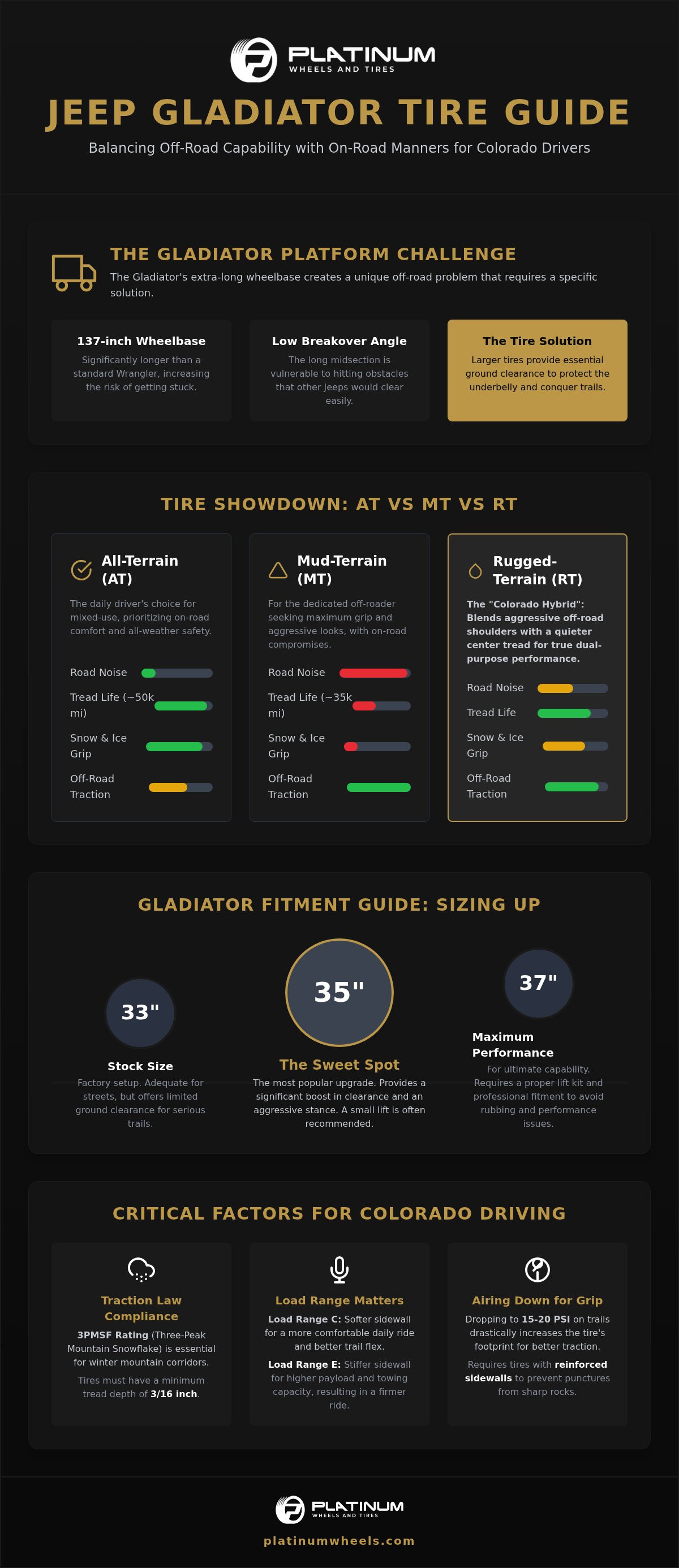
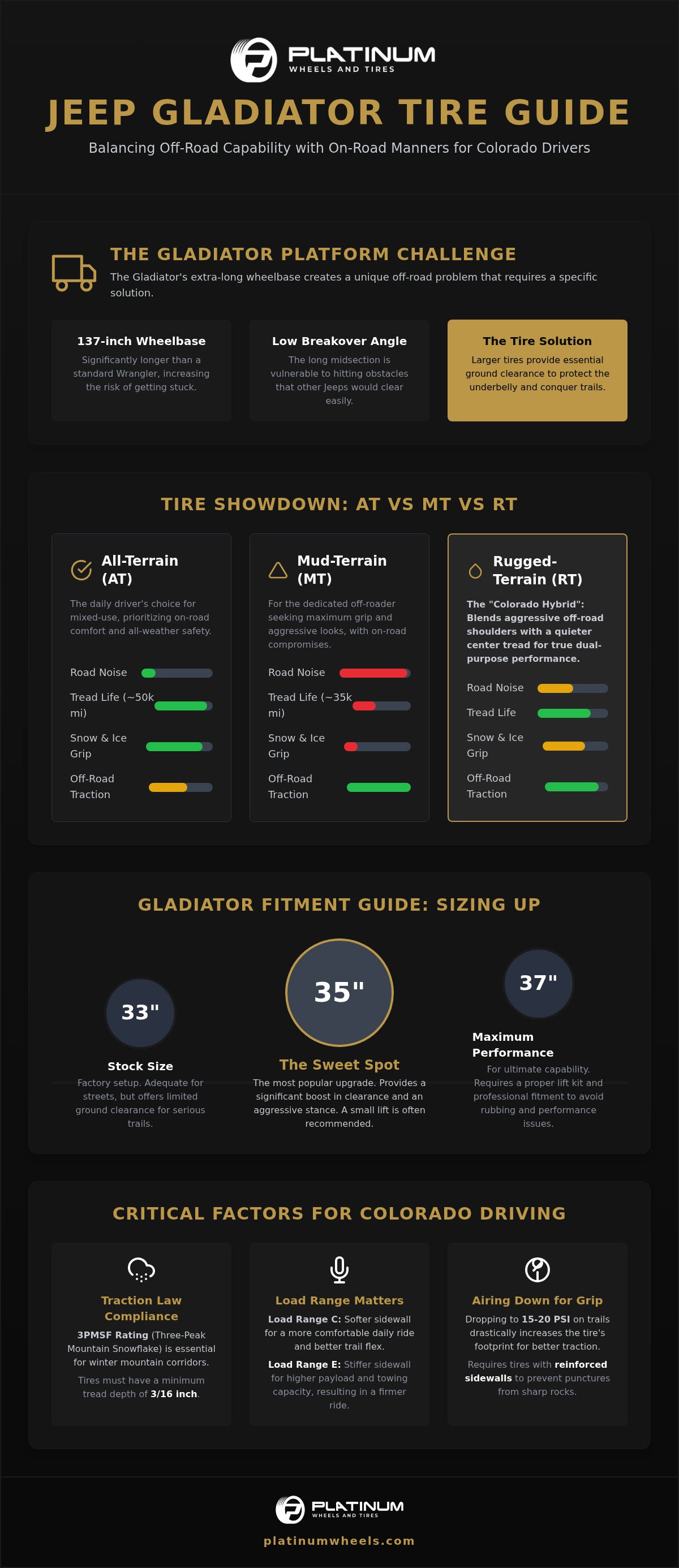
The Gladiator isn't just a Wrangler with a truck bed; it's a unique platform with specific engineering demands. Because of its 137 inch wheelbase, your breakover angle is much lower than a standard Jeep. This means the center of your rig is more likely to high-center on obstacles. Choosing the right jeep gladiator tires involves more than just picking a cool tread pattern. You need a setup that provides enough height to protect that long underbelly while maintaining the stability needed for highway speeds. Leveraging modern Off-road tire technology ensures you get a carcass that can handle the weight of a fully loaded bed without sacrificing trail flex.
For Denver drivers, we often recommend a "Colorado Hybrid" approach. This tire category sits between a traditional all-terrain and a dedicated mud-terrain. It provides the aggressive shoulder lugs needed for traction in deep mud or loose scree, but uses a rubber compound that stays pliable when temperatures drop below freezing on I-70. Sidewall strength is another critical factor. When you air down to 15 or 20 PSI for better grip on Rocky Mountain trails, you need reinforced sidewalls to prevent punctures from sharp granite edges. Keep in mind that as you go bigger, you increase unsprung weight. This can impact your Gladiator's 7,700 pound towing capacity and overall payload, so balancing size with weight is key for performance.
Stock vs. Aftermarket: Why Upgrade Your Gladiator Rubber?
Factory tires are designed for the average driver, which usually means they're too narrow and lack the grip required for moderate trails like Kingston Peak. Upgrading your jeep gladiator tires provides an immediate aesthetic transformation, giving the truck a wider, more authoritative stance. Beyond looks, aftermarket tires offer significantly better ground clearance. A jump from the stock 32 inch or 33 inch tires to a 35 inch setup can be the difference between sliding over a rock and slamming your transmission crossmember into it. It's about protecting your investment while expanding where you can go.
Colorado Driving Factors: Snow, Ice, and Sharp Granite
In the Front Range, a Three-Peak Mountain Snowflake (3PMSF) rating is essential. This isn't just about safety; it's about compliance. Colorado's Traction Law requires at least a 3/16 inch tread depth and specific winter ratings during mountain corridor restrictions. We look for tires with high silica content, which prevents the tread from turning into hard plastic in sub-zero temperatures. This flexibility allows the tire to "bite" into ice rather than sliding over it. Additionally, a quality tire must resist "chunking," which is when sharp rocks tear small pieces out of the tread. A durable, cut-resistant compound is a must for any rig heading into the high country.
All-Terrain vs. Mud-Terrain: Which Fits Your Lifestyle?
Choosing the right jeep gladiator tires often comes down to how you spend your Monday through Friday versus your Saturday morning. In the Denver metro area, your truck needs to be a chameleon. It has to handle the stop-and-go traffic of the Tech Center while remaining ready for a spur-of-the-moment trip into the mountains. The debate between All-Terrain (AT) and Mud-Terrain (MT) isn't just about looks; it's about how much vibration and noise you're willing to tolerate on the drive to the trailhead. While MT tires look undeniably aggressive, the daily reality of driving them on dry pavement is a factor every owner should weigh carefully.
Lately, we've seen a massive surge in the "Rugged Terrain" (RT) category. These tires act as a bridge, featuring the high-void shoulders of a mud tire for off-road grip and a tighter center tread pattern for a quieter highway experience. If you're a Jeep enthusiast who wants that "Rubicon look" without the heavy steering feel or the rapid tread wear typical of dedicated mud tires, an RT might be your perfect match. Tread life expectancy varies, but most quality AT tires will last 50,000 miles or more, while MT tires often require replacement closer to the 35,000-mile mark due to uneven wear on asphalt.
The Case for All-Terrain Tires on the Front Range
If you're commuting from Aurora or Lakewood, All-Terrain tires are usually the most logical choice. These tires feature heavy siping, which are the small slits in the tread blocks that provide extra "bite" on wet and icy pavement. This design is superior for the slushy, unpredictable winters we face in the city. AT tires also provide lower rolling resistance, which helps preserve your fuel economy during long stretches on the interstate. For a detailed breakdown of specific brands, take a look at our guide on choosing the best all-terrain tires for Colorado.
When to Commit to Mud-Terrain Tires
You should commit to Mud-Terrain tires if your weekends consistently involve technical rock crawling or deep mud pits. If trails like Bill Moore Lake or Spring Creek are on your regular rotation, the massive tread blocks and reinforced carcasses of an MT are non-negotiable. However, you have to manage the "hum." At 75 mph, the air moving through those large tread gaps creates a distinct drone that some find therapeutic and others find exhausting. If you're ready for the trade-off, you can explore the 5 best mud terrain tires for Colorado trails to see which ones offer the best balance of grit and longevity. If you aren't sure which direction to go, chat with our local team to find a set of jeep gladiator tires that fits your specific driving habits.
The Gladiator Fitment Guide: 33s, 35s, and 37-Inch Tires
Finding the right fitment for your jeep gladiator tires is a balancing act between trail clearance and mechanical limits. For owners of Sport or Overland trims, 33-inch tires represent the safest upgrade. They fill out the wheel wells better than factory rubber without requiring any suspension modifications. If you own a Rubicon or Mojave, you already have 33s from the factory, and your high-clearance fenders make the jump to larger sizes much easier. However, the wheel itself is just as important as the tire size. Many owners overlook wheel offset and backspacing, which are the measurements that determine how far your tire sticks out from the hub. If your offset is too high, your wider tires will rub against the control arms during tight turns.
We consider 35-inch tires the "sweet spot" for most Colorado rigs. This size provides a significant boost in ground clearance for the Gladiator's long underbelly while remaining manageable for daily driving. To avoid rubbing at full steering lock, we typically recommend a wheel with an offset between +12mm and 0mm. This pushes the tire outward just enough to clear internal components while keeping the tread mostly under the flares. It's a professional setup that looks aggressive and performs reliably on everything from the daily commute to moderate mountain passes.
Fitting 35s on a Stock vs. Leveled Gladiator
While a Rubicon can technically fit 35s on stock suspension, Sport and Overland trims usually require a bit of help. Deciding between a leveling kit vs lift kit is your first step. A simple 1.5-inch to 2-inch leveling kit is often enough to clear 35s on the street, but you might still experience rubbing on the plastic air dam or inner fender liners when the suspension compresses off-road. Using a wider wheel also changes the "balloon" look of the sidewall. A wider rim provides better sidewall support, which protects the tire during aired-down trail runs.
The Jump to 37s: Suspension and Re-gearing Requirements
Stepping up to 37-inch jeep gladiator tires is a major commitment. To run 37s with full articulation, you really need a 2.5-inch to 3.5-inch suspension lift. Beyond clearance, you have to consider the massive increase in rotating mass. These tires put significantly more stress on your factory axles, ball joints, and steering components. Re-gearing your differentials is also a must at this size. Without a gear swap, your truck will struggle to find 8th gear on the highway, and your acceleration will feel sluggish. It's about restoring the factory power band so your rig stays fun to drive.
Performance Factors: Load Ratings and Daily Manners
Once you have settled on a size, you must consider the "manners" of your truck. Not all jeep gladiator tires are built the same internally. Load Range C tires are usually lighter and offer a softer ride, similar to factory specifications. These are great for daily drivers who want comfort. However, if you are hitting technical trails, you will likely want a Load Range E tire. These are 10-ply rated and offer incredible puncture resistance against sharp Colorado rocks. The trade-off is stiffness. You will feel more of the road on your way to Castle Rock, but you gain peace of mind when crawling over granite.
Weight is the silent killer of performance. A 35-inch mud tire can weigh 20 pounds more than your stock rubber. This increases your unsprung weight, making your brakes work harder and wearing out your shocks faster. It is also vital to maintain your tpms sensor functionality. When we install new wheel and tire packages, we ensure these sensors are correctly integrated so you do not have to stare at a warning light every time you drive through Denver.
Speedometer and Odometer Calibration
Calibration is non-negotiable for any serious upgrade. If you move from a 32-inch stock tire to a 35-inch setup, your speedometer will read significantly slower than your actual speed. This is not just about avoiding speeding tickets on I-25. Your Gladiator computer uses tire size to determine transmission shift points. Running uncalibrated tires leads to "gear hunting" and unnecessary wear on your transmission. We use professional programmers to reset these values, ensuring your truck shifts exactly like it did on the showroom floor.
Tire Pressure and the 'Chalk Test'
Don't rely on the door placard for aftermarket pressure. A wider tire requires a different volume of air to maintain a flat contact patch. We recommend the "chalk test" to find your perfect PSI. Draw a thick line of chalk across the tread and drive a short distance on flat pavement. If the chalk wears off only in the middle, your pressure is too high. If it wears off only on the edges, it is too low. Finding this "Goldilocks" pressure prevents premature cupping and ensures you get every mile of life out of your investment.
Ready for a professional setup that handles the highway and the trail? Visit Platinum Wheels today to get a tire package that rides as good as it looks.
Professional Installation and Custom Packages in Denver
Buying aftermarket wheel and tire packages is the smartest move for any Gladiator owner looking to overhaul their rig. Instead of piecing things together and hoping the math works out, a package ensures that the wheel width and offset are engineered to match your new jeep gladiator tires perfectly. This eliminates the guesswork and the stress of potential fitment issues that often come with DIY ordering. At Platinum Wheels, we take fitment seriously. We offer a no-rub guarantee because we've spent years testing exactly which combinations work on Sport, Overland, and Rubicon trims. We know how to account for the Gladiator's unique fender flares and inner liners, ensuring your truck performs as well as it looks.
Our shop serves the entire Front Range community, from the technical trail enthusiasts in Boulder to the daily commuters in Castle Rock. We often recommend combining your tire upgrade with a professional leveling kit installation. This one-stop approach allows us to align your suspension geometry and tire clearance at the same time. It's the most efficient way to get your rig trail-ready while ensuring your steering remains crisp and your tires wear evenly over thousands of miles. We prioritize reliability and precision, so you can head into the mountains with total peace of mind.
The Platinum Wheels Advantage for Jeep Owners
We don't just mount tires; we perfect your truck's stance. Whether you're aiming for a "flush" look that keeps the sidewall tucked under the fenders or an aggressive "poked" stance for a wider track, our team provides expert advice on wheel specifications. We utilize high-speed road force balancing to eliminate the highway vibrations that often plague larger jeep gladiator tires. This advanced process simulates the weight of the vehicle on the tire while it spins, catching inconsistencies that standard balancers simply can't detect. Our local expertise means we understand the seasonal needs of Colorado drivers. We'll help you pick a setup that handles a rocky July trail run just as confidently as a slushy January morning on I-25.
Ready to Upgrade Your Gladiator?
Scheduling a fitment consultation at our Denver shop is the first step toward transforming your truck. When you visit, bring along your vehicle's trim details, your current lift status, and a clear idea of your trail goals. Are you building a dedicated rock crawler for the high country or a versatile weekend camper? Knowing these details helps us recommend the right load ratings and tread patterns for your specific lifestyle. Browse our Jeep Gladiator wheel and tire packages today! and let's get your rig ready for its next Colorado adventure.
Elevate Your Colorado Adventure with Expert Fitment
Upgrading your truck is about more than just aesthetics. It's about matching your rig to the specific demands of the Front Range. You now know how to navigate the choice between highway-friendly all-terrains and rock-ready mud-terrains. You also understand why proper calibration and offset are essential when stepping up to 35-inch or 37-inch jeep gladiator tires. These technical details ensure your truck remains a pleasure to drive whether you're cruising through Lakewood or airing down for a technical climb in the high country.
Don't leave your fitment to chance. As Denver's leading off-road fitment experts, we specialize in 35-inch and 37-inch Jeep setups that look aggressive and perform flawlessly. Our team handles everything from professional lift and leveling kit installations to precise TPMS integration. We take the guesswork out of your build so you can focus on the trail ahead. Build Your Custom Jeep Gladiator Tire Package at Platinum Wheels and start exploring the Rockies with confidence. Your next adventure is waiting.
Frequently Asked Questions
Can I fit 35-inch tires on a stock Jeep Gladiator Rubicon?
Yes, you can fit 35-inch tires on a stock Rubicon or Mojave trim because of their factory high-clearance fender flares. While they fit perfectly for daily driving, you may experience slight rubbing on the inner fender liners during extreme off-road articulation or full steering lock. For Sport or Overland trims, you will definitely need a leveling kit or lift to clear this size without significant contact.
Will upgrading to 37-inch tires void my Jeep warranty?
Upgrading to 37-inch tires does not void your entire vehicle warranty, but it can affect coverage for specific related components. Under the Magnuson-Moss Warranty Act, a dealer must prove the aftermarket part caused the failure to deny a claim. However, expect them to scrutinize your ball joints, wheel bearings, and steering rack more closely if you run heavy, oversized rubber that exceeds factory specifications.
How much does tire weight affect the Gladiator's fuel economy?
Increased tire weight has a direct impact on your Gladiator's fuel economy, typically causing a drop of 1 to 3 MPG. Larger jeep gladiator tires increase unsprung mass and rolling resistance, which forces the engine to work harder during every acceleration. Choosing a lighter Load Range C tire instead of a heavy Load Range E option can help mitigate some of these losses and keep your fuel costs manageable.
What is the best tire pressure for 35-inch tires on the highway?
The best highway pressure for 35-inch tires is usually between 28 and 34 PSI. This is lower than the factory door placard because the larger tire volume supports the truck's weight at a lower pressure. We recommend performing a "chalk test" as described earlier in this guide to find the exact PSI that ensures a perfectly flat contact patch for even tread wear on your specific rig.
Do I need to re-gear my Gladiator if I move to 35s or 37s?
Re-gearing is highly recommended for 37-inch tires but is often optional for 35s. If you move to 37s, your truck will struggle to reach 8th gear and feel sluggish on mountain passes without a gear swap to 4.88 or 5.13. For 35s, the factory 4.10 gears in Rubicon models are usually adequate, though Sport models with 3.73 gears may feel a noticeable loss in passing power.
How do I keep my TPMS light from coming on with new wheels?
To keep your TPMS light from coming on, you must install new, compatible sensors in your aftermarket wheels. Most modern Gladiators require a specific frequency to communicate with the vehicle's computer. Once installed, you may need a programmer to adjust the low-pressure warning threshold, especially if you are running your new jeep gladiator tires at a lower PSI than the factory settings to ensure a better ride.
Which tires are best for Colorado's 'I-70 Traction Law' requirements?
For compliance with Colorado's I-70 Traction Law, you need tires rated as winter (Three-Peak Mountain Snowflake icon) or Mud and Snow (M+S). As of fall 2025, the law also requires a minimum tread depth of 3/16-inch for all vehicles on the mountain corridor. Many modern all-terrain and hybrid tires carry the 3PMSF rating, providing the necessary grip for icy conditions during the restricted winter months from September to May.
How often should I rotate my off-road tires to prevent uneven wear?
You should rotate your off-road tires every 3,000 to 5,000 miles to prevent uneven wear and cupping. Aggressive tread patterns, particularly mud-terrains, are prone to "scalloping" if left in the same position for too long. A five-tire rotation that includes your full-size spare is the best way to maximize the lifespan of your investment and keep your highway ride as quiet as possible during your Denver commute.