
Best All-Terrain Tires for Denver & Colorado Driving
The best all-terrain tires aren't defined solely by how deep the lugs look in a showroom, but by how they handle a 70 mph commute on I-25 after a weekend at the trailhead. You shouldn't have to choose between a quiet highway ride and the aggressive grip needed to survive a sudden October squall on Vail Pass. We understand the frustration of dealing with excessive road noise or, even worse, the fear of hydroplaning because your tread isn't built for Colorado's unpredictable mountain storms.
You're looking for a setup that balances rugged durability with daily drivability, and we're here to help you find it. This guide reveals the top all-terrain tires of 2026, evaluated specifically for Front Range conditions like highway comfort, off-road durability, and precise fitment. We'll show you how to select tires featuring the Three-Peak Mountain Snowflake (3PMSF) symbol to stay compliant with the Colorado Passenger Vehicle Traction Law, which requires a 3/16-inch tread depth during winter months. From verifying wheel clearance to avoid fender rub to matching load ratings for heavy towing, you'll gain the confidence to tackle rocky trails and icy highways alike.
Key Takeaways
- Learn how hybrid engineering and specific void-to-rubber ratios differentiate the best all terrain tires for balancing trail grip with quiet highway performance.
- Understand how to navigate the Colorado Passenger Vehicle Traction Law by selecting tires with the Three-Peak Mountain Snowflake (3PMSF) rating for severe alpine conditions.
- Identify the critical differences between P-metric and Load Range E tires to ensure your SUV or truck has the correct structural capacity for heavy towing and off-road durability.
- Discover how to verify suspension clearance and prevent wheel rub through professional fitment assessments before upgrading to larger tire and wheel packages.
- Maximize your investment by utilizing high-precision road-force balancing and strategic rotation intervals to prevent uneven tread wear and premature tire replacement.
What Defines the Best All Terrain Tires for Real-World Driving?
Selecting the best all terrain tires involves more than just picking the most aggressive look in the showroom. These tires are hybrid engineered designs that bridge the gap between dedicated street tires and heavy mud-terrain models. By balancing open shoulder blocks with stable center ribs, manufacturers create a product that can handle a weekend at Yankee Hill while remaining civilized on the drive to work. All-terrain tires achieve this by utilizing specific void-to-rubber ratios. A higher void ratio helps eject dirt and slush, but too much open space creates the dreaded highway hum. The trick lies in finding the sweet spot where the rubber stays quiet but the grip remains relentless.
Modern silica tread compounds have revolutionized how these tires perform in the Front Range. Unlike older rubber formulas that turned rock-hard in the cold, silica-infused compounds stay flexible when the temperature drops below freezing. This flexibility is critical for wet braking and maintaining traction on icy Denver streets. It's also why many modern options carry the Three-Peak Mountain Snowflake (3PMSF) rating. While a standard M+S (Mud and Snow) designation only measures tread geometry, the 3PMSF symbol proves the tire has passed actual testing for severe snow service. It's a non-negotiable standard for anyone regularly crossing the Continental Divide.
Tread Geometry, Void Ratios, and Road Noise Mechanics
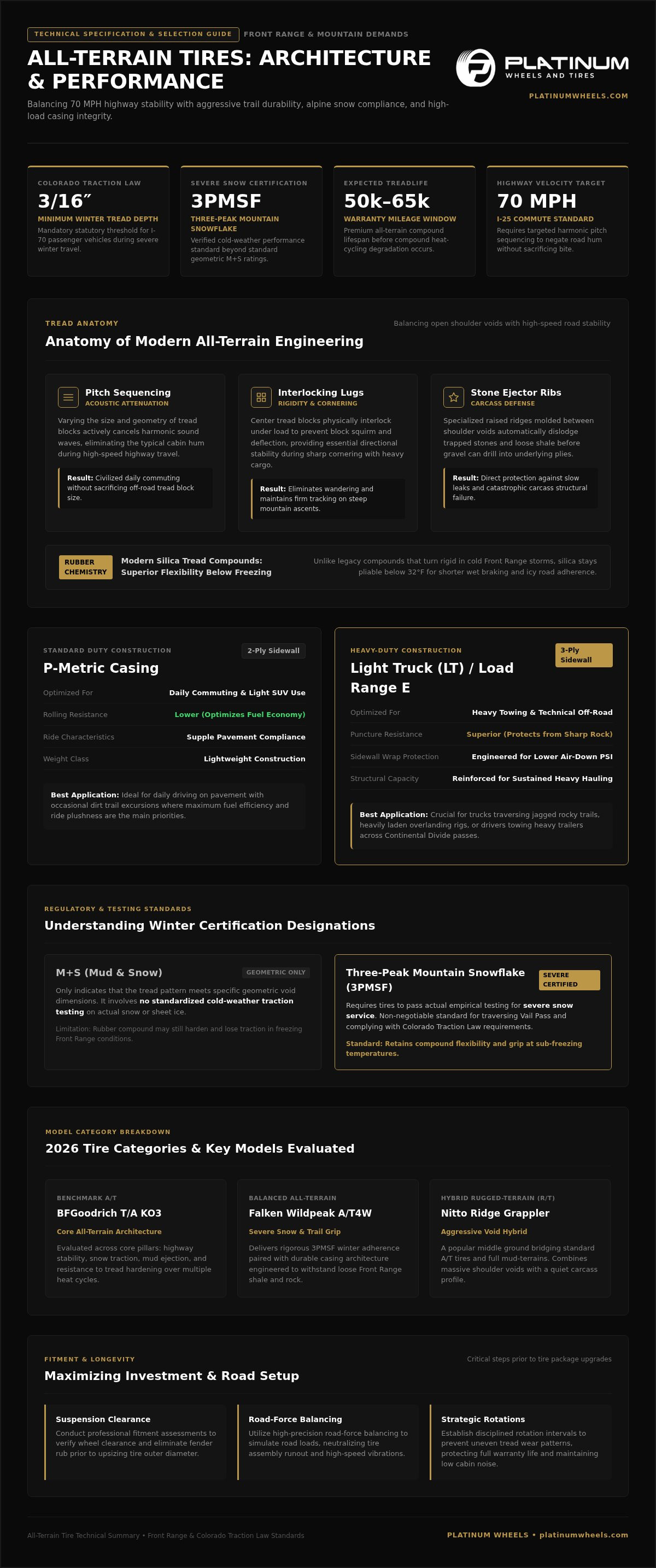
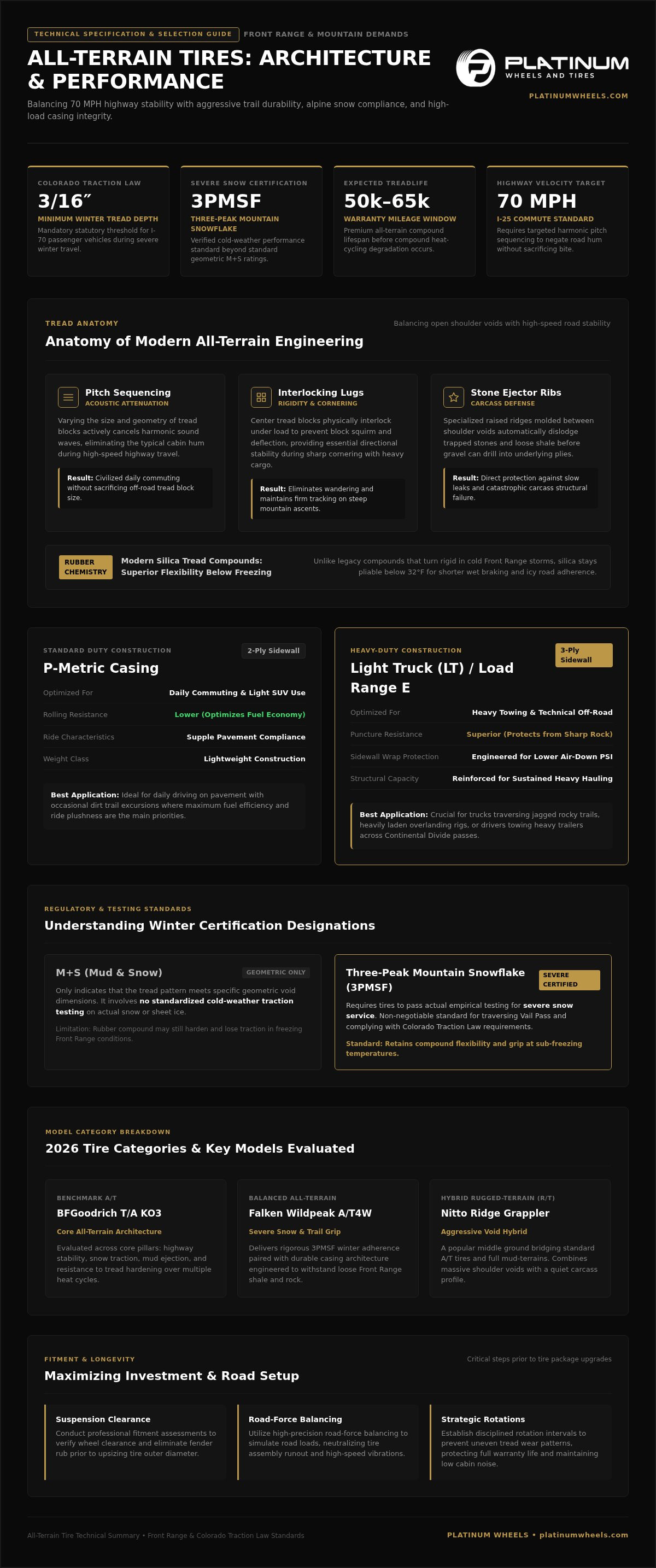
Engineers use pitch sequencing to prevent that annoying harmonic drone at highway speeds. By varying the size and shape of the tread blocks, the tire cancels out sound waves before they reach the cabin. Interlocking center lugs are another key feature. They provide the rigidity needed for stable cornering, especially when you're driving a truck loaded with gear. To protect the tire's internal structure, look for stone ejector ribs. These small ridges located between the shoulder blocks prevent gravel from drilling into the carcass and causing a slow leak or structural failure.
Casing Strength: 2-Ply vs. 3-Ply Sidewall Architecture
Your choice between a P-metric and a Light Truck (LT) casing depends on how you use your vehicle. Standard passenger-metric casings are lightweight and optimize fuel economy, providing a supple ride on pavement. However, if you spend time on jagged rocky trails, an LT casing with 3-ply sidewall architecture is superior. These robust plies offer the puncture resistance necessary to survive sharp obstacles. Many premium designs also feature sidewall wrap protection. This extra rubber extends down the side of the tire, providing crucial bite and protection when you air down for maximum traction on technical terrain.
Top Categories and Performance Metrics for 2026 All-Terrain Tires
Identifying the best all terrain tires for your specific build requires looking past the tread pattern and analyzing how a tire performs under pressure. In 2026, manufacturers have pushed the boundaries with new releases like the BFGoodrich All-Terrain T/A KO3 and the Falken Wildpeak A/T4W. These models are evaluated on four key pillars: highway stability, snow traction, mud ejection, and treadwear longevity. While most high-quality options offer warranties between 50,000 and 65,000 miles, the real test is how the rubber compound ages. Over multiple heat cycles, cheaper compounds can harden and lose their grip, even if the tread looks deep. Ensuring your tires maintain a minimum of 3/16-inch tread depth is vital for safety and compliance with Colorado's Traction Law along the I-70 corridor.
For drivers who want the most aggressive capability without moving to a full mud-terrain, hybrid rugged-terrain (R/T) variants like the Nitto Ridge Grappler have become a popular middle ground. These tires bridge the gap by combining large tread voids with a quieter carcass design. If you're unsure which category fits your weekend plans, you can browse our current selection of New Tires to see how these designs differ in person.
Rugged All-Terrain Workhorses for Heavy Hauling and Trails
Rugged designs feature aggressive shoulder patterns specifically engineered to maintain a bite through thick mud and loose shale. If you frequently tow heavy trailers or drive on sharp gravel roads, look for cut-and-chip resistant compounds. These specialized rubber blends prevent the tread from tearing apart when subjected to high torque and abrasive surfaces. Internal belt construction is equally important for heavy payloads. Load Range E tires utilize reinforced steel belts to maintain an even contact patch, preventing the tire from "crowning" and wearing out prematurely in the center when the truck is fully loaded. For drivers looking to optimize their vehicle build with tailored upgrades, you can discover Motortech 4X4 to see how specialist technicians outfit capable 4WD rigs for demanding conditions.
Daily Driver All-Terrain Options for Commuters and Light Trails
Commuter-focused all-terrain tires prioritize wet asphalt grip and fuel efficiency. These models often feature high-density zig-zag siping, which creates thousands of tiny biting edges for superior traction on light snow and rain-slicked streets. Lightweight casing construction helps preserve the fuel economy of half-ton trucks and SUVs by reducing unsprung weight. To improve your highway experience, these tires utilize optimized continuous center ribs. This design choice provides a stable lane-holding feel and helps eradicate steering wander during the intense crosswinds common across the Eastern Plains and Front Range.
Front Range and Mountain Driving: Choosing Tires for Tough Regional Demands
Driving in Colorado isn't like driving anywhere else. You can leave a 60 degree afternoon in Denver and hit a whiteout blizzard on Loveland Pass an hour later. This rapid transition is exactly why picking the best all terrain tires for this region requires a local perspective. National reviews often miss the nuances of high-altitude driving, where oxygen is thin but the trail hazards are thick. From the gritty sandstone of the Garden of the Gods area to the sharp granite of the high passes, your rubber needs to be as versatile as the weather. For a deeper dive into these specifics, check out our guide on choosing the best all-terrain tires for Colorado.
I-70 Winter Compliance: The Importance of 3PMSF Certification
The Colorado Traction Law is a reality for anyone using the I-70 Mountain Corridor between September 1 and May 31. To stay legal and safe, your tires must have a minimum tread depth of 3/16-inch. While M+S tires are technically allowed, we strongly recommend Three-Peak Mountain Snowflake (3PMSF) certified rubber. This symbol means the tire passed rigorous testing for acceleration on medium-packed snow. Standard all-season compounds often turn rigid and glassy once temperatures drop below 45 degrees. In contrast, winter-rated all-terrain compounds stay pliable. This allows the tread blocks to actually bite into the ice instead of sliding over it, providing the grip you need for steep mountain grades.
High-Altitude Trail Durability: Resisting Mountain Trail Hazards
Once you leave the pavement, the terrain changes from urban asphalt to sharp granite, loose shale, and gritty sandstone. Trails near Boulder and Colorado Springs are notorious for sidewall-slicing rocks. To prevent a trailside flat, you need reinforced multi-ply sidewalls. These extra layers provide a structural shield against pinch flats when navigating technical sections. Additionally, the best all terrain tires for high-altitude use feature self-cleaning tread voids. These wide channels use centrifugal force to fling out slush and wet clay mud. Without this ejection capability, your tread quickly fills up, turning your off-road tire into a useless, slick surface. For those planning specialized technical rock crawling, exploring dedicated options in offroad tires and wheels is the next logical step.
Fitment Essentials: Load Ratings, Sizing, and Suspension Clearance
Selecting the best all terrain tires for your rig is only half the battle. The other half is ensuring those tires actually fit and function without compromising safety or performance. You need to understand the crucial distinction between P-metric, Standard Load (SL), and Load Range E light truck tires. While P-metric tires offer a supple, car-like ride for light SUVs, they lack the structural integrity required for heavy-duty Colorado work. If you're hauling a camper up to Estes Park, you need the 10-ply equivalent construction found in Load Range E models. Just remember that transitioning to these stiffer carcasses requires a shift in mindset regarding tire inflation. LT tires typically require higher PSI than factory passenger tires to support the same load, so checking your door jamb sticker isn't enough; you'll need to consult a load-inflation table.
Tire geometry also plays a massive role in how your vehicle handles. Increased width and overall diameter impact clearance around sway bars and control arms. If you're eyeing a larger set of rubber, understanding how a leveling kit vs lift kit affects your wheel wells is essential. A simple leveling kit might clear 33-inch tires on some trucks, while a full lift kit is necessary to unlock 35s or larger without massive interference. If you want to skip the trial and error, talk to our fitment experts today to find the perfect match for your specific suspension setup.
Understanding Load Index and Ply Ratings for Towing
For those who use their trucks for heavy hauling, Load Range E tires are the gold standard. These tires feature a 10-ply equivalent rating designed to support massive towing loads safely. The benefit isn't just weight capacity; it's stability. Stiffer sidewalls eliminate trailer sway and that unsettling wallowing sensation when your bed is full of camping gear or construction materials. While P-metric tires deliver softer ride comfort for daily commuting, their lower puncture resistance makes them a liability on rocky access roads. Choosing the right rating ensures your tire doesn't just look the part, but performs under pressure.
Preventing Rub: Wheel Offset, Backspacing, and Sizing
Wheel offset is the measurement that moves your tire centerline inward or outward relative to the suspension. Get this wrong, and you'll experience aggressive scrub on frame rails, bumper corners, and inner fender liners. Backspacing works in tandem with offset to determine how much room is left for your brake calipers and control arms. Many enthusiasts try to fix rubbing issues with wheel spacers, but this is often a band-aid for poor wheel choice. Instead, opting for complete aftermarket wheel and tire packages guarantees a pre-engineered fitment. This approach removes the guesswork, ensuring your best all terrain tires have the room they need to cycle through their full range of motion without damage.
Professional Mounting, Balancing, and Setup for Maximum Tread Life
Investing in the best all terrain tires is only the first step toward a capable rig. The real performance comes from how those tires are mounted, balanced, and maintained over their lifespan. You shouldn't trust a high-end set of rubber to a shop that treats heavy truck assemblies like standard sedan tires. Professional setup ensures you actually get the 50,000 to 65,000 miles promised by manufacturers. Without high-precision road-force balancing and a specific alignment protocol, you'll likely deal with persistent highway vibrations and premature tread wear that ruins your investment.
Road-Force Balancing vs. Standard High-Speed Spin Balancing
Standard spin balancers only measure weight distribution, but heavy all-terrain assemblies require more detail. Road-force balancers apply a loaded roller to the tire, simulating the actual weight of your vehicle as it rolls down the road. This process detects internal carcass stiff spots and "out of round" variations that a simple spin balancer misses. By matching the tire's high spot to the wheel's low spot, we eliminate the root causes of steering wheel wobble. This precision is vital for aggressive tires with large tread blocks, ensuring your drive remains smooth even at high highway speeds across the Front Range.
Routine Rotation, TPMS Calibration, and Alignment Protocol
Avoid ignoring your maintenance schedule if you want to prevent heel-toe feathering on aggressive outer shoulder lugs. We recommend rotating your all-terrain tires every 5,000 miles using a modified cross pattern. This specific rotation helps prevent cupping wear, which is common on heavier trucks. If you've transitioned from factory passenger tires to stiff Light Truck (LT) carcasses, your dashboard electronics need an update. You must recalibrate your tpms sensor thresholds to match the higher operational pressures these tires require. This prevents the annoying dash light headache while ensuring your monitoring system stays accurate.
Finally, a professional alignment is the only way to protect your tread from camber wear after a suspension upgrade. When you combine the best all terrain tires with a new lift or leveling kit, the geometry of your front end changes. Our team at Platinum Wheels specializes exclusively in these complex setups. We understand the nuances of Denver driving and high-altitude trail needs. Reach out to us for consultative expertise on your next custom wheel, tire, and suspension project to ensure your vehicle is trail-ready and highway-safe.
Gear Up for the High Country
Mastering Colorado's diverse terrain requires more than just a standard set of rubber. You've learned that selecting the best all terrain tires involves balancing Three-Peak Mountain Snowflake winter compliance with the rugged sidewall durability needed for rocky mountain passes. Whether you're commuting through Denver or airing down for a weekend trail, the right load rating and suspension clearance are the foundation of a safe, capable build.
As Front Range specialists in custom truck wheels, tires, and suspension systems, we take the guesswork out of your setup. Our team provides expert fitment verification to ensure zero wheel rub for drivers across Denver, Aurora, and Lakewood. We don't just sell tires; we provide complete packages featuring precision road-force balancing and professional TPMS programming for total peace of mind. Don't settle for a noisy, vibrating ride when you can have the confidence that comes with a perfectly engineered fitment.
Upgrade your truck with professional tire and wheel packages at Platinum Wheels. We'll see you at the trailhead.
Frequently Asked Questions
What is the difference between all-terrain tires and mud-terrain tires?
All-terrain tires utilize a hybrid tread pattern designed for a 50/50 split between highway comfort and off-road traction. Mud-terrain tires feature much larger tread voids and aggressive sidewall lugs optimized for deep mud and technical rock crawling. While mud-terrains offer superior grip on rugged trails, they often create significant noise on I-25. For most Denver drivers, the best all terrain tires provide a more balanced experience without the excessive highway drone.
Can I run all-terrain tires year-round in Colorado winter weather?
You can run all-terrain tires year-round in Colorado if they feature the Three-Peak Mountain Snowflake (3PMSF) symbol. These tires are engineered with specialized rubber compounds that remain flexible in sub-freezing temperatures. This flexibility is critical for staying compliant with the Colorado Passenger Vehicle Traction Law on the I-70 Mountain Corridor. Without this rating, standard all-season rubber can harden, significantly reducing your braking performance during a sudden Aurora or Lakewood snowstorm.
How much road noise do modern all-terrain tires produce on the highway?
Modern all-terrain tires are remarkably quiet compared to designs from a decade ago. Manufacturers now use computer-tuned pitch sequencing to vary the size of tread blocks, which cancels out harmonic noise at highway speeds. While you might notice a slight hum compared to a standard street tire, premium options are designed to be civilized for daily commutes between Wheat Ridge and Commerce City. Proper road-force balancing is essential to ensure these larger assemblies don't vibrate.
Do all-terrain tires significantly decrease vehicle fuel economy?
Upgrading to all-terrain tires typically results in a minor decrease in fuel economy, often ranging from one to three miles per gallon. This happens because all-terrain designs are heavier and have higher rolling resistance than standard factory tires. If you choose a Load Range E tire for extra durability on rocky trails near Golden, the added weight will impact your efficiency more than a lighter P-metric version. We help you balance these trade-offs based on your specific driving habits.
What does the Three-Peak Mountain Snowflake (3PMSF) symbol indicate on an all-terrain tire?
The 3PMSF symbol indicates that a tire has passed specific industry testing for acceleration on medium-packed snow. It represents a higher standard than the basic M+S (Mud and Snow) rating, which only considers tread geometry. For drivers navigating steep grades in Highlands Ranch or Castle Rock during winter, this certification ensures the tire provides the severe snow traction necessary for mountain safety. It's the industry benchmark for reliable performance in alpine environments.
What is the difference between Load Range C, D, and E all-terrain tires?
These designations refer to the tire's load-carrying capacity and ply rating. Load Range C tires are common for lighter SUVs, while Load Range E tires feature a 10-ply equivalent construction designed for heavy-duty towing and maximum puncture resistance. If you're hauling a heavy trailer through Parker or Colorado Springs, the stiffer sidewalls of a Load Range E tire eliminate unstable wallowing. We match the load index to your vehicle's Gross Vehicle Weight Rating for safety.
How many miles do premium all-terrain tires typically last?
Premium all-terrain tires typically last between 50,000 and 65,000 miles, depending on the specific model and your driving style. To reach this lifespan in the Front Range, you must prioritize regular maintenance. This includes rotating your tires every 5,000 miles and maintaining correct inflation pressures for the heavier casing. Frequent travel on abrasive gravel roads or sharp granite trails near Boulder can accelerate wear, making high-quality rubber compounds even more important for long-term value.
Will upgrading to larger all-terrain tires cause rubbing on my stock suspension?
Upgrading to larger tires often causes rubbing on stock suspension components like sway bars or inner fender liners. This is especially true if you increase the tire's width or overall diameter without adjusting the wheel offset. To avoid this, many owners in Littleton and Arvada install a leveling kit or lift kit. Our team at Platinum Wheels provides expert fitment verification for every package, ensuring your best all terrain tires have the clearance they need for full steering lock.