
Expert Tire Alignment in Denver: Protect Your Truck Tires
You spent serious money outfitting your truck with aggressive all-terrain rubber, but a single brutal pothole on I-25 can leave your steering wheel cocked off-center. Searching for a qualified tire alignment near me often sends you to standard franchise shops that flatly refuse lifted 4x4s or lack the equipment to align them correctly. You shouldn't have to watch your expensive tire tread scrub down to the cords simply because conventional garages don't understand aftermarket builds.
Dialing in your truck's geometry does far more than straighten out the wheel; it directly protects your tire investment, sharpens vehicle handling, and stabilizes aftermarket suspension components across rugged Colorado highways and mountain trails. In this guide, you will learn how to identify whether your steering symptoms stem from alignment or tire balance, understand exactly how lift kits alter factory geometry, and discover how to choose a capable specialist along the Front Range.
Key Takeaways
- Learn how precise adjustments to camber, caster, and toe preserve your contact patch and stop aggressive truck tires from wearing out prematurely.
- Identify subtle steering drift and handling changes early so you can separate simple wheel balance issues from serious suspension misalignment.
- Understand why installing lift kits, leveling kits, or oversized off-road tires alters factory geometry and requires custom calibration beyond standard dealer specs.
- Discover the critical questions to ask when searching for a qualified tire alignment near me equipped to handle wide track widths and modified 4x4 setups.
What Is Tire Alignment and Why Does It Matter?
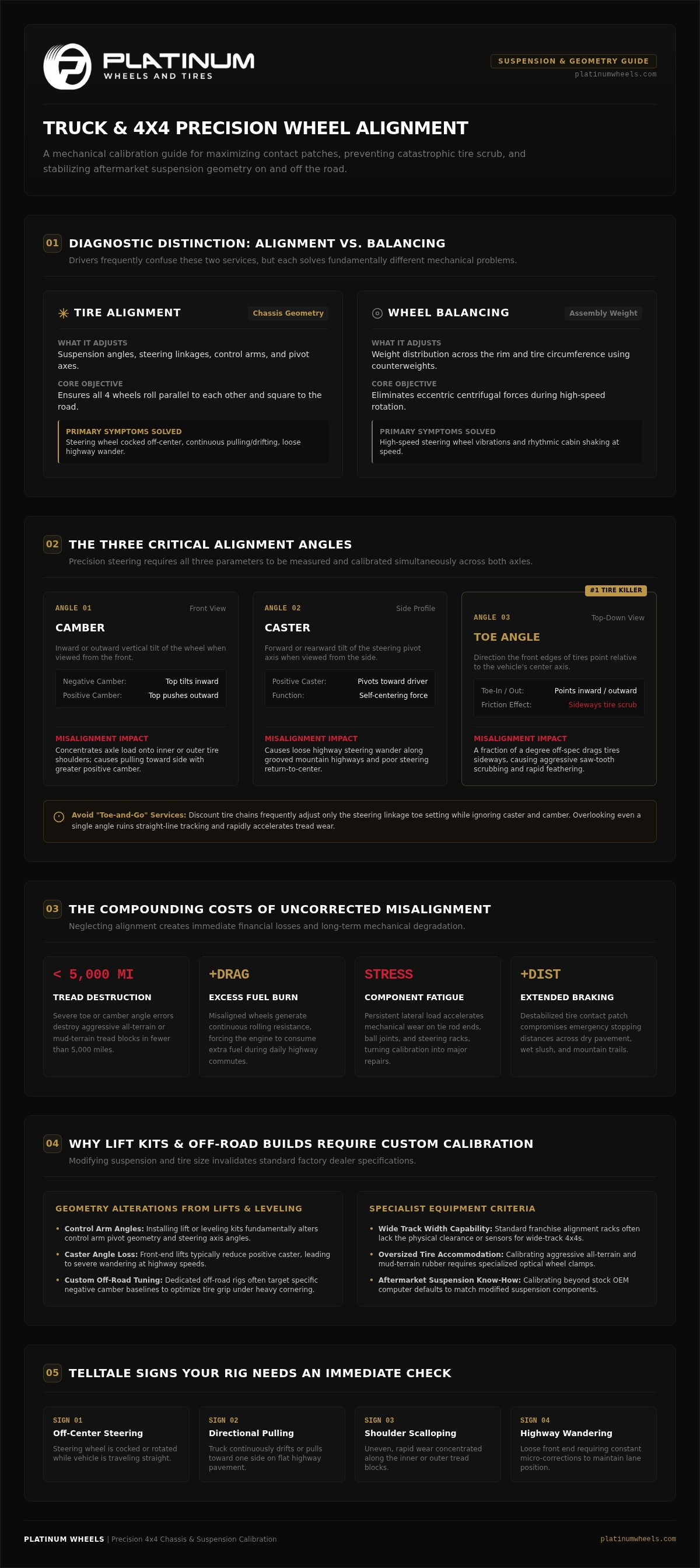
A common misconception among truck owners is that an alignment adjusts the rubber tires or wheels directly. In reality, understanding what is tire alignment requires looking past the wheel face into the chassis itself. Wheel alignment mechanically calibrates your vehicle's suspension geometry to precise factory or custom specifications, ensuring all four wheels roll completely parallel to each other and square to the road surface. This dialed-in positioning maximizes the tire contact patch, providing predictable grip across dry pavement, wet slush, and rocky mountain trails.
When suspension components shift out of true, your truck fights against its own forward momentum. Misalignment creates harsh tire scrub, degrades steering return-to-center capability, and lengthens emergency braking distances by destabilizing the contact patch. Searching out a dedicated tire alignment near me is essential preventative maintenance, especially right after outfitting your rig with fresh all terrain tires designed for rugged Colorado adventures.
Tire Alignment vs. Wheel Balancing: Clearing the Confusion
Drivers often conflate balancing and alignment, yet each resolves a distinct mechanical issue. Wheel balancing corrects microscopic weight distribution discrepancies across the rim and tire assembly using calibrated weights, ensuring the wheel rotates smoothly without eccentric forces. Alignment, by contrast, calibrates the physical steering angles and control arms that dictate how tires meet the pavement. High-speed steering vibrations almost always indicate balance issues, whereas constant pulling or a crooked steering wheel signals chassis misalignment. Dedicated service centers such as MonacoPro Auto Garage regularly inspect both mechanical factors together to ensure optimal ride quality and prevent premature component wear.
The Financial Impact of Neglecting Your Alignment
Ignoring suspension misalignment rapidly turns into an expensive mistake. Severe toe or camber angle errors cause premature shoulder scalloping, destroying aggressive all-terrain or mud-terrain tread blocks in fewer than 5,000 miles. Beyond shredding expensive rubber, misaligned wheels create continuous drag, increasing rolling resistance and forcing your engine to burn extra fuel on daily I-25 commutes. That persistent lateral stress also accelerates mechanical wear on tie rod ends, ball joints, and steering racks, turning a quick calibration check into major chassis repairs down the road.
Understanding Primary Alignment Angles: Camber, Caster, and Toe
Precision steering relies on three geometric parameters working in absolute harmony across both axles. Many discount tire chains offer a quick "toe-and-go" check, adjusting only the steering linkage while ignoring the rest of your front end. A true comprehensive service measures and calibrates camber, caster, and toe simultaneously. Overlooking even one angle ruins straight-line tracking and accelerates tire wear across aggressive tread blocks.
- Camber: Controls inner or outer tire edge contact; misadjustment causes accelerated shoulder wear and pulling toward the side with more positive camber.
- Caster: Stabilizes high-speed directional tracking; misadjustment leads to loose highway steering wander and poor steering wheel return-to-center.
- Toe: Directs straight-ahead parallel rolling; misadjustment causes rapid tread feathering and aggressive saw-tooth scrubbing across the entire tire surface.
Among these three parameters, toe angle stands as the single most aggressive tire-killing factor on modern trucks and SUVs.
Camber Angle: Inward vs. Outward Tilt
Camber represents the inward or outward vertical tilt of the wheel when viewed directly from the front of the vehicle. Negative camber tilts the top inward, while positive camber pushes the top outward. Excess negative camber concentrates your vehicle's heavy front-axle load onto the inner tire shoulder, rapidly grinding down tread blocks. Dedicated off-road rigs often target a tiny amount of negative camber to maximize grip during hard turns, but improper baseline settings destroy expensive rubber quickly.
Caster Angle: Steering Stability and Self-Centering
Caster describes the forward or rearward tilt of your steering pivot axis when viewed from the side profile. Positive caster angles the pivot toward the driver, creating a natural stabilizing force similar to the wheels on a shopping cart. If your truck has insufficient positive caster, the front end wanders unpredictably along grooved mountain highways, forcing you into constant steering corrections just to stay centered in your lane.
Toe Angle: Inward vs. Outward Tire Pointing
Toe measures whether the front edges of your tires point inward toward each other or outward away from the center axis. A fraction of a degree off-spec drags your tires sideways down the highway, generating severe friction and abrasive feathering. If you notice unusual tread scrub after upgrading to a fresh wheel and suspension setup, locate an experienced shop offering precision tire alignment near me to balance these critical angles before your tread disappears.
Telltale Signs Your Vehicle Needs an Immediate Alignment Check
Modern truck suspension systems absorb an immense amount of road punishment before catastrophic handling issues surface. That rugged engineering can easily mask early geometry problems until irreversible damage ruins your tread. Along the Colorado Front Range, severe winter freeze-thaw cycles spawn deep, jagged potholes on high-speed sections of I-25, 6th Avenue, and C-470. A single hard strike at highway speeds can knock your tie rods and cam bolts out of place.
Venturing onto rocky backcountry trails outside Boulder, Idaho Springs, or Rampart Range delivers repeated jarring impacts that slowly fatigue your steering linkages. Scheduling an evaluation with a trusted shop for a tire alignment near me keeps small structural shifts from ruining fresh investments like upgraded aftermarket wheel and tire packages.
Visual Tread Wear Warnings You Cannot Ignore
Catching irregular wear patterns early saves your tread before it scrubs down to the secondary rubber layer:
- Feathering: Slide your palm across the tread face; if individual blocks feel smooth in one direction but bite sharply in the opposite direction, excessive toe misalignment is actively dragging the tire sideways.
- One-Sided Shoulder Wear: Heavy wear isolated along the inner or outer perimeter indicates severe camber angle deviation, forcing the vehicle's corner weight onto a tiny strip of rubber.
- Center Tread Cupping: Scalloped dips or depressions around the circumference point to out-of-spec geometry combined with weak shock damping, causing the tire to bounce rhythmically against the asphalt.
Steering Wheel and Handling Red Flags
Chassis misalignment directly compromises how your truck communicates through the steering wheel. If your steering wheel spoke rests at an off-center angle while cruising straight down a flat highway, your front-end geometry has shifted. Hard pulling toward the shoulder without steering input, a delayed response when initiating turns, or audible tire squeal during low-speed parking garage maneuvers all signal that your wheels are fighting each other. When these symptoms appear, searching for an expert tire alignment near me prevents lasting damage to your tires and suspension linkages.
Why Lift Kits, Leveling Kits, and Larger Tires Require Custom Alignment
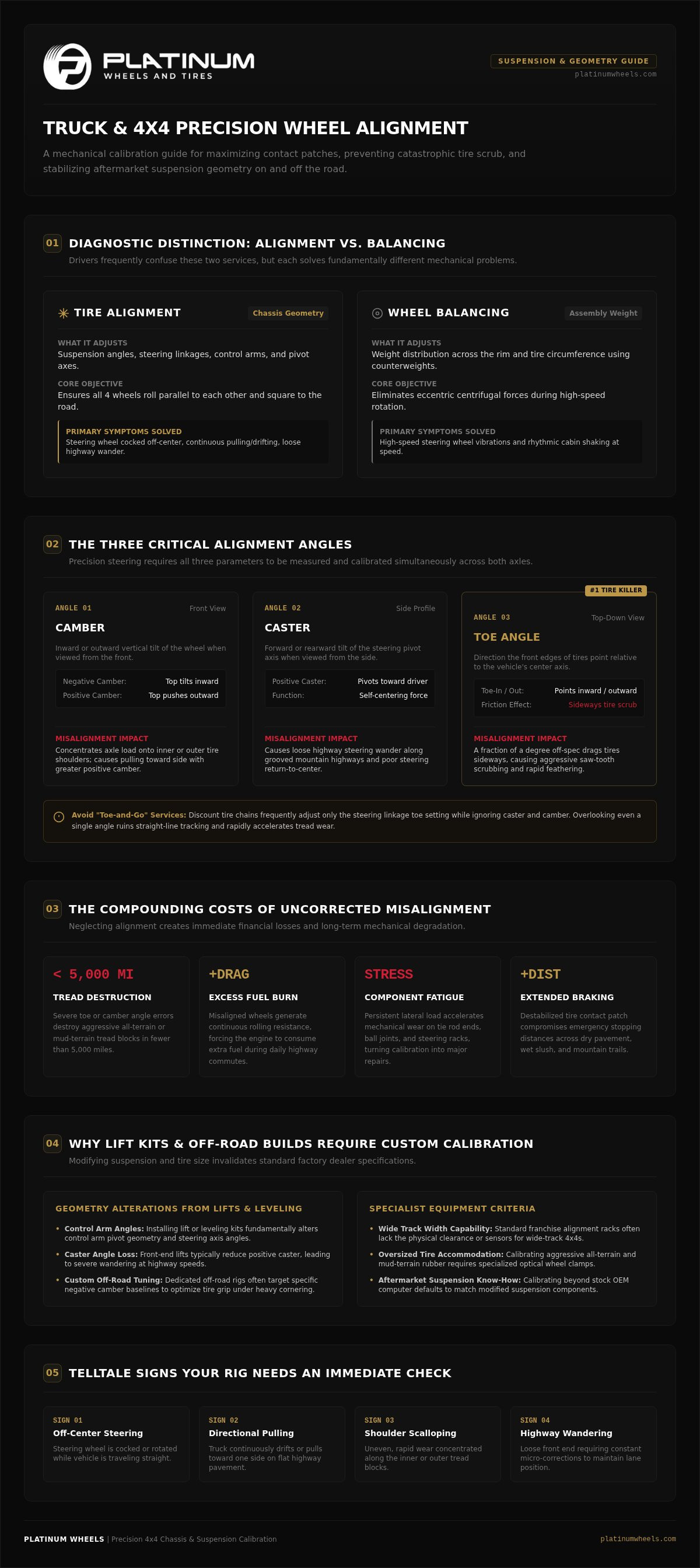
Modifying your truck's ride height fundamentally alters control arm operating angles, rendering factory alignment baselines obsolete. Standard alignment racks rely on computer databases loaded with stock suspension specs. When you alter ride height, track width, or tire diameter, standard dealership targets simply don't apply. Understanding the physical differences in a leveling kit vs lift kit helps explain why suspension changes demand customized geometry. A tailored alignment protects aggressive mud-terrain tread from cupping, restores high-speed stability, and should accompany essential post-upgrade steps like calibrating your tpms sensor system.
The Geometry Shift Caused by Front-End Leveling
Lifting the front end pushes the lower control arms down, effectively tilting the steering knuckle forward and shedding valuable positive caster. This loss creates a flighty, disconnected steering feel that wanders across highway grooves and resists snapping back to center after turns. Factory cam bolts rarely offer enough adjustment range to correct this shift. Equipping your truck with aftermarket upper control arms restores the necessary pivot angle, allowing technicians to re-establish the caster needed for stable highway tracking.
Compensating for Oversized Tires and Negative Offset Wheels
Bolting on 33-inch or 35-inch tires paired with aggressive negative-offset wheels significantly widens your track width and pushes the tire scrub radius outward. This increased leverage amplifies steering stress, meaning even fractional toe errors scrub rubber at an accelerated rate. Precision alignment adjustments also optimize caster and setback to prevent oversized shoulder lugs from rubbing against cab mounts or inner fender liners at full steering lock.
Finding a reliable shop when searching for a tire alignment near me ensures your modified platform receives expert attention rather than generic factory shortcuts. When you want to protect your investment and optimize handling, upgrade your setup with purpose-built wheel and suspension packages at Platinum Wheels.
How to Choose the Right Precision Alignment Specialist Near You
Selecting the right service center requires evaluating equipment capacity and technician expertise. Most corporate franchise shops operate standard passenger-car racks designed strictly for narrow factory track widths and stock wheelbases. Driving a lifted 4x4, an extended-cab truck, or a vehicle running high-offset wheels onto these standard ramps often leads to clamped sensor interference or outright service refusal. You need a facility equipped to handle modified platforms and specialized fitments—much like how larger commercial vehicles rely on specialized providers such as AA Truck Body & Paint for heavy-duty structural care and bodywork.
Clearly communicating your driving habits allows technicians to dial in custom angles rather than locking your steering into generic factory presets. If you haul heavy trailers over mountain passes or spend weekends tackling rocky forest trails, mention those details up front so your caster and toe targets reflect actual real-world loading.
Key Questions to Ask Before Handing Over Your Keys
Screen any potential garage thoroughly before letting them adjust your suspension:
- Rack and Rim Compatibility: Does your lift rack accommodate wide-track stances, and do your wheel clamps attach safely to delicate custom lip finishes without scratching the paint?
- Diagnostic Technology: Do you use high-definition optical digital imaging systems rather than rudimentary bubble gauges or outdated light sensors?
- Verifiable Documentation: Will you deliver a comprehensive before-and-after diagnostic printout verifying exact primary angles for both the front and rear axles?
Partnering with Front Range Wheel and Suspension Specialists
Trucks built for Colorado demand a shop rooted in off-road culture. A dedicated specialist understands how altered roll centers and taller sidewalls interact with mountain roads, bridging the gap between hardware installation and geometry tuning. Upgrading to aggressive custom wheels and rims designed for high-altitude driving requires precise fitment verification so tires never contact control arms at full steering lock.
Searching for a reliable tire alignment near me shouldn't leave you guessing whether your modified build is in good hands. Partner with local experts who focus strictly on trucks and 4x4s. Build your ultimate wheel and suspension setup with the knowledgeable team at Platinum Wheels.
Lock In Your Suspension Geometry and Maximize Tire Life
Outfitting your truck with aggressive rubber and custom rims is a major investment, but dialed-in suspension geometry is what keeps that investment alive. Colorado's harsh freeze-thaw cycles and rugged backcountry trails test your chassis constantly. Choosing the right specialist when looking for a tire alignment near me makes all the difference between replacing scalloped tires prematurely and enjoying miles of predictable, centered highway handling.
Modified trucks require an expert touch that understands altered roll centers, wider offsets, and lifted control arm angles. As the Denver Front Range specialist for custom truck wheels, all-terrain tires, and leveling systems, Platinum Wheels focuses on precise fitment and suspension integration for your 4x4. Upgrade Your Stance and Protect Your Tires at Platinum Wheels today, and hit the highway with complete confidence in your build.
Frequently Asked Questions
How often should I get an alignment on my truck or SUV?
Get an alignment checked every 6,000 to 10,000 miles, or at every other oil change and tire rotation. Driving across rough Colorado trails or hitting seasonal potholes around Denver accelerates suspension drift. Even if you don't feel a strong pull, annual geometry checks prevent minor angle deviations from scrubbing down expensive all-terrain rubber over your daily Front Range commutes.
Can hitting a pothole knock my front end out of alignment?
Yes, striking a deep pothole at speed can instantly knock your suspension geometry out of specification. The violent impact bends tie rods, shifts control arm bushings, or rotates eccentric alignment cam bolts. Front Range freeze-thaw cycles make roads like I-25 and 6th Avenue notorious tire hazards. Searching for a precision tire alignment near me immediately after a hard impact prevents rapid tire feathering.
Is a 4-wheel alignment necessary, or is a front-end alignment enough?
A comprehensive 4-wheel alignment is always recommended over a simple front-end adjustment. Even on solid rear axle trucks where rear angles are fixed, a full alignment ensures the front wheels calibrate precisely relative to the rear thrust line. Adjusting only the front wheels can leave your truck dog-tracking down the highway, causing uneven handling, crooked steering wheels, and premature shoulder wear.
Why does my truck pull to one side even after an alignment?
Persistent pulling after an alignment usually stems from uneven tire pressure, radial tire pull, or highway road crown. Radial pull occurs when internal tire belt construction creates conicity, causing the tire to roll slightly like a cone. Technicians diagnose this by swapping front tires side-to-side. Alternatively, steep road crowns designed for rain drainage naturally cause a slight rightward drift on local highways.
Do I need an alignment immediately after installing new tires?
You should always verify alignment angles whenever mounting fresh tires onto your truck or SUV. New rubber does not cause misalignment, but existing suspension angle errors will immediately begin grinding down virgin tread blocks. Getting an alignment check when purchasing a fresh set of all-terrain or mud-terrain tires safeguards your financial investment and ensures you get full rated tread life.
What happens if I lift my truck and skip the wheel alignment?
Skipping an alignment after installing a lift kit causes severe tire destruction, darting highway handling, and unpredictable steering. Elevating the ride height pulls the steering knuckles inward and drops tie rods out of plane, creating extreme toe-in and stripping positive caster. This geometry shift makes high-speed driving dangerous while scouring outer tread blocks down to the cords within a few hundred miles.
How long does a professional precision alignment service typically take?
A standard computerized alignment check and calibration typically takes between 45 and 90 minutes. Modern digital imaging racks measure all primary angles in minutes, but trucks equipped with aftermarket control arms, lift kits, or seized adjustment cam bolts require extra technician bench time. Looking for a specialized tire alignment near me ensures technicians take the proper care needed to dial in custom suspension setups accurately.