
Best Mud Terrain Tires for Denver Off-Roading
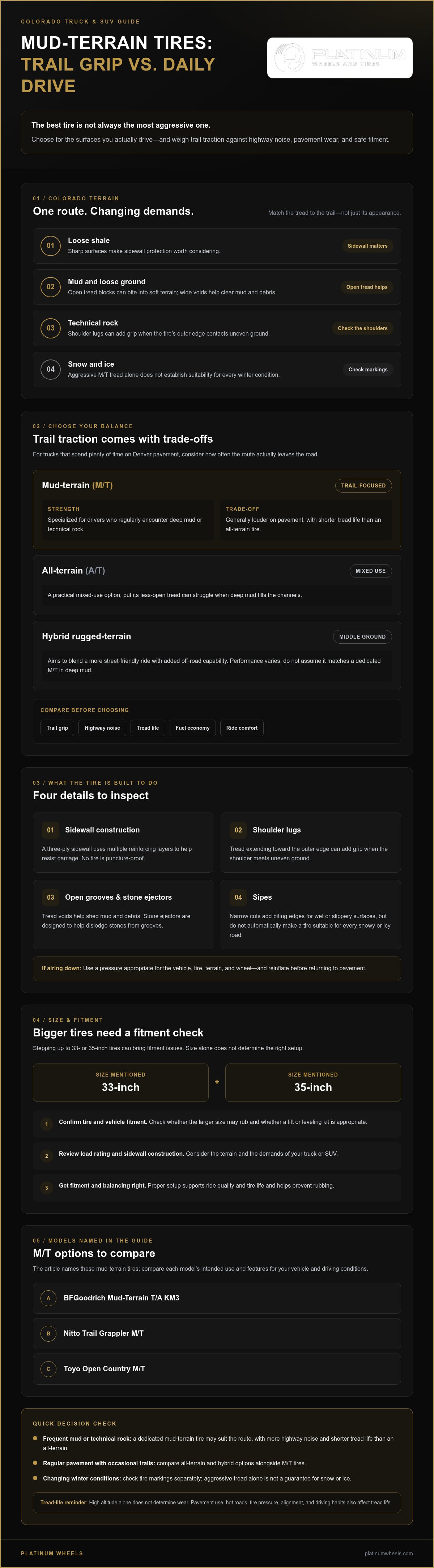
The most aggressive mud terrain tires might be the wrong choice for a Denver truck that spends more time on I-25 than on the trail. You want confident grip in Colorado mud and on rocky routes, but the trade-offs matter: louder highway driving, faster wear on pavement, and possible fitment issues when stepping up to 33- or 35-inch tires.
So which tire offers the best balance of trail traction and everyday manners? This guide compares options such as the BFGoodrich Mud-Terrain T/A KM3, Nitto Trail Grappler M/T, and Toyo Open Country M/T. It also explains when a hybrid tire may better suit a daily driver, what to check before choosing a larger size, and whether your truck needs a lift or leveling kit. You’ll learn why proper fitment and balancing matter for ride quality and tire life, so you can choose a setup for your truck, SUV, and Colorado adventures.
Key Takeaways
- Match your tire choice to Colorado’s mix of loose shale, mud, and technical rock, not just the most aggressive tread pattern.
- Compare mud terrain tires with all-terrain options for trail grip, highway noise, tread life, and fuel economy.
- Compare five tire options to find a fit for your off-road plans and daily driving needs.
- Understand why sidewall construction matters on rocky trails and what to consider before choosing a larger tire size.
- Learn how professional fitment, balancing, and the right lift or leveling kit can help prevent rubbing and support confident trail use.
Why Mud Terrain Tires are Essential for Colorado’s Backcountry Trails
Colorado’s backcountry doesn’t present one consistent surface. A route may move from loose shale to a muddy climb, then demand careful tire placement over uneven rock. Higher elevations can also bring snow, but an aggressive tread alone doesn’t guarantee confidence in every winter condition. The right setup depends on where you drive, how often you leave pavement, and what your truck or SUV can safely accommodate.
The Functional Edge: Traction Beyond the Pavement
Off-road tires are a category of vehicle tires designed with deeper tread to help gain traction on surfaces such as mud and gravel. On a trail, large tread blocks can press into soft ground and uneven terrain. Wide channels, known as voids, help release mud and debris as the tire rotates. This self-cleaning action helps keep tread edges available to grip, rather than letting packed mud turn the tread into a smoother surface.
All-terrain tires suit mixed use, but their less open tread can struggle when deep mud fills the channels, especially on a muddy mountain pass. Mud terrain tires are a more specialized option for drivers who regularly encounter that terrain or technical rock. The aggressive look has a functional purpose when the route gets rough.
Balancing the Daily Commute and the Weekend Trail
There’s a trade-off. More open, aggressive tread can improve performance in mud and on loose surfaces, but it generally means more road noise and shorter tread life than an all-terrain tire. If your truck sees plenty of Denver pavement, consider how often you’ll use the trails before choosing the most aggressive pattern.
Hybrid rugged-terrain tires offer a middle ground for some daily-driven trucks and SUVs. They aim to blend a more street-friendly ride with added off-road capability, though performance varies by tire and conditions. Compare each tire’s intended use and features rather than assuming a hybrid will match a dedicated M/T in deep mud.
Set Expectations for Colorado Driving
High altitude by itself doesn’t determine how quickly a tire wears. Frequent pavement driving, hot roads, tire pressure, alignment, and driving habits all affect tread life. A heavy, aggressive tire can also change the feel of your commute, so weigh highway noise and ride comfort alongside trail grip.
For Denver-area drivers moving from street-focused tires, start with the trails you plan to tackle and how often you’ll drive there. Check the tire’s winter markings separately if snow is part of your routine. An M/T tread pattern alone doesn’t establish suitability for every snow or ice condition.
The Anatomy of a High-Performance Mud Terrain Tire
A mud-terrain tire is built for off-road traction, with open tread blocks and wide grooves that help it bite into soft ground and clear mud. Those features are only part of the package. For Colorado trails, look beyond tire size and load rating to sidewall construction, shoulder design, rubber compound, and details such as stone ejectors. Each can affect how the tire responds to shale, rocks, and changing conditions.
Sidewall Armor and Shoulder Lugs
Sharp shale can threaten a tire’s sidewall, an area that doesn’t benefit from the main tread’s contact with the ground. A three-ply sidewall uses multiple layers of reinforcing material to help resist damage, though no tire is puncture-proof. Sidewall puncture resistance describes a tire’s ability to withstand sharp impacts or cuts along its side, reducing the risk of damage that could end a rock-crawling run.
Shoulder lugs extend the tread pattern toward the tire’s outer edge, adding grip when the shoulder contacts uneven ground. That can matter when crawling over rocks or driving with reduced tire pressure, a technique some off-roaders use to increase the contact patch. Airing down requires care: use a pressure appropriate for the vehicle, tire, terrain, and wheel, and reinflate before returning to pavement.
Tread Patterns and Siping
Look for a tread pattern that can shed packed dirt instead of letting it fill the voids between blocks. Some tires also use stone ejectors, raised features in the grooves designed to help dislodge stones. Clearing debris can help limit stones lodging in the tread and damaging the casing over time.
Sipes are narrow cuts in tread blocks. They add biting edges that can help on wet or slippery surfaces, but their presence doesn’t make a tire automatically suitable for every snowy or icy road. Check the tire’s markings and the rules for your route. The Colorado Department of Transportation explains the applicable requirements in Colorado's Traction Law.
Open tread can also create more road noise. Some tire designs use varied block shapes and spacing to help reduce repetitive sound, but results differ by model, vehicle, and road surface. If highway comfort matters, compare noise feedback along with the tread and construction details.
Rubber compound adds another trade-off. A softer compound can conform to irregular rock for grip, while a harder compound may prioritize wear life. Actual performance depends on the tire’s design and use. For Denver-area truck owners comparing construction and fitment, off-road tire and wheel options can help frame a setup around the vehicle and intended terrain.
Mud Terrain vs. All-Terrain: Making the Right Choice for Your Daily Driver
The best tire depends on where your truck spends its time. All-terrain tires generally make a more comfortable choice for frequent pavement driving, while mud-terrain tires trade some highway refinement and tread life for added traction in deep mud and rough terrain. Neither category is automatically right for every Colorado driver. Start with your actual driving mix, then weigh trail demands against daily comfort.
The Highway Trade-off
Aggressive tread blocks and open grooves can create a noticeable hum on the highway. Modern tread designs may use varied block shapes and spacing to reduce repetitive noise, but there’s no single decibel difference that applies to every A/T and M/T tire. Vehicle, tire size, road surface, and speed all affect what you hear. If your routine includes long I-25 drives, compare specific models and look for feedback from drivers using similar vehicles.
A heavier, more aggressive tire can also increase rolling resistance, which may affect fuel economy. The change depends on the tire and vehicle, so treat it as a possible trade-off rather than a guaranteed figure. Tread life varies just as widely. Fixed comparisons such as 40,000 versus 60,000 miles can be misleading without model-specific warranty information and the conditions behind those estimates. Heat, pressure, alignment, rotation, and driving habits all influence wear. The U.S. Tire Manufacturers Association offers guidance on proper tire care and maintenance.
Trail Capability: Where the M/T Dominates
On packed dirt or moderate gravel, a quality A/T may provide the traction most drivers need. In deep, sticky mud, its tread channels can pack with material and lose their ability to bite. An M/T’s more open pattern is designed to clear mud and maintain traction in conditions where an A/T may struggle. On rocky routes, consider the tire’s construction as well as its tread, especially if the trail involves sharp edges or uneven side loads.
Snow and ice call for extra care. An aggressive mud tread doesn’t automatically provide strong grip on packed snow or ice, and the tire’s winter rating and condition matter. Check the requirements for your route instead of assuming an M/T is winter-ready.
Use an “off-road percentage” as a planning guide, not a strict formula. An 80/20 driver who spends most miles commuting may prefer an A/T or a more road-friendly hybrid. A 50/50 driver who regularly tackles muddy or technical trails may find the M/T trade-offs worthwhile. If pavement comfort is your priority, explore this all-terrain tires guide before choosing a setup.
Top 5 Mud Terrain Tires for 2026: Performance Roundup
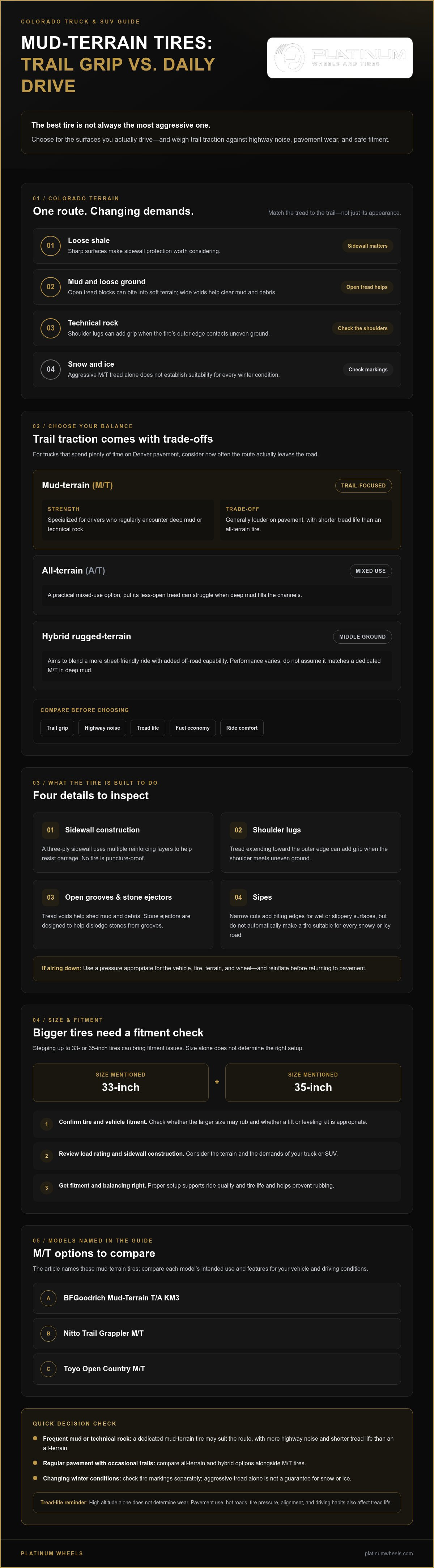
A list of popular tires is a useful starting point, not a guarantee that a tire suits every Colorado truck. Consider these five options, then compare size, construction, road manners, and fitment for your vehicle and trail plans.
- BFGoodrich Mud-Terrain T/A KM3: An option to investigate if you prioritize dedicated off-road use. Confirm the available size and construction meet your vehicle’s needs.
- Nitto Trail Grappler M/T: A recognized mud-terrain choice. Compare its specifications and owner feedback with your expected highway use rather than relying on reputation alone.
- Toyo Open Country M/T: Another dedicated M/T contender for truck applications. Check load requirements and exact fitment for your vehicle.
- Mickey Thompson Baja Boss M/T: A model worth comparing for trail-focused setups. Review its published construction details before choosing it for sharp, rocky routes.
- Nitto Ridge Grappler: A rugged-terrain hybrid, not a dedicated M/T. Consider it if you want to balance off-road capability with daily-driver comfort.
There isn’t enough comparable noise or pricing information here to honestly name a single “quietest” or “value king” tire. Ask for model-specific details, including warranty terms and construction, and compare them with the roads and trails you actually drive. The Ridge Grappler may be a sensible starting point for a daily driver weighing a hybrid against a more aggressive tread, but verify that its characteristics suit your priorities.
Nitto and Toyo: Compare for Your Use
Rather than treating either brand as an automatic winner, compare the Trail Grappler M/T and Open Country M/T by size, load requirements, tread design, and your balance of pavement and trail miles. For a broader brand comparison, see this Nitto and Toyo tire comparison, keeping in mind that its focus is all-terrain tires.
Fitment for Colorado Front Range Trucks
Temperature swings make it especially important to follow the tire maker’s pressure and maintenance guidance rather than assuming one setup suits every condition. A 35-inch tire isn’t a universal fit for Ford or Chevrolet trucks: clearance depends on the specific vehicle, wheel setup, and suspension. A lift or leveling kit may be needed, but confirm fitment before buying. Review this off-road tires and wheels fitment guide as you plan the full setup.
For local guidance on matching mud terrain tires, wheels, and suspension upgrades, explore wheel and tire packages at Platinum Wheels.
Professional Fitment and Installation: Getting Your Truck Trail-Ready in Denver
Choosing mud terrain tires is only part of building a capable setup. Larger, heavier tires need to match your truck’s wheel specifications, available clearance, and suspension. A tire that looks right on paper can rub against the fender or suspension components when you turn or travel over uneven ground. Confirming fitment before purchase helps avoid costly surprises and prepares your setup for both the trail and the drive there.
Suspension Synergy: Lift and Leveling Kits
A leveling kit or lift kit can create additional clearance, but neither guarantees that a particular tire size will fit every truck. Vehicle model, wheel width and offset, and suspension travel all affect clearance. Use this guide to understand the differences between a leveling kit and lift kit, then confirm the combination for your exact vehicle and intended tire size.
Avoid guesswork with trimming or other “trim and tuck” changes. Rubbing can happen only at full steering lock or when the suspension compresses, so a quick visual check at rest may not reveal every clearance issue. Ask an experienced fitment professional to assess the wheel and tire combination before installation. If suspension height changes, ask whether the vehicle needs an alignment afterward. Proper alignment helps support predictable handling and even tire wear.
Mounting, Balancing, and TPMS
Large off-road tires demand careful mounting and balancing. A properly seated tire and balanced wheel help reduce vibration and support a smoother ride, especially on highways between Denver and trailheads. The right wheel and tire package should also account for load requirements and vehicle fitment, not just appearance.
Don’t overlook TPMS sensors during an upgrade. Your vehicle’s tire-pressure monitoring system depends on compatible sensors to report pressure information, so verify sensor compatibility when selecting new wheels and tires. Platinum Wheels offers wheel and tire packages that can include TPMS sensors, helping keep the components of the setup matched.
Plan the Complete Setup
Platinum Wheels serves Colorado’s Front Range with off-road tire and wheel options, plus professional installation of lift and leveling kits. For Denver truck owners, coordinating tire size, wheels, sensors, and suspension can help prevent fitment surprises. Explore these aftermarket wheel and tire packages as you plan a complete upgrade.
Ready to discuss a setup for your truck? Explore tire and suspension options at Platinum Wheels.
Choose a Setup That’s Ready for Colorado Trails
The right tire choice starts with an honest look at your driving: prioritize the aggressive grip of mud terrain tires for frequent deep-mud and rocky routes, or consider an all-terrain or hybrid option if highway comfort matters more. Just as important, match tire size to your truck’s clearance and suspension so the setup works beyond the showroom.
Platinum Wheels serves Denver and the Colorado Front Range with wheel and tire fitment, plus lift and leveling kits for off-road setups. Wheel and tire packages can also be matched with TPMS sensors, helping you plan the upgrade as a complete system rather than a collection of separate parts.
Upgrade your truck with professional mud terrain tire installation at Platinum Wheels and get guidance on a setup suited to your vehicle and Colorado adventures. Choose carefully, fit it properly, and head toward the trail with confidence.
Frequently Asked Questions
Are mud terrain tires good for daily driving in Denver?
They can work for daily driving, but expect more tread noise and potentially faster wear than with many all-terrain tires. If your truck spends most of its time commuting on pavement, consider whether you’ll use the extra mud and rock traction often enough to accept those trade-offs. For frequent trail use, an M/T setup may make sense. Compare specific tire models and think about your regular routes before deciding.
How long do mud terrain tires typically last?
There isn’t one reliable mileage figure for every mud-terrain tire. Tread life depends on the tire model, vehicle, road conditions, inflation pressure, alignment, rotations, and driving habits. Frequent highway miles and hot pavement can contribute to faster wear than occasional trail use alone. Check the manufacturer’s warranty and maintenance guidance for the exact tire you’re considering, and monitor tread condition regularly rather than relying on a generic lifespan estimate.
Do I need a lift kit to run mud terrain tires?
Not always. Whether you need a lift or leveling kit depends on the tire’s actual size, your vehicle, wheel width and offset, and available clearance during turns and suspension travel. A larger tire may rub even if it appears to fit while parked. Have the specific combination checked before buying. Platinum Wheels offers lift and leveling kits, with professional installation, to help accommodate suitable larger tire setups.
Are mud terrain tires noisy on the highway?
They’re generally louder than comparable all-terrain tires because their open tread blocks interact differently with pavement. The sound varies by tire design, size, vehicle, speed, and road surface, so there’s no single noise level that applies to every M/T. Some designs aim to reduce repetitive tread hum, but they may still be noticeable on Denver-area highway commutes. If cabin comfort matters, compare model-specific reviews and consider a hybrid option.
How do mud terrain tires perform in Colorado snow?
Performance varies by tire, and an aggressive mud tread alone doesn’t guarantee dependable grip on packed snow or ice. Check the tire’s winter markings and condition, and follow requirements for your route. For example, Colorado’s I-70 traction law requires qualifying tires on AWD and 4WD vehicles to meet tread-depth and tire-rating criteria during its seasonal enforcement period. Four-wheel drive by itself doesn’t establish compliance.
What is the best mud terrain tire for rock crawling?
There isn’t one best choice for every rock-crawling vehicle and route. Compare sidewall construction, tread and shoulder design, available sizes, and fitment for your truck. The BFGoodrich Mud-Terrain T/A KM3 is one option to compare, but no single model is ideal for every crawler. Match the tire to your terrain, vehicle requirements, and balance of trail use with highway driving.
Can I use my factory wheels with new mud terrain tires?
Possibly, if the factory wheels meet the tire’s approved width and load requirements and fit your vehicle correctly. The tire’s overall size also needs to clear suspension and body components through steering turns and suspension movement. Don’t assume a larger tire will fit simply because it mounts to the original wheel. Confirm the specifications for your exact wheel and tire combination, including TPMS sensor compatibility, before purchasing.
Why is professional balancing so important for large M/T tires?
Large off-road tires and wheels need careful mounting and balancing to help reduce vibration and support predictable highway handling. An imbalance may be felt through the steering wheel, seat, or floor, especially at speed. Platinum Wheels provides wheel and tire packages with professional mounting and balancing, plus TPMS sensors. Its Colorado Front Range fitment guidance serves drivers in Denver, Aurora, Lakewood, Englewood, Wheat Ridge, Commerce City, Westminster, Thorton, Broomfield, Arvada, Golden, Littleton, Parker, Highlands Ranch, Castle Rock, Boulder, Fort Collins, and Colorado Springs.