
RAM 2500 Custom Wheels Denver: Upgrade Your Heavy-Duty Ride
Your Ram 2500 is a precision-engineered powerhouse, but the wrong set of ram 2500 wheels can turn it into a liability the moment you hook up a heavy trailer. It's easy to get distracted by a sleek finish or a deep dish design, but for a heavy-duty truck, wheel selection is a safety and engineering decision first. You want that aggressive, wide stance that commands respect on Denver streets, yet the anxiety over 8-lug bolt patterns and tire rubbing is enough to stall any upgrade. It's a common concern for Colorado owners who need their rigs to perform on the job site and the trail alike.
We understand that you don't want to choose between a rugged look and actual utility. This guide will help you master the technical requirements for your truck to ensure it looks incredible while maintaining every pound of its towing and payload capacity. We'll dive into the specifics of the 8x165.1mm bolt pattern, the importance of a 121.3mm hub bore, and how to choose the perfect offset to avoid the dreaded "death wobble" or alignment issues. You'll learn exactly how to achieve a perfectly flush fitment that handles the Rocky Mountain terrain with ease.
Key Takeaways
- Master the heavy-duty requirements for ram 2500 wheels, including the 8x165.1 bolt pattern and the importance of hub-centric designs to eliminate highway vibrations.
- Learn how to balance visual impact with mechanical health by choosing the right offset to move away from the tucked-in factory stance without causing premature component wear.
- Discover why forged wheels offer the ultimate strength-to-weight ratio for the heavy Cummins diesel engine, especially when tackling rugged Colorado trails.
- Get the facts on fitting 35-inch or 37-inch tires, including why a 2.5-inch leveling kit is often the key to achieving a rub-free, aggressive look.
- Understand why high-capacity mounting and professional TPMS calibration are essential for maintaining safety and performance in heavy-duty truck applications.
Ram 2500 Wheel Specs: Bolt Patterns, Hub Bore, and Load Ratings
Upgrading a heavy-duty truck isn't just about picking a design that looks good in the driveway. It's about engineering. Your Ram 2500 is a workhorse designed to carry thousands of pounds and tow even more. Choosing the right ram 2500 wheels requires a solid grasp of wheel sizing specifications to ensure your new setup doesn't fail when you're hauling a trailer up I-70. Safety starts with the foundation; specifically, how that wheel connects to your axle.
Decoding the 8-Lug Bolt Pattern
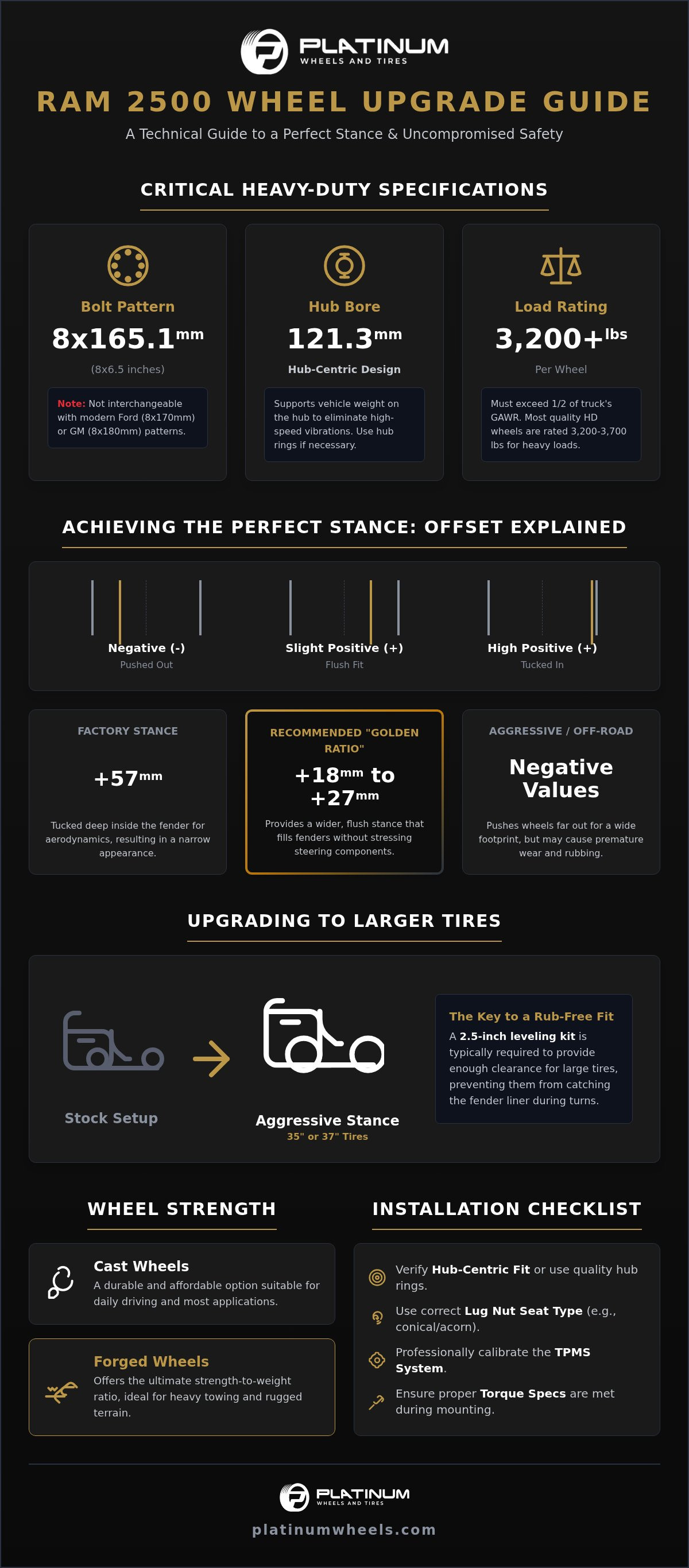
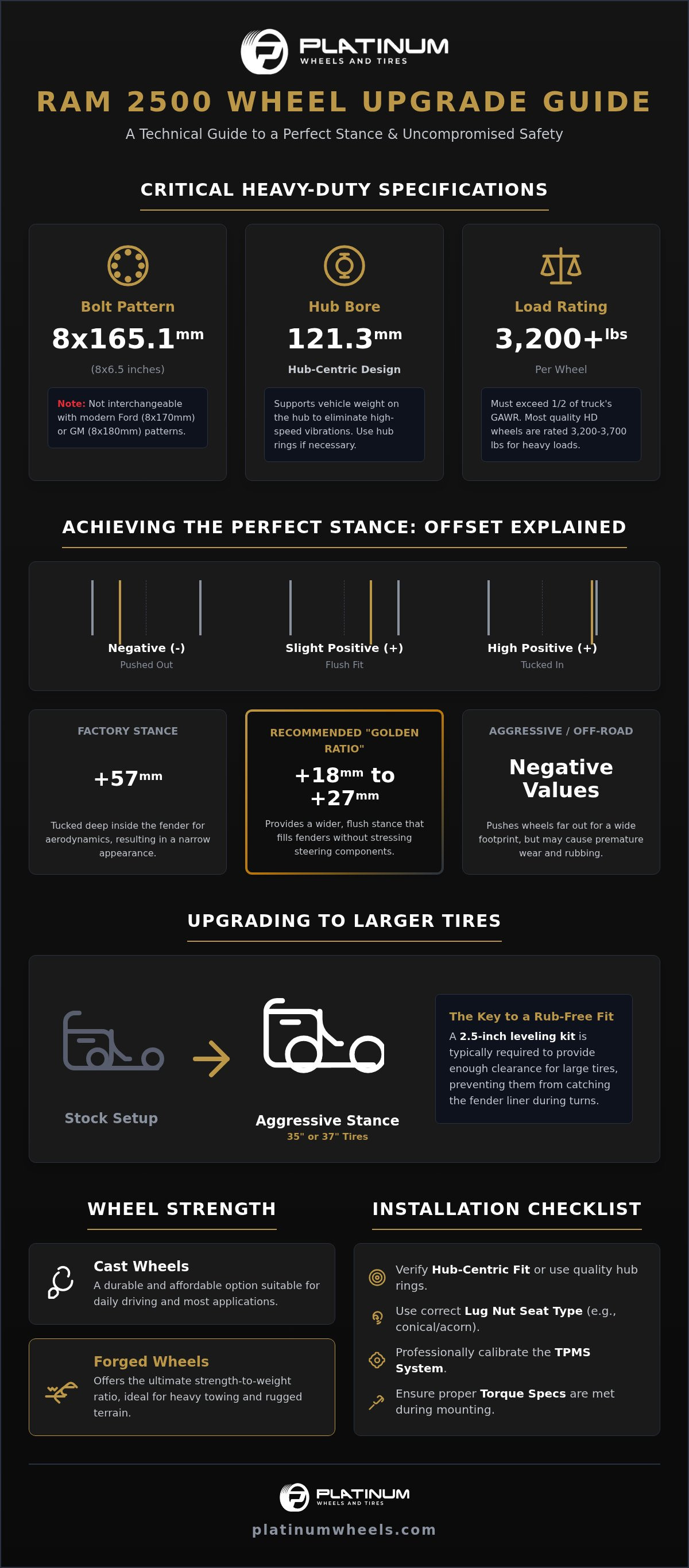
The Ram 2500 platform utilizes a 8x165.1mm bolt pattern, which is also commonly referred to as 8x6.5 inches. This has been the heavy-duty standard for decades. It's vital to remember that you cannot swap wheels from a modern Ford or GM 8-lug truck. Ford moved to a 170mm pattern years ago, and GM transitioned to 180mm around 2011. Even if the holes look close, they won't line up. Precision is key here.
Beyond the bolts, you must account for the 121.3mm hub bore. Ram 2500 trucks are hub-centric, meaning the center of the wheel rests on the hub itself to support the vehicle's weight. Many aftermarket wheels are lug-centric, which places the entire load on the studs. At Platinum Wheels, we always recommend hub-centric wheels or high-quality hub rings to ensure a vibration-free ride. You also need to verify your lug nut seat type. Most heavy-duty aftermarket wheels use a conical or "acorn" seat, while some specialty rims might require flat washers. Using the wrong hardware is a recipe for sheared studs on the trail.
Load Ratings: The Safety Factor for Towing
Never sacrifice strength for style. Every wheel has a maximum load rating stamped on the back of a spoke or the barrel. To find your minimum requirement, look at the Gross Axle Weight Rating (GAWR) on your driver's side door jamb. If your rear GAWR is 6,000 pounds, each of your ram 2500 wheels must be rated for at least 3,000 pounds. Most reputable HD wheels are rated between 3,200 and 3,700 pounds to provide a safety margin for the Cummins diesel's immense weight.
Many "budget" wheels designed for lighter trucks or SUVs simply aren't built for 3/4-ton applications. They might look aggressive, but they can crack or deform under the stress of a fifth-wheel trailer. If you plan on running 12.50-inch wide tires, ensure your rim is at least 8.5 to 9 inches wide. A rim that's too narrow will cause the tire to "balloon," leading to uneven tread wear and unstable handling at highway speeds. We suggest sticking with wheels specifically engineered for heavy-duty trucks to maintain your maximum towing capacity without compromise.
Offset and Backspacing: Achieving the Perfect Ram Stance
Factory ram 2500 wheels come with a conservative +57mm offset. This high positive number keeps the tire tucked deep within the wheel well, which is great for aerodynamics but leaves the truck looking a bit narrow. When you start shopping for an upgrade, you'll encounter the choice between positive and negative offsets. A positive offset moves the mounting surface toward the outside of the wheel, while a negative offset pulls it toward the center, pushing the entire wheel outward. For most heavy-duty owners in Denver, finding the middle ground is the secret to a stance that looks aggressive without destroying your steering geometry.
Changing your offset directly impacts the scrub radius of your solid front axle. If you push the wheels too far out with a deep negative offset, you increase the leverage on your wheel bearings and ball joints. This extra stress can lead to premature wear or even steering wander on the highway. We often recommend a "Golden Ratio" for Ram trucks, typically between +18mm and +27mm. This range provides a slightly wider stance that fills out the fenders while keeping the steering feel crisp and predictable.
The Impact of Negative Offset Wheels
Choosing a negative offset is the fastest way to get that "wide stance" look popular for Colorado off-roading. It provides a broader footprint, which can feel more stable on uneven trails. However, you need to be prepared for the mechanical trade-offs. Beyond the added stress on your suspension, pushing the wheels out increases the arc the tire travels when turning. This often makes the difference between a clean fit and needing a leveling kit vs lift kit to prevent the tires from catching the back of the fender liner or the bumper during tight maneuvers.
Backspacing and Suspension Clearance
While offset measures from the centerline, backspacing measures from the mounting surface to the back edge of the rim. This is the critical number for ensuring your ram 2500 wheels don't rub against your control arms or sway bar. If you're planning to run 12.50-wide tires, you'll need to verify that your backspacing allows for full steering lock without metal-on-rubber contact. Maintaining these clearances isn't just about avoiding annoying noises; it's about staying compliant with Federal Motor Vehicle Safety Standards by ensuring your suspension and safety systems operate exactly as intended. If you aren't sure which measurement fits your specific trim, come chat with us to find the perfect custom wheel setup for your rig.
Cast vs. Forged Wheels: Durability for Colorado Terrain
Living in the Front Range means your ram 2500 wheels face conditions most trucks never encounter. From the steep, winding grades of the Rockies to the corrosive de-icers used on I-25, your choice of wheel material is a long-term durability decision. Most aftermarket options fall into three categories: cast, flow-formed, or forged. While cast aluminum wheels are the most affordable and offer the widest variety of styles, they are also the heaviest and least dense. For a daily driver that stays mostly on pavement, high-quality cast wheels are a solid pick, but the heavy Cummins diesel engine and rugged Colorado trails often demand something more robust.
Forged wheels represent the pinnacle of strength. They're machined from a solid block of pressurized aluminum, which eliminates the microscopic porosity found in cast rims. This process creates a wheel that is both significantly stronger and lighter. If your budget allows, forged options are the smartest investment for anyone frequently towing heavy trailers or heading deep into the backcountry. Flow-formed wheels serve as a middle ground; the barrel is stretched using hydraulic rollers to increase density, offering a strength-to-weight ratio that sits between cast and forged at a more accessible price point.
Why Weight Matters for Heavy-Duty Trucks
Reducing unsprung weight is a game changer for mountain driving. When you swap heavy factory rims for lighter forged or flow-formed ram 2500 wheels, you improve your truck's ability to accelerate and, more importantly, brake effectively on long descents. Lighter wheels also help mitigate the fuel economy losses that usually come with mounting larger tires. Forged wheels provide the structural integrity required to handle the 1,000+ lb-ft of torque generated by a Ram 2500 without risking spoke fatigue or barrel deformation. Following NHTSA tire safety guidelines regarding load capacity is even easier when you start with a wheel designed for extreme mechanical stress.
Finish Options for the Front Range
The magnesium chloride and road salt used in Denver winters are brutal on wheel finishes. We generally recommend powder coating over traditional paint for anyone who doesn't plan on swapping to a winter set. Powder coating is baked onto the metal, creating a thick, durable barrier that resists chipping and chemical corrosion. If you're a fan of the classic look, be aware that chrome pitting is a major issue in high-altitude environments where the air is thin and the sun is intense. To keep your custom wheels and rims looking new, regular rinsing during the winter months is essential to remove salt buildup before it can eat into the clear coat.
Fitment Guide: 35s and 37s on the Ram 2500
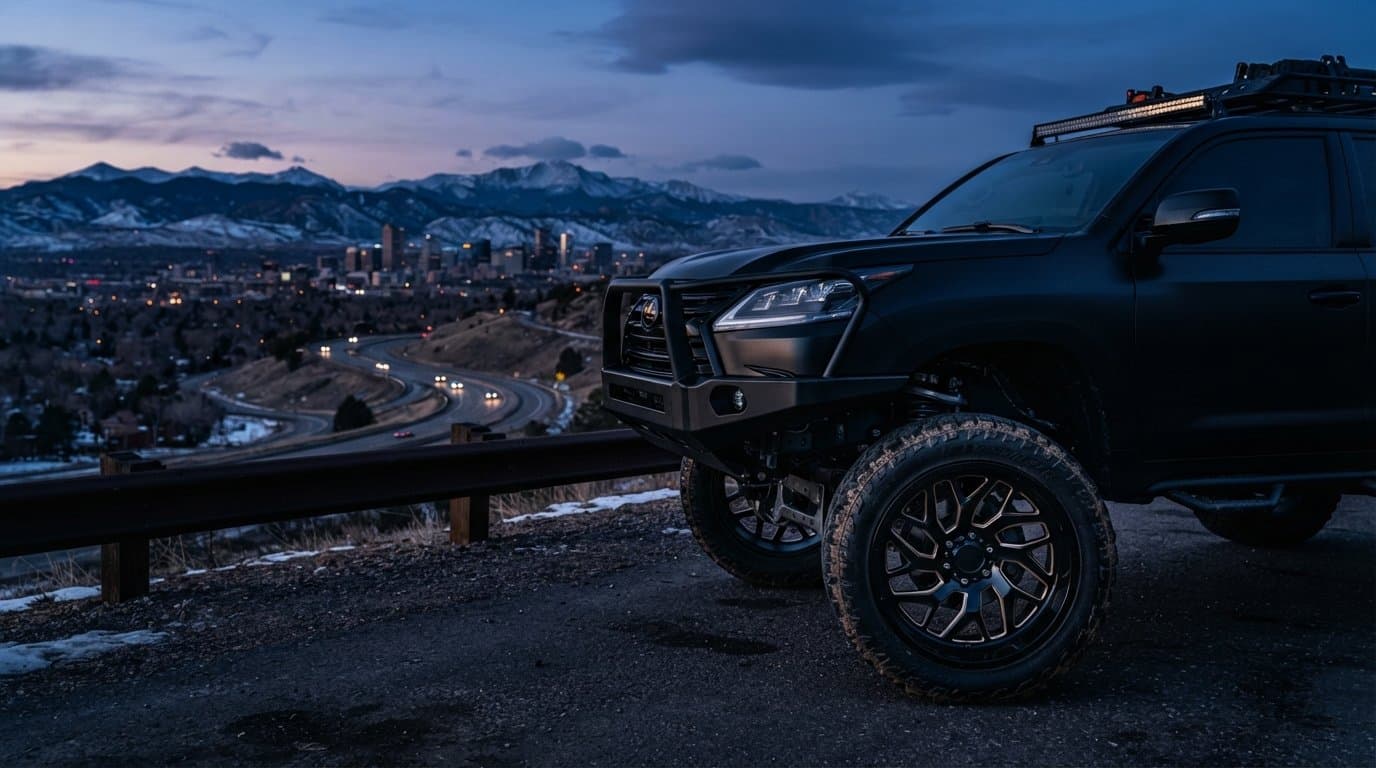
Upgrading to larger tires is the most common request we hear from Denver truck owners. While the factory wheel wells are generous, fitting 35 or 37-inch tires on your ram 2500 wheels involves more than just mounting rubber. Many owners believe 35s fit stock suspension without issue, but the reality is that the high factory offset often causes the tire to rub against the radius arms during tight turns. To get a rub-free experience and that coveted aggressive stance, you need to coordinate your wheel offset with the right suspension height.
The 35-Inch Tire Sweet Spot
For most drivers, 35-inch tires are the ideal choice for a truck that serves as both a daily driver and a weekend trail rig. To achieve the best performance, choose wheel widths between 8.5 and 9.5 inches. This width provides proper sidewall support for a 12.50-wide tire, preventing the "crowning" that leads to premature tread wear. While some 35s can fit with minor rubbing, we recommend a 2.5-inch leveling kit. This small lift provides the necessary clearance for articulation on rugged Colorado terrain. Pairing this setup with the right all terrain tires will maintain your factory ride quality while significantly boosting your off-road capability.
Stepping Up to 37-Inch Tires
Going to 37s is a bold move that requires a more technical approach. At this size, wheel offset becomes the most critical factor. Staying within a +18mm to +25mm offset range helps pull the tire away from the suspension without pushing it so far out that it destroys the fender during a turn. Because lifting the front end to accommodate 37s pulls the axle off-center, an adjustable track bar is a mandatory upgrade to keep everything aligned. Centering the axle ensures that your tires won't rub on one side more than the other during compression.
Be aware that 37-inch tires will impact your towing performance. The larger diameter effectively changes your gear ratio, which can make the Cummins diesel feel less punchy when hauling heavy loads. You may need to consider re-gearing or at least a speedometer recalibration to keep your transmission shift points in check. Some minor trimming of the plastic fender liner or the pinch weld is often required for 37s to clear at full lock. Always prioritize safety when trimming; avoid cutting into structural components that could weaken the body. If you want to ensure your fitment is perfect from day one, browse our Ram 2500 wheel and leveling kit packages to find a tested combination for your truck.
Professional Installation and TPMS Integration in Denver
Investing in a high-end set of ram 2500 wheels is only half the battle. Because these trucks are designed to handle massive payloads and high-torque output, the installation process requires a level of precision that most general tire shops simply can't provide. A 3/4-ton truck puts immense stress on its rolling gear. Improperly mounted or balanced wheels won't just vibrate; they can lead to accelerated suspension wear or even safety failures under load. At Platinum Wheels, we treat every installation as a critical engineering task to ensure your rig remains as capable as it looks.
Expert Mounting for 3/4-Ton Trucks
Standard balancing often falls short for heavy-duty 8-lug setups. We utilize road force balancing to simulate the weight of the truck on the tire while it spins. This identifies internal tire defects or rim runout that traditional balancers miss, effectively eliminating the high-speed vibrations that plague many Ram owners on I-25. Precision also extends to the mounting surface. Newer Ram models feature larger brake calipers that require specific clearances, and we verify every millimeter before the truck leaves the rack.
Our technicians follow strict torque sequences for 8-lug heavy-duty hubs. Over-tightening can warp rotors, while under-tightening is a catastrophic risk on the trail. We also prioritize the integration of your TPMS sensor system. Heavy-duty trucks operate at much higher tire pressures than half-ton pickups, often requiring 65 to 80 PSI. We calibrate your sensors to these HD specs, ensuring you don't deal with a persistent "low pressure" warning light after moving to your new ram 2500 wheels.
The Complete Wheel and Tire Package
Choosing one of our aftermarket wheel and tire packages is the most efficient way to upgrade. These bundles arrive ready for the road, having been professionally mounted and balanced by experts who understand the Colorado Front Range's specific demands. You gain the peace of mind that comes with our fitment guarantee: if we recommend a setup, we stand behind its performance and clearance on your specific Ram trim.
Beyond the initial install, you benefit from local support and warranty service right here in Denver. If you ever experience a vibration or need a sensor reset after a rotation, you aren't chasing an online retailer for answers. We're your neighbors and fellow enthusiasts, committed to keeping your heavy-duty ride performing flawlessly. Ready to transform your truck? Schedule your Ram 2500 fitment consultation at Platinum Wheels today!
Command the Road with Confidence
Upgrading your truck is a significant investment that should pay off in both style and performance. You now have the technical roadmap to choose ram 2500 wheels that don't just look aggressive but actually enhance your truck's heavy-duty capabilities. Remember that the 8x165.1 bolt pattern and proper load ratings are the foundation of a safe build, while the right offset ensures your 35s or 37s clear the suspension without sacrificing steering precision.
At Platinum Wheels, we bring the expertise of true truck enthusiasts to every project. We specialize in high-capacity balancing for 8-lug setups and precise TPMS calibration, serving owners in Denver, Aurora, and across the entire Front Range. We ensure your aftermarket upgrade maintains the reliability you expect from a 3/4-ton rig. It's time to stop second-guessing your fitment and start enjoying the rugged, capable ride you've always wanted for the Colorado backcountry.
Build Your Custom Ram 2500 Wheel & Tire Package
Frequently Asked Questions
What is the bolt pattern for a Ram 2500?
The standard bolt pattern for a Ram 2500 is 8x165.1mm, also known as 8x6.5 inches. This 8-lug configuration is a heavy-duty industry standard that remains consistent across late-model trucks. It's important to verify this measurement because it differs from Ford and newer GM patterns. When shopping for ram 2500 wheels in Denver, always ensure you're matching this specific 165.1mm spacing to avoid fitment disasters during installation.
Can I fit 35-inch tires on my stock Ram 2500 without a lift?
Yes, you can fit 35-inch tires on a stock Ram 2500, but there are important caveats. While the fender wells are large enough, the factory high-positive offset often causes the tire to rub against the radius arms at full steering lock. We typically recommend a 2.5-inch leveling kit to provide the necessary clearance for off-road articulation on Colorado trails. This ensures your tires don't catch the plastic liners during tight maneuvers in Aurora.
What wheel offset is best for a flush look on a Ram 2500?
To achieve a flush look where the tire sits even with the fender flare, an offset between +18mm and +27mm is usually ideal. The factory wheels sit deep at +57mm, so moving to a lower positive number pushes the wheel out just enough. This range provides a wider stance without the extreme mechanical stress caused by deep negative offsets. It's a popular setup for Denver owners who want a cleaner profile.
Do I need to replace my TPMS sensors when getting new wheels?
You don't necessarily need to replace them, but it's often the smartest time to do so. Your factory sensors have internal batteries with a finite lifespan. If your truck is more than five years old, replacing them during a wheel swap prevents you from paying for a second installation later. We carry specialized TPMS sensors at our Denver shop that are calibrated for the high pressures required by heavy-duty 8-lug trucks.
Will 20x10 wheels with a negative offset cause rubbing on my Ram?
In most cases, 20x10 wheels with a negative offset like -12mm or -24mm will cause rubbing on a Ram 2500 unless you've installed a lift kit. The negative offset pushes the wheel further out, which increases the swing of the tire when you turn. This often leads to contact with the back of the fender or the front bumper. If you're set on this wide look, be prepared for minor trimming or suspension modifications.
Are forged wheels worth the extra cost for a heavy-duty truck?
Forged wheels are absolutely worth the investment for Ram 2500 owners who frequently tow or go off-road. Because they're machined from a solid block of aluminum, they're significantly stronger and lighter than cast alternatives. This extra durability is crucial for handling the massive torque of the Cummins diesel. In the rugged terrain around Castle Rock and Golden, forged wheels provide the peace of mind that your rims won't crack under pressure.
How does wheel weight affect my Cummins diesel’s performance?
Reducing wheel weight improves your truck's unsprung weight, which leads to better braking response and more agile handling. Even with the immense power of the Cummins engine, heavy wheels require more energy to start and stop. By choosing lighter ram 2500 wheels, you can help offset the fuel economy dip that usually follows a move to larger tires. This is especially noticeable when navigating the steep mountain passes on I-70.
Does Platinum Wheels offer installation for Ram 2500 leveling kits?
Platinum Wheels provides professional installation for both leveling kits and full lift kits at our Denver location. We focus exclusively on truck and SUV suspension enhancements to ensure your new wheel and tire package fits perfectly. Our team understands the specific geometry of the Ram's solid front axle, allowing us to perform the upgrade while avoiding common issues like the death wobble or poor alignment that can occur at less specialized shops.