35 Inch Tires for Trucks: The Complete 2026 Fitment and Performance Guide
Upgrading to 35 inch tires for trucks is much more than a simple tire swap; it's a total vehicle system upgrade that requires a precise synergy of suspension, wheel offset, and tread choice. Most owners want that aggressive stance and extra trail clearance, but the fear of hearing your brand-new rubber chew through a fender liner is real. You've likely spent hours wondering if your wheel offset is correct or if a basic leveling kit is actually enough to clear 35s through a full lock-to-lock turn. We understand that frustration because we see it in our shop every day.
We're here to take the guesswork out of your build so you can achieve a professional, rub-free setup that handles Colorado's unpredictable terrain with total confidence. This guide breaks down the critical 2026 fitment standards, explains the physics of backspacing, and helps you select the perfect tread for everything from deep mud to I-70's strict winter traction laws. You'll learn how to stay within Colorado's 80-inch height limit while ensuring your setup is safe, legal, and ready for the mountains.
Key Takeaways
- Master the suspension requirements needed to run 35 inch tires for trucks with zero rubbing, focusing on clearing frame components and crash bars.
- Choose the right tread pattern for your lifestyle, whether you need the quiet efficiency of an All-Terrain or the aggressive grip of a Mud-Terrain for mountain trails.
- Protect your vehicle's performance by learning how larger tires affect gear ratios, shift points, and speedometer accuracy.
- Ensure your truck remains safe and legal by selecting the correct load ratings for towing and meeting Colorado's specific traction and height regulations.
- Get a "ready-to-drive" experience by understanding why professional installation is critical for complex wheel and tire packages.
The 35-Inch Tire Standard: Why Truck Owners Upgrade in 2026
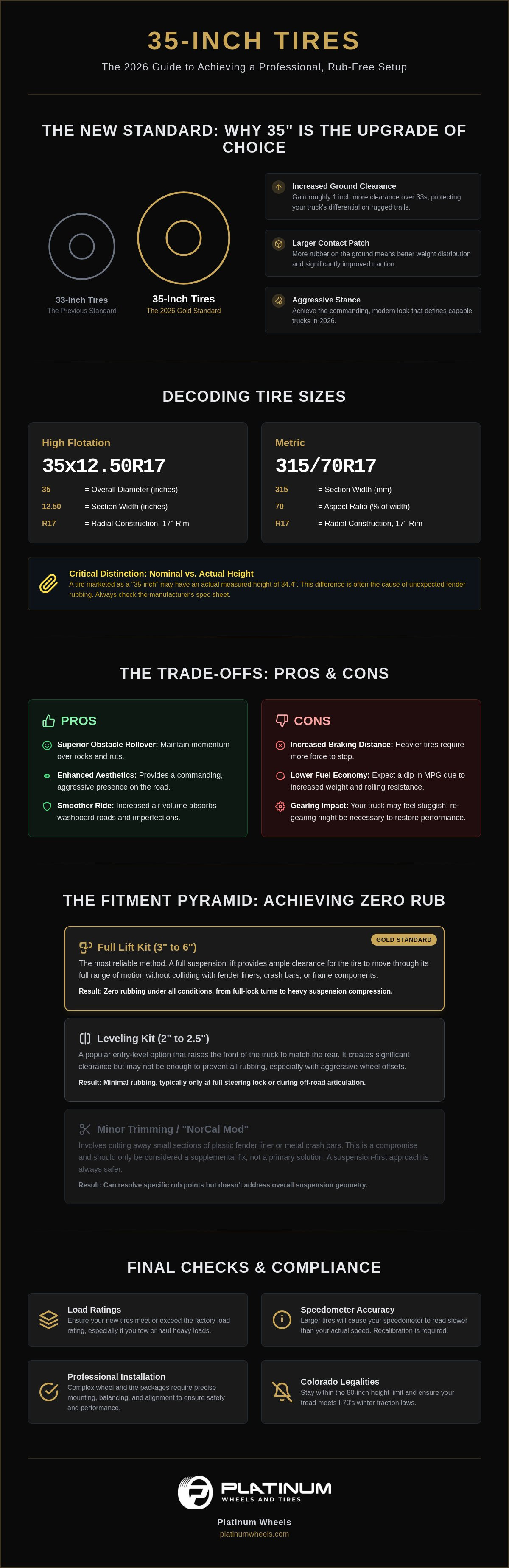
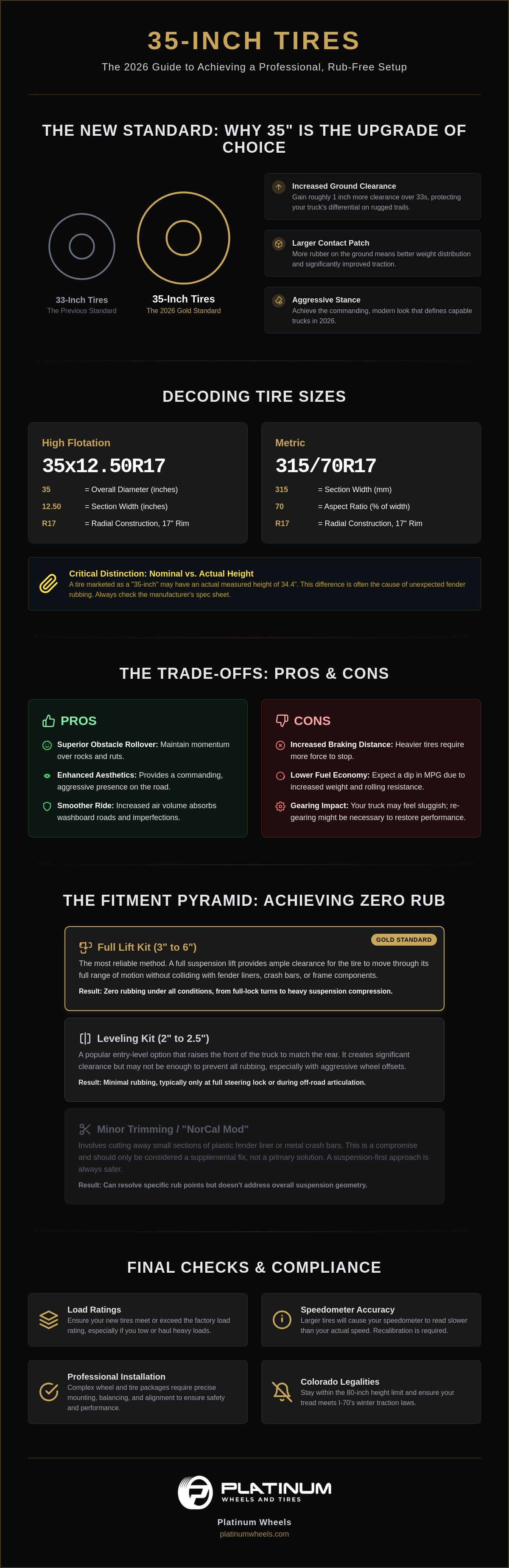
Stepping up to 35 inch tires for trucks has become the gold standard for enthusiasts in 2026. While a 33-inch tire was once the go-to upgrade, modern truck designs with larger wheel wells and higher factory outputs have shifted the goalposts. The 35-inch diameter is now the sweet spot. It provides a perfect balance where your truck looks undeniably aggressive on the streets of Denver, yet remains remarkably capable when you head toward the tight switchbacks of the Rockies. This upgrade isn't just about the "cool factor"; it's a functional choice that increases your ground clearance by roughly an inch over common 33-inch setups, giving your differential more breathing room over jagged obstacles.
The 2026 market reflects this shift clearly. Half-ton and heavy-duty trucks are now engineered with the clearance and torque to handle larger rubber right off the showroom floor, often requiring only minor modifications to accommodate the extra height. By moving to a 35-inch setup, you gain a larger contact patch. This means more rubber on the ground, which translates to better weight distribution and significantly improved traction when you're airing down for a weekend on the trails.
The Anatomy of a 35-Inch Tire
Before you pull the trigger, it helps to master the jargon. When you start understanding tire size codes, you'll notice two main ways these tires are labeled. High flotation sizes like 35x12.50R17 are straightforward, telling you the exact diameter and width in inches. However, many 2026 builds utilize metric equivalents like a 315/70R17. While these are often marketed as 35s, their actual height might only be 34.4 inches depending on the manufacturer's specific mold. In 2026 tire manufacturing, "nominal height" is the marketing number on the sidewall, while "actual height" is the physical measurement when inflated; this distinction is often the difference between a clean turn and a shredded fender liner.
Pros and Cons of Stepping Up to 35s
The benefits are immediate and visceral. On Colorado trails, a 35-inch tire offers superior obstacle rollover, allowing you to maintain momentum through rock gardens that might stop a smaller tire cold. You'll also notice a smoother ride over washboard roads thanks to the increased air volume in the tire. Of course, physics always demands a trade-off. You should prepare for the following realities:
- Braking Distances: Larger tires are heavier, meaning your brakes have to work harder to stop that extra rotational mass.
- Fuel Economy: Expect a slight dip in MPG as your engine works harder to turn the larger diameter.
- Gearing: Your truck might feel a bit more sluggish off the line unless you consider a re-gear or professional performance tuning from specialists like Oztrack Performance Tuning & Engines to match the new tire height.
For most of our clients, these trade-offs are a small price to pay for the massive jump in off-road capability and the commanding presence a set of 35 inch tires for trucks provides.
Essential Fitment Requirements: How to Fit 35-Inch Tires
Achieving a zero-rub setup is the top priority when installing 35 inch tires for trucks. It is about more than avoiding an annoying sound; it is about protecting your investment and ensuring your truck remains safe on the road. This focus on precision is what separates basic upgrades from professional conversions like those by Auto Industries Factory LLC, where vehicle geometry is meticulously engineered. Most factory trucks are built with tight tolerances that don't allow for an extra two inches of rubber. When you turn the steering wheel, the tire sweeps through an arc that often collides with crash bars, frame rails, or the inner fender liner. If you don't address these clearance issues, you risk damaging your tires or compromising your truck's steering geometry during a critical maneuver.
If you are determined to keep your truck as close to stock as possible, you might consider minor trimming or the famous "NorCal" mod. This involves cutting away small sections of plastic or metal to create clearance. However, we always recommend a suspension-first approach. Adhering to NHTSA tire safety standards is critical when making these changes, as improper modifications can affect your vehicle's stability and braking performance. Using a professional lift or leveling kit is the most reliable way to create the space needed for larger tires while maintaining a smooth ride.
Leveling Kits vs. Lift Kits for 35s
Can you fit 35 inch tires for trucks on a simple leveling kit? The answer depends heavily on your vehicle. For many Ford F-150 and Chevy Silverado owners, a 2-inch or 2.5-inch leveling kit gets you close, but you'll almost certainly experience rubbing at full lock or when the suspension compresses over a bump. A 3-inch to 6-inch lift kit remains the gold standard because it provides the necessary vertical and horizontal clearance without requiring aggressive cutting. If you're planning a build, check out our Custom Wheels and Rims: The Ultimate Denver Truck Owner’s Guide (2026) for more specific model breakdowns.
The Importance of Wheel Offset and Backspacing
Offset is the secret sauce to a perfect fit. Moving the wheel's mounting surface inward, known as negative offset, pushes the tire outward and away from the truck. This creates space between the tire and the inner suspension components like control arms. However, pushing them out too far increases your scrub radius, which puts extra stress on your wheel bearings and can cause the tire to hit the outer fender. As wheel width decreases relative to tire width, the sidewall bulges more aggressively, which can lead to unexpected contact with suspension components even if the tread appears to clear. Finding the right balance is why we often suggest high-quality wheel and tire packages to ensure total compatibility.
Best 35-Inch Tires for Colorado: Tread Patterns Analyzed
Selecting the right tread for 35 inch tires for trucks in Colorado requires a strategy that accounts for both the dry pavement of Aurora and the slushy climbs of the Eisenhower Tunnel. You aren't just buying rubber; you're buying the ability to navigate a 12,000-foot pass in a surprise October snowstorm. In 2026, the market has evolved beyond simple on-road versus off-road categories. Your choice should reflect where you actually drive, not just where you wish you were driving.
All-Terrain (A/T) tires remain the most popular choice for Denver drivers. They offer a quiet ride on the highway while providing enough bite for most forest service roads. If your truck spends 90% of its time on asphalt but needs to be mountain-ready, this is your category. For those seeking maximum dominance in deep mud or jagged rock crawling, Mud-Terrain (M/T) tires are the answer. Their massive lugs and wide voids self-clean effectively, though they come with a louder hum on the highway and a softer compound that wears faster on dry pavement.
The real game-changer in 2026 is the Rugged Terrain (R/T) or hybrid tire. These designs combine the aggressive sidewall of an M/T with the tighter center tread of an A/T. It's the perfect middle ground for a truck that needs to look the part without sacrificing daily drivability. Regardless of which pattern you choose, ensure it carries the Three-Peak Mountain Snowflake (3PMSF) symbol. From September 1st to May 31st, the I-70 Mountain Corridor traction law requires specific ratings or a tread depth of at least 3/16-inch. Having that snowflake icon gives you peace of mind and legal compliance during winter travel.
All-Terrain vs. Mud-Terrain for the Front Range
Commuting at 75 MPH on C-470 feels very different on an M/T compared to an A/T. Mud-terrains utilize softer compounds for grip, which results in a shorter tread life and a noticeable drone at high speeds. All-terrains generally last longer and offer better wet-weather performance on icy city streets. If you're weighing these options for your 35 inch tires for trucks, read our detailed breakdown on Choosing the Best All-Terrain Tires for Colorado: The Complete 2026 Guide.
Top Tire Brands to Consider in 2026
Nitto Ridge Grappler continues to lead the hybrid pack, offering a dual-sidewall design that lets you choose your look. For those demanding pure strength, the Toyo Open Country M/T is legendary for its carcass durability on sharp rocks. If you want a proven all-rounder, the BFGoodrich KO2 and the newer KO3 remain staples for Colorado trucks, providing exceptional performance in the snow and dirt alike. These brands have mastered the balance of weight and durability required for modern heavy-duty builds.
Technical Considerations: Load Ratings and Speedometer Accuracy
Installing 35 inch tires for trucks is a significant mechanical change that alters how your vehicle communicates with its own computers. Beyond the physical fitment discussed earlier, you must account for the added weight and the increased diameter. A 35-inch tire is significantly heavier than a factory 32 or 33-inch tire, which increases rotational mass. This means your brakes have to work harder to stop the truck. Your suspension components, like ball joints and tie rods, will also experience accelerated wear if they aren't monitored regularly; companies like Car Suspension Repair suggest that keeping a close eye on your shock absorbers is essential when managing the extra stress of oversized tires.
Choosing the right load range is critical if you plan on towing or hauling. Most 35-inch tires come in Load Range E, which is suitable for most half-ton and three-quarter-ton trucks. However, some newer 2026 models and heavy-duty builds may require Load Range F to maintain the manufacturer's maximum towing capacity. Using a tire with an insufficient load rating is dangerous and can lead to sidewall failure under heavy loads. When you purchase new tires, always verify that the load index meets or exceeds your truck's original specifications.
For those who use their vehicles for work and want to keep up with shifting industry standards, you can visit The Truckermann to learn more about the future of professional driving and logistics shifts in 2026.
Hidden Costs of Sizing Up
Your speedometer relies on the number of tire rotations to calculate speed. Because 35 inch tires for trucks have a larger circumference, they rotate fewer times per mile. This causes your speedometer to read slower than your actual speed and throws off your transmission's shift points. To fix this, you'll need a speedometer recalibration tool or a flash programmer. If your truck feels sluggish after the upgrade, it's because the larger tires have effectively "tallied" your gear ratio. Re-gearing the differentials is the professional way to restore that lost low-end torque. Don't forget to check our TPMS Sensor Guide: Avoiding the Dash Light Headache in 2026 to ensure your safety systems stay functional after the swap.
Maintaining Your 35s
Maintaining these larger tires requires a different approach than stock rubber. We recommend a 5-tire rotation pattern if you have a full-size spare. This ensures all tires wear evenly and keeps your spare from dry-rotting while unused. For air pressure, ignore the door placard. A "chalk test" is the best way to find the ideal PSI for your specific truck's weight; simply draw a line across the tread and drive a short distance to see where the chalk wears off. Be aware that wider 35-inch tires have a larger surface area, which can decrease hydroplaning resistance in heavy rain compared to narrower factory tires. Ensuring your tread stays deep and your pressure stays correct is the only way to stay safe on wet Colorado roads.
While mechanical performance is the priority for any off-road build, maintaining the cabin's condition is just as important for long-term enjoyment. To help with this, you can discover D3 Auto Care LLC and their comprehensive checklist for professional interior detailing.
Beyond mechanical upkeep, keeping your truck's exterior in top shape is essential; for professional mobile care, check out Suds Detailing to maintain your vehicle's finish.
Professional Installation: Getting Your 35s Ready in Denver
Many truck owners try to take their new 35 inch tires for trucks to a standard big box retailer, only to be turned away. These stores often have rigid corporate policies or equipment limitations that prevent them from mounting oversized tires on high-offset custom wheels. They aren't equipped to handle the nuances of a modified suspension or the specific clearance requirements of a heavy-duty off-road build. At Platinum Wheels, we specialize in exactly these scenarios, providing the technical expertise required for the Front Range lifestyle.
Our team understands the local landscape from the city streets of Aurora to the rocky trails of the high country. We don't just slap rubber on rims; we ensure the entire setup works as a cohesive unit. Whether you are in Lakewood or the heart of the Denver metro area, you deserve a shop that treats your truck like the professional build it is. We prioritize precision and efficiency, ensuring your setup is balanced and ready to drive the moment it leaves our bay.
The Value of a Complete Package
Choosing a comprehensive solution is the most efficient way to upgrade your vehicle. By combining your 35 inch tires for trucks with the right rims from the start, you benefit from our expert fitment knowledge. This approach eliminates the risk of ordering parts that don't play well together. Bundling your tire purchase with a professional lift kit installation also saves time and ensures your suspension is tuned specifically for the new weight and height. For a deeper dive into these options, see our Complete Guide to Off Road Wheel Tire Packages in Denver (2026).
Visit Our Denver Shop Today
We take a consultative approach to every build. We help you choose the right offset for your specific truck to achieve that perfect stance without the headache of constant rubbing. Our precision mounting and balancing processes ensure your highway driving remains vibration-free, even with aggressive mud-terrain treads. You don't have to guess if your setup is safe or if your TPMS sensors are synced correctly. Our technicians handle the technical details so you can focus on the trail ahead. Build your custom 35-inch wheel and tire package at Platinum Wheels and experience the difference that local expertise makes for your truck.
Ready to Build Your Ultimate Colorado Truck?
Upgrading to 35 inch tires for trucks is the single most transformative modification you can make to your vehicle. A successful build requires more than just picking a tread pattern; it's a systemic approach that balances suspension height, wheel offset, and precise speedometer calibration. By choosing a tire with the Three-Peak Mountain Snowflake rating, you ensure your truck is ready for the unpredictable I-70 winter corridors while maintaining the aggressive look you desire. Don't let the fear of rubbing or poor handling keep you on stock rubber when trail dominance is within reach.
Our team at Platinum Wheels specializes in truck lift and leveling kits designed to clear oversized tires perfectly. We provide expert wheel offset and backspacing consultation to ensure your setup looks professional and performs safely across the entire Colorado Front Range. We take the guesswork out of the process, delivering a ready-to-drive experience that respects your truck's engineering. Get a Professional 35-Inch Tire Fitment Quote in Denver today and start your next adventure with total confidence. Your truck is capable of so much more; let's get it trail-ready together.
Frequently Asked Questions
Do I need a lift kit to fit 35-inch tires on my truck?
In most cases, you'll need at least a leveling kit or a small lift kit to clear 35 inch tires for trucks without significant rubbing. While some heavy-duty trucks have larger wheel wells, half-ton pickups typically require 2 to 3 inches of additional height to ensure the tires don't catch on the fender liners or crash bars during tight turns. A dedicated suspension system is always the safest way to create the necessary clearance.
Will 35-inch tires void my truck warranty?
Installing larger tires won't void your entire vehicle warranty, but it can lead to denied claims for specific components like wheel bearings or suspension joints. Under the Magnuson-Moss Warranty Act, a dealer must prove that the aftermarket modification directly caused the failure to deny coverage. We recommend checking with your local Denver dealer if you have concerns about specific powertrain components before starting your build.
How much do 35-inch tires affect gas mileage?
You should expect a decrease of approximately 1 to 3 miles per gallon when stepping up to a 35-inch setup. The larger diameter and increased weight create more rolling resistance and require more energy to get the vehicle moving. Your engine works harder to rotate the heavier mass; this is especially noticeable in stop-and-go city driving or when climbing steep mountain passes.
What is the best wheel width for a 35x12.50 tire?
The ideal wheel width for a 35x12.50 tire is between 8.5 and 10 inches. An 8.5-inch rim offers better bead protection for off-roading, while a 10-inch rim provides a flatter tread profile for more even wear on the highway. Avoid using stock narrow rims, as they can cause the tire to balloon. This leads to premature center-tread wear and compromised handling.
Can I fit 35s on a stock Ford F-150?
No, 35 inch tires for trucks will not fit a stock Ford F-150 without significant rubbing against the crash bars and wheel wells. You'll need at least a 2.5-inch leveling kit or a dedicated lift to clear them properly. Even with a level, some minor plastic trimming is often required for a completely rub-free experience when you're turning at full lock.
Are 35-inch tires good in the snow?
35-inch tires can be excellent in the snow if you choose a model with the Three-Peak Mountain Snowflake (3PMSF) rating. Wide tires can sometimes float on top of slush rather than cutting through it, so siping and rubber compound are more important than size alone. For Colorado winters, an All-Terrain or Hybrid tire usually outperforms a dedicated Mud-Terrain on icy city streets.
How much louder are 35-inch mud tires on the highway?
Mud-terrain tires are noticeably louder than factory tires, producing a distinct rhythmic hum that increases with your speed. At highway speeds, the drone can become intrusive during long drives across the Front Range. If you're sensitive to cabin noise, a Rugged-Terrain or All-Terrain tire offers a much quieter alternative while still providing that aggressive off-road look you want.
Do I need to re-gear my truck for 35-inch tires?
Re-gearing isn't always mandatory, but it's highly recommended to restore lost power and improve transmission health. Larger tires effectively change your final drive ratio, which can make your truck feel sluggish and cause the transmission to hunt for gears on inclines. Moving to a 4.10 or 4.56 gear ratio helps your truck handle 35s as if it were still running on factory-sized rubber.