
Dodge Durango Tires: Best All-Terrain Deals in Denver
Putting the wrong all-terrain rubber on a high-output SUV is an easy way to ruin highway comfort and shred tread in a single season. Finding the ideal dodge durango tires requires balancing heavy vehicle curb weight and raw engine torque against the real demands of Front Range commuting and weekend mountain pass driving.
You already know how tricky that balance can be. Whether you are trying to avoid unbearable highway cabin drone, stay compliant with winter I-70 Traction Law requirements west of Morrison, or decipher factory wheel fitments across 18-inch, 20-inch, and wide SRT setups, one wrong spec can compromise your ride and strain your AWD transfer case.
In this guide, you'll discover the exact tire sizes, performance categories, and fitment strategies to optimize your Dodge Durango for heavy towing, daily comfort, and Colorado mountain roads. We will break down severe-snow-rated compounds, safe sizing limits, and proven packages built for your specific trim.
Key Takeaways
- Match your factory trim requirements accurately, from standard 18-inch and 20-inch setups to wide 295/45ZR20 SRT configurations, to ensure proper brake clearance and suspension geometry.
- Choose dodge durango tires with reinforced sidewalls and extra-load (XL) ratings to handle heavy curb weights, high torque output, and maximum towing capacities without rapid treadwear.
- Prioritize Three-Peak Mountain Snowflake (3PMSF) certified compounds with ample tread depth to stay fully compliant with Colorado I-70 Traction Law rules during winter mountain travel.
- Understand the real-world clearance and speedometer impacts of upsizing to popular dimensions like 275/55R20, while maintaining matching rolling circumferences to protect your AWD transfer case.
- Protect your ride quality and wheel investment with proper 5x127 bolt pattern fitment, pre-programmed TPMS sensors, and precision road-force balancing.
Dodge Durango Tire Sizes by Trim and Model Year
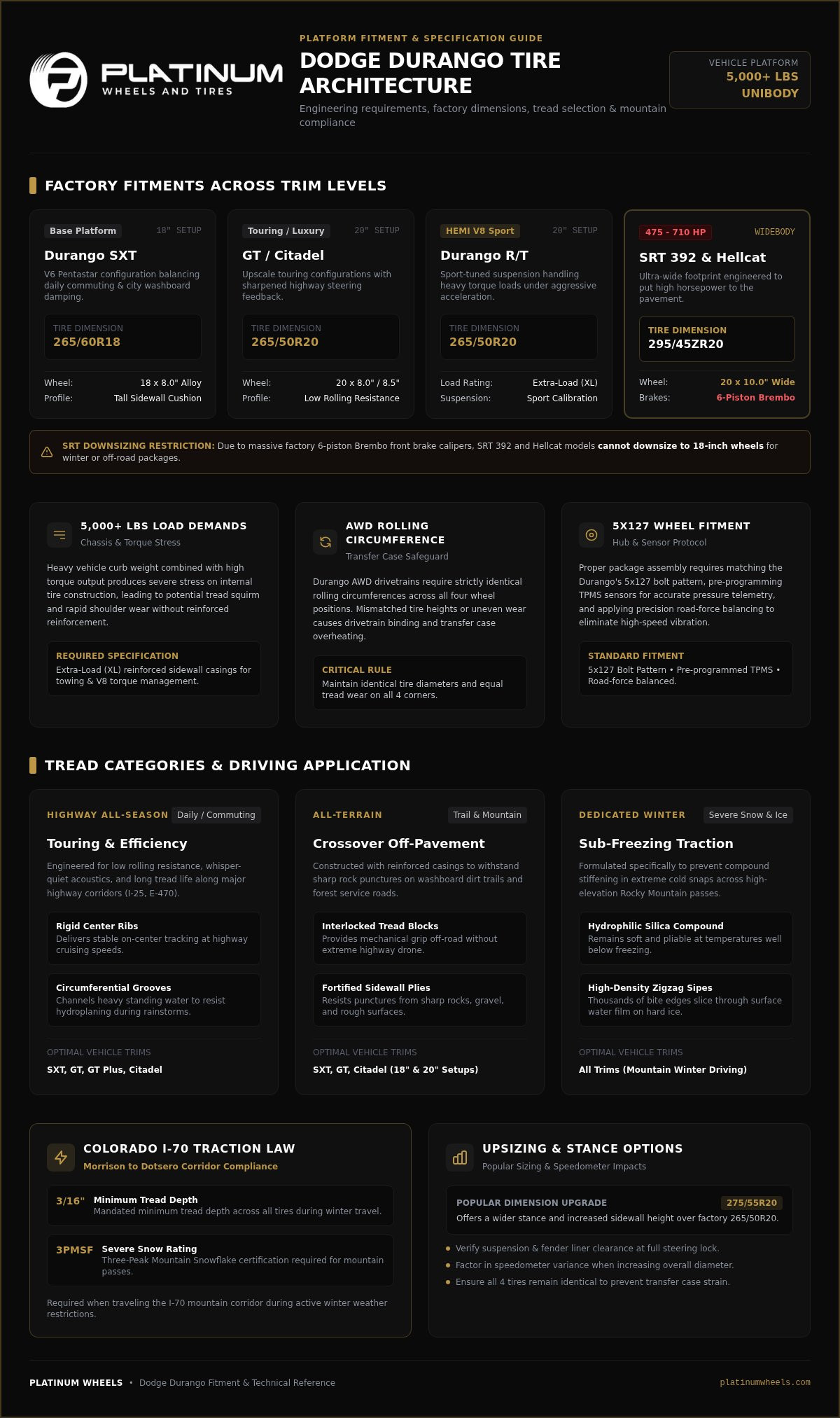
Selecting the right dodge durango tires starts with recognizing that Dodge engineered several distinct vehicle setups on the same unibody architecture. A rear-wheel-drive V6 Pentastar demands a vastly different tire construction than an all-wheel-drive HEMI pulling a heavy trailer up Floyd Hill. Reviewing official Dodge Durango trim and platform specifications reveals how curb weights, suspension tuning, and brake clearances change across the lineup. Always check your tire placard on the driver-side door jamb before shopping. Durango AWD drivetrains require identical rolling circumferences at all four positions to avoid transfer case overheating and drivetrain binding.
Factory Fitments for SXT, GT, and Citadel Models
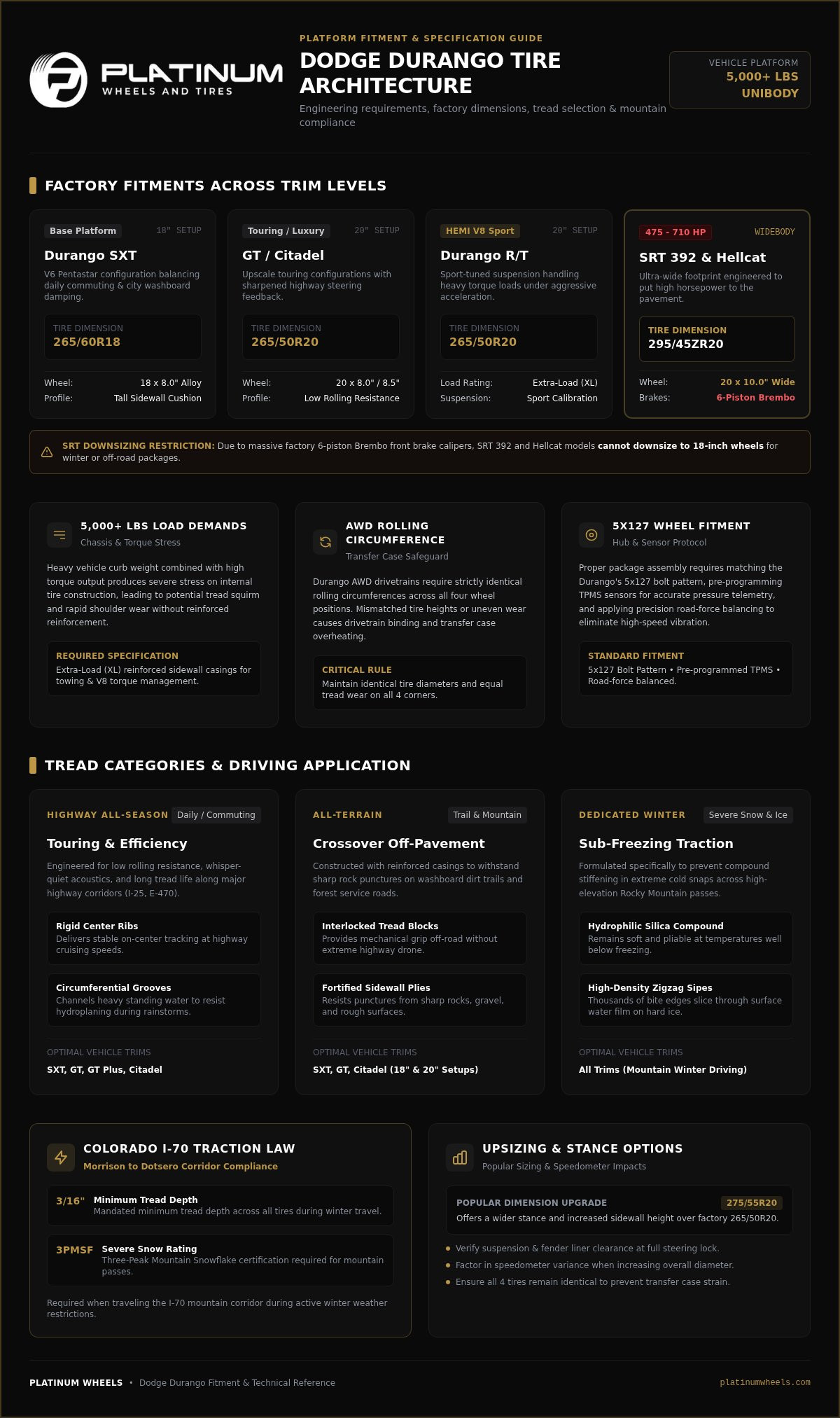
Base SXT trims typically roll out on 265/60R18 tires mounted to 18x8-inch alloy wheels. GT, GT Plus, and upscale Citadel trims step up to 265/50R20 rubber on 20x8.0 or 20x8.5-inch rims. The 18-inch sizing offers an accommodating sidewall height that cushions rough Denver city streets and washboard dirt roads. The 20-inch touring all-season profiles sharpen steering feedback and high-speed road manners while keeping rolling resistance low for long-distance highway travel.
Performance Fitments for R/T, SRT 392, and Hellcat
Durango R/T trims roll on 265/50R20 configurations paired with sport-tuned suspension geometry. These require extra-load ratings to support heavy V8 torque loads during aggressive acceleration. Step into the SRT 392 or SRT Hellcat, and factory specifications expand to an aggressive 295/45ZR20 profile on wide 20x10-inch wheels. This ultra-wide footprint delivers the expansive contact patch necessary to manage between 475 and 710 horsepower. For performance enthusiasts planning to upgrade engine software alongside high-traction rubber, you can discover EcuFilesMarket to access Stage 1 and Stage 2 tuning files. Because SRT trims feature massive 6-piston Brembo front brake calipers, you cannot downsize to 18-inch wheels for off-road or winter setups.
Weighing well north of 5,000 pounds, a Dodge Durango places intense physical demands on its rubber. If you pick a tire with flimsy internal construction, that substantial vehicle curb weight and low-end torque translate into noticeable tread squirm, numb steering response, and premature shoulder wear. Selecting the right dodge durango tires comes down to evaluating your annual commute mileage, trailer towing habits, and exposure to Colorado mountain weather.Highway All-Season Tires for Everyday Commuting
Highway all-season compounds prioritize ultra-low rolling resistance, quiet cabin acoustics, and long tread life. Rigid continuous center ribs maintain on-center tracking, while deep circumferential grooves channel standing water away to prevent hydroplaning during heavy Front Range rainstorms. For SXT, GT, and Citadel drivers logging primary miles along I-25, E-470, or downtown Denver, touring all-season tires deliver maximum ride suppleness and predictable dry-road braking without annoying pavement vibration.
All-Terrain Tires for Mountain Trails and Light Off-Road
Weekend adventures across forest service roads or washboard trails require reinforced tire casings that resist sharp rock punctures. Modern crossover-specific all-terrains use interlocked tread blocks and fortified sidewall plies, giving you confident off-pavement bite without the heavy drone of traditional truck tires. If you want year-round versatility, check out our breakdown on choosing the best all-terrain tires for Colorado to match your off-pavement ambition with quiet highway manners.
Dedicated Winter Tires for Severe Colorado Ice and Snow
When sub-freezing cold snaps grip the Rockies, all-season compounds naturally stiffen and lose mechanical grip. Dedicated winter tires feature specialized hydrophilic silica compounds that stay pliable below freezing, alongside thousands of high-density zigzag sipes that slice through surface water film on hard-packed snow and black ice. These tires ensure total compliance with the Colorado Department of Transportation Traction Law, which mandates a minimum 3/16-inch tread depth and approved severe-snow capability on I-70 between Morrison and Dotsero.
If you want a winter set or an all-weather upgrade matched to your driving routine, the local specialists at Platinum Wheels can help you configure the right tire compound and wheel package for your vehicle.
Key Selection Criteria: Matching Tires to Your Driving Demands
Every vehicle upgrade involves tradeoffs, but choosing dodge durango tires demands special precision. A Durango with a HEMI V8 packs significant tongue weight and instantaneous torque. If your tires lack adequate sidewall support, you compromise braking distance, towing stability, and driveline longevity across high-altitude mountain routes.
Towing Capacity, Tongue Weight, and Load Index Needs
Equipped with the factory Tow N Go package, a modern Durango pulls up to 8,700 pounds. That level of heavy trailering places extreme vertical force on the rear axle. Following NHTSA tire safety and ratings guidelines, always verify that your replacement tires match or exceed the factory load index. Standard-load (SL) passenger tires often flex under heavy tongue loads, producing sloppy steering response and elevated carcass heat. Look for extra-load (XL) rated tires carrying a load index of 111 or higher, providing at least 2,403 pounds of capacity per corner to keep your trailer tracking straight up steep grades.
Navigating Colorado Traction Laws and 3PMSF Ratings
Colorado's Passenger Vehicle Traction Law remains active every year from September 1 through May 31 along the 126-mile corridor between Morrison and Dotsero. While Durango AWD systems help you accelerate from a stop on icy inclines, all four wheels need adequate tread to brake and steer safely downhill. The law mandates at least 3/16 inch (6/32 inch) of tread depth alongside a Mud and Snow (M+S) or Three-Peak Mountain Snowflake (3PMSF) designation. Getting caught out of compliance results in a $133 fine, which jumps to $657 if your vehicle blocks traffic lanes during a winter storm.
Managing Road Noise, Ride Comfort, and Tread Wear
Aggressive tread blocks deliver trail bite, but they can create annoying harmonic drone against a unibody cabin at 75 mph. Modern crossover-oriented designs solve this with multi-pitch tread sequencing, varying block sizes around the tire circumference to cancel sound frequencies before they enter the interior. Tread life also depends on axle harmony. Durango AWD transfer cases allow no more than a 2/32 to 3/32 inch difference in tread depth between the front and rear axles. Allowing uneven wear places severe thermal stress on center differential clutches, making disciplined 5,000-mile tire rotations essential.
Upsizing, Stance, and Wheel Package Considerations
Modifying your wheel and tire dimensions gives your SUV an aggressive, planted aesthetic while improving off-pavement clearance. Achieving that look requires careful engineering. Installing oversized dodge durango tires without calculating offset and backspacing leads to rubbing on suspension arms and body panels. Selecting complete, pre-configured aftermarket wheel and tire packages ensures every dimension clears your wheel wells smoothly without compromising factory suspension travel.
Safe Tire Widths and Diameters on Stock Suspension
Stock Durango suspensions easily handle modest increases. The most common modification on factory 20-inch wheels involves stepping up from the OEM 265/50R20 size (30.4 inches tall) to a 275/55R20 tire (31.9 inches tall). That 1.5-inch diameter increase represents roughly a 4.5% to 5.0% change in rolling circumference. It fills out the wheel arches, delivers an extra 0.75 inches of ground clearance, and provides thicker sidewall cushion over potholed city streets. Pushing past a 32-inch diameter on factory ride height introduces scrub against the front plastic wheel well liners and the steering knuckle at full steering lock.
Selecting Compatible Custom Wheels and Offsets
Dodge Durango hubs use a 5x127 mm (5x5.0 inches) bolt pattern with high positive factory offsets, typically ranging from +34mm to +50mm depending on wheel width. Before bolting on aftermarket rims, read through our custom wheels and rims guide to avoid incorrect fitment. Pushing into aggressive zero or negative offsets forces the tire outward past the fenders. While that creates a wide stance, it alters the vehicle scrub radius, puts strain on hub bearings, and forces the tire into the rocker panel during full-lock suspension compression.
TPMS Sensor Synchronization and Speedometer Calibration
A taller tire rotates fewer times per mile, which skews vehicle speed readings. A Durango rolling on 275/55R20 tires travels roughly 68 mph when the speedometer registers 65 mph. Reprogramming the tire circumference in the PCM corrects shift points, odometer accuracy, and ABS calibration. Swapping wheel assemblies also demands properly matched wheel sensors. Review our TPMS sensor guide to keep dashboard warnings off. Pre-programmed direct sensors integrate directly into Dodge's central receiver module, delivering real-time pressure monitoring across all four corners.
Ready to upgrade your stance and trail capability? Build your custom Dodge Durango wheel and tire package with our Denver fitment specialists today.
Professional Durango Tire Installation and Maintenance Best Practices
Mounting premium dodge durango tires requires high-grade equipment and precise torque procedures. With factory lug nut torque specified at a substantial 130 lb-ft across all modern 3rd-generation trims, uneven tightening distorts brake rotors and damages wheel hubs. Protecting large alloy rims during tire mounting demands touchless tire-changer arms and composite clamp guards. These specialized tools shield expensive painted or machined surfaces from cosmetic scratches.
Why Road-Force Balancing Matters for Full-Size SUVs
Standard high-speed spin balancers measure only geometric weight discrepancies. In contrast, road-force variation balancers press a heavy load roller directly against the spinning tire tread, simulating the actual downforce of your SUV against asphalt. This process detects internal belt variations, stiff spots, and rim runout. By matching the low point of the wheel to the high spot of the tire carcass, technicians neutralize radial vibrations before the assembly is mounted. That precision eliminates high-speed steering wheel shudder across the Durango's independent front suspension.
Recommended Rotation Cycles, Alignment, and Pressure Habits
Preserving tread investment across Front Range driving conditions demands disciplined maintenance intervals:
- Rotate every 5,000 to 6,000 miles: Front tires shoulder the burden of steering scrub, while rear tires absorb heavy acceleration torque. Consistent modified-X rotations keep tread consumption uniform across all four corners.
- Perform annual four-wheel alignments: Potholed urban corridors and frost heaves knock toe angles out of specification, leading to rapid inner-shoulder cupping.
- Verify cold pressures monthly: Factory placards specify 33 PSI front and 36 PSI rear on standard 20-inch setups, with spares rated at 39 PSI. Colorado temperatures swing 40 degrees in a single day, causing inflation pressure to drop by roughly 1 PSI for every 10-degree dip.
Upgrading Your Durango Setup with Denver Specialists
Local terrain requires local expertise. Technicians who understand the strain of stop-and-go metro commuting combined with weekend mountain pass climbing can fine-tune every parameter of your assembly. Working with a regional shop ensures your wheels receive correct hub-centric rings, proper lug seat engagement, and calibrated TPMS programming out of the box. Drivers in Denver, Lakewood, Aurora, and Littleton can schedule your custom tire fitment to set up complete packages designed specifically for the Rocky Mountain region.
Equip Your Durango for Peak Colorado Performance
Finding the right dodge durango tires transforms how your SUV handles every mile, whether you are hauling a trailer down I-25 or climbing steep switchbacks beyond the Eisenhower Tunnel. Prioritizing extra-load ratings preserves high-speed stability, while selecting Three-Peak Mountain Snowflake certified all-terrain rubber keeps you confident through unpredictable Front Range snowstorms and legally compliant on mountain passes.
Don't settle for guesswork when dialing in fitment, stance, and tire compound. As a local Colorado independent shop serving Denver, Aurora, Lakewood, and Littleton, Platinum Wheels focuses specifically on truck and SUV wheel, tire, and suspension setups. We build complete, turnkey wheel and tire packages that arrive precision mounted, road-force balanced, and equipped with pre-programmed TPMS sensors for an effortless bolt-on experience.
Find Your Perfect Durango Tire and Wheel Package at Platinum Wheels and hit the road ready for whatever Rocky Mountain weather throws your way.
Frequently Asked Questions
What is the stock tire size on a Dodge Durango?
Stock sizes vary directly by model trim. SXT configurations roll out on 265/60R18 tires mounted to 18x8-inch wheels. GT, Citadel, and R/T models arrive equipped with 265/50R20 tires on 20x8.0 or 20x8.5-inch wheels. High-output SRT 392 and SRT Hellcat models run wide 295/45ZR20 tires on 20x10-inch forged wheels to support extra vehicle power.
Can I put all-terrain tires on my Dodge Durango?
Yes, all-terrain tires work exceptionally well on the unibody platform. Modern crossover-specific all-terrains give you enhanced tread strength for rocky trails without creating excessive road hum on the highway. Choosing dodge durango tires with reinforced casings protects your wheels against pothole impacts around Denver while maintaining stable high-speed manners along the Front Range.
Are Dodge Durango tires compliant with Colorado I-70 Traction Laws?
Compliance depends entirely on your tire's tread depth and winter certification. Colorado law mandates at least 3/16 inch (6/32 inch) of tread depth on AWD vehicles during active restrictions between Morrison and Dotsero. Your tires must display either a Mud and Snow (M+S) marking or the Three-Peak Mountain Snowflake (3PMSF) symbol on the sidewall.
How much tire clearance does a stock Dodge Durango have for wider tires?
Stock Durango suspensions safely accommodate widths up to 275mm without rubbing. Stepping up from a 265/50R20 to a 275/55R20 size adds about 1.5 inches of overall diameter. Pushing beyond 285mm wide or over 32 inches tall causes contact with the front plastic wheel well liner and upper suspension components at full steering lock.
What happens if I change Durango tire sizes without reprogramming the speedometer?
Installing taller tires makes your vehicle travel faster than the instrument cluster indicates. Upsizing from a factory 265/50R20 to a 275/55R20 tire introduces roughly a 4.5% to 5% speedometer error. Leaving the PCM uncalibrated skews your odometer reading, alters transmission shift schedules, and affects the timing of factory electronic stability control interventions.
How often should I rotate the tires on an all-wheel-drive Dodge Durango?
Rotate your dodge durango tires every 5,000 to 6,000 miles using a modified-X pattern. Durango AWD systems require balanced tread depths within 2/32 to 3/32 inch across all four corners. Front tires wear heavily along the outer shoulders from steering angles, while rear tires handle heavy acceleration torque that thins center tread blocks.
Can I mount 295/45R20 tires on standard non-SRT Dodge Durango wheels?
No, you shouldn't mount 295/45R20 tires on standard factory wheels. Non-SRT trims feature 8.0-inch or 8.5-inch rim widths, while a 295mm tire requires a wheel at least 9.5 to 10 inches wide. Squeezing an ultra-wide tire onto a narrow rim pulls the sidewalls inward, distorting the contact patch and compromising cornering stability.