
Expert Wheel Alignment in Denver: Protect Your Tires
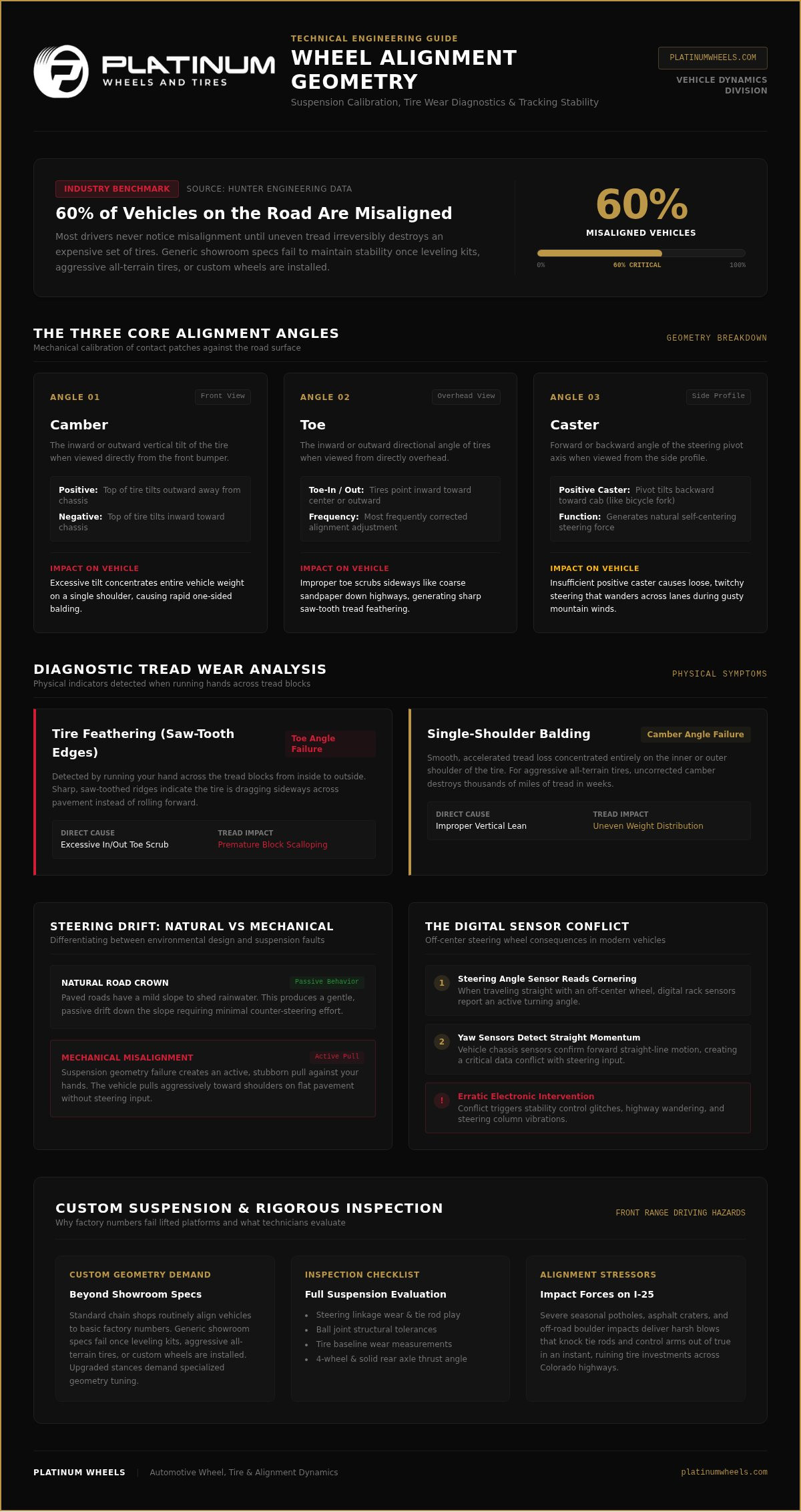
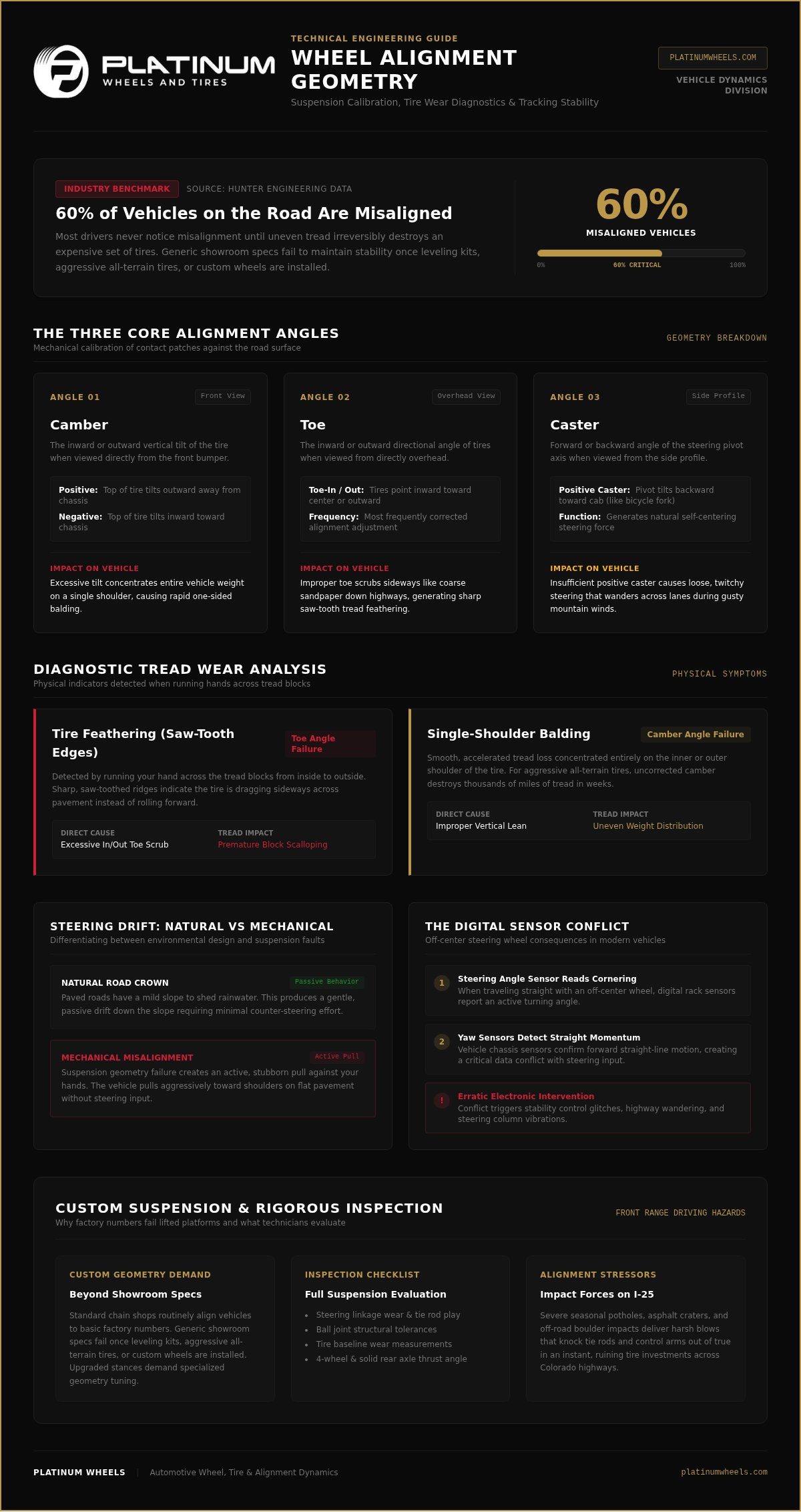
According to Hunter Engineering, 60% of vehicles on the road are misaligned, and most drivers never notice until uneven tread destroys an expensive set of tires. If you are fighting highway drift on I-25 or searching for an expert wheel alignment near me in the Denver area, you already know how frustrating that wandering steering wheel can be. Standard chain shops routinely align vehicles to basic factory numbers, but generic showroom specs fail once you install leveling kits, aggressive all-terrain tires, or custom wheels.
You shouldn't have to sacrifice tread life or wrestle your steering wheel just to enjoy an upgraded stance. In this guide, you'll discover how precision wheel alignment prevents premature tire wear, restores steering stability, and keeps lifted trucks tracking straight on Colorado highways. We'll explore the critical differences between factory and custom suspension geometry, revealing exactly how proper adjustments protect your tire investment on every Front Range commute.
Key Takeaways
- Spot subtle early warning signs like off-center steering wheels and highway drift before uneven wear permanently ruins your tire investment.
- Understand how camber, caster, and toe angles directly dictate tire contact patch balance, rolling resistance, and high-speed stability.
- Discover why searching for an expert wheel alignment near me is critical for lifted trucks and custom wheels that require specialized suspension geometry.
- Learn what technicians inspect during a professional alignment evaluation, including steering linkage wear, ball joints, and tire baselines.
- Protect your suspension setup from harsh Front Range driving hazards, from severe seasonal potholes to off-road trail impacts.
Warning Signs You Need a Wheel Alignment Near Me Right Now
Driving along I-25 or tackling rocky Front Range trails puts relentless stress on steering geometry. A harsh blow from an asphalt crater or an off-road boulder can knock tie rods and control arms out of true in an instant. When that happens, your truck communicates through steering feedback and tire wear. If your daily commute feels like an endless wrestling match, finding an experienced shop for a wheel alignment near me is the fastest way to stop unnecessary tire destruction.
Steering Drift and Off-Center Wheel Position
Most paved roads feature a slight slope called road crown to shed rainwater. Natural road crown causes a mild, passive drift down the slope, but mechanical misalignment creates an active, stubborn pull against your hands. When a vehicle aggressively pulls toward the shoulder on flat pavement without steering input, your suspension geometry has suffered a critical alignment failure.
Driving with an off-center steering wheel creates digital issues, too. Modern steering racks utilize digital steering angle sensors tied to electronic stability control and driver assistance systems. When your wheel sits cocked at an angle while traveling straight, the computer reads a cornering command while yaw sensors detect straight-line momentum. This conflict triggers erratic stability intervention, wandering handling, and frustrating steering column vibrations at cruising speeds.
Reading Your Tire Tread Wear Patterns
Tire tread provides an unvarnished diagnostic report of suspension health. Run your hand across the tread blocks from inside to outside. If you feel sharp, saw-toothed edges across the tread faces, you are feeling tire feathering, the unmistakable signature of incorrect toe angles. When toe alignment sits too far inward or outward, tires drag sideways across the pavement rather than rolling straight.
Smooth, accelerated balding on only the inside or outside shoulder points straight to excessive camber angles. For drivers investing in rugged all terrain tires, uncorrected camber and toe errors will chew through thousands of miles of tread life in just a few weeks. Gaining a practical baseline by understanding wheel alignment mechanics ensures you catch these wear patterns before they permanently scallop your tread blocks and ruin your ride quality.
Understanding Wheel Alignment Geometry: Camber, Caster, and Toe
Wheel alignment isn't just about pointing your tires straight ahead. It is the precise mechanical calibration of complex suspension angles to guarantee your tire contact patches sit square against the road. When searching for a knowledgeable shop to handle a wheel alignment near me, understanding how camber, caster, and toe interact helps you recognize handling quirks before tire damage becomes irreversible.
Camber and Toe: The Tire-Wear Culprits
Camber represents the inward or outward vertical tilt of the tire when viewed from the front bumper. Positive camber angles the top of the tire outward, whereas negative camber angles it inward toward the chassis. A fraction of negative camber aids cornering grip, but excessive tilt concentrates vehicle weight entirely on one shoulder.
Toe describes the inward or outward directional angle of the tires when viewed from directly overhead. Because Front Range roads constantly jostle steering links, toe is the most frequently corrected adjustment during routine checkups. Even a fraction of an inch of improper toe scrub acts like coarse sandpaper, dragging tires sideways down the highway and chewing through tread compound in record time.
Caster Angle: High-Speed Tracking and Wander
While camber and toe dictate tire wear, caster angle determines high-speed tracking and self-centering effort. Caster is the forward or backward angle of the steering pivot axis when viewed from the side profile, much like the raked front fork of a bicycle. Positive caster tilts the pivot backward toward the cab, creating a natural stabilizing force that snaps your steering wheel back to center out of a turn.
Insufficient positive caster produces a loose, twitchy steering feel that drifts across highway lanes during gusty mountain winds. Calibrating caster to established automotive industry standards balances angles between the driver and passenger sides, actively compensating for natural road pitch without sacrificing highway poise.
Thrust Angle and 4-Wheel Alignment Basics
Front-end alignments only solve half the equation. Even trucks with solid rear axles experience thrust angle misalignment if leaf spring centering pins sheer, U-bolts stretch, or control arm bushings compress. Thrust angle dictates the precise line of travel pushed forward by the rear axle relative to the vehicle centerline.
When rear geometry shifts out of square, the vehicle suffers from "dog tracking," where the rear wheels follow a separate path from the front steering axle. A modern computer-guided four-wheel alignment squares the rear axle first, then aligns the front wheels directly to that true centerline. If you have recently upgraded your ride height, consulting our Denver fitment specialists ensures your suspension angles match your custom footprint perfectly.
Why Lifted Trucks and Custom Wheels Demand Specialized Alignment
Lifting or leveling a truck fundamentally alters how steering components interact under load. Mainstream tire franchises often struggle here because their computerized alignment racks rely on stock factory profiles that no longer apply to modified builds. Searching for a specialized wheel alignment near me after completing suspension work connects you with technicians who understand custom geometry rather than rigid showroom baselines.
Geometry Changes from Suspension Upgrades
Whether you chose a subtle rake adjustment or significant ground clearance when deciding between a leveling kit vs lift kit, elevating the chassis pushes upper and lower control arms downward. This steep angle forces factory ball joints and steering knuckles toward the physical limits of their operational range, robbing the front suspension of vital positive caster.
Without upgraded aftermarket upper control arms built with corrected geometry, your truck will feel light and twitchy at speed. Steeper tie-rod angles also trigger bump steer. When you hit a pavement expansion joint or highway dip, the suspension cycles up and down, forcing the tie rods to swing through an arc that violently toes the front tires outward without any steering wheel input.
Accommodating Aggressive Off-Road Tire Setups
Bolting on wider custom wheels and rims featuring aggressive negative offsets expands your vehicle's scrub radius. Scrub radius is the distance between the steering pivot line and the center of the tire contact patch. Pushing wheels further outward provides an aggressive, wide stance, but it also turns the tire into a longer lever arm acting against your steering linkages.
Oversized 35-inch or 37-inch mud-terrain tires amplify minor alignment errors into severe wandering, road walk, and heavy steering resistance. A dedicated specialist adjusts camber and caster specifically to keep those large tread blocks flat while centering the wheel hub inside the wheel well, preventing annoying tire rub against the body mounts and bumper plastic at full lock.
What to Expect During a Professional Wheel Alignment Inspection
A true alignment service is a methodical mechanical procedure, not a simple computer scan. When booking a wheel alignment near me across Denver, you should expect a comprehensive evaluation that addresses structural integrity before adjusting a single bolt. A professional alignment workflow follows five core stages:
- Suspension Pre-Check: A thorough physical inspection of ball joints, tie rods, control arm bushings, and wheel bearings for unwanted play.
- Tire Pressure and Tread Baseline: Setting all four tires to exact manufacturer pressure specifications and measuring tread depth consistency.
- Target Calibration: Mounting high-definition digital sensor targets securely onto each wheel clamp without touching or scratching custom finishes.
- Mechanical Angle Adjustment: Fine-tuning eccentric cam bolts, tie-rod turnbuckles, and aftermarket adjustable control arms while the vehicle rests under full load.
- Printout Verification and Road Testing: Reviewing computerized before-and-after specification angles followed by a highway test drive to confirm zero steering pull.
The Crucial Pre-Alignment Suspension Check
Attempting to align a truck with worn chassis components is a complete waste of time. Alignment angles hold true only when suspension pivot points are rigid, because tight suspension parts must precede alignment adjustments or every reading shifts the second the tires roll forward. Technicians must inspect steering racks for fluid leaks, examine pitman and idler arms for internal looseness, and check steering link sleeves for thread play.
If a ball joint has vertical movement or an inner tie rod shows lateral slop, adjusting alignment angles is impossible. The slack in the joints will cause camber and toe to drift unpredictably under real-world driving conditions, instantly undoing the technician's adjustments. Addressing these underlying mechanical issues first ensures any subsequent alignment holds true; drivers can learn more about Fix My Car to see how full-service technicians diagnose and repair worn steering and suspension components.
Digital Laser Sensors and Spec Calibration
Once mechanical components pass inspection, high-resolution cameras calculate angle measurements down to hundredths of a degree. These imaging systems instantly map thrust angle, steering axis inclination, camber, and total toe across all four corners.
Technicians adjust steering links and eccentric control arm cams while the vehicle sits under its own static weight on slip plates. After locking the hardware down to specification, you receive a full diagnostic printout showing live before-and-after values highlighted in green. If you want to protect your new stance and suspension setup, visit Platinum Wheels in Denver to get your rig dialed in by experienced fitment specialists.
Front Range Driving: Protecting Your Wheels, Tires, and Suspension Setup
Colorado roads subject steering setups to extraordinary abuse. Rapid temperature swings trigger relentless freeze-thaw cycles along I-25, I-70, and C-470, carving out rim-bending potholes and jagged asphalt heaves. Routine alignment checks serve as essential insurance, keeping newly installed aftermarket wheel and tire packages rolling true rather than scrubbing away expensive tread on scarred pavement.
How Colorado Terrain Knocks Alignment Out of Spec
Heavy snowplow blades tear deep gouges into mountain highways, while spring frost heaves create brutal impacts that jar tie-rod adjustment sleeves loose. If you venture into the backcountry for weekend rock crawling, dropping off ledges or wedging a tire against a boulder places immense lateral force across the steering linkage. These harsh impacts stretch hardware, shift solid axles, and knock eccentric cam bolts out of position.
For drivers commuting through mountain corridors and exploring rugged trails, having your geometry checked every 6,000 miles or at least annually is sound practice. If you take a hard hit against a hidden granite shelf or slam into an unavoidable highway crater, searching for a skilled specialist for a wheel alignment near me immediately prevents minor misalignments from ruining your tires.
Maximizing the Return on Your Wheel and Tire Investment
Routine tire rotations alone cannot cure compromised suspension geometry. While regular rotations balance tread depletion between front and rear axles, pairing them with verified digital alignment checks guarantees that your tires maintain a perfectly flat contact patch. This diligence is crucial when running heavy, deep-lug offroad tires and wheels, where uneven block wear causes loud highway drone and wandering handling.
Keeping your truck tracking straight protects your tread investment and guarantees confidence whether you are navigating slushy mountain passes or cruising the Denver metro area. Reach out to Platinum Wheels to consult with our local specialists on custom wheel, tire, and stance solutions engineered for rugged Colorado driving.
Dial In Your Truck's Geometry for the Miles Ahead
Your wheels, tires, and suspension represent a serious investment in your rig's capability and curb appeal. Precision alignment is the vital insurance policy that keeps that investment protected against harsh Rocky Mountain roads. Leveled stances, aggressive offsets, and oversized rubber demand specialized geometry calculations that standard factory specs simply can't deliver.
When you feel highway drift or spot early tread feathering, don't wait until your tires are permanently ruined. Finding a trusted shop for a precision wheel alignment near me restores crisp steering response, eliminates erratic bump steer, and keeps your truck tracking true. With deep local roots serving Front Range drivers, our team pairs specialized suspension fitment expertise with comprehensive wheel and tire packages mounted, balanced, and road-ready. Upgrade your stance and protect your tires with Platinum Wheels, and take on every Colorado adventure with complete confidence.
Frequently Asked Questions
How often should I get a wheel alignment on my truck or SUV?
You should have your alignment checked annually or every 6,000 miles, ideally timed with your regular tire rotations. Front Range motorists who frequently travel rutted mountain passes, tackle off-road trails near Boulder or Golden, or hit severe seasonal potholes on I-25 should consider checks twice a year to ensure their suspension angles remain true.
Can a bad wheel alignment cause steering wheel vibration at highway speeds?
Severe toe or camber misalignment can cause front-end instability, but rhythmic steering wheel vibration at highway speeds usually points to wheel imbalance or an out-of-round tire. Misalignment drags the tire sideways, creating scalloped or feathered wear patterns. That uneven tread damage eventually causes harmonic shaking through the steering column as speeds increase.
Do I automatically need an alignment after installing new tires or custom wheels?
Yes, scheduling an alignment check is the single best way to protect your financial investment when bolting on new tires or custom rims. Even if your truck tracked straight beforehand, slight geometry flaws will rapidly degrade fresh tread blocks. Verifying your angles ensures your new rubber makes uniform, square contact with the asphalt from day one.
What is the difference between a wheel alignment and wheel balancing?
Wheel alignment adjusts the mechanical angles of your suspension components, ensuring your tires sit square to the pavement and parallel to each other. Wheel balancing, on the other hand, corrects uneven weight distribution around the spinning wheel and tire assembly using precision counterweights. Both services work together to deliver smooth highway handling and prevent premature tire wear.
Why does my truck pull to the right even after getting an alignment?
A lingering pull usually stems from excessive road crown, uneven tire pressures, or radial tire pull caused by internal belt damage. Standard roads slope slightly to the right for drainage, which natural steering setups feel. If cross-caster was not intentionally tuned to offset local road pitch, your truck will drift toward the ditch even with green alignment specs.
Can you align a truck equipped with an aftermarket suspension lift or leveling kit?
Yes, but lifted applications require a specialized technician who understands altered geometry rather than someone relying purely on stock computer presets. Raising ride height shifts factory caster and camber specs. When booking a wheel alignment near me across Denver or Lakewood, choose a shop experienced in setting custom angles and installing aftermarket upper control arms.
How long does a professional digital four-wheel alignment typically take?
A standard four-wheel alignment generally takes between 45 and 90 minutes. The initial inspection, digital target clamp mounting, and diagnostic scan take roughly 20 minutes. Fine-tuning rusted tie-rod sleeves, adjusting control arm cam bolts under static vehicle weight, and completing a post-service road test make up the remainder of the shop time.