Custom Chevy Silverado Rims in Denver | Expert Wheel Sets
A single mistake in offset or bolt pattern can transform your high-performance truck into a vibrating, rubbing mess that's unsafe for the Eisenhower Tunnel. You've spent a lot of time and money on your rig; it's natural to feel a bit of fitment anxiety when shopping for aftermarket wheels. Between the confusion of 6-lug versus 8-lug patterns and the legitimate fear of Colorado road salt eating through a flashy finish, the stakes are high for Denver truck owners. We know you want a more aggressive stance and a truck that stands out at the trailhead, but you need the peace of mind that comes with expert technical specs.
This guide is designed to help you master the world of chevy silverado rims so you can upgrade with total confidence. We'll walk you through the precise fitment requirements for 1500 and 2500HD models; we also explain how to choose a finish that withstands our brutal winters. You'll learn how to achieve that perfect off-road look without compromising your suspension or risking tire rub on tight turns. From understanding the 6x139.7 bolt pattern to selecting the right wheel and tire package, we're covering everything you need to build a setup that's as rugged as the Front Range.
Key Takeaways
- Identify the critical bolt pattern differences between 1500 and HD models to ensure your new wheels mount perfectly the first time.
- Navigate the complexities of wheel offset to get an aggressive stance while avoiding the frustration of tire rub.
- Choose "winter-proof" finishes that protect your investment against Colorado's harsh road salt and mag-chloride treatments.
- Discover how lift and leveling kits expand your options for larger chevy silverado rims without compromising your truck's handling.
- Understand why professional installation and TPMS programming are mandatory for maintaining safety and performance on 2026 models.
Understanding Chevy Silverado Wheel Fitment & Bolt Patterns
Getting the right set of chevy silverado rims starts with understanding the mechanical foundation of your truck. If you've ever felt a steering wheel shimmy while cruising down I-25 at 75 mph, you've likely experienced the result of poor fitment. It isn't just about the diameter or how the wheel looks in the wheel well; it's about the precise interface between the wheel and the hub. For Silverado owners, this means paying attention to bolt patterns, load ratings, and center bore dimensions that vary significantly across different model years and weight classes.
Silverado 1500 vs. Heavy Duty: The Lug Nut Count
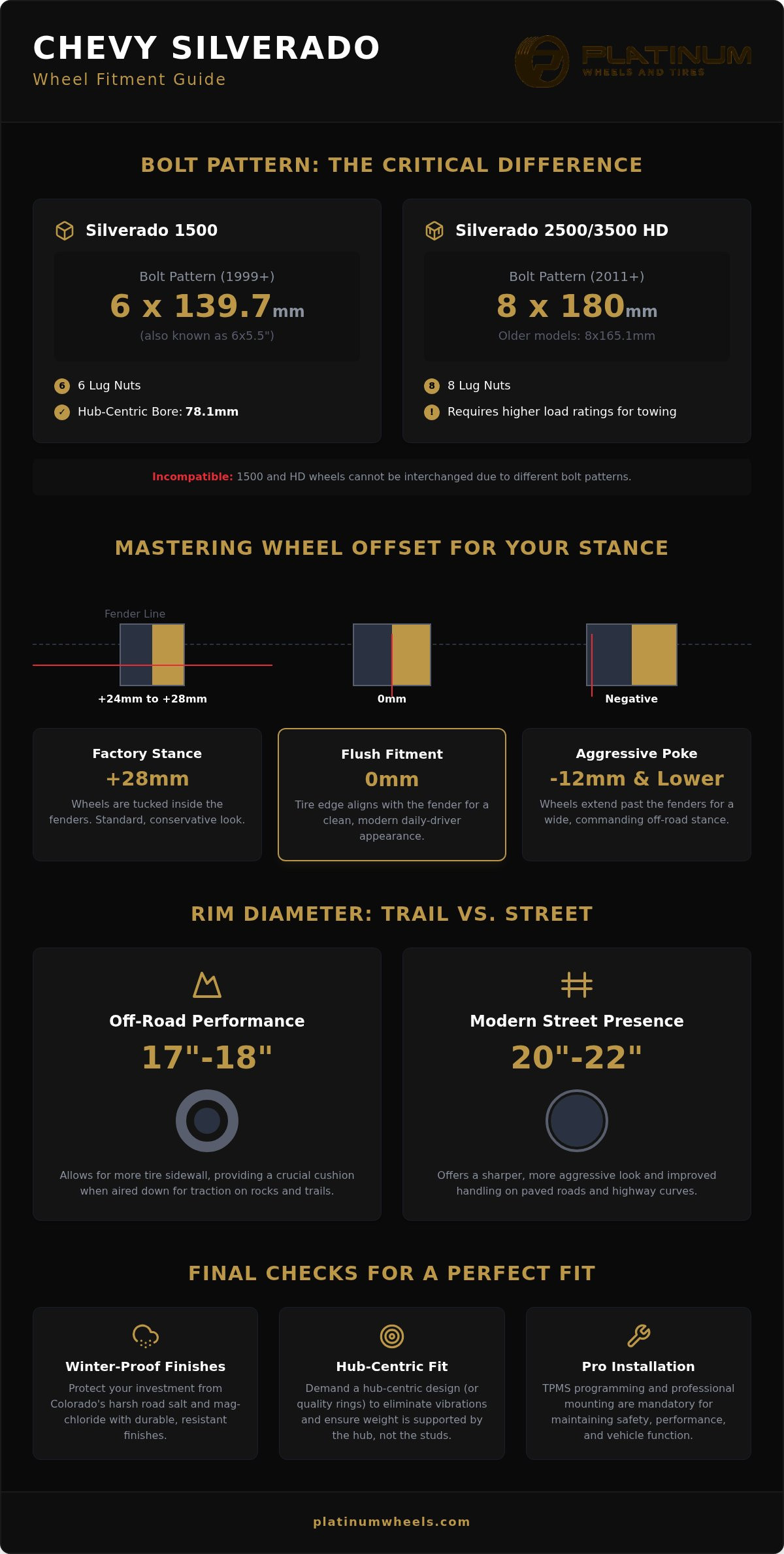
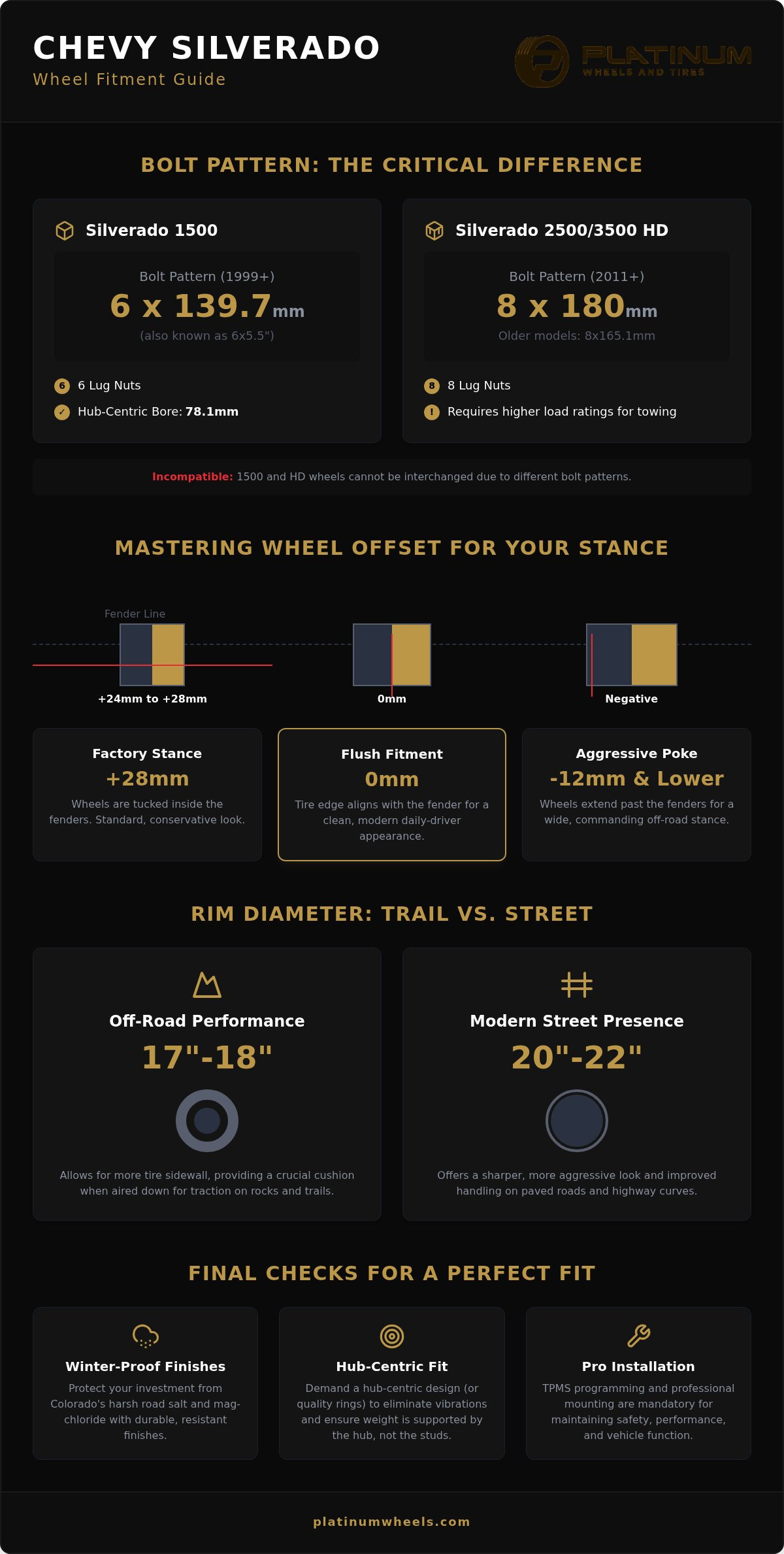
The most immediate distinction you'll notice is the lug nut count. Since the late 1990s, the Silverado 1500 has consistently used a 6x139.7 bolt pattern, often referred to as 6x5.5 inches. This setup is standard for light-duty trucks and provides a solid balance of weight and strength. However, if you drive a 2011 or newer Silverado 2500HD or 3500HD, your truck utilizes a much larger 8x180 pattern. Older HD models used an 8x165.1 (8x6.5) pattern, so checking your specific year is vital.
You cannot swap wheels between these two platforms. Even if you find a great deal on a set of take-offs, the physical spacing of the studs makes them incompatible. Beyond the bolt pattern, heavy-duty trucks require rims with higher load ratings to support the massive tongue weights associated with towing horse trailers or construction equipment. We ensure every wheel we install meets or exceeds the Gross Axle Weight Rating of your specific Silverado to guarantee safety during heavy hauls.
The Importance of Hub-Centric Design
Hub-centric wheels are designed so that the center hole of the rim fits perfectly over the hub of the truck. This design ensures the weight of the vehicle is supported by the hub itself, rather than just the lug studs. Many generic aftermarket wheels are lug-centric, meaning they have a larger center bore to fit multiple vehicle types. While these can work, they often lead to vibrations that are nearly impossible to balance out on a heavy truck.
A thorough Understanding Wheel Sizing is critical here; specifically how the center bore diameter affects safety and ride quality. If a wheel has a center bore larger than your Silverado's hub, which is 78.1mm for most 1500s, we use high-quality hub-centric rings to bridge that gap. This technical step is a priority at Platinum Wheels because it eliminates microscopic movements that cause safety issues and premature tire wear. When you choose your next set of chevy silverado rims, demand a hub-centric fit to keep your ride smooth on Colorado's varied terrain.
Choosing the Right Rim Size & Offset for Your Silverado
Selecting the right diameter for your Silverado is a balancing act between aesthetic preference and how you actually use your truck. While factory options are safe, they often lack the personality many Denver owners crave. When you start looking at aftermarket chevy silverado rims, you're choosing more than a style; you're determining how the vehicle handles on pavement and dirt. Getting this right requires a deep dive into dimensions that go far beyond just the height of the wheel.
Popular Rim Sizes: 17s to 22s
If you spend your weekends on the trails near Idaho Springs, 17-inch or 18-inch rims are your best bet. These smaller diameters allow for more tire sidewall, which provides a vital cushion when aired down for traction on rocks. Conversely, 20-inch and 22-inch wheels have become the modern standard for street presence. They offer a sharper look and better handling on paved curves, though you sacrifice some off-road compliance. We often help clients find the middle ground by pairing these larger sizes with aggressive all-terrain tires to create a cohesive custom wheels and rims package that performs as well as it looks.
Decoding Offset for the Silverado Chassis
Offset is the most misunderstood technical spec in the industry. It measures the distance from the wheel's mounting surface to its true centerline. Factory Silverado wheels typically feature a positive offset between +24mm and +28mm, which keeps the tire tucked neatly inside the fender. Moving to a 0mm offset usually brings the tire edge perfectly flush with the fender flare for a clean, daily-driver look. This setup provides a wider stance without the extreme stress of a deep-dish wheel.
Achieving that wide, aggressive "poke" seen on many mountain rigs requires a negative offset. This pushes the wheel outward, significantly widening the truck's stance. However, this change impacts your scrub radius and can increase the effort needed to turn the wheel. Using an incorrect offset creates excessive leverage that leads to the premature wear and eventual failure of your truck's wheel bearings. You also have to account for backspacing to ensure your new chevy silverado rims don't grind against your brake calipers or upper control arms during tight maneuvers.
Safety is paramount during these modifications. We strictly follow OSHA standards for wheel installation to ensure every set is mounted and torqued correctly for the road. If you're unsure which offset will clear your specific suspension setup, consult with our technicians to find the perfect fitment for your build.
Best Finishes and Materials for Colorado’s Harsh Environments
Buying chevy silverado rims in Denver requires a different strategy than in milder climates. Our roads are treated with aggressive magnesium chloride and road salt for nearly half the year; these chemicals are notorious for eating through low-quality finishes. If you don't choose a winter-proof option, your investment can look pitted and corroded after just one season of mountain driving. We focus on helping you select materials and coatings that stand up to the Front Range's unique environmental demands without sacrificing style.
If you love the mirror-like shine of chrome, stay away from traditional electroplated options. They pit and peel almost immediately when exposed to Colorado's winter road treatments. We recommend PVD (Physical Vapor Deposition) chrome instead. This process uses a high-tech powder coat base that mimics the look of traditional chrome but offers the durability of a rugged painted finish. It's the only way to get that classic look while ensuring your wheels survive the drive to Vail or Breckenridge.
Finish Durability: Matte Black, Gloss, and Machined
Satin and matte black remain the most popular choices for local Silverado builds for good reason. These finishes are incredibly forgiving; they hide brake dust and small trail scuffs much better than high-gloss options. You should be cautious with "machined" faces where the raw aluminum is exposed under a thin clear coat. If that clear coat gets a rock chip, salt will seep in and cause unsightly spiderweb corrosion that's impossible to buff out. We often suggest adding a ceramic coating to your chevy silverado rims and all terrain tires to provide a secondary defensive barrier against the elements.
Wheel Construction for the Front Range
Weight and strength are just as important as aesthetics. Cast wheels are the most common and affordable, but they're also the heaviest. For those who tow heavy trailers or hit the washboard roads of the backcountry, flow-formed wheels offer a significant upgrade. This construction uses a specialized spinning process to create a denser, stronger barrel that's much lighter than traditional cast alloy. It's the perfect middle ground for a daily-driven truck that still works hard.
Forged wheels represent the absolute pinnacle of performance. They are carved from a single block of solid aluminum, making them nearly indestructible under high-stress off-roading or heavy-duty towing. Reducing the weight of your wheels—known as unsprung mass—directly improves your Silverado's braking response and acceleration. It's a technical advantage you'll feel every time you merge onto the highway or descend a steep mountain pass.
How Lift and Leveling Kits Impact Your Silverado Rim Choice
Your suspension and wheel choices are inextricably linked. If you're planning to upgrade your chevy silverado rims, you must first decide on the height of your truck. A suspension modification isn't just about looks; it creates the physical space required for larger wheel and tire combinations. Understanding the difference between a leveling kit vs lift kit is the first step in determining what will actually fit without damaging your truck.
For most 4WD Silverados, we recommend a square setup, which means using the same wheel width and offset on all four corners. This allows for proper tire rotation and maintains consistent handling. If you push for ultra-wide 10-inch or 12-inch rims, you'll need significantly more lift height to clear the wheel wells during a full turn. Wider wheels increase the arc the tire travels; this often leads to contact with plastic wheel well liners or the metal behind the fender, necessitating the common fender mod to prevent rubbing.
Fitment Guide for Leveled Silverados
A 2-inch leveling kit is the most popular choice for Denver daily drivers. This setup typically allows you to fit 33-inch tires on 20-inch rims with minimal fuss. However, you must be careful with your offset. If you choose a rim with too much positive offset, the inner sidewall of the tire will rub against the factory upper control arm. For a leveled truck, sticking to a 9-inch wide rim with a near-zero offset provides a clean look while maintaining safe mechanical clearances.
Going Big: 35s and Beyond with a Lift Kit
When you move to a 4-inch or 6-inch lift kit, the possibilities for aggressive chevy silverado rims expand. This is where you can safely run 35-inch or even 37-inch tires. At these heights, many lift kits require high-clearance aftermarket upper control arms to allow for the increased range of motion and to clear wider wheel packages. Wheel backspacing is the measurement from the mounting surface to the back edge of the rim, and it directly determines how much room is left for suspension components. If you're ready to transform your truck's stance, book your professional lift and wheel installation with our team to ensure your components work in perfect harmony.
Professional Silverado Rim Installation in Denver & Aurora
Choosing your chevy silverado rims is only half the battle. The installation process determines whether your truck drives like a dream or a vibrating nightmare. While online retailers ship boxes to your door, they don't help you with the final, most critical steps of the build. For owners of 2026 models, tpms sensor programming is mandatory to keep your safety systems functioning and that annoying dash light off. We handle the technical side of the installation so you can focus on the drive.
We highly recommend choosing a complete aftermarket wheel and tire package. This ensures your rims and tires are matched for the correct load rating and fitment before they ever touch your truck. It simplifies the entire process and guarantees that your setup is balanced and ready for the road the moment you leave our shop. Buying locally means you have a partner who understands the specific demands of Colorado's terrain and climate.
Expert Mounting and Balancing
Road force balancing is our standard for large off-road tires. Standard balancing often misses the tiny inconsistencies in heavy tire carcasses that cause highway shimmies at 75 mph. We use specialized equipment to simulate the weight of the vehicle on the tire during the balance process. We also focus on the aesthetic details that matter to enthusiasts. This includes using black weights and hidden valves to maintain a clean, high-end look on your new chevy silverado rims. Safety is our top priority; we always torque lug nuts to the factory-spec 140 lb-ft for most 1500 models to prevent wheel stud failure.
The Platinum Wheels Experience
Our consultative approach means we look at your specific suspension, intended use, and desired stance before we ever mount a tire. We've spent years perfecting the "Fitment Guarantee," ensuring that your truck leaves our shop with zero rubbing and zero vibrations. Serving the entire Front Range from Castle Rock to Fort Collins, we provide the expert suspension advice you simply won't find at a general repair shop or a massive online warehouse. We live and breathe truck culture in Colorado, and we're here to make sure your Silverado reflects that passion. Visit Platinum Wheels in Denver for your Silverado upgrade!
Build Your Perfect Silverado Setup Today
Upgrading your truck is about more than just aesthetics; it's about ensuring every technical detail from bolt patterns to offset is executed with precision. You now have the knowledge to distinguish between 1500 and HD fitments and the insight to choose finishes that actually survive a Colorado winter. Whether you're aiming for a flush daily-driver look or an aggressive off-road stance, the right chevy silverado rims will transform your driving experience on the Front Range. Don't let fitment anxiety or the fear of road salt keep you from the rig you've always wanted.
As Denver’s leading truck fitment experts, we specialize in off-road and heavy-duty setups that are built to perform. Platinum Wheels is an authorized installer for top-tier suspension brands, ensuring your lift or leveling kit works in perfect harmony with your new wheel package. We take the guesswork out of the process with our fitment guarantee and professional road force balancing. Browse Custom Chevy Silverado Rim Packages at Platinum Wheels and let's get your truck ready for your next mountain adventure. It's time to hit the trails with total confidence in your build.
Frequently Asked Questions
What is the bolt pattern for a Chevy Silverado 1500?
The current Chevy Silverado 1500 utilizes a 6x139.7 bolt pattern, which is also commonly referred to as 6x5.5 inches. This six-lug configuration has been the standard for the 1500 platform for decades, providing the necessary strength for light-duty hauling. It's important to remember that this differs from the 8x180 pattern found on 2500HD and 3500HD models. We always verify your specific year and trim to ensure the chevy silverado rims you choose mount perfectly to your hubs.
Will 20-inch rims fit my Silverado without a lift kit?
Yes, 20-inch rims will fit a stock Silverado 1500 without a lift kit since many factory trims come equipped with 20-inch wheels from the dealership. The key to a successful fitment is maintaining a tire diameter and wheel offset that matches factory specifications. If you choose a tire with a larger sidewall or a wheel with aggressive negative offset, you might experience rubbing during tight turns. We recommend staying close to a +24mm to +28mm offset for stock height trucks.
What is the best wheel offset for a flush look on a Silverado?
A 0mm offset is typically the best choice for achieving a "flush" look where the tire edge aligns perfectly with the fender flare. Most factory chevy silverado rims feature a positive offset of +24mm to +28mm, which keeps the wheels tucked inside the wheel well. Moving to a 0mm offset pushes the wheel outward just enough to fill the gap without requiring significant suspension modifications or causing excessive tire poke beyond the bodywork.
Do I need new TPMS sensors when I buy aftermarket rims?
You don't strictly need new sensors if your existing ones are functional, but we highly recommend installing new TPMS sensors with every aftermarket wheel package. Sensors have internal batteries that typically last five to seven years; swapping them into new rims often leads to seal failures or battery death shortly after installation. For 2026 Silverado models, our team uses specialized programming tools to sync the new sensors with your truck's onboard computer to prevent dash light headaches.
Can I use my factory lug nuts on aftermarket Chevy rims?
You generally cannot use factory lug nuts on aftermarket wheels because the lug seat shape and nut diameter are often different. Most factory Silverado lug nuts use a large "flanged" design that won't fit into the narrower lug holes of custom rims. Aftermarket wheels typically require "conical" or "tapered" seat lug nuts. We provide the correct high-strength lug nuts with every installation to ensure your wheels stay securely torqued to the required 140 lb-ft.
How do I prevent my custom rims from pitting in Colorado winters?
Prevent pitting by choosing PVD chrome or high-quality painted and powder-coated finishes rather than traditional electroplated chrome. Colorado's use of magnesium chloride is extremely corrosive; it settles into the pores of the metal and causes rapid oxidation. We suggest applying a ceramic coating before winter begins and washing your wheels weekly to remove salt buildup. Avoiding "machined" finishes with exposed aluminum also reduces the risk of spiderweb corrosion under the clear coat.
What is the difference between hub-centric and lug-centric wheels?
Hub-centric wheels feature a center bore that fits exactly over the truck's hub, ensuring the vehicle's weight is supported by the hub itself. Lug-centric wheels rely solely on the lug studs to center the wheel and bear the load. Because the Silverado hub diameter is 78.1mm, we prioritize hub-centric designs or use precision-engineered hub rings. This technical detail is vital for preventing the high-speed vibrations often felt when driving on I-70 or I-25 through Denver.
Does changing my wheel size affect my speedometer?
Changing your wheel diameter only affects your speedometer if the overall height of the tire changes as well. If you move from an 18-inch wheel to a 20-inch wheel but use a lower-profile tire to maintain the same total diameter, your speedometer remains accurate. However, if you install a larger off-road tire, your speedometer will read slower than your actual speed. We can help you calculate these differences or discuss recalibration options for your Silverado's computer during your installation.