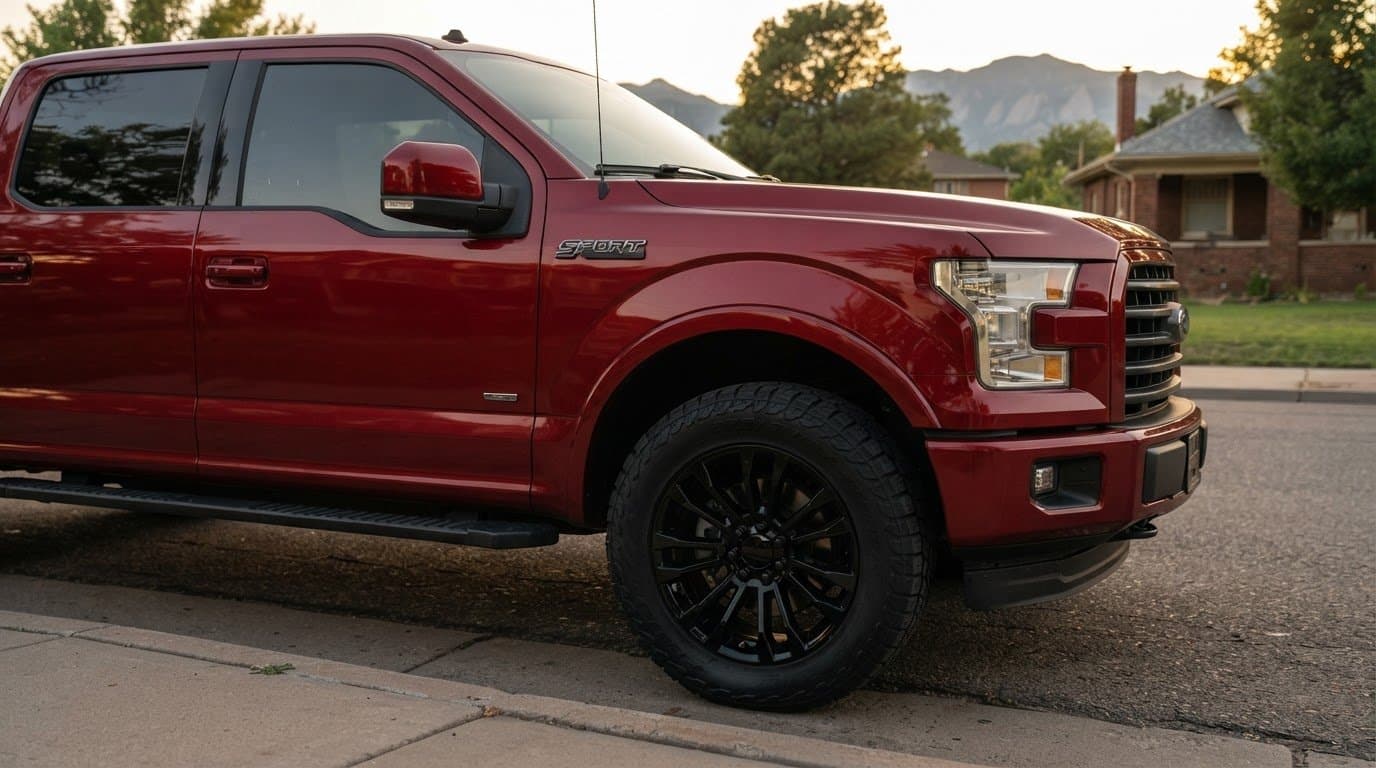
Best F-150 Rims in Denver: Upgrade Your Truck's Style
The right F-150 rims don’t have to mean an oversized wheel or a dramatic lift. A 20-inch wheel diameter is used on the 2015-2026 Ford F-150 20-inch insert wheel kit, while the best fit for your truck depends on its setup and the look you want. Keeping factory tire sizing in the conversation can help create a clean, balanced upgrade.
It’s natural to focus first on wheel size or finish, but fitment is what ties the whole look together. Whether your truck sits at stock height or has a lift, wheel position, tire dimensions, and finish all shape the final stance.
Here, you’ll learn how those choices work together, from OEM+ styling to bolder custom looks. We’ll cover stock-height and lifted fitments, finishes, and factory tire sizing so you can make a more informed choice for your F-150 in Denver.
Key Takeaways
- Match wheel fitment to your F-150’s ride height and intended stance for a cohesive look.
- Compare finishes with your truck’s overall style before settling on a custom appearance.
- Consider factory tire sizing when aiming for an OEM+ upgrade that feels balanced.
- Understand how lug nuts, TPMS sensors, and spacers factor into a wheel change.
Custom wheel fitments for stock-height and lifted trucks
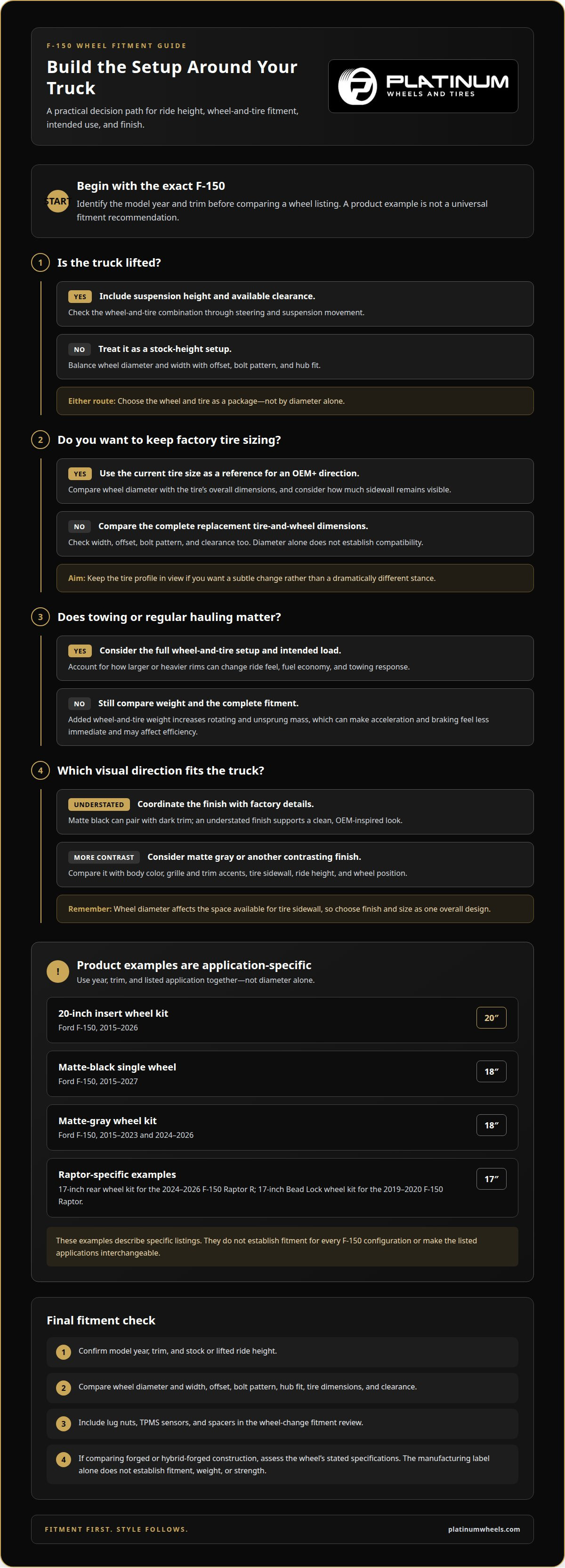
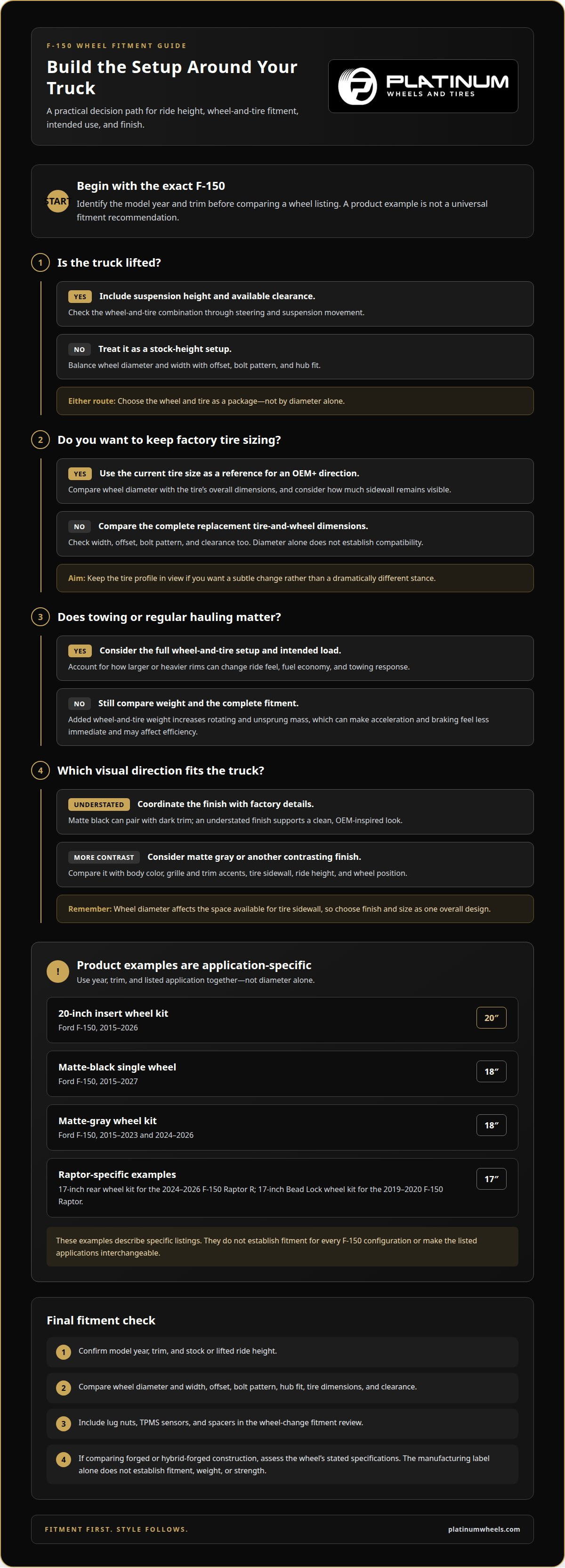
Fitment starts with the F-150’s model details and ride height, then balances wheel position, tire size, and clearance. Stock-height and lifted trucks can use different setups, so select the wheel and tire combination as a package rather than judging diameter alone.
Vehicle-Specific Wheel Measurements
For a stock-height Ford F-150, consider wheel diameter and width alongside offset, bolt pattern, and hub fit. A lifted truck adds another factor: the wheel and tire must work with its suspension height and available clearance through steering and suspension movement.
A 20-inch wheel diameter is used on the Ford F-150 2015-2026 20-inch insert wheel kit. That example shows why model year and intended style belong in the fitment conversation; it doesn’t establish fitment for every F-150 configuration.
Effects of Larger or Heavier Rims
Larger or heavier rims can change ride feel, fuel economy, and towing response. Added wheel-and-tire weight increases rotating and unsprung mass, which can make acceleration and braking feel less immediate and may affect efficiency. For towing, consider the complete wheel-and-tire setup and the truck’s intended load, not appearance alone.
Hybrid forged wheels can be a suggestion for drivers comparing custom styles and construction methods. The term describes a manufacturing approach, not a guarantee of a particular weight or strength. Compare the wheel’s stated specifications with the F-150’s fitment needs before choosing a design.
Forged wheel manufacturing shapes metal under pressure, while hybrid processes combine forging with other forming methods. Those labels alone don’t tell you whether a wheel fits your truck; dimensions and application remain central.
To request a custom wheel quote, provide the F-150’s model year, stock or lifted ride height, current tire sizing, and the look you want. Include whether towing or regular hauling matters. These details help narrow the wheel measurements and tire pairing instead of starting with appearance alone.
Wheel finishes and customization
Finish changes how an F-150’s wheels read against its body, trim, and tires. Matte black gives the wheel face a restrained, dark appearance, while matte gray creates contrast without the same all-black effect. Choose the finish alongside wheel diameter, so the design feels intentional rather than disconnected from the truck’s overall stance.
Available examples show how finish and model year can intersect. An 18-inch matte-black single wheel is listed for the Ford F-150 2015-2027. An 18-inch matte-gray wheel kit is listed for 2015-2023 and 2024-2026 F-150 models. An 18-inch matte-black wheel kit is also listed for 2024-2026 models. These examples describe specific wheel listings, not a universal fit for every truck.
Start customization by choosing the visual direction. Match matte black with dark trim for a coordinated look, or use matte gray to make the wheel face stand apart. Then compare the finish in context: body color, grille and trim accents, tire sidewall, and whether the truck sits at stock height or has a lift. A finish can look different when the tire profile or wheel position changes.
Size matters, too. A wheel diameter sets the space available for the tire sidewall, influencing the overall visual balance. Don’t choose an 18-inch option on appearance alone; connect the wheel to the F-150’s model year and intended tire fitment. That keeps customization focused on a complete setup, not just a finish sample.
For a clean OEM-inspired result, keep the finish understated and coordinate it with factory details. For a more noticeable custom look, select a contrasting finish and make sure it complements the truck’s other accents. A custom wheel selection can help bring the finish and overall design together.
OEM+ styling and factory tire fitments
OEM+ styling updates an F-150’s appearance while keeping the overall design close to its original character. Factory tire fitment is part of that balance: the wheel must pair with a tire suited to the truck, not just match a preferred finish. Start with the exact model year and trim, then compare wheel diameter and tire dimensions as one setup.
Specific wheel listings show why year and model details matter. A black insert wheel kit for the Ford F-150 2015-2023 has a 20-inch wheel diameter. For the 2024-2026 F-150 Raptor R, a rear wheel kit has a 17-inch diameter. A 17-inch Bead Lock wheel kit is listed for the 2019-2020 Ford F-150 Raptor. These are distinct applications, not interchangeable fitment recommendations.
For a factory-inspired upgrade, use your truck’s current tire sizing as a reference. Compare the replacement wheel diameter with the tire’s overall dimensions, then consider how much sidewall will remain visible. Matching diameter alone doesn’t establish compatibility: width, offset, bolt pattern, and clearance also affect fit. Keep the original tire profile in mind if you want a subtle change rather than a dramatically different stance.
Trim matters as much as model year. An F-150 Raptor R and a standard F-150 aren’t the same configuration, so don’t transfer a wheel example between them based on diameter alone. Confirm the wheel application, then pair it with tires appropriate for that exact truck. That approach helps preserve a composed OEM+ look without treating a product listing as a universal specification.
Use this sequence to narrow the choice: identify the F-150’s year and trim, decide whether to retain factory tire sizing, and choose a wheel design that complements the truck’s existing details. A black insert design can add contrast while retaining a familiar spoke pattern; a Raptor-specific wheel example illustrates why trim-specific fitment deserves attention.
What lug nuts, TPMS sensors, and spacers are needed when changing F-150 rims?
A wheel change involves more than matching diameter. Lug nuts must suit the wheel’s seat and the truck’s thread and hardware requirements. A factory-style wheel and an aftermarket wheel can use different lug-seat designs, so the original nuts aren’t automatically the right match. The correct hardware helps the wheel seat securely against its mounting surface.
Before installation, identify the F-150 model year and the replacement wheel’s specifications. Then match the lug nut’s seat shape, thread, and usable length to that wheel and vehicle. Conical and flat-seat designs aren’t interchangeable choices. Avoid selecting lug nuts by appearance alone; the wheel’s mounting design determines the compatible seat.
TPMS sensors monitor tire pressure and communicate with the vehicle’s tire-pressure monitoring system. A replacement wheel setup may reuse existing sensors or require compatible TPMS sensors, depending on the wheel and vehicle application. Sensor fit and system pairing matter: a sensor that doesn’t communicate correctly won’t provide the intended monitoring. Include TPMS in your wheel-and-tire plan rather than treating it as a last-minute add-on.
Spacers move a wheel outward from its mounting face. They may be considered when the desired wheel position or clearance calls for adjustment, but they aren’t required for every F-150 wheel change. Their thickness affects wheel position, tire clearance, and the space available near suspension or body components. Pairing a spacer with the wheel’s offset and tire dimensions is essential to avoid an unsuitable fit.
A practical installation sequence is straightforward: match wheel specifications to the F-150, select compatible lug nuts, account for TPMS sensor fit, then determine whether the wheel’s position requires a spacer. Platinum Wheels offers TPMS sensors as part of its wheel and tire options. Explore TPMS sensor options when planning a complete wheel change.
Platinum Wheels: Custom Truck Wheels & Off-Road Rims
Platinum Wheels helps F-150 owners bring wheel style, tire choice, and truck setup into one plan. Its Custom Truck Wheels & Off-Road Rims and Wheel & Tire Packages suit drivers choosing a coordinated upgrade, while All-Terrain & Mud-Terrain Tires offer options for different driving priorities. For a changed stance, Lift Kits & Leveling Kits can be part of the broader setup.
Turn to Platinum Wheels when you’re ready to move from comparing finishes and fitment ideas to selecting a wheel-and-tire combination for your truck. Share your F-150’s model details, current setup, and the look you’re aiming for to guide the conversation.
Contact Platinum Wheels to discuss your F-150 wheel upgrade.
Shape Your F-150’s Next Look
Choose a direction that fits how you use your truck, not just how it looks parked. A daily driver, a tow-focused setup, and a truck built for rougher routes can call for different priorities. Bring your F-150’s model details, current setup, and preferred style into the conversation, then shape the next step around those needs.
Platinum Wheels offers Custom Truck Wheels & Off-Road Rims, All-Terrain & Mud-Terrain Tires, and Wheel & Tire Packages. That gives you a place to discuss a coordinated approach to F-150 rims, from the wheel design to the tire pairing. A clear goal makes it easier to focus on the details that matter to your build.
Contact Platinum Wheels about F-150 rims and start planning a look that feels right for your truck. Your next upgrade can begin with a practical conversation and a strong sense of direction.
Frequently Asked Questions
What are the stock F-150 rim sizes and tire sizes by trim?
Stock wheel and tire sizing depends on the F-150’s model year and trim, so there isn’t one size that applies across every configuration. Use the tire size currently fitted as a starting point, then compare it with the vehicle’s factory information. If a previous owner changed the wheels or tires, the current setup may not reflect the original specification.
Which aftermarket rims fit an F-150 without a lift or rubbing?
Choose aftermarket rims based on the specific F-150’s model year, trim, wheel dimensions, and tire pairing. For a no-lift setup, the complete combination must clear the truck during steering and suspension movement, not merely sit properly while parked. A wheel’s diameter alone can’t establish that. Keep the tire size and wheel position in the fitment decision.
What is the difference between 17-inch, 18-inch, 20-inch, and 22-inch F-150 rims?
Wheel size numbers describe diameter, not the tire’s full outside diameter. With a larger wheel, a tire generally has less sidewall if its overall diameter stays similar. That changes the wheel-to-tire visual balance, but doesn’t establish fitment or ride behavior by itself. Compare tire dimensions and truck application alongside wheel diameter instead of choosing by appearance alone.
Can F-150 wheels from one model year fit another year or trim?
Sometimes, but shared F-150 branding doesn’t make wheels universally interchangeable. Model year, trim, wheel dimensions, and brake or suspension clearance all influence compatibility. A Raptor-specific wheel application, for example, shouldn’t be assumed to fit another trim just because both trucks are F-150s. Treat each wheel’s stated vehicle application as a starting point for matching the setup.
Where can I buy used or new F-150 rims near me?
Platinum Wheels offers custom truck wheels, off-road rims, and wheel-and-tire packages for F-150 owners.