Best Chevy Colorado Tires for Denver Roads & Trails
What if the only thing holding your truck back from a weekend at St. Mary’s Glacier or a smooth commute down I-70 isn't the suspension, but the four contact patches touching the ground? It's a common frustration for local owners who realize quickly that stock rubber just doesn't cut it when Colorado weather shifts or the pavement ends. You want that aggressive, leveled stance and confident traction in the snow, but you don't want to deal with the headache of tires rubbing or a deafening highway hum.
We understand that choosing the right chevy colorado tires involves more than just picking a cool tread pattern. It's about finding that precise balance between off-road grip and refined street performance while navigating the technical maze of load ratings and fitment. This expert guide simplifies the process by providing local insights into the best tires for our unique terrain and climate. We'll walk you through the top performing brands, explain how to avoid common fitment pitfalls, and show you how to achieve a professional, ready-to-drive setup that transforms your truck's capability and look.
Key Takeaways
- Bridge the gap between highway efficiency and mountain capability by identifying exactly where stock rubber falls short on Colorado's steep grades.
- Navigate the technical differences between All-Terrain and Mud-Terrain chevy colorado tires to find the perfect match for your specific driving habits.
- Master trim-specific fitment details to ensure your new setup provides maximum clearance and improved aesthetics without the risk of rubbing.
- Explore how a leveling kit serves as a gateway to larger 33-inch tires and increased ground clearance for more demanding trails.
- Learn the advantages of opting for a professionally mounted "ready-to-drive" wheel and tire package tailored for the Front Range environment.
Why Your Stock Chevy Colorado Tires Might Be Looking You Back
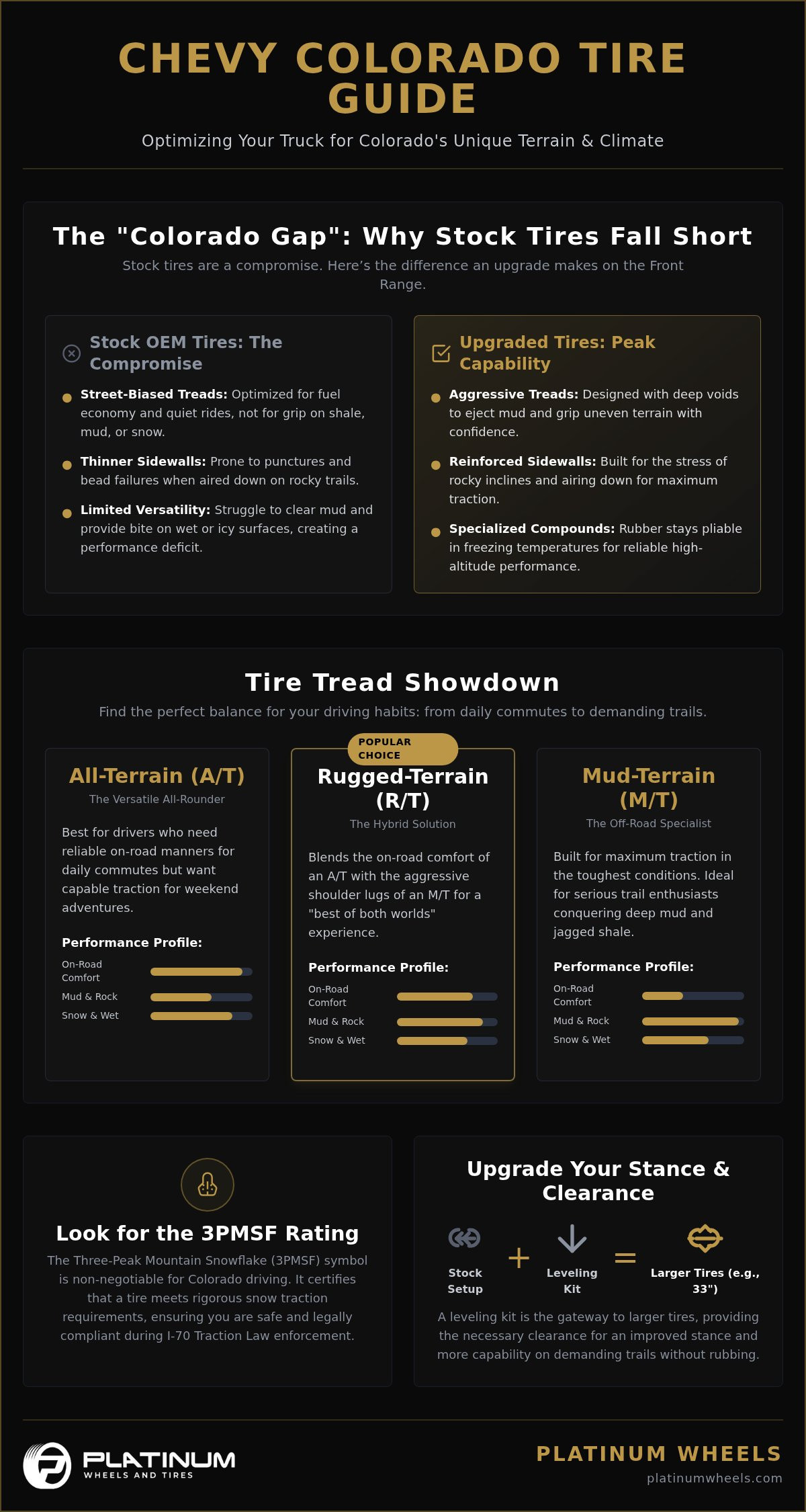
When you drive a new truck off the lot, the factory rubber is almost always a compromise. Manufacturers optimize these tires for high fuel economy ratings and a whisper-quiet cabin to appeal to the widest possible audience. While this works well for suburban commutes, it creates a performance deficit for owners living near the Front Range. Your chevy colorado tires need to handle more than just dry pavement; they need to survive the sharp shale of a mountain pass and the slushy uncertainty of a Denver spring. Factory-installed tires often lack the aggressive tread blocks and specialized compounds required to thrive in our specific environment.
Recognizing that your current setup is holding you back is the first step toward a true performance upgrade. If you've felt your wheels spinning on a light dusting of snow or noticed the tread struggling to find purchase on wet gravel, you've experienced the "Colorado Gap." This is the space between what a standard all-season tire can do and what the Rockies actually demand. Upgrading your tires moves your truck from a state of mere maintenance to a state of peak capability. It's a strategic shift that ensures your truck performs exactly as the engineers intended when they designed its rugged off-road suspension.
The Limits of All-Season OEM Tires
Most stock trims come equipped with street-biased treads that prioritize rolling resistance over grip. These designs lack the deep voids necessary to clear mud or provide "bite" on wet rocks. Additionally, factory tires often feature thinner sidewalls to save weight. When you're out on a trail, airing down your tires is essential for creating a larger footprint and gaining better traction. Without reinforced sidewalls, you risk punctures or bead failures on jagged terrain. Start by understanding tire codes to see how your current load rating and ply construction compare to heavy-duty off-road alternatives. You'll likely find that your OEM tires aren't built for the lateral stress of rocky inclines.
Defining the Ideal Colorado Tire Profile
A great Colorado tire must function as a multi-tool. It should provide aggressive traction for weekend adventures without making the daily drive to Aurora unbearable with excessive road noise. Look specifically for the Three-Peak Mountain Snowflake (3PMSF) rating. This certification ensures the tire meets rigorous snow traction requirements, keeping you safe and legally compliant during Traction Law enforcement on I-70. While a beefy tread looks fantastic and improves your truck's stance, the focus should remain on a rubber compound that stays pliable in freezing temperatures. The goal is a chevy colorado tires setup that balances aesthetics with the technical reality of high-altitude driving.
All-Terrain vs. Mud-Terrain: Choosing the Right Treads
Choosing the right treads for your truck often comes down to an honest assessment of your driving habits. While everyone loves the look of a deep, aggressive tread, the reality of Denver traffic and I-70 winter conditions might point you toward a specific design. Most chevy colorado tires in our region fall into the All-Terrain (A/T) category because they provide a reliable balance of dry-road manners and off-road capability. When selecting chevy colorado tires, consider how much time you actually spend on the dirt versus the asphalt.
If you spend your weekends conquering trails like Sevenmile or Middle St. Vrain, Mud-Terrain (M/T) tires offer the deep voids and sidewall protection you need. These tires are built to eject mud and grip onto jagged shale, but they do come with trade-offs. You'll notice more road noise on the way to Aurora and a slightly stiffer ride. For those who want the best of both worlds, Rugged-Terrain (R/T) hybrids are gaining popularity. These designs feature the tighter center tread of an A/T for highway comfort but keep the beefy shoulder lugs of an M/T for trail performance.
Tread pattern design also plays a critical role in safety. Deep grooves aren't just for mud; they are essential for water evacuation. On a rainy afternoon in Lakewood, a well-designed tread prevents hydroplaning by channeling water away from the contact patch. Consulting NHTSA tire safety ratings can give you a clearer picture of how different models handle wet surfaces and heat buildup during long mountain climbs.
Pros and Cons of All-Terrain Tires
A/T tires excel in longevity and fuel efficiency. They're the quietest option for daily driving around Denver, making them ideal if your truck is your primary vehicle. However, they can struggle in deep, sticky mud where the tighter tread blocks might get packed and lose traction. If you're looking for a versatile setup, we offer several all-terrain and mud-terrain tires that fit perfectly without modifications.
Pros and Cons of Mud-Terrain Tires
M/T tires are the undisputed kings of extreme conditions. Their aggressive sidewall lugs protect your rims from sharp rocks and provide extra bite when crawling through ruts. The downside is that they tend to wear faster on hot pavement and can be quite loud at highway speeds. You'll also see a slight dip in fuel economy due to higher rolling resistance. It's a performance-first choice for the dedicated enthusiast.
Chevy Colorado Tire Sizes and Fitment by Trim Level
Generic fitment tools often treat every truck the same. This approach fails local owners because trim levels significantly dictate what you can actually fit under the fenders. When selecting new chevy colorado tires, you need to know your starting point. For the WT and LT trims, you'll typically see a 255/65R17 or 265/60R18. Move up to the Z71, and the 265/65R18 becomes the standard, though some models sport a 255/55R20. While these work for highway cruising, they often leave the wheel wells looking empty and lack the sidewall height needed for airing down on the trail.
The biggest question we hear is "Will it rub?" This usually happens at full steering lock or when the suspension compresses while turning. To stay safe and effective, always cross-reference your choices with NHTSA tire safety guidelines to ensure your load capacity and pressure ratings meet factory standards. Proper fitment isn't just about looks; it's about maintaining the mechanical integrity of your steering rack and suspension components. Pushing the limits of tire size without accounting for clearance can lead to shredded fender liners or compromised handling during emergency maneuvers.
ZR2 and Trail Boss Specialized Fitment
The Trail Boss and ZR2 trims are built for aggression. The Trail Boss comes with a 2-inch factory lift, allowing for more substantial 265/65R18 rubber out of the gate. If you're driving a ZR2, you're already sitting on LT285/70R17 tires, which are roughly 33 inches in diameter. The ZR2 Bison takes this further with LT315/70R17 tires. When upgrading these specific chevy colorado tires, you must protect the performance of the Multimatic DSSV dampers. Avoid oversized setups that might interfere with these high-end shocks. A plus-one sizing is often safe, but anything larger requires careful measurement of the wheel well liners and potential trimming.
Understanding Wheel Offset and Backspacing
Offset is the secret to a perfect stance. It measures the distance from the wheel's mounting surface to its centerline. A negative offset pushes the wheel further out from the truck, which can prevent the inner sidewall from rubbing against the suspension arms. This also gives your Colorado that wide, planted look favored by enthusiasts. However, pushing them out too far can cause the tire to catch the outer fender flare. You can learn more about how to find wheel offset for your truck to ensure your new rims complement your tire choice perfectly. Balancing backspacing with tire width is the only way to achieve a rub-free experience on the trail.
Enhancing Capability: Leveling Kits and Larger Tires
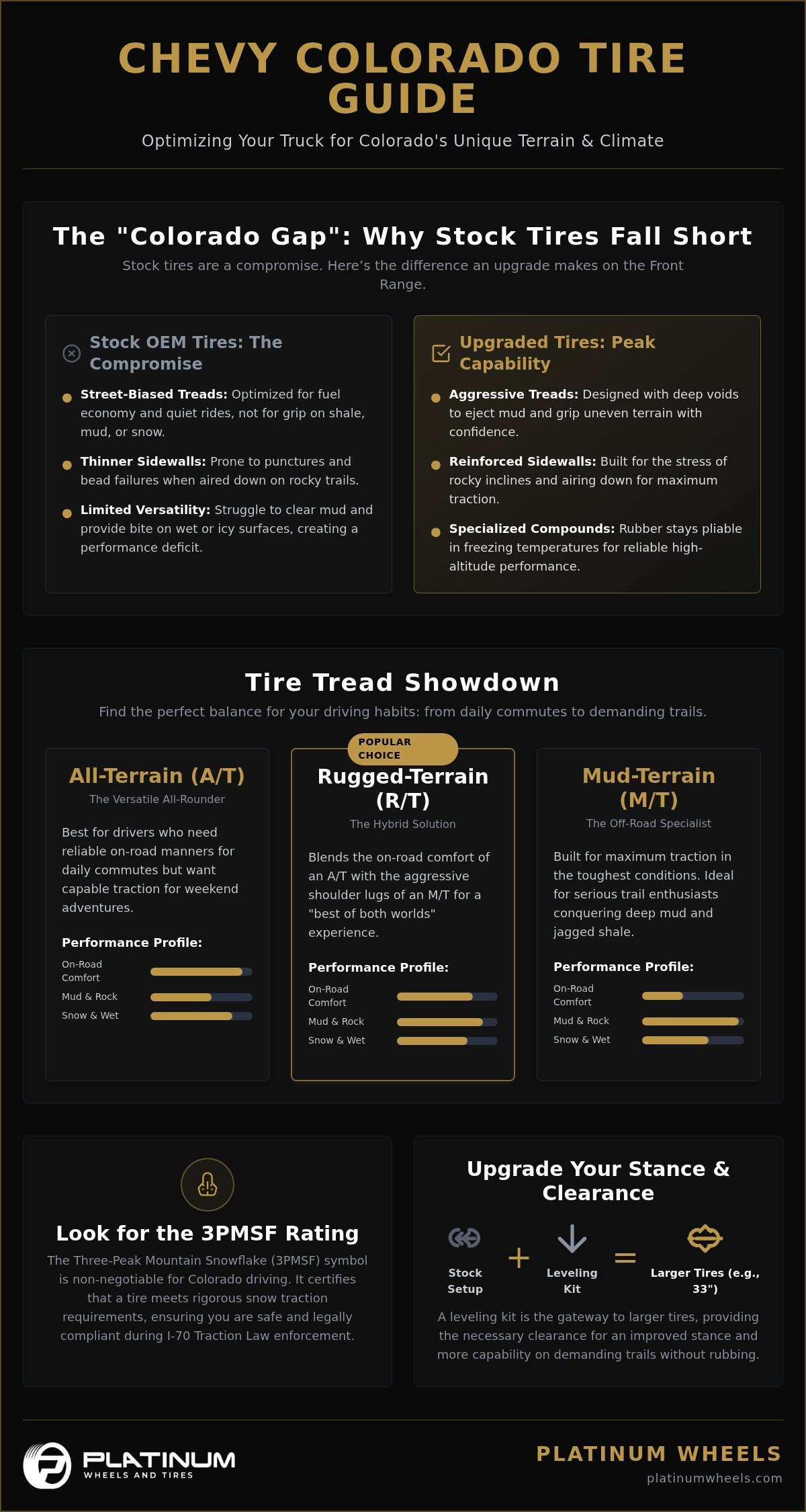
Standard suspension setups often feature a "rake," where the front end sits lower than the rear to account for heavy towing loads. While practical for hauling, it creates a clearance bottleneck when you want to fit more aggressive chevy colorado tires. A leveling kit solves this by raising the front suspension to match the rear, instantly providing a more balanced profile and the necessary room for 33-inch or larger rubber. This modification is often the most cost-effective way to transform your truck's capability for the rugged trails found throughout the Front Range.
Professional installation is non-negotiable when altering your suspension geometry. Even a minor height change affects your truck's alignment, which can lead to premature tire wear or unpredictable handling on the highway. We prioritize precision during every install to ensure your truck remains safe and stable at speed. Beyond the height, bigger tires are the only way to actually increase ground clearance under your axles. While a lift kit raises the frame, only a larger chevy colorado tires diameter physically moves your differentials further away from the rocks and obstacles on the trail. This extra inch or two of clearance can be the difference between clearing a jagged rock and expensive underbody damage.
The Leveling Kit Advantage
Fixing the factory rake does more than just improve aesthetics. It significantly improves your approach angle, allowing your front bumper to clear steep inclines without scraping. Before you decide on a specific height, you should compare the leveling kit vs lift kit to see which setup aligns with your off-roading goals. For many Denver drivers, a simple leveling kit provides the perfect middle ground for daily driving and weekend exploration. If you are ready to take the next step, our team specializes in lift kits and leveling kits that maintain your ride quality while boosting off-road performance.
TPMS and Technology Integration
Modern trucks rely on complex electronics to monitor performance. When you build a custom wheel and tire package, you need to ensure your TPMS sensors are compatible with the latest 2026 Colorado systems. Denver's extreme temperature shifts often cause pressure fluctuations; reliable sensors keep you informed and safe. You can read our TPMS sensor guide to learn how to avoid annoying dashboard warnings after an upgrade. Additionally, remember that larger tires will throw off your speedometer calibration. A quick software adjustment is often necessary to keep your readings accurate and your odometer on track.
Expert Tire Installation and Packages in Denver
Selecting the right chevy colorado tires is only half the battle. The final result depends entirely on the precision of the installation and the quality of the components used to mount them. When you work with a local specialist, you move beyond a simple transaction and into a consultative experience designed to ensure your truck is trail-ready the moment it leaves the shop. Professional installation at Platinum Wheels involves more than just mounting rubber to rims; it includes expert balancing, TPMS sensor calibration, and a thorough check of clearance levels to confirm that your new setup performs flawlessly under load.
Buying a complete package offers a level of convenience and reliability that a piecemeal approach can't match. We ensure that every component, from the valve stems to the wheel weights, meets the high standards required for high-altitude driving and off-road stress. This "ready-to-drive" philosophy means your truck maintains its alignment and handling characteristics, preventing the vibrations or pulling that often occur with cut-rate installations. Our team understands the specific nuances of the Colorado's suspension, allowing us to identify potential issues before you ever hit the dirt.
Custom Wheel and Tire Packages
Choosing a bundled setup is the most efficient way to transform your truck's aesthetics and capability simultaneously. By pairing top-tier tire brands with premium off-road rims, you create a cohesive look that standard factory wheels simply can't provide. You can explore aftermarket wheel and tire packages designed specifically for the unique demands of our region. These packages come pre-mounted and high-speed balanced, which saves you time and ensures that the fitment is verified by technicians who speak the language of the off-road hobbyist. It's a streamlined path to a more aggressive stance and better trail performance.
Maintenance is the key to protecting your investment after the initial install. Off-road tires, particularly those with aggressive Mud-Terrain treads, require more frequent rotations to prevent "cupping" or uneven wear patterns. We recommend checking your tire pressure regularly, especially as temperatures fluctuate across the Front Range. Properly balanced tires don't just ride smoother; they protect your suspension components from unnecessary wear and tear over the long haul.
Serving the Colorado Front Range
We are deeply rooted in the Denver and Aurora communities, and our advice is always tailored to the trails we all drive. Whether you're prepping for a run up to Kingston Peak or just want more confidence on slushy winter mornings, we provide the local expertise you won't find at a national big-box retailer. Our goal is to be your trusted advisor, ensuring your truck is as capable as it is stylish. Don't leave your fitment to chance. Contact Platinum Wheels today to find the perfect tires for your Chevy Colorado and experience the difference that expert local service makes.
Get Trail-Ready Today
Your truck's potential shouldn't be limited by factory rubber. Whether you are navigating I-70 slush or climbing rocky Front Range trails, the right choice in chevy colorado tires makes all the difference. We have explored how trim-specific fitment and leveling kits open the door to aggressive 33-inch setups while maintaining that essential highway comfort for your daily commute. Choosing the right tread pattern is about more than just looks; it is about ensuring your safety and performance in the unpredictable Colorado climate.
At Platinum Wheels, we provide more than just a transaction. We offer specialized fitment expertise for ZR2 and Trail Boss trims alongside professional installation right here in Denver and Aurora. Our premium all-terrain and mud-terrain tire packages are designed to get you trail-ready without the typical fitment guesswork. Stop settling for "good enough" and start driving with absolute confidence. Get a Custom Chevy Colorado Tire Quote from Platinum Wheels today and see how the right fitment changes your entire driving experience. We look forward to seeing you out on the trails.
Frequently Asked Questions
What is the largest tire size I can fit on a stock Chevy Colorado?
Most stock WT, LT, and Z71 trims safely accommodate up to a 265/65R18 or 265/70R17 without rubbing. If you drive a Trail Boss or ZR2, the factory lift allows for 33-inch tires, such as the LT285/70R17, right off the lot. Fitting anything larger on a standard Colorado usually requires trimming the fender liners or adjusting the wheel offset to prevent contact with suspension components during tight turns in Denver parking lots.
Do I need a lift kit to run 33-inch tires on my Colorado?
You generally need at least a leveling kit or a small lift to run 33-inch tires on a standard WT, LT, or Z71 trim. While the ZR2 comes factory-equipped for this size, other models lack the necessary wheel well clearance. Without a suspension modification, 33-inch chevy colorado tires will likely rub against the frame or fender flares during full steering lock or when traversing uneven trails near Golden or Boulder.
Which all-terrain tires are best for Colorado snow and ice?
Look for all-terrain tires featuring the Three-Peak Mountain Snowflake (3PMSF) symbol, which indicates superior performance in severe snow conditions. Models like the BFGoodrich All-Terrain T/A KO3 or Falken Wildpeak A/T4W are highly recommended for Denver drivers. These tires remain pliable in freezing temperatures, providing the reliable grip you need for icy mountain passes while remaining compliant with the Colorado Traction Law on I-70 during winter months.
Will upgrading my tires affect my Chevy Colorado's fuel economy?
Upgrading to larger or more aggressive tires will typically result in a minor decrease in fuel economy. Heavier off-road tires increase unsprung weight and rolling resistance, which requires more energy to move. Most Colorado owners see a drop of one to two miles per gallon depending on the tire's weight and tread pattern. Choosing a lighter all-terrain tire can help mitigate this impact while still providing the traction needed for weekend adventures.
How often should I rotate my off-road tires?
Rotate your off-road tires every 5,000 miles to ensure even tread wear and maximize their lifespan. Aggressive tread patterns, especially mud-terrains, are prone to cupping and uneven wear if left in the same position for too long. Regular rotations help maintain a quieter ride during your Denver commute and prevent the premature vibrations that often occur with heavy-duty tires. We also recommend checking your balance and alignment during these intervals for the best results.
Do I need to replace my TPMS sensors when I get new wheels?
We recommend installing new TPMS sensors when building a custom wheel and tire package for your 2026 Colorado. While you can technically swap your old sensors, they have a limited battery life and seals that can fail over time. Installing fresh sensors during your initial mount and balance at our shop in Aurora ensures your dashboard remains free of warning lights and provides accurate pressure readings during extreme temperature shifts.
Are mud-terrain tires too loud for daily driving in Denver?
Mud-terrain tires are noticeably louder than all-season or all-terrain options on dry pavement. While modern designs have improved significantly, the large voids between tread blocks naturally produce a hum at highway speeds. If you spend most of your time on I-25 or C-470, the noise might become fatiguing. For most Denver drivers, a rugged-terrain hybrid offers the aggressive look of a mud-terrain with a much quieter on-road experience.
What is the difference between a leveling kit and a lift kit for tire fitment?
A leveling kit primarily raises the front of your truck to match the rear height, which is often enough to clear 33-inch chevy colorado tires. In contrast, a lift kit raises both the front and rear suspension, providing significantly more ground clearance and room for even larger setups. While a leveling kit is a cost-effective solution for a better stance, a full lift kit is the superior choice for serious off-roading and maximum suspension travel.