Jeep Lift Kit Installation in Denver & Aurora | Expert Guide
A Jeep lift in Colorado is a balancing act between trail articulation and I-70 highway stability. You want that aggressive stance and the clearance to crawl over the Rockies, but you're likely worried about the dreaded death wobble or losing your smooth daily drive. It's a common concern for local enthusiasts who need their rig to perform at 11,000 feet on Saturday and handle the commute on Monday. Choosing a jeep lift kit shouldn't mean sacrificing your peace of mind or your ability to park in your own Denver garage.
We'll help you navigate the technical side of suspension upgrades so you can hit the trails with confidence. In this guide, you'll discover how to select the perfect lift type for your specific needs, whether you're looking for a simple leveling solution or a full suspension overhaul. We'll break down the differences between spacer and suspension systems, address garage clearance concerns for Aurora homes, and explain why professional fitment is the key to a reliable build. By the end, you'll know exactly how to achieve that mountain-ready look without compromising safety or performance.
Key Takeaways
- Learn how a properly tuned suspension improves your Jeep's approach angles and articulation for technical rock crawling in the Rockies.
- Master the technical differences between spacer lifts and full suspension systems to choose the right jeep lift kit for your lifestyle.
- Identify the ideal lift height for your desired tire size to ensure your Wrangler or Gladiator remains stable on I-70.
- Understand why professional installation and precision alignment are the only ways to truly eliminate the risk of the dreaded death wobble.
- Discover why a consultative, one-stop-shop approach ensures your wheels, tires, and lift work together as a single, high-performance system.
Understanding Jeep Lift Kits: More Than Just Ground Clearance
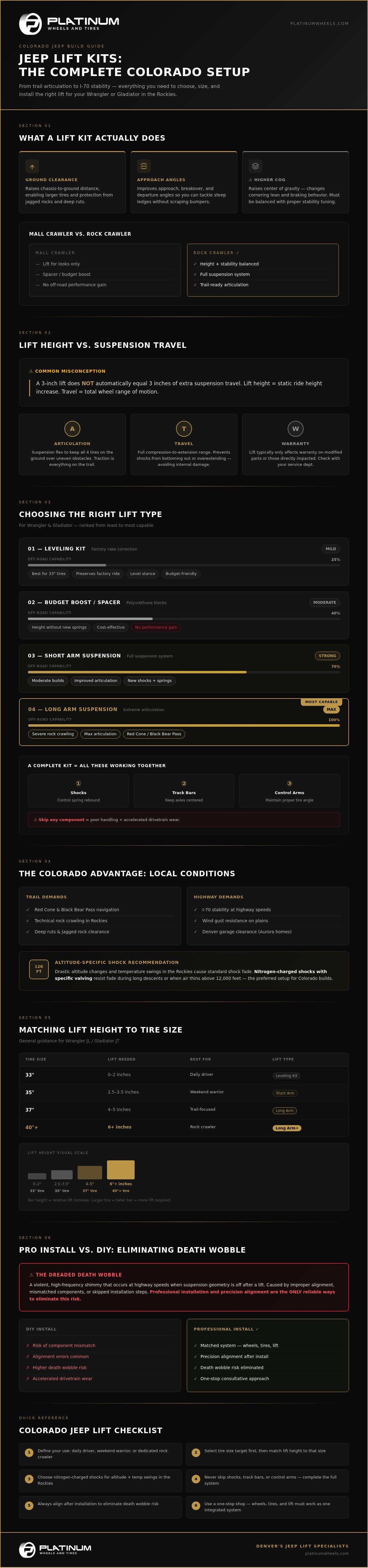
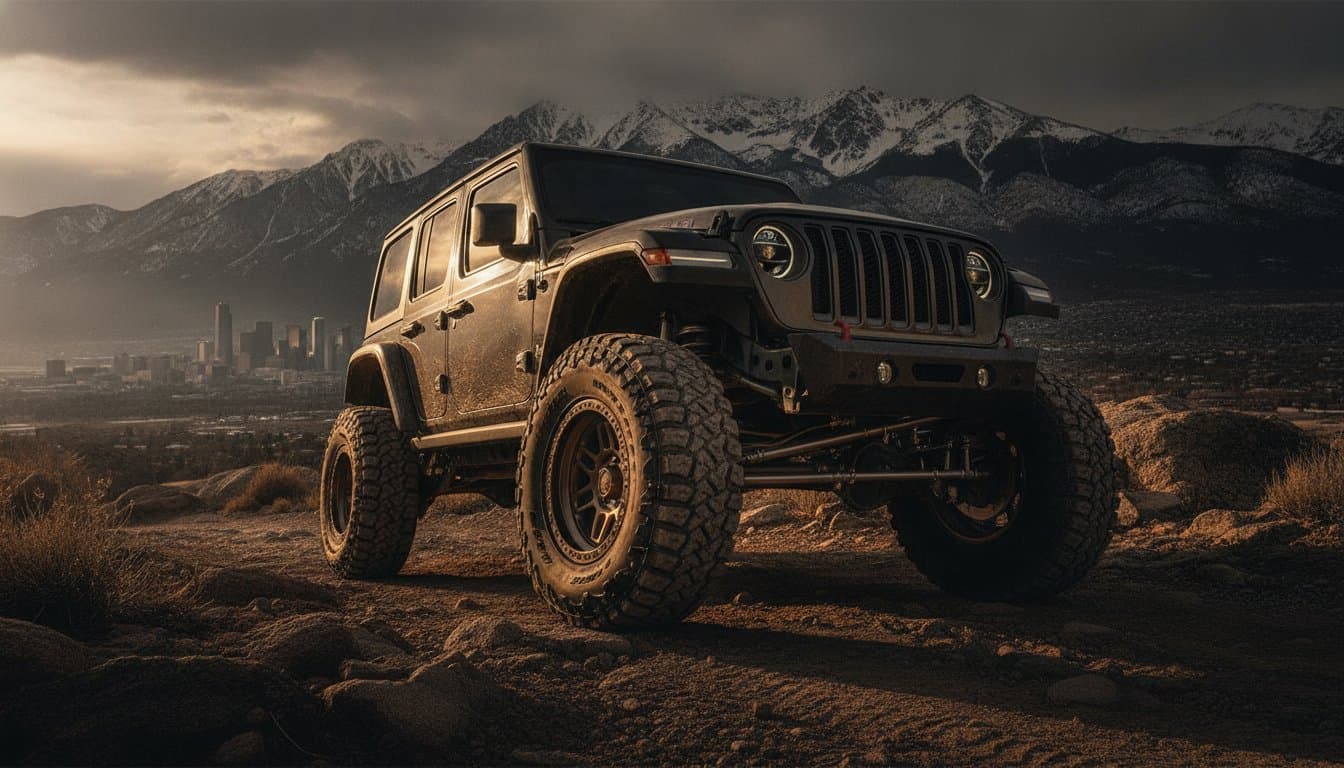
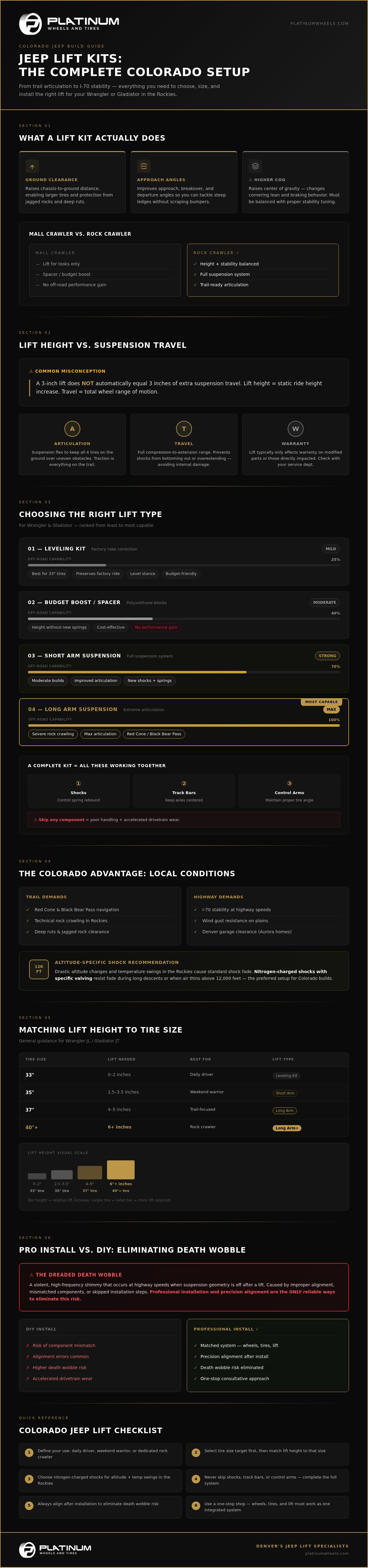
A jeep lift kit is a fundamental upgrade that goes far beyond simple aesthetics. At its core, installing a lift involves altering your vehicle's suspension geometry to increase the distance between the chassis and the ground. While the aggressive, towering look is a major draw for many Denver owners, the mechanical benefits are what truly matter when you leave the pavement. By raising the body, you gain the ability to fit larger all-terrain or mud-terrain tires, which are essential for navigating the deep ruts and jagged rocks found throughout Colorado.
Beyond tire clearance, a lift kit significantly improves your Jeep's approach, breakover, and departure angles. This means you can climb steeper ledges and descend into deeper washes without scraping your bumpers or high-centering on the frame. However, it's important to remember that raising your vehicle also raises its center of gravity. A higher center of gravity changes how the vehicle leans in corners and reacts during emergency braking. This is why we distinguish between a purely aesthetic "mall crawler" and a functional "rock crawler" built for the trail. A proper build balances height with stability to ensure your rig remains safe and predictable.
Why Colorado Jeeps Require a Specific Approach
Building a Jeep in the Front Range presents unique challenges that off-roaders in flatter states don't face. You need a setup that can handle the white-knuckle drive up I-70 at highway speeds just as well as it handles the technical challenges of Red Cone or Black Bear Pass. Highway manners are non-negotiable for most local drivers. If your suspension is too soft, you'll feel every gust of wind on the plains; if it's too stiff, the expansion joints on the highway will become exhausting.
Environmental factors also play a role. The drastic altitude changes and temperature swings in the Rockies can affect shock performance. Nitrogen-charged shocks and specific valving are often preferred here because they resist shock fade during long descents or when the air thins out at 12,000 feet. We help you choose components that are resilient enough for our local climate.
Lift Height vs. Suspension Travel
Many owners assume that a 3-inch lift automatically equates to 3 inches of extra suspension travel, but that isn't always the case. Lift height refers to the static increase in your ride height. Suspension travel, on the other hand, is the total range of motion your wheels have from full compression to full extension. In the off-road world, we prioritize articulation.
- Articulation: This is the ability of your suspension to flex, keeping all four tires firmly on the ground over uneven obstacles. Traction is everything on a trail.
- Travel: Proper travel ensures your shocks don't bottom out or overextend, which can cause internal damage.
- Warranties: It's a common question: does a lift void your warranty? Generally, a lift only affects the warranty on the specific parts modified or those directly impacted by the change. We recommend checking with your local service department for their specific policies.
Choosing the Right Lift Type for Your Wrangler or Gladiator
Selecting a jeep lift kit requires understanding your end goal. Is this a daily driver that needs a bit of attitude, or a dedicated trail rig? You generally have three choices: leveling kits, budget boosts, or full suspension systems. Budget boosts, often called spacer lifts, use polyurethane blocks to provide height without replacing factory springs. They're cost-effective for looks but don't enhance off-road performance. For those pushing deeper into the Rockies, short arm or long arm suspension systems become necessary. Short arm kits work well for most moderate builds, while long arm systems provide the extreme articulation needed for severe rock crawling.
A complete kit is more than just height. It's a symphony of components working together. Shocks control the rebound of your springs; track bars keep your axles centered under the frame; and control arms maintain the proper angle of your tires. Missing any of these pieces can lead to poor handling or accelerated wear on your drivetrain. If you skip the details, you'll likely feel it the first time you hit a pothole on Colfax Avenue.
Leveling Kits vs. Lift Kits
Most Jeeps come from the factory with a "rake," where the front sits slightly lower than the rear. This is designed to level out when the vehicle is fully loaded or towing. However, many owners prefer a perfectly level profile. If you plan on sticking with 33-inch tires and want to keep your factory ride quality, a leveling kit is often the smartest move. It provides just enough clearance for larger rubber without the complexity of a full suspension swap. You can dive deeper into the technical differences in our Leveling Kit vs. Lift Kit guide.
Full Suspension Systems: The Gold Standard
When you're ready for 35-inch or 37-inch tires, a full suspension jeep lift kit is the only way to go. These kits replace your factory coil springs and shocks with heavy-duty versions designed for the added weight of armor, winches, and spare tires. High-performance shocks from brands like Fox or King provide superior heat dissipation, which is vital when you're washboard-running on forest service roads for hours.
Proper geometry is crucial at these heights. We often use geometry correction brackets to fix the caster angle, ensuring your Jeep doesn't feel "flighty" at highway speeds. If you're unsure which setup fits your Aurora garage or your off-road ambitions, you can chat with our experts at Platinum Wheels to map out your build. We'll help you balance trail capability with the road manners you need for the ride home.
The Colorado Setup: Matching Lift Height to Tire Size
The 2.5-inch jeep lift kit is widely considered the sweet spot for a Colorado daily driver. It provides enough room to fit 35-inch tires without making the vehicle too tall for most standard residential garages in Denver or Aurora. This setup maintains a lower center of gravity while offering a significant boost in trail capability. If you're eyeing 37-inch tires for more aggressive rock crawling, you'll need to step up to at least a 3.5-inch lift. At this height, you aren't just clearing the fenders; you're ensuring the tires don't smash into the inner wheel wells during full suspension compression.
There's a big difference between street clearance and trail clearance. You might fit 35s on a stock Jeep with high-clearance fender flares, but as soon as you disconnect your sway bars and flex the suspension on a trail like Argentine Pass, those tires will rub. A proper suspension lift provides the necessary room for the axle to move throughout its entire range. For most Front Range drivers, pairing this clearance with high-quality all terrain tires offers the best balance of snow traction, highway quietness, and off-road grip.
Wheel Offset and Backspacing Essentials
Choosing the right wheels is just as important as the jeep lift kit itself. If your wheels have too much backspacing, your new, wider tires will rub against the control arms or sway bar when you turn the steering wheel. To prevent this, you need wheels that push the tire further outward. This is where custom wheels and rims become a technical necessity rather than just a style choice. We carefully calculate the offset to ensure your tires clear the suspension components during both tight turns and full articulation on the trail.
The Impact of 35" and 37" Tires on Performance
Bolting on larger tires affects your Jeep's power and stopping ability. Moving to 35s or 37s often requires re-gearing your differentials to regain lost acceleration and keep your transmission from hunting for gears on the climb up to the Eisenhower Tunnel. Additionally, the extra rotating mass makes your factory brakes work much harder. We often recommend upgraded rotors and pads to maintain safe stopping distances during steep mountain descents.
To streamline the process and ensure everything fits perfectly from day one, many of our customers opt for aftermarket wheel and tire packages. This approach saves on labor costs and ensures your build is cohesive and trail-ready. We focus on the total performance of the vehicle, making sure your suspension, wheels, and tires work in harmony rather than fighting each other on the road.
Professional Installation vs. DIY: Avoiding the Dreaded Death Wobble
The "Death Wobble" is the stuff of Jeep nightmares. It's a violent, uncontrollable shaking of the front end that usually occurs after hitting a bump at highway speeds. While many enthusiasts view a jeep lift kit as a simple weekend project, improper installation is the leading cause of this terrifying vibration. It typically stems from loose suspension components, worn bushings, or incorrect steering geometry. Some owners try to mask the issue by installing a beefier steering stabilizer. While a stabilizer helps damp road vibrations, it's merely a band-aid for poor geometry or loose parts. It won't fix the underlying mechanical instability.
One of the most common mistakes in home garages is torquing suspension bolts while the vehicle is still on jack stands. For a lift to function correctly, every bolt must be torqued to factory specifications under "ride height" load. This means the Jeep's full weight must be on its tires before the final tightening. Skipping this step leads to bound bushings, premature wear, and unpredictable handling. A professional install ensures that every component is settled and secured exactly as the manufacturer intended.
Critical Geometry: Caster, Camber, and Toe
Lifting your Jeep inherently changes its steering geometry. As the frame moves higher, the front axle rotates forward, which reduces your positive caster angle. Low caster makes the steering feel "flighty" or "darty," which is especially dangerous on the winding stretches of I-70. Additionally, because Jeeps utilize solid axles, lifting them pulls the axle toward the driver's side. An adjustable track bar is essential to re-center the axle and keep your tires tracking straight. Achieving these precise measurements requires professional-grade alignment racks specifically calibrated for modified suspensions.
The Value of Expert Installation in Denver
Professional installation provides more than just a finished look; it offers the peace of mind that comes with a comprehensive safety check. We utilize specialized tools, such as heavy-duty spring compressors and high-precision torque wrenches, that most home mechanics simply don't have. Beyond the suspension work, we also handle the necessary TPMS sensor recalibration. This ensures your dashboard stays clear of warning lights after your new wheel and tire setup is mounted.
Don't risk your safety or your vehicle's performance on a "good enough" driveway install. If you want a build that handles the trail and the highway with equal precision, schedule your professional jeep lift kit installation with Platinum Wheels today. We'll make sure your suspension geometry is dialed in perfectly before you head toward the mountains.
Expert Jeep Lift Kit Installation in Denver at Platinum Wheels
Platinum Wheels stands as Denver's premier destination for high-quality suspension work. We don't just sell parts; we engineer builds that handle the unique demands of the Colorado Front Range. Many shops might bolt on a kit and send you on your way, but we take a consultative approach to every vehicle that enters our bays. We build rigs for the Rockies. Our team understands that a rig designed for the tight trails near Boulder needs to behave differently than one primarily used for highway travel between Aurora and Lakewood.
Our team focuses exclusively on wheels, tires, and suspension. This specialization allows us to provide a level of precision that general repair shops often miss. By getting your wheels, tires, and jeep lift kit installed and balanced at the same time, you ensure that every component is perfectly matched for clearance and performance. It's the most efficient way to achieve a mountain-ready build without the headache of multiple appointments or mismatched parts. We prioritize your peace of mind by ensuring your vehicle is safe, stable, and ready for adventure.
Our Process: From Consultation to Trail-Ready
Selecting the right hardware for your specific Jeep model is the first step in our process. Whether you drive a JK, a newer JL, or the versatile JT Gladiator, we help you choose a setup that addresses your specific goals. We don't believe in one-size-fits-all solutions. Our technicians prioritize geometry correction and precision alignment to ensure your steering remains crisp and your tires wear evenly. We focus on the details that keep your Jeep tracking straight on the highway while providing maximum flex on the trail.
We only work with premium brands and high-quality hardware. We know how the thin air and temperature swings of the Rockies affect your components, so we select parts that are built to last. From heavy-duty springs to high-performance shocks, every piece of your build is chosen for its reliability. We ensure that your jeep lift kit installation meets our high standards for craftsmanship and durability.
Ready to Elevate Your Jeep?
Platinum Wheels is more than just a shop; we're a local, independent business with deep roots in the Colorado off-road community. We live and breathe the automotive lifestyle, and we're passionate about helping our neighbors from Castle Rock to Fort Collins get the most out of their vehicles. We treat your Jeep with the same care and precision we'd use on our own rigs. Transparency and honesty are at the core of everything we do, making us a trusted advisor for your off-road needs.
If you're ready to transform your vehicle's stance and capability, visit us for a fitment consultation. We'll walk you through the options, check your garage clearance, and help you build a Jeep that's truly trail-ready. Contact us today for a custom quote on your project and let's get your build started. We're ready to help you reach new heights.
Elevate Your Colorado Off-Road Experience
Building a mountain-ready Jeep is a technical journey that requires the right balance of precision and local expertise. You've seen how critical suspension geometry is for maintaining stability on the highway and how matching your lift height to tire size prevents trail-day headaches. Don't settle for a "bolt-on" approach that leaves your safety to chance. A professional installation ensures you avoid the dreaded death wobble while gaining the clearance needed for the Rockies' most demanding trails.
Our expert Denver-based technicians specialize in truck and SUV suspension, providing the specialized care your vehicle deserves. We focus on the seamless integration of premium wheel and tire packages with your jeep lift kit to create a high-performance system that looks as good as it handles. Whether you're navigating Aurora streets or Boulder backroads, we're here to help you build with total confidence. We're passionate about the off-road lifestyle and committed to delivering results that stand up to the unique demands of our region.
Get Your Custom Jeep Lift Quote from Platinum Wheels Today!
We'll see you out on the trails.
Frequently Asked Questions
Will a lift kit void my Jeep factory warranty?
A jeep lift kit won't void your entire factory warranty. According to the Magnuson-Moss Warranty Act, a dealer must prove that an aftermarket part caused a specific failure to deny a claim. Generally, only the modified suspension components and directly related parts lose their coverage. It's always smart to talk with your local Denver dealer to understand their specific stance on modifications before you start your build.
How much does it cost to install a Jeep lift kit in Denver?
The cost to install a lift varies significantly based on the complexity of the kit and the labor hours required. A simple leveling kit is much more affordable than a full long-arm suspension system with high-performance shocks. Because every build is unique, we recommend getting a customized quote that includes professional installation and a precision alignment to ensure your rig is safe for the road.
What is the best lift kit height for a Jeep Wrangler JL?
For most Wrangler JL owners, a 2.5-inch lift is the ideal choice for a daily driver. This height allows you to comfortably run 35-inch tires while maintaining excellent road manners and fitting into standard residential garages. If you're planning on 37-inch tires for technical rock crawling, you'll likely need to step up to a 3.5-inch system with geometry correction for better stability.
Do I need a steering stabilizer with my lift kit?
You don't strictly need a new steering stabilizer if your suspension geometry is set up correctly. Many people use a beefier stabilizer as a band-aid for the death wobble, but that only masks the underlying problem. While a high-quality stabilizer helps damp road feedback from larger tires, your primary focus should always be on proper alignment and caster angles after installing your jeep lift kit.
Can I fit 35-inch tires on a stock Jeep Wrangler?
You can technically fit 35-inch tires on a stock Wrangler JL or JT, but they'll likely rub against the fenders during off-road articulation. For the older JK model, 35s will almost certainly rub even on the street during tight turns. Installing a lift ensures your tires have the necessary clearance to move through their full range of motion without damaging your vehicle's bodywork or tires.
How does a lift kit affect my Jeep's gas mileage?
Expect your gas mileage to decrease after a lift and larger tires. The increased ride height creates more aerodynamic drag, while heavier wheels and tires require more energy to get moving. Re-gearing your differentials can help regain some efficiency and performance, but a lifted Jeep will almost always be less fuel-efficient than a stock one. It's the trade-off for significantly better trail capability.
What is the difference between a body lift and a suspension lift?
A body lift uses spacers to raise the Jeep’s body off the frame, providing tire clearance without changing suspension travel. A suspension lift replaces springs and shocks, increasing both ground clearance and off-road performance. While body lifts are cheaper, they don't improve articulation or ride quality. Most Colorado enthusiasts prefer suspension lifts because they handle the rough terrain of the Rockies much more effectively.
How often should I have my lifted Jeep’s suspension inspected?
You should have your lifted suspension inspected every 3,000 to 5,000 miles, ideally during every oil change. It's also a good idea to perform a quick check after any particularly demanding weekend on the trails. Technicians should look for loose bolts, worn bushings, and leaking shocks. Regular maintenance prevents small issues from turning into expensive repairs or safety hazards while you're driving at highway speeds.