Truck Wheel and Tire Packages in Denver: The Ultimate 2026 Guide to Performance & Style
What if the "perfect" wheel and tire setup you found online actually ruins your truck's performance the moment you hit the I-70 climb? It's a common frustration for local drivers who realize too late that a generic package isn't built for the thin air and steep grades of the Rockies. When searching for truck wheel and tire packages Denver experts recommend, you need more than just a flashy rim. You need a precision-engineered combination that handles high-altitude shifts and rugged Front Range trails without the constant fear of rubbing or poor fitment.
We know you want a truck that looks aggressive and sits perfectly level, but the technical details like wheel offset and backspacing can feel overwhelming. It's frustrating to invest in an upgrade only to deal with a lingering TPMS light or tires that can't handle a sudden Colorado blizzard. This guide promises to simplify that process, helping you choose a setup optimized for both Denver's highways and the muddy backcountry. We'll explore the latest 2026 traction regulations, fitment secrets to avoid trimming your fenders, and how to achieve a professional "one-and-done" installation that keeps your rig trail-ready and your peace of mind intact.
Key Takeaways
- Learn how to select specific wheel and tire combinations that handle Colorado’s steep grades and high-altitude driving without compromising power.
- Discover the benefits of investing in professional truck wheel and tire packages Denver drivers trust to ensure perfect fitment and eliminate tire rubbing.
- Master the technical side of upgrades by understanding how wheel offset and backspacing impact your truck's stance and suspension clearance.
- Understand why modern TPMS integration and Road Force balancing are essential for a smooth, vibration-free ride across the Front Range.
- Find out why a consultative, local approach outperforms generic online retailers when prepping your rig for rugged mountain trails.
Why Denver Truck Owners Choose Custom Wheel and Tire Packages
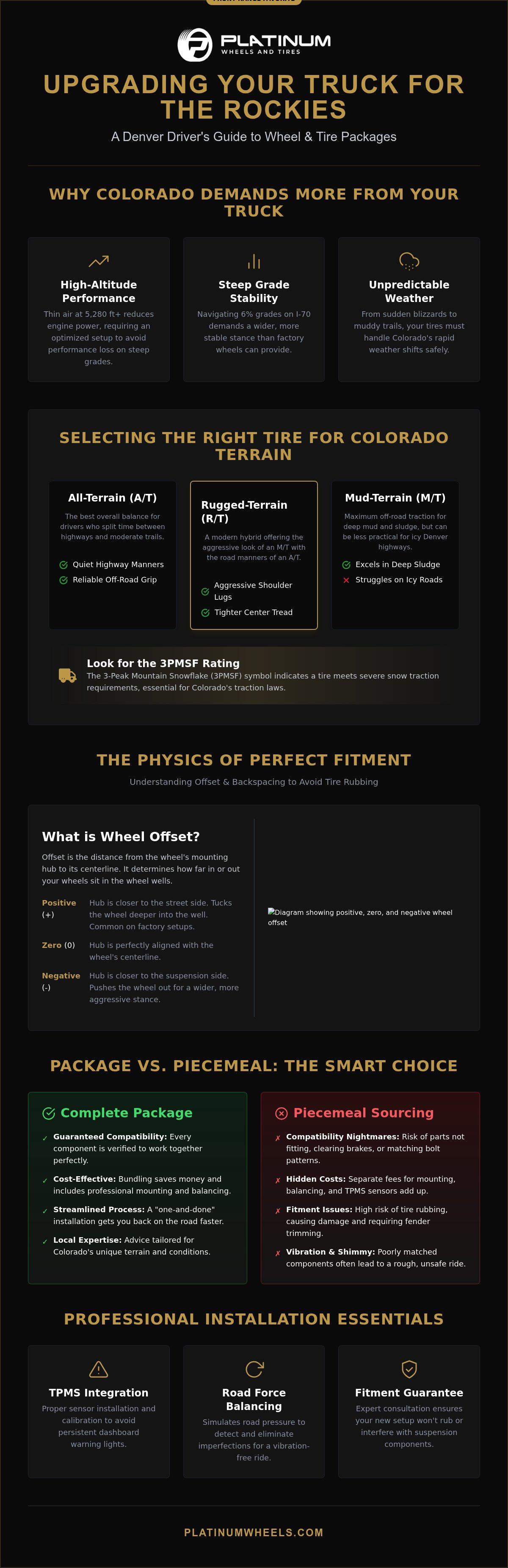
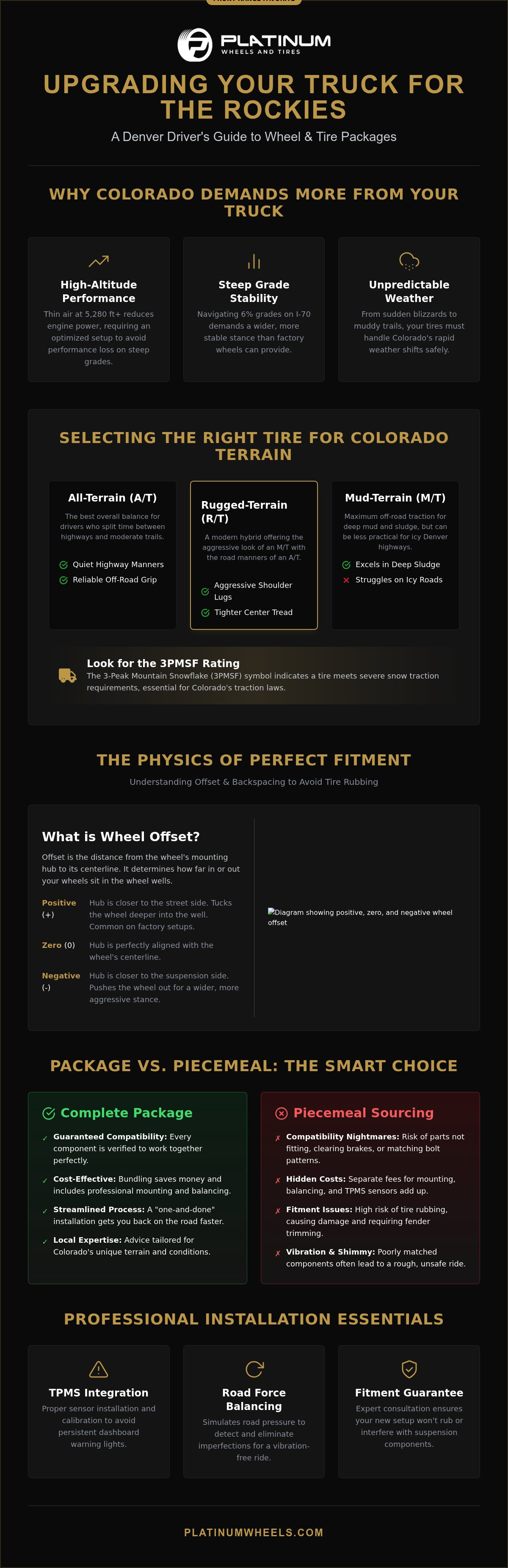
Driving a truck in the Mile High City involves challenges that drivers in flatter states never face. Between the thin air at 5,280 feet and the 6 percent grades on I-70, your vehicle's components are constantly under pressure. Choosing the right truck wheel and tire packages Denver requires is about more than just picking a design that looks good in a driveway. It is about engineering a setup that survives Colorado's rapid weather shifts and rugged geography. Factory wheels are often built for fuel efficiency on flat, sea-level pavement; they rarely provide the traction or clearance needed for a snowy commute through Morrison or a weekend run up to the Eisenhower Tunnel.
The 'Colorado Look' and Performance
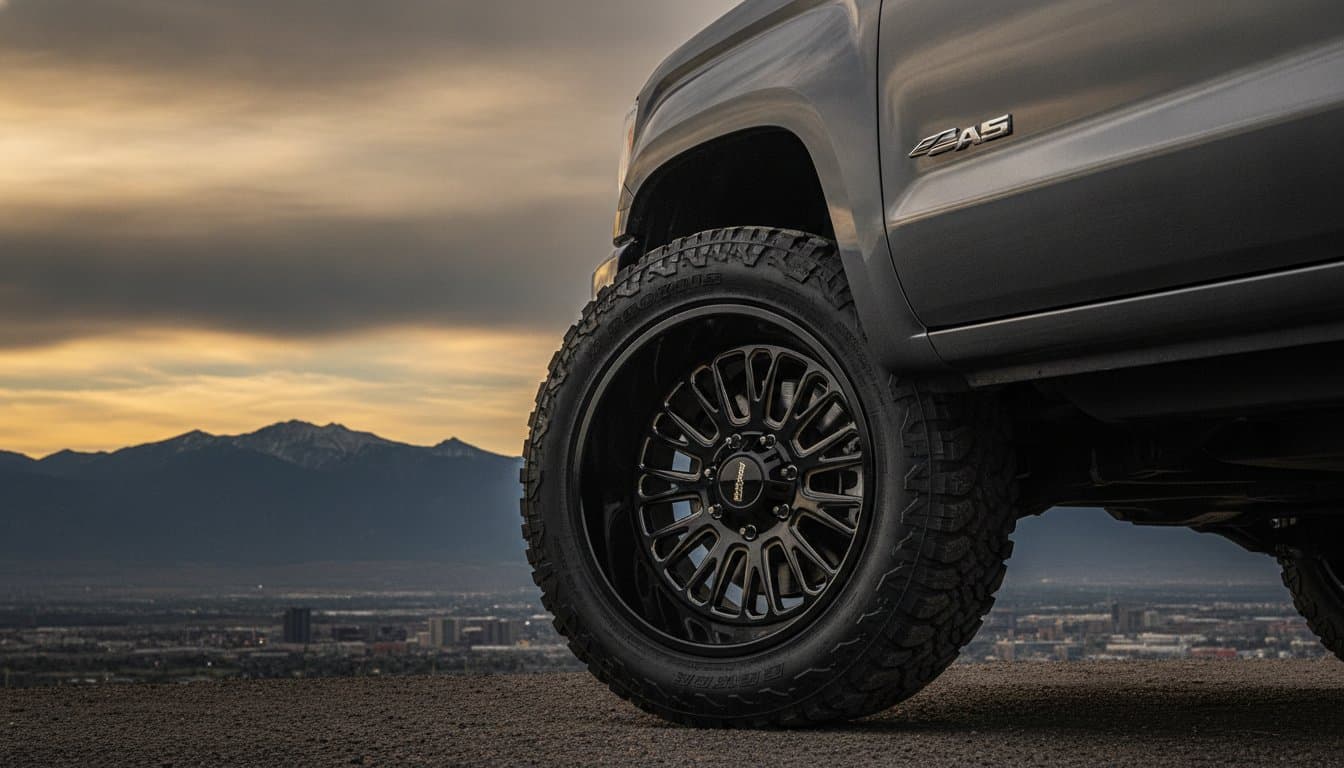
Most trucks leave the dealership with "skinny" tires tucked deep inside the wheel wells. While this works for basic utility, it lacks the stability and presence required for high-altitude driving. Transitioning to a wider, more aggressive footprint gives your rig a planted feel. This wider stance improves lateral stability when you are navigating windy mountain passes. Increased ground clearance is another functional win. A taller tire helps you clear unplowed snow accumulation on side streets without turning your front air dam into a snowplow. We focus on balancing that aggressive off-road durability with the highway comfort you need for your daily commute along the Front Range.
Package vs. Piecemeal: The Logical Choice
Sourcing rims and tires from different vendors often leads to compatibility nightmares. You might find a wheel you love only to realize it won't clear your brake calipers or that the tire's load rating is insufficient for your towing needs. Choosing a complete package eliminates this guesswork. Every component is pre-verified to work in harmony. Understanding The Physics of Wheel Sizing is essential for vehicle safety, and a professional package ensures that the bolt pattern, centerbore, and load capacity are perfectly matched to your specific truck model.
Buying a package is also the most cost-effective route. It streamlines the logistics of your upgrade by including professional mounting and high-speed balancing in one go. This prevents the "steering wheel shimmy" that often occurs with poorly matched components. Local expertise is the final piece of the puzzle. Generic online retailers don't know which setups will rub against your wheel liners during a sharp turn on a trail. We provide a consultative experience that prioritizes your peace of mind and ensures your truck is ready for the mountains the moment you leave the shop.
Selecting the Best Tires and Rims for Colorado Terrain
Choosing the right components for truck wheel and tire packages Denver requires a deep understanding of our local environment. You aren't just driving on flat asphalt; you're climbing 11,000-foot passes and descending steep grades that test your brakes and traction. While Mud-Terrain (M/T) tires offer the most aggressive look and excel in deep sludge, they often struggle on icy Denver highways. Most local owners find that All-Terrain (A/T) tires provide the best balance of quiet highway manners and off-road grip. Following NHTSA Tire Safety Guidelines is vital when selecting these, as improper load ratings can lead to premature wear or failure under the stress of mountain driving.
Recently, Rugged Terrain (R/T) tires have emerged as the go-to middle ground for Front Range enthusiasts. These hybrids offer the aggressive shoulder lugs of an M/T tire with the tighter center tread of an A/T, giving you the best of both worlds. Beyond tread patterns, you must consider load ranges when selecting truck wheel and tire packages Denver shops provide. For truck owners who frequently tow trailers or haul heavy campers into the backcountry, Load Range E is often the standard. These tires feature a 10-ply construction that resists punctures and minimizes sidewall flex during heavy-duty tasks.
Tire Compounds for Denver's Four Seasons
Colorado's erratic weather demands specialized rubber compounds. For safe travel on I-70 during the winter months, look for tires with the 3-Peak Mountain Snowflake (3PMSF) rating. This symbol indicates the tire meets specific traction requirements for severe snow conditions, which is essential for complying with state traction laws. If you're struggling to decide, check out our guide on choosing all terrain tires for Colorado to see which tread designs perform best on packed snow and loose rock.
Rim Materials and Finishes
The rims you choose are just as important as the rubber. Alloy rims are the preferred choice for mountain driving because they dissipate heat much faster than steel. This is a critical safety factor during long descents from the Continental Divide where brake heat can transfer to your wheels. Additionally, Denver's use of magnesium chloride and road salt can be brutal on wheel finishes. Matte or gloss powder-coated finishes typically hold up better than traditional chrome or raw polished aluminum. If you're ready to upgrade, you can explore our latest rim designs to find a style that withstands the elements while giving your rig a custom look.
The Physics of Fitment: Offset, Backspacing, and Clearance
Understanding fitment is the most technical part of building your rig. When you invest in truck wheel and tire packages Denver shops provide, you're navigating a delicate balance between aggressive aesthetics and mechanical reality. Most factory wheels have a high positive offset, which keeps the tires tucked neatly inside the wheel wells. However, as you move toward a zero or negative offset, the mounting surface of the wheel moves inward, pushing the tire outward. This shift creates the wide, commanding presence most enthusiasts crave, but it also alters the scrub radius and puts additional leverage on your wheel bearings.
Negative Offset is the key to achieving a wide, aggressive truck stance.
Backspacing is the other half of the fitment equation. While offset is measured from the centerline of the wheel, backspacing measures the distance from the mounting hub to the back edge of the rim. This measurement is critical for brake caliper clearance and ensuring the inner wheel lip doesn't strike your suspension components. Staying compliant with Colorado's official tire regulations is also a priority; these rules govern equipment safety and tread requirements to ensure your modifications don't compromise road safety on busy Denver thoroughfares.
Stance and Suspension Interaction
Your choice of stance dictates your suspension needs. We often see owners debating between a leveling kit vs lift kit to clear larger tires. While a 33-inch tire might fit with a simple level, jumping to a 35-inch tire often requires a full lift or significant "trimming" of the inner plastic liners. It's not just about the height of the tire; the width and offset determine how the tire arcs when you're turning the steering wheel. A wide tire on a deep negative offset wheel has a much larger swing radius, which is usually where the dreaded "rubbing" occurs during tight parking maneuvers.
Avoiding Common Fitment Mistakes
Modern trucks with independent front suspensions (IFS) are particularly sensitive to improper backspacing. If the wheel sits too far inward, the tire sidewall can rub against the upper control arm or the sway bar. To avoid these headaches, it's helpful to use a wheel tire size calculator to preview how your new setup compares to your factory specs. We also emphasize using hub-centric wheels for Denver highway driving. These wheels center themselves on the hub rather than just the lug nuts, which is the only way to ensure a vibration-free ride at 75 mph on E-470.
The Logistics of a Professional Wheel and Tire Installation
Selecting the right components is only half the battle. The real value is found in the execution. Investing in truck wheel and tire packages Denver drivers rely on means ensuring the final installation is as precise as the engineering behind the parts. A botched mounting job or a lazy balancing act can turn a premium upgrade into a vibrating, noisy headache that ruins your driving experience on the way to the mountains. Professional installation is about protecting your investment in high-end rims while ensuring your vehicle remains safe and efficient at highway speeds.
TPMS Integration and Safety
For 2026 trucks, the Tire Pressure Monitoring System (TPMS) is a non-negotiable safety feature. These sensors are your first line of defense against a blowout on a steep mountain pass. While some shops try to save time by swapping your old, weathered factory sensors into new wheels, we strongly advise against it. Seals can fail and batteries eventually die; it's much more reliable to sync brand-new sensors directly to your truck’s onboard computer during the initial build. If you've ever dealt with a persistent warning light after an upgrade, our TPMS sensor guide offers deeper insights into avoiding these dash-light frustrations.
The Mounting and Balancing Process
Custom finishes require a gentle touch. We use specialized touchless mounting equipment that never makes metal-to-metal contact with your rims. This prevents the unsightly scratches and gouges that often occur at high-volume tire chains. Once the tires are mounted, Road Force balancing becomes the priority. This isn't your standard spin balance; it applies pressure to the tire to simulate the weight of the vehicle, identifying "hard spots" that cause steering wheel shimmy.
- High-speed balancing: This is essential for Denver drivers hitting 75+ mph on E-470 or I-25.
- Aesthetic details: We use black adhesive weights on dark rims to maintain a clean, professional look.
- Torque checks: Every lug nut is hand-torqued to manufacturer specifications to prevent warped rotors or loose wheels.
Don't overlook the post-installation alignment. Changing your wheel offset or tire diameter alters your suspension geometry. A professional alignment ensures your tires wear evenly and your truck tracks straight, preventing you from burning through a new set of rubber in six months. If you're ready for a "one-and-done" experience, schedule your professional installation with our expert team today to ensure your rig is trail-ready.
Custom Truck Packages at Platinum Wheels Denver
At Platinum Wheels, we don't try to be everything to everyone. We don't perform general mechanical repairs or paint jobs; instead, we focus exclusively on wheels, tires, and suspension. This specialized approach allows us to master the technical nuances that generalist shops often overlook. When you choose our truck wheel and tire packages Denver team, you're working with professional enthusiasts who understand that a great build requires both mechanical precision and a deep respect for your vehicle's factory limits. We ensure that your new setup doesn't just look the part but also maintains the towing and payload capacity you rely on for Colorado life.
Our process is built on transparency and communication. It begins with a detailed consultation where we discuss your driving habits, whether you're commuting from Aurora or hauling a trailer through Castle Rock. We move from selection to a "ready-to-drive" installation that includes syncing your TPMS sensors and performing a final torque check to manufacturer specifications. This methodical workflow ensures that your truck leaves our shop trail-ready and vibration-free, giving you the peace of mind that only comes from expert craftsmanship.
Local Expertise for the Front Range
Colorado's truck culture is diverse, and we understand the specific fitment needs of the most popular platforms on our roads. Whether you're driving a Ford F-150, a Chevy Silverado, a RAM 1500, or a Toyota Tacoma, we know exactly which offsets and tire widths work best for our terrain. We provide a neighborly, consultative experience that prioritizes your specific goals over a quick sale. Our commitment to speed and precision means we value your time, ensuring your rig is back on the road quickly without cutting corners on the technical details.
Ready to Transform Your Truck?
Investing in a complete setup is the most efficient way to upgrade your vehicle's performance and style. We've seen firsthand why aftermarket wheel and tire packages offer the best value for local drivers, combining cost savings with the assurance of a perfectly matched build. By sourcing your rims and tires as a single package, you eliminate the compatibility risks and logistics of dealing with multiple vendors.
Every truck has a unique story, and we're here to help you write the next chapter of yours. Whether you want a leveled daily driver or a wide-stance off-road beast, we'll help you navigate the options to find a custom quote tailored to your specific vehicle and driving style. Contact Platinum Wheels today for your custom truck package quote! Let's build a rig that handles the Mile High City and the mountains beyond with equal confidence.
Elevate Your Rig for the Mile High City
Upgrading your vehicle for Colorado's terrain requires a balance of technical precision and local insight. Choosing the right truck wheel and tire packages Denver drivers trust means ensuring your offset is perfectly dialed in and your tires are rated for the severe snow of the Rockies. You now understand how critical Road Force balancing is for smooth highway cruising and why expert TPMS calibration keeps your dash clear of warning lights. Don't settle for a generic online kit that might rub or vibrate when you're navigating a tight mountain trail.
Whether you're in Aurora, Castle Rock, or downtown Denver, your truck deserves a setup that's as capable as it is aggressive. We take pride in being a specialized off-road fitment authority that understands the unique demands of the Front Range. We're here to help you navigate every technical detail with a neighborly, consultative approach that puts your peace of mind first. Build your custom truck wheel and tire package at Platinum Wheels today! We're ready to help you transform your vehicle into the ultimate mountain-ready machine.
Frequently Asked Questions
Will a wheel and tire package fit my truck without a lift kit?
Yes, many wheel and tire combinations fit factory-height trucks, but your size options are more limited. Most stock pickups can accommodate a slightly larger tire or a wheel with a more aggressive offset without any modifications. However, if you're eyeing 35-inch tires or deep negative offsets, you'll likely need at least a leveling kit to prevent the rubber from rubbing against your inner fender liners during sharp turns.
What is the best tire for Denver's mix of city and mountain driving?
All-Terrain (A/T) or Rugged-Terrain (R/T) tires are the ideal choice for the Front Range. These designs provide a quiet, comfortable ride on I-25 while offering the aggressive tread blocks needed for weekend trail runs. When selecting truck wheel and tire packages Denver residents should always look for the 3-Peak Mountain Snowflake (3PMSF) symbol to ensure the tires meet Colorado's strict winter traction regulations.
Do I need new TPMS sensors when I buy a wheel and tire package?
We strongly recommend installing new TPMS sensors with your new package. While it's possible to harvest sensors from your old wheels, the internal batteries and rubber seals often wear out after a few years. Starting with fresh, pre-programmed sensors ensures your safety system communicates perfectly with your truck's computer. It also saves you the labor cost of dismounting your old set just to retrieve the parts.
What does wheel offset mean and why does it matter for my truck?
Wheel offset is the distance from the wheel's mounting surface to its centerline, and it dictates how your truck sits. A negative offset pushes the wheels outward for a wide, aggressive stance, while a positive offset keeps them tucked inside the wheel wells. Getting this measurement right is vital. If the offset is too extreme in either direction, you risk hitting your brake calipers or causing significant tire rub on your suspension components.
How much does a professional truck wheel and tire installation cost in Denver?
Installation costs in the Denver metro area depend on the wheel size, tire type, and the complexity of your TPMS system. Professional shops typically include mounting, high-speed Road Force balancing, and sensor programming in their service fee. Because every rig is different, the best approach is to request a consultative quote that accounts for your specific vehicle's requirements and the technical demands of your chosen wheel and tire setup.
Can I use my factory tires on aftermarket wheels?
You can reuse your factory tires as long as the new wheel diameter and width are compatible with your existing rubber. It's a common way to refresh a truck's look without the cost of a full tire set. We'll need to verify that the tire's load rating is appropriate for the new rims and that the bead seat matches perfectly to ensure your vehicle remains safe for high-altitude highway driving.
How do I prevent my new custom wheels from corroding in Colorado winters?
Regular cleaning is your best defense against the magnesium chloride and road salt used on local highways. We recommend choosing wheels with a durable powder-coated or clear-coated finish rather than raw polished aluminum. Applying a high-quality wheel sealant or ceramic coating before the first snow provides an extra layer of protection, making it much harder for corrosive chemicals to pit or stain your custom finish.
Will larger tires affect my truck's fuel economy or speedometer?
Yes, increasing your tire size will change your speedometer accuracy and typically lower your fuel economy. Larger tires have a greater circumference, which means they travel further with each revolution, causing your speedometer to read slower than your actual speed. The added weight and rolling resistance also require more energy to move. We often suggest a speedometer recalibration tool to keep your electronics accurate after installing truck wheel and tire packages Denver experts have customized for your rig.