Does a Lift Kit Affect Ride Quality? What Every Truck Owner Should Know in 2026
What if the biggest myth about modifying your suspension is that you have to trade your comfort for a commanding view of the road? Many owners hesitate to upgrade because they wonder: does a lift kit affect ride quality to the point of making the truck unbearable? It's a valid concern. You don't want a rig that bounces like a pogo stick every time you hit a pothole in Denver or feels unstable while navigating a steep mountain pass.
We understand the anxiety behind choosing between a stiff ride and the ground clearance you need for Colorado trails. This guide reveals the professional secrets to maintaining a factory-like feel while gaining the height you want. You'll learn how 2026 components from brands like BDS and Icon have revolutionized suspension geometry to eliminate the tank-like feel of older kits. We'll explore the critical differences between budget spacers and high-performance systems, ensuring you have the confidence to build a truck that looks aggressive and handles safely.
Key Takeaways
- Understand how suspension geometry changes and why asking "does a lift kit affect ride quality" often comes down to the quality of your components rather than the height itself.
- Identify the critical role of high-quality shock absorbers and corrected control arm angles in preventing a stiff or bouncy ride.
- Learn to avoid the "E-Load trap" by selecting the right tire and wheel packages that won't overwhelm your new suspension components.
- Discover why professional installation and precision alignment are essential for maintaining safety while driving through steep Colorado mountain passes.
- Compare the functional differences between suspension and body lifts to ensure you achieve the right balance of ground clearance and daily comfort.
The Short Answer: Does a Lift Kit Change How Your Truck Drives?
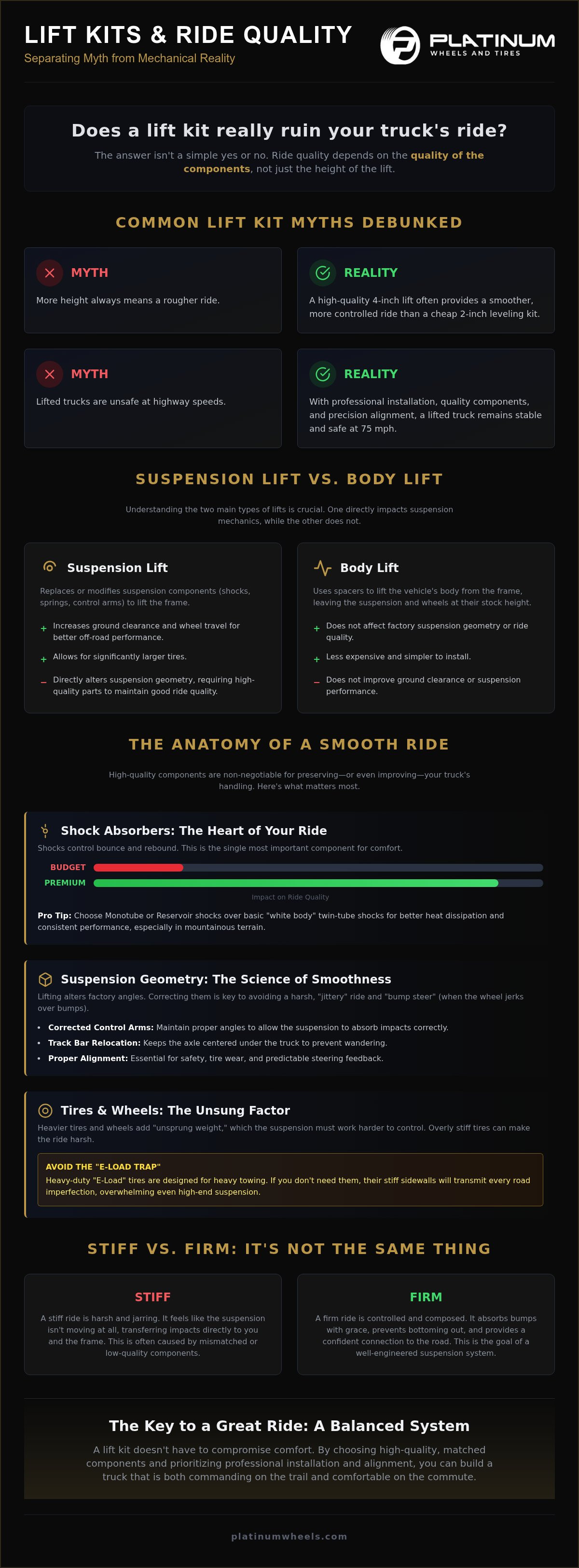
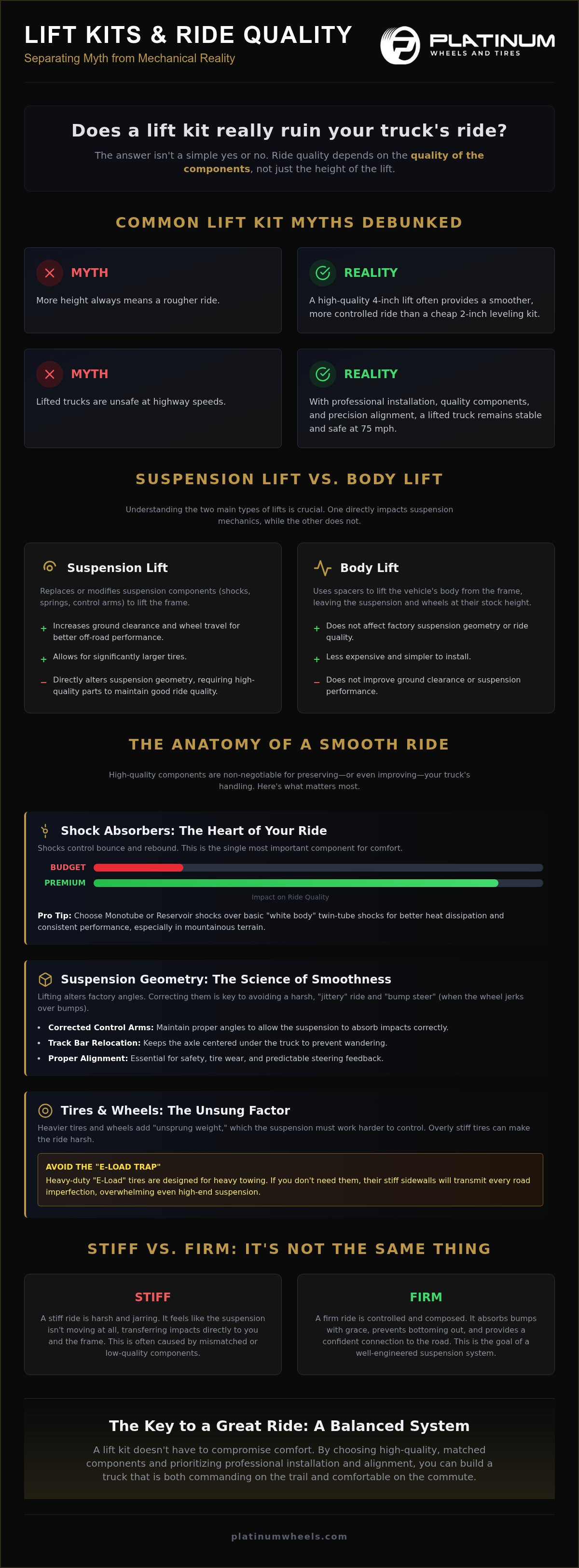
The honest truth is that any modification to your factory setup changes the driving experience. When people ask, "does a lift kit affect ride quality," they often expect a simple yes or no. In reality, a suspension lift alters every mechanical variable from your center of gravity to your steering geometry. You're raising the vehicle's mass, which naturally increases body roll during sharp turns. However, "different" doesn't have to mean "worse." A professionally installed kit often feels more controlled and planted than a soft, mushy factory setup, especially when you're hauling gear through the Front Range.
True ride quality is a cocktail of three factors: stiffness, vibration, and steering feedback. Understanding how a lift kit affects ride quality requires looking at the specific components you choose. If you pick a budget kit with cheap shocks, you'll likely feel every pebble on the road. High-end systems, however, use advanced valving to soak up vibrations while maintaining a firm connection to the pavement. It's about finding the balance that fits your specific needs as a driver.
Common Myths About Lifted Truck Comfort
Don't let forum horror stories dictate your build. One common myth is that going higher always results in a rougher ride; actually, a 4-inch premium lift often rides better than a cheap 2-inch leveling spacer. Another fear is losing towing capacity. While your hitch height changes, a properly engineered kit maintains your truck's ability to pull a trailer safely. Finally, modern lift kits aren't inherently unsafe for highway speeds. As long as your alignment is dialed in and you use quality components, your truck will remain stable at 75 mph on I-70.
The Difference Between 'Stiff' and 'Firm' Handling
There's a massive difference between a suspension that is stiff, which feels like hitting a brick wall, and one that is firm, which feels composed. Off-road enthusiasts prefer a firm setup because it prevents the truck from bottoming out on technical trails. In the city, a firm suspension actually absorbs Denver potholes with more grace than stock springs. Instead of the truck crashing into a hole, it cycles through the travel and recovers quickly. Plus, there's a psychological benefit. Sitting higher gives you better visibility and a sense of command over the road that many drivers find more relaxing than being low to the ground.
The Mechanics of Comfort: How Lifting Changes Your Suspension
Suspension geometry is the relationship between all moving parts in your undercarriage. When you install a lift, you're fundamentally altering these factory-set angles. For instance, steep control arm angles can transfer road impacts directly into the frame rather than allowing the springs to soak them up. This mechanical shift is exactly why asking "does a lift kit affect ride quality" is so important. If these angles aren't corrected, you'll experience increased ball joint stress and a ride that feels "jittery" over small bumps. Proper geometry ensures that your suspension moves vertically as intended, preserving the smoothness you expect from a modern truck.
It's not just about comfort; it's about how the entire vehicle communicates. Official data from the NHTSA highlights how lifting changes your suspension and can even impact modern safety systems like pre-collision sensors. This makes choosing high-quality components and professional calibration vital for staying safe on the road. Beyond the geometry, your spring rates determine how much you feel the road. If your new springs are rated for a heavy winch and steel bumper you don't actually have, the truck will feel like it's riding on bricks. Matching the spring rate to your actual vehicle weight is a professional secret to achieving a plush, factory-like ride.
Shock Absorbers: The Heart of Your Ride Quality
Your shocks are responsible for controlling "bounce" and "rebound." In our Colorado climate, monotube shocks generally outperform twin-tube designs because they dissipate heat faster and don't foam up during rapid cycling. Many budget kits include "white body" shocks. These are the primary reason for poor ride quality; they lack the sophisticated valving needed to manage heavy truck tires. If you frequently tackle long mountain descents, consider reservoir shocks. They provide extra oil capacity to keep your damping consistent even when things get hot. Investing in premium dampers is the fastest way to ensure that a lift kit doesn't ruin your daily commute.
Steering Geometry and the Dreaded 'Bump Steer'
Ever hit a pothole in Denver and felt the steering wheel jerk in your hands? That's bump steer. It happens when the drag link and track bar are no longer parallel. Lifting your truck increases these angles, which can make the steering feel "loose" or "darty" at highway speeds. Using a drop pitman arm or track bar brackets helps restore that factory alignment. To ensure your rig handles these technical details correctly, it's worth looking into professional lift kits & leveling kits that include all the necessary correction hardware. When these parts work in harmony, you'll find that the answer to "does a lift kit affect ride quality" can actually be a positive one.
Suspension Lift vs. Body Lift: Which Impacts Ride More?
Choosing the right method is the first step toward achieving your truck goals without compromising your daily drive. If you're asking "does a lift kit affect ride quality," you must first distinguish between these two fundamental approaches. A body lift uses high-grade spacers to increase the distance between your truck's frame and the cab. It doesn't touch your springs, shocks, or control arms. On the other hand, a suspension lift replaces factory components like coils, leaf springs, and shocks to provide true ground clearance and improved articulation.
Body lifts are often considered the "stealth" option for maintaining comfort. Since the actual suspension remains stock, your ride quality stays exactly as it was when it left the showroom floor. You won't deal with new vibrations or changes in spring stiffness. However, there are trade-offs. You'll notice aesthetic gaps between the frame and body, and your center of gravity still rises, which can slightly increase body roll. Suspension lifts are more complex, but they offer the functional benefits needed for Colorado's rugged terrain while allowing for a completely customized feel.
When to Choose a Body Lift for Comfort
If your primary goal is to fit larger wheels and tires for a beefier look, a body lift is a smart, cost-effective choice. It allows you to clear 35-inch tires without modifying the factory suspension, which means you maintain your original payload and towing ratings. This is a popular route for Denver drivers who spend most of their time on the pavement. You get the aggressive stance you want without the risk of a "stiff" ride that sometimes comes with poorly matched aftermarket springs. It's an efficient way to gain height while keeping your commute smooth and predictable.
Why Suspension Lifts Are Worth the Investment
While body lifts are great for looks, suspension lifts provide the functional performance required for mountain trails. You get increased wheel travel, which is vital for absorbing large obstacles rather than bouncing over them. A quality system also helps with correcting the "rake" of the truck, a topic we cover extensively in our leveling kit vs lift kit guide. Beyond performance, premium suspension components are built to outlast stock parts. They handle the salt, grit, and steep grades of the Front Range with superior durability, ensuring your rig handles the high-altitude hairpins of I-70 with total confidence.
The Hidden Factors: Tires, Wheels, and Alignment
Sometimes the answer to "does a lift kit affect ride quality" has nothing to do with the actual suspension components. It often comes down to the rubber meeting the road. Unsprung weight is the mass of components not supported by your springs, specifically your tires and wheels. When you swap factory wheels for heavy 35-inch mud-terrains, you're adding significant weight that your shocks must now control. This extra mass makes the suspension work harder to dampen movement. If your shocks aren't valved for that extra weight, the truck will feel sluggish or "heavy" over every Denver pothole.
Many owners fall into the "E-Load trap" without realizing it. They buy 10-ply tires designed for heavy-duty three-quarter-ton trucks and install them on a light half-ton rig. These tires feature incredibly stiff sidewalls meant for carrying massive payloads. On a lighter truck, they feel like solid rocks, transmitting every vibration directly into the cabin. Additionally, aggressive wheel offsets change the leverage applied to your wheel hubs and bearings. A wider stance looks great, but it increases the mechanical advantage the tire has over the suspension, which can accelerate wear and alter your steering feel.
Tire Choice and Road Noise
Aggressive tread patterns don't just look tough; they create harmonics. These vibrations can often be mistaken for suspension issues or poor lift quality. If you want a rig that handles the highway silently but still conquers the trails, you need to balance your priorities. We recommend checking out our all terrain tires guide to find a set that won't drive you crazy on long trips to the mountains. Don't forget that tire pressure is your best friend. Dropping just a few PSI can drastically soften a harsh ride, provided you stay within safe limits for your specific load.
The Critical Post-Lift Alignment
A standard alignment often falls short for a modified vehicle. While a technician might get your truck "within factory spec," lifted rigs usually require specific adjustments to caster and toe to prevent highway wandering. Incorrect caster is the primary reason a lifted truck feels "darty" or requires constant correction at high speeds. Precision is non-negotiable here. After we install a kit, we always advise a re-torque of all suspension bolts after the first 500 miles. Parts settle, and keeping everything tight is the best way to preserve your Custom Truck Wheels & Off-Road Rims and ensure long-term safety on the Front Range.
Professional Installation: The Denver Secret to a Perfect Ride
Achieving the perfect balance between height and comfort isn't just about the parts you buy; it's about how they're installed. When you ask "does a lift kit affect ride quality," the answer often depends on the technician's attention to detail. At Platinum Wheels, we focus exclusively on truck and SUV suspension rather than general mechanical repair. This specialization allows us to optimize every component for the unique demands of the Colorado Front Range. From the thin air at high altitudes to the corrosive road salt used in Denver winters, we ensure your rig is built to handle the environment safely.
A proper install in Denver is critical for mountain driving safety. Navigating steep grades and sharp hairpins requires a suspension that reacts predictably. We don't just bolt parts on; we verify that every angle is corrected to maintain factory-like handling. For those looking for a total transformation, we often recommend pairing your lift with our aftermarket wheel and tire packages. This ensures that the weight, offset, and tread pattern work in harmony with your new suspension geometry, providing a cohesive driving experience rather than a collection of mismatched parts.
Why DIY Lift Kits Often Fail the Comfort Test
Many driveway builds suffer from annoying squeaks and a jarring ride because of improperly clocked bushings. If you tighten suspension bolts while the truck is still on jacks, the rubber bushings remain under constant tension once the vehicle is lowered to the ground. This leads to premature wear and a stiff feel that many owners mistakenly blame on the kit itself. DIYers also frequently overlook small but vital components like brake line extensions or sway bar drops. Using "universal" parts that don't quite fit your specific model can create clearance issues that a professional shop would identify and solve immediately.
Expert Fitment in the Denver Area
Our local expertise means we know how to tune a truck for both downtown Denver streets and rugged Rocky Mountain trails. We handle the technical complexities, including ensuring your TPMS sensors are correctly calibrated to avoid dashboard warnings. You can find more details on this in our TPMS sensor guide. Every truck that leaves our shop undergoes a rigorous final checklist. We verify torque specs, check for component interference, and perform a specialized alignment. This meticulous process ensures that your answer to "does a lift kit affect ride quality" is a resounding yes, it makes it better for the way you drive in Colorado.
Elevate Your Drive Without Compromising Comfort
Lifting your truck is one of the most rewarding modifications you can make, provided you prioritize precision over shortcuts. We've seen that the answer to "does a lift kit affect ride quality" isn't found in the height itself, but in the harmony of your suspension geometry, tire selection, and alignment. By choosing high-quality components and matching them to your specific vehicle weight, you can enjoy the rugged looks you want while maintaining the smooth, stable handling required for I-70 commutes and weekend trail runs. It's about building a rig that performs as well as it looks.
As specialized suspension experts serving the Colorado Front Range, we understand the unique challenges our terrain presents. Whether you need premium wheel and tire packages or a complete suspension overhaul, our team ensures every bolt is torqued and every angle is dialed for maximum performance. Don't settle for a stiff, wandering ride when you can have professional-grade stability. Get a Professional Lift Kit Consultation at Platinum Wheels Today. We're here to help you build a truck that's ready for anything the Rockies throw your way.
Frequently Asked Questions
Will a 2-inch lift kit affect my ride quality as much as a 6-inch lift?
Generally, no. A 6-inch lift has a much more dramatic impact on your truck's suspension geometry and center of gravity than a 2-inch kit. Higher lifts require extensive modifications to driveshafts and steering components to maintain stability. While a 2-inch lift is often manageable with basic hardware, a 6-inch system demands precision engineering to avoid a harsh or unstable ride on the highway.
Do lift kits cause more wear and tear on other vehicle parts?
Yes, lift kits can accelerate wear on components like ball joints, CV axles, and wheel bearings if the geometry isn't properly corrected. Increasing the operating angles of these parts puts them under significantly more stress than factory settings. Professional installation ensures these angles remain within safe limits, which is vital for preventing premature failure and maintaining safety during mountain driving.
Can I improve my ride quality after installing a lift kit?
You can absolutely improve your ride quality by upgrading to high-quality shocks or adjusting your tire pressure. Many owners find that swapping out basic "white body" shocks for premium monotube dampers or reservoir shocks makes a world of difference. Addressing these technical details is one way to answer the question of how does a lift kit affect ride quality for the better.
Does a leveling kit affect ride quality differently than a lift kit?
Leveling kits primarily affect the front suspension and can sometimes result in a slightly stiffer ride compared to a full suspension lift. Since many leveling kits use spacers to achieve height, they may reduce the available downward travel of your suspension. A full lift kit usually replaces the springs and shocks entirely, which often provides a more balanced and comfortable experience for daily driving.
Why does my truck feel 'bouncy' after installing a new lift?
A bouncy truck is usually a sign of mismatched shock absorbers or incorrect spring rates for your vehicle's actual weight. If your shocks are too weak to control the rebound of your new springs, the truck will continue to oscillate after hitting a bump. This is a common issue with budget-friendly kits that include entry-level dampers rather than performance-tuned shocks.
How much does a professional lift kit installation cost in Denver?
The cost of professional installation in the Denver area varies based on the complexity of the kit and your specific truck model. Labor requirements change significantly between a simple spacer install and a complex 4-link suspension system that requires bracket modifications. Specialized alignment and the time needed to calibrate modern safety sensors also influence the final investment for your build.
Will a lift kit void my vehicle's factory warranty?
A lift kit won't automatically void your entire factory warranty, but it can affect coverage for specific suspension and drivetrain components. Under federal law, a dealer must prove that the aftermarket part directly caused a failure to deny a warranty claim. It's always a smart move to check with your local Denver dealer before modifying a vehicle that is still under its original warranty period.
Should I change my shocks when I install a lift kit?
You should almost always change your shocks when installing a lift kit to ensure they have the proper length and valving for the new height. Factory shocks aren't designed to operate at increased heights and can "top out," leading to poor performance and internal damage. Upgrading to shocks designed specifically for the lift is the best way to ensure that a lift kit doesn't negatively affect ride quality.