BFGoodrich Tires: The 2026 Colorado Guide to Off-Road Performance
Your choice of rubber matters more than your locking differentials when you're staring down a slushy climb on Vail Pass or a jagged shelf road in San Juan County. It's a bold reality for high-altitude driving; the wrong set of bfgoodrich tires can turn a capable rig into a liability. Most Colorado drivers want that aggressive trail look, yet they're rightfully concerned about a deafening drone during a Monday morning commute on I-25. You shouldn't have to sacrifice your peace of mind or your hearing just to enjoy the backcountry.
This guide will help you master the 2026 lineup so you can find the perfect balance of rugged off-road dominance and refined highway comfort. We'll dive into the technical evolution of the new KO3 versus the classic KO2, explain how 35-inch tires interact with your specific leveling kit, and ensure your setup meets the strict 3/16-inch tread depth requirements of the Colorado Traction Law. By the end, you'll have the confidence to choose the right footprint for your lifestyle and the knowledge of where to get them expertly mounted right here in the Front Range.
Key Takeaways
- Learn how the latest 2026 models, including the Trail-Terrain T/A+, provide the necessary traction to stay compliant with Colorado’s strict winter driving laws.
- Compare the All-Terrain KO3 and Mud-Terrain KM3 to find your ideal mix of quiet highway manners and aggressive rock-crawling capability.
- Get expert fitment advice on running 33-inch or 35-inch bfgoodrich tires with your specific lift or leveling kit to ensure zero rubbing.
- Master the "Chalk Test" to determine the perfect street PSI for your rig, ensuring even tread wear and maximum longevity.
- Discover the benefits of professional installation for your wheel and tire package to maintain performance and peace of mind on the trail.
The BFGoodrich Legacy: Why It Dominates the Colorado Front Range
BFGoodrich didn't just join the off-road market; they built it from the ground up. In 1976, they pioneered the first radial all-terrain tire, a move that fundamentally shifted how we explore the backcountry. Before this innovation, drivers had to choose between stiff, uncomfortable bias-ply tires or highway rubber that failed the moment it touched dirt. Since 1976, BFGoodrich has remained the undisputed backbone of the 4x4 community by engineering the first radial all-terrain tire that could actually survive the transition from dirt to pavement.
From Baja to the Rockies: A Tradition of Innovation
The grueling Baja 1000 serves as the ultimate laboratory for bfgoodrich tires. When a tire can survive hundreds of miles of silt, jagged rocks, and high-speed impacts in the Mexican desert, it gains a level of durability that translates directly to the I-70 corridor. We see the benefits of this racing heritage in the "T/A" (Traction Advantage) designation, which has remained the gold standard for performance for decades. It's this specific engineering that allows a heavy truck to maintain stability at highway speeds while possessing the grit to crawl through the Eisenhower Tunnel during a February blizzard.
Sidewall failure is the quickest way to ruin a weekend in the Rockies. BFGoodrich addresses this with their proprietary CoreGard technology, which uses split-and-bruise resistant sidewall rubber and an increased rubber thickness to deflect protruding objects. Whether you're navigating the sharp edges of a shelf road near Telluride or airing down for the loose scree of a high-mountain pass, that extra layer of protection provides the peace of mind you need to push further into the wild.
Why Colorado Truck Owners Choose BFG
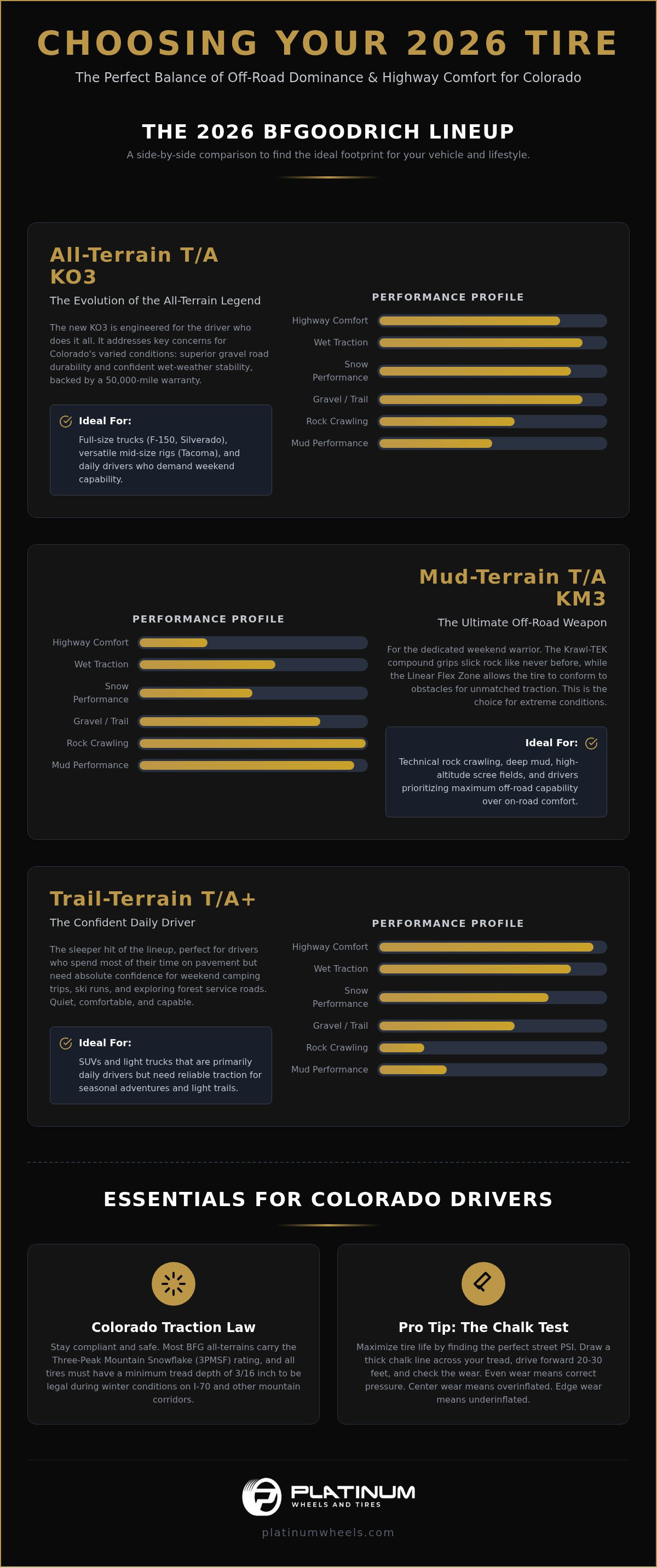
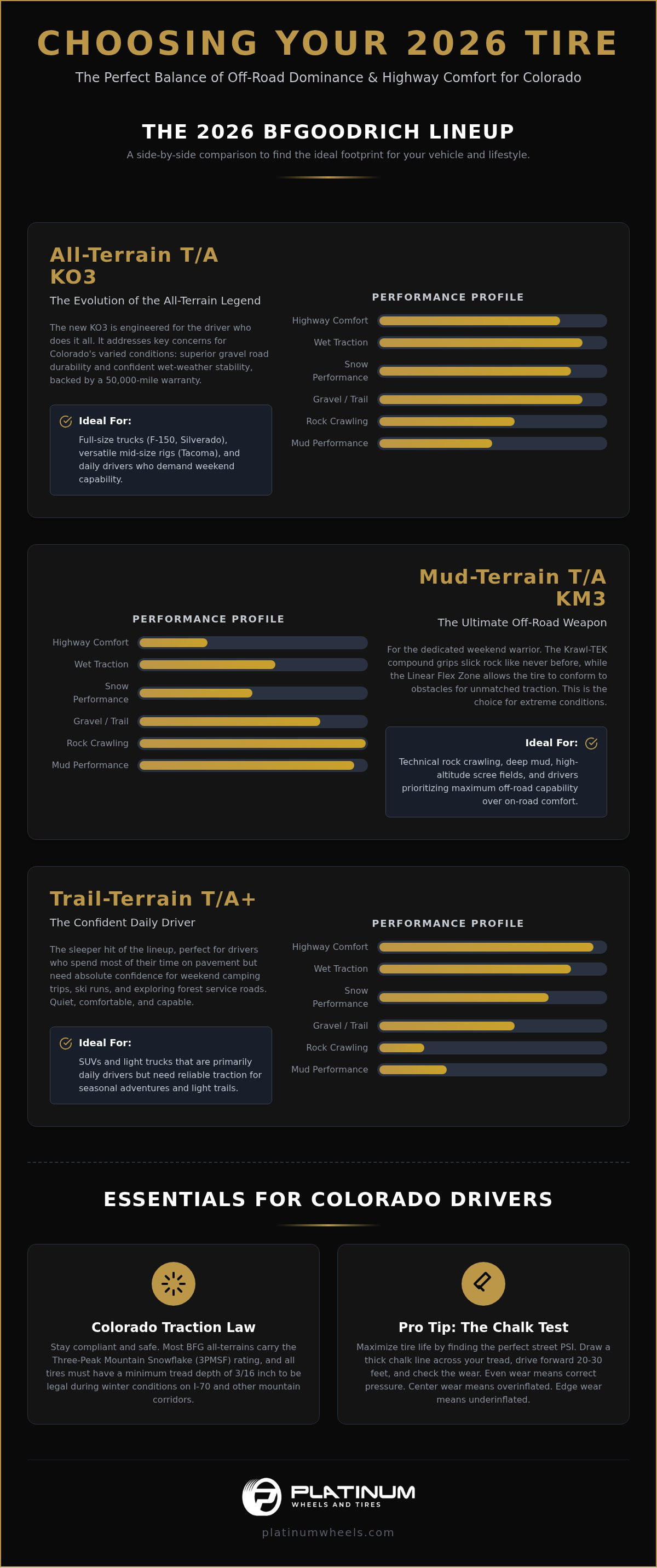
Denver drivers face a unique challenge: we need one tire that handles 90-degree summer days in Aurora and sub-zero mornings in the high country. Most BFG all-terrain models carry the Three-Peak Mountain Snowflake (3PMSF) rating, ensuring they meet the severe snow service requirements of the Colorado Traction Law. This isn't just about avoiding a fine on the way to Copper Mountain; it's about the psychological security of knowing your rig will bite into the packed powder when you need it most.
Performance on varied surfaces is where these tires truly shine. They offer a predictable grip on the slickrock of nearby Moab, yet they don't lose their composure on the daily grind of Front Range traffic. Local enthusiasts trust this brand because it balances the aggressive needs of an overlander with the practical demands of a daily driver. At Platinum Wheels, we've seen how these tires transform a standard SUV into a mountain-ready machine that feels just as comfortable at a trailhead as it does in a downtown parking garage.
The 2026 Lineup: KO3 vs. KM3 vs. Trail-Terrain
Choosing the right footprint for your vehicle requires a clear understanding of where you spend most of your time. In 2026, the bfgoodrich tires lineup has become more specialized than ever, offering distinct solutions for everything from the daily I-25 commute to technical rock crawling near Buena Vista. Whether you prioritize a silent cabin or maximum mud evacuation, there's a specific tread pattern designed for your vehicle's weight and intended use.
KO3: The New King of All-Terrain?
The All-Terrain T/A KO3 represents a massive leap forward from the legendary KO2. It addresses the two biggest concerns for Front Range drivers: gravel protection and wet-weather stability. The new tread compound is engineered to resist tearing on sharp mountain trails while providing a 50,000-mile limited treadwear warranty. We've found that this updated compound handles Colorado's extreme temperature swings better than its predecessor, staying pliable during sub-zero mornings without becoming too soft on 90-degree summer afternoons. It's the ideal choice for full-size builds like the Ford F-150 and Chevy Silverado, or mid-size workhorses like the Toyota Tacoma.
KM3: Dominating the Mud and Rocks
If you're a dedicated weekend warrior in Colorado Springs frequently hitting trails like Saran Wrap or Eagle Rock, the KM3 is your primary weapon. This tire features the 'Krawl-TEK' compound, designed specifically to grip slick surfaces and jagged edges. The 'Linear Flex Zone' is a technical standout; it allows the tire to wrap around obstacles when you're aired down, providing traction that feels almost magnetic. You'll notice more road noise on the highway compared to the KO3, but that's a small price to pay for a tire that refuses to quit in deep mud or high-altitude scree fields.
For drivers who stay mostly on the pavement but need confidence for weekend camping trips, the new Trail-Terrain T/A+ is the sleeper hit of 2026. Launched in June, this tire offers 25% longer tread wear and a 10% improvement in wet traction compared to previous light-duty models. It's even become the original equipment choice for the 2026 Rivian R2. It provides a 65,000-mile warranty and a ride that's significantly quieter than its more aggressive siblings. If you're looking to upgrade your CUV or light truck, our team can help you build complete aftermarket wheel and tire packages that pair these tires with the perfect offset for your daily needs.
Technical Fitment: BFG Tires with Lifts and Leveling Kits
A tire's advertised size and its real-world footprint are two different things. When you're shopping for bfgoodrich tires, you'll find that their aggressive shoulder lugs and tread blocks often require more breathing room than a standard highway tire of the same dimension. A 35-inch Mud-Terrain T/A KM3, for example, has a squared-off profile that can catch on fender liners during a full-lock turn, even if the nominal diameter suggests it should fit. Precision fitment is the difference between a rig that conquers the trail and one that leaves you with a shredded inner fender.
Wheel offset and backspacing are the silent partners in this equation. As you move to wider T/A tires, you often need to push the wheel outward to clear the upper control arms. However, this change in geometry increases the "scrub radius," which can lead to rubbing on the bumper or the pinch weld at the back of the wheel well. That's why professional installation at a specialized shop like Platinum Wheels is vital. We don't just slap rubber on rims; we analyze how the new setup interacts with your suspension geometry to ensure your truck remains safe and functional.
Sizing Up: 33s vs. 35s on Colorado Trucks
For most late-model half-ton trucks, a 33-inch tire is the sweet spot for a leveled setup. It provides a significant boost in ground clearance without requiring permanent modifications to your vehicle. If you're determined to run 35s, you'll likely need to decide between a leveling kit vs. lift kit. While a leveling kit can technically accommodate 35-inch BFG Mud-Terrains, it often demands aggressive trimming of plastic liners or even metal modifications to prevent rubbing during suspension compression.
Don't overlook the weight of these upgrades. Most off-road BFG tires in these sizes come in an E-load range. These are heavy, durable tires that can handle the sharpest rocks on a mountain pass, but their increased unsprung mass will affect your braking distances and acceleration. It's a trade-off that requires a slightly different driving style, especially when descending steep grades on I-70. We always recommend checking your brake pad life when jumping up to a 35-inch tire to account for the extra stopping force required.
TPMS and Balancing for Oversized Tires
Big tires are notoriously difficult to balance correctly. We use road-force balancing to ensure your heavy off-road tire and wheel package spins true at highway speeds. This process simulates the force of the road on the tire, identifying hidden uniformities that a standard balancer might miss. Without this, you'll likely feel a persistent shimmy through the steering wheel at 65 mph, which can lead to premature wear on your steering rack and ball joints.
Finally, your truck's brain needs to know what's happening at all four corners. Upgrading to larger tires often involves moving or replacing sensors. Check out our TPMS sensor guide to understand how we keep your dash lights off and your safety systems functioning correctly. Proper calibration ensures your traction control and anti-lock brakes respond accurately to the increased diameter of your new setup, keeping you safe during sudden stops on slushy Colorado roads.
Optimizing Performance: Airing Down and Maintenance
Buying a set of bfgoodrich tires is a significant investment in your vehicle's capability, but the work doesn't stop at the shop door. To get the most out of your tread, you need to understand how to tune your tire pressure for specific environments. The "Chalk Test" is the most reliable way to find your ideal street PSI. By drawing a thick line of chalk across the tread and driving a short distance, you can see if the chalk wears off evenly. If it only wears in the center, your pressure is too high; if it wears only on the edges, it's too low. This is especially important for Colorado rigs that carry heavy aftermarket bumpers or winches, as the factory door placard no longer accounts for the added weight of your gear.
Mastering Tire Pressure for Colorado Terrain
When you hit the trailhead, airing down to 15-20 PSI transforms how your truck interacts with loose shale and sand. This lower pressure allows the tire to "envelope" obstacles, significantly increasing the contact patch and providing mechanical keying that high pressure simply can't match. However, you must be careful not to drop too low; going below 12 PSI without beadlock wheels risks popping the tire bead off the rim. Maintaining the correct air pressure ensures that the tread wears evenly across the entire width of the tire, preventing premature replacement.
Extending the Life of Your Investment
Aggressive tread patterns require more frequent attention than standard all-season rubber. We recommend 5,000-mile rotations as a non-negotiable rule for all-terrain tires to prevent "cupping," which is the uneven wear that creates that dreaded rhythmic humming on the highway. Additionally, Colorado's high-altitude UV rays are brutal on rubber. Use a high-quality protectant to keep your sidewalls from cracking, and always inspect your tires for rock "bites" or gouges after a weekend in the mountains.
If you notice unusual vibrations or steering wheel feedback after a rocky trail run, your alignment might have shifted. Keeping your suspension in spec is the only way to ensure your tires don't scrub away their life on the pavement. If you've recently upgraded your rig or feel a shimmy at highway speeds, come see us at Platinum Wheels for a professional fitment and balance check to ensure your setup stays trail-ready.
Get Your BFGoodrich Setup at Platinum Wheels Denver
Choosing the right set of bfgoodrich tires is only half the battle; the installation process is where your vehicle's true performance is unlocked. While a general mechanic might be able to mount a standard tire, they often lack the specialized equipment and fitment knowledge required for high-offset wheels and aggressive off-road suspension. We serve the entire Front Range, from the growing communities in Castle Rock up to the enthusiasts in Fort Collins, ensuring every rig leaves our shop trail-ready. Our team understands the nuances of Colorado driving because we live and wheel here ourselves, and we know exactly how a heavy E-load tire should feel on a mountain pass.
We focus on a "ready-to-drive" experience that eliminates the guesswork for our customers. This means every package we build is professionally mounted and road-force balanced to handle the unique demands of high-altitude highway speeds and technical trails. You won't have to worry about the vibrations or steering feedback that often plague poorly installed oversized tires. We take pride in being a reliable fixture in the Denver community, positioning ourselves as trusted advisors who prioritize your vehicle's safety and longevity over a simple transaction.
The Platinum Wheels Difference
Big box stores often rely on automated databases that don't account for aftermarket modifications or specific regional needs. At Platinum Wheels, we specialize in truck-specific fitment that considers your lift height, wheel backspacing, and intended trail usage. We love pairing the legendary durability of BFG tires with top-tier brands like Fuel or Method to create a look that's as functional as it is aesthetic. Our expertise ensures that your wheel and tire combination doesn't just look good in the driveway, but performs flawlessly when you're aired down in the backcountry. We understand that a Denver rig needs to be versatile, and we help you achieve that balance without the high-pressure sales tactics found elsewhere.
Start Your Build Today
Building your dream rig starts with a professional consultation about how you actually use your truck. When you schedule your appointment, bring your vehicle specifications and a clear idea of your goal usage, whether that's high-speed desert running or slow-speed rock crawling near Idaho Springs. We'll help you navigate our aftermarket wheel and tire packages to find the combination that matches your style and performance needs perfectly. Our technicians are ready to transform your vehicle with precision and efficiency. Ready to see what's possible for your truck or SUV? View our Custom Wheel and Tire Packages and get your build started with the experts today.
Dominate the Rockies with Precision
Navigating the high-altitude demands of the Front Range requires more than just a generic set of wheels. You've seen how the 2026 lineup, from the street-smart Trail-Terrain T/A+ to the rock-crawling KM3, offers specialized solutions for every type of Colorado driver. Success on the trail comes down to the details. You need to understand your PSI, ensure clearance for those 35-inch upgrades, and maintain a strict rotation schedule to preserve your investment.
Don't leave your performance to chance with a big-box retailer that doesn't understand our local terrain. As an authorized retailer and expert Denver-based fitment specialist, we're here to ensure your rig is balanced, cleared, and ready for whatever the I-70 corridor throws your way. We're specialized in truck lift and leveling kits to give your vehicle the perfect stance and capability. Finding the right bfgoodrich tires is the first step toward a safer, more capable adventure.
Build your custom BFGoodrich wheel and tire package at Platinum Wheels today! It's time to stop dreaming about the backcountry and start exploring it with total confidence.
Frequently Asked Questions
Are BFGoodrich All-Terrain KO3 tires good in the snow?
Yes, they are exceptional in winter conditions and carry the Three-Peak Mountain Snowflake (3PMSF) rating. This ensures they meet the requirements of the Colorado Traction Law on the I-70 corridor. The new KO3 compound is specifically engineered to stay flexible in freezing temperatures, providing superior grip on packed snow and ice compared to standard all-season rubber.
How many miles do BFGoodrich KO2/KO3 tires last?
The All-Terrain T/A KO3 comes with a 50,000-mile limited treadwear warranty, while the Trail-Terrain T/A+ offers up to 65,000 miles. Real-world longevity depends heavily on consistent 5,000-mile rotations and proper alignment. In our region, the abrasive nature of mountain roads can accelerate wear if you don't maintain correct street PSI using the chalk test method.
What is the difference between Load Range C and Load Range E in BFG tires?
Load Range E tires feature a 10-ply equivalent construction designed for heavy towing and maximum sidewall puncture resistance on sharp rocks. Load Range C is a lighter 6-ply equivalent that offers a softer ride and better fuel economy for mid-size trucks. If you frequently air down for technical trails, the extra reinforcement of an E-rated tire provides vital peace of mind.
Will 35-inch BFGoodrich tires fit on my truck with just a leveling kit?
Fitting 35-inch bfgoodrich tires usually requires more than just a leveling kit on most late-model half-ton trucks. While the height might clear, the width often causes rubbing on the control arms or fender liners during full-lock turns. You'll likely need to adjust your wheel offset or perform minor trimming to ensure the aggressive shoulder lugs don't catch on your vehicle's bodywork.
Why are BFGoodrich tires more expensive than other off-road brands?
You're paying for proprietary technologies like CoreGard sidewall protection and race-proven compounds that other brands can't replicate. BFG invests heavily in Baja racing to ensure their consumer tires survive the harshest environments on earth. This engineering translates to fewer flat tires and better tread life, which often makes them a more cost-effective choice over the life of the vehicle.
Do I need to re-calibrate my speedometer after installing larger BFG tires?
Yes, you should re-calibrate your speedometer because a larger tire diameter changes the distance traveled per revolution. If you don't, your speedometer will read slower than your actual speed, and your transmission shift points may become sluggish. Modern programmers make this a simple fix that ensures your odometer remains accurate and your safety systems function as intended.
Are BFGoodrich Mud-Terrain tires too loud for daily driving in Denver?
The Mud-Terrain KM3 is surprisingly quiet for such an aggressive tire, but it will always produce more hum than an all-terrain model. If your daily commute involves long stretches of I-25, the rhythmic drone might become noticeable over time. For most Denver drivers who prioritize cabin comfort during the week, the All-Terrain KO3 offers a much better balance of silence and capability.
How often should I rotate my BFGoodrich All-Terrain tires?
Rotate your bfgoodrich tires every 5,000 miles to prevent uneven wear patterns like cupping. Aggressive treads are particularly susceptible to developing uneven edges if left in one position too long, which leads to increased vibration and noise. A cross-rotation pattern is typically best for 4WD vehicles to ensure each tire experiences different forces and wears as evenly as possible.