Complete Guide to Off Road Wheel Tire Packages in Denver (2026)
Imagine spending your Saturday morning finally mounting a new setup, only to hear the soul-crushing sound of rubber scrubbing against your wheel well at the very first turn. It is a common nightmare for Denver truck owners who try to piece together a build without professional guidance. Choosing the right off road wheel tire packages involves more than just picking a cool design. It is a technical balancing act of offset, backspacing, and clearance that determines whether your rig is trail-ready or a safety hazard.
You want that aggressive stance and superior traction for the Colorado Front Range without the headache of a constant TPMS warning light or tires that simply don't fit. This guide will show you how to select the perfect combination for your specific vehicle, ensuring every component works in harmony for peak performance. We will break down the 2026 tire trends, explain the critical math behind professional fitment, and help you navigate local regulations like the $25.25 OHV permit requirement so you can hit the dirt with total confidence.
Key Takeaways
- Bundling your rims and rubber into integrated off road wheel tire packages reduces overall costs and ensures your setup arrives professionally mounted and balanced for a smooth, vibration-free ride.
- Master the technical side of fitment by understanding how wheel offset and backspacing affect your truck's stance and clearance.
- Learn to choose between all-terrain and mud-terrain tires based on your specific mix of I-25 commuting and rugged Rocky Mountain trail use.
- Identify when a leveling or lift kit is necessary to prevent tire rub and maintain vehicle safety when moving to larger, more aggressive wheel sizes.
- Discover the benefits of local professional installation in Denver, including expert TPMS programming and specialized fitment advice you won't get from online retailers.
Why Integrated Off-Road Wheel and Tire Packages Are the Smart Choice
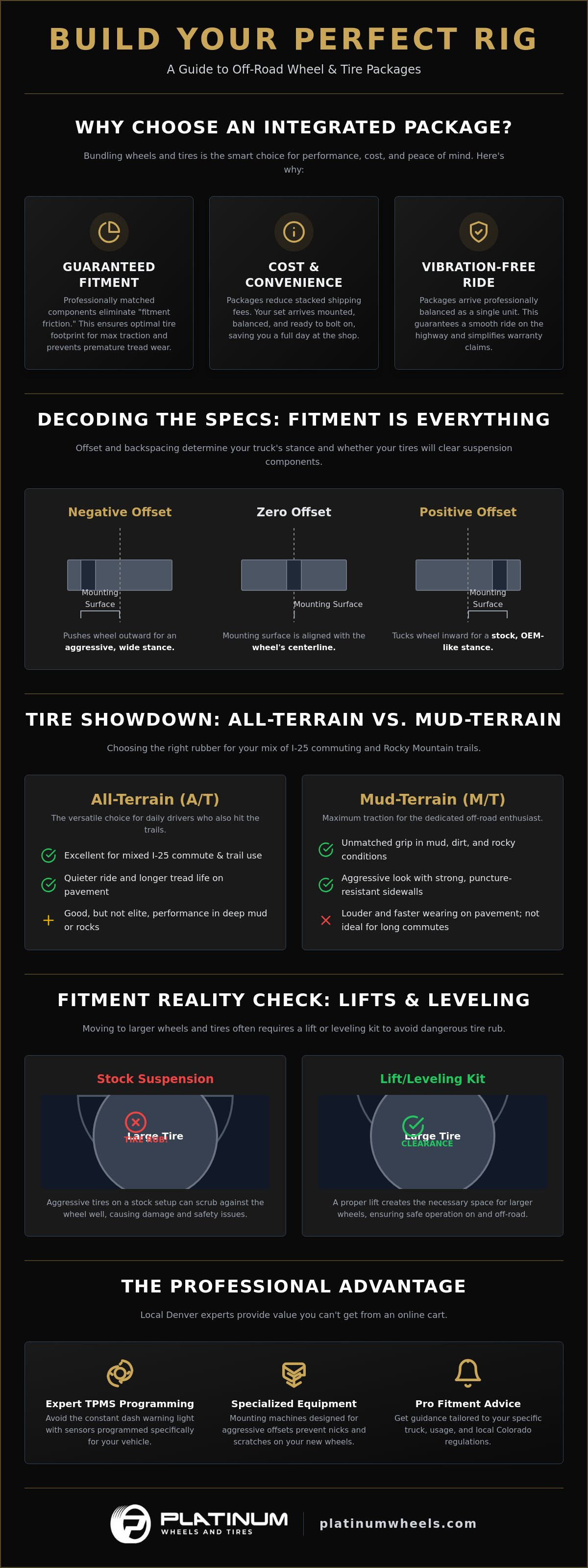
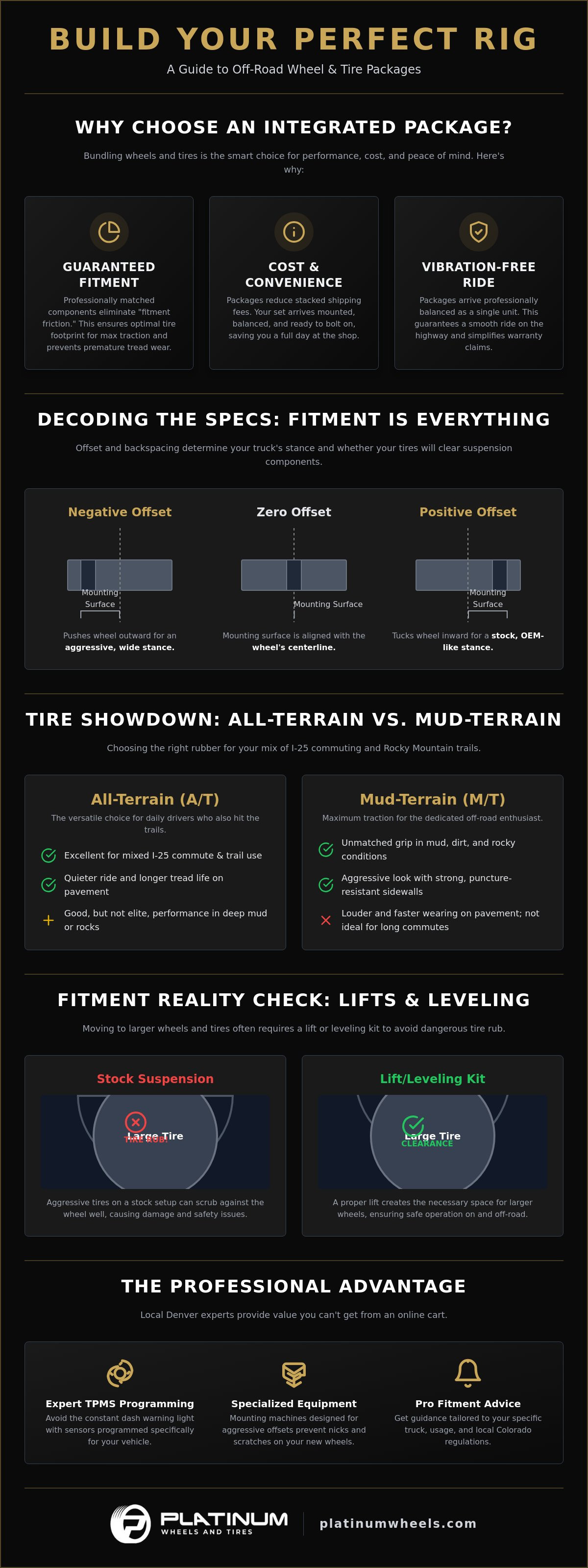
Investing in a high-quality rig requires a strategy, not just a credit card. Buying your rims and tires separately often leads to a logistical headache that most Denver drivers want to avoid. When you opt for integrated off road wheel tire packages, you are essentially purchasing a pre-engineered performance system. This approach eliminates the common "fitment friction" that happens when a tire's sidewall profile doesn't play nice with a wheel's specific lip design. By pairing these components from the start, you ensure the assembly is balanced as a single unit. This is the only way to guarantee a vibration-free ride when you're cruising down I-25 at highway speeds before heading into the hills.
Accountability is another major factor for your peace of mind. If you buy tires from one online giant and rims from another, you'll likely find yourself playing referee between two different customer service departments if a vibration occurs or a finish fails. Choosing a complete assembly creates a single point of contact for your warranty. It simplifies your life, protects your investment, and ensures that the experts who sold you the gear are the same ones responsible for its performance on the road.
Cost Efficiency and Convenience in 2026
Bundling is the most efficient way to build your truck in 2026. Individual shipping and handling fees for heavy off-road components add up fast. By purchasing a complete package, you often bypass these stacked costs while streamlining the entire transaction. Choosing an integrated solution offers several logistical advantages:
- Reduced Shipping: Combining items into a single freight shipment lowers total delivery costs.
- Interior Protection: You won't have to load dirty, heavy tires into your clean SUV or truck cab.
- Ready to Bolt On: Your set arrives mounted and balanced, including pre-programmed TPMS sensors.
This approach saves you a full day of driving between shops and waiting in lobbies. We include pre-programmed TPMS sensors in our off road wheel tire packages, so you can skip the "dash light" headache that plagues so many DIY builds. It turns a complex mechanical upgrade into a simple afternoon project.
Guaranteed Fitment and Performance
Technical precision is what separates a great build from a dangerous one. Different off-road tire categories require specific rim widths to ensure the tire bead seats with maximum integrity. If a rim is too narrow or too wide for the tire, you risk a de-bead when you're airing down for the trails. A professional package ensures the tire footprint is optimized. This gives you a flat, consistent contact patch that improves traction on the loose scree of the Rocky Mountains and prevents your expensive new tread from wearing out prematurely on the pavement. Our specialized focus on trucks and SUVs means we use mounting equipment designed for aggressive offsets, preventing the finish nicks that often happen at generalist tire chains.
Decoding the Specs: Offset, Backspacing, and TPMS
Technical specifications are the backbone of a high-performance build. If you ignore the numbers, you're essentially inviting expensive mechanical failures and safety risks to your rig. When you're browsing off road wheel tire packages, you'll encounter two critical measurements: offset and backspacing. Offset refers to the distance from the wheel's mounting surface to its true centerline. Backspacing measures the distance from that same mounting surface to the back edge of the rim. These figures dictate whether your wheels will clear your brake calipers and suspension components or if they'll stick out past your fenders.
Choosing between negative and positive offset is what defines your truck's stance. A negative offset pushes the wheel outward, away from the vehicle. This is the secret to that aggressive, wide look that many Denver enthusiasts crave. Conversely, a positive offset keeps the wheel tucked closer to the suspension, similar to an OEM setup. While you're researching the right rubber to wrap around those rims, it's helpful to consult an expert guide to all-terrain tires to see how different tread widths interact with these wheel specs. You can also explore our custom wheel options to see how these offsets look on local builds.
Don't overlook the importance of hub-centric designs. Unlike generic lug-centric wheels that rely solely on the studs for centering, hub-centric wheels fit perfectly over the axle hub. This setup ensures the weight of your truck is supported by the hub itself, which is vital for heavy-duty off-roading and maintaining a smooth ride on the highway. It's a small detail that makes a massive difference in long-term reliability.
Understanding Wheel Offset and Stance
Negative offset is the industry standard for achieving a commanding presence on the road. It widens your vehicle's track, which can provide better stability on off-camber trails. However, you must balance aesthetics with steering geometry. Extreme offsets can put extra stress on your wheel bearings and change how your truck handles in tight turns. To find the right wheel offset for your truck, you need to consider your current suspension height and fender clearance to avoid the dreaded "rub" during full steering lock.
The Critical Role of TPMS Sensors
Modern trucks aren't just mechanical; they're highly computerized. Your Ford, Chevy, or Ram relies on TPMS sensors to monitor air pressure and keep you safe. When you upgrade to new off road wheel tire packages, installing fresh sensors is the only way to avoid the persistent dash light headache. We ensure these sensors are pre-installed and ready for programming, so your vehicle's safety systems remain fully functional from the moment you leave the shop. It's about maintaining that professional, factory-clean experience even with a heavily modified setup.
Choosing the Best All-Terrain vs. Mud-Terrain for Colorado
Selecting the right tread pattern is the most consequential decision you'll make for your rig's performance. In the Front Range, your tires must handle vastly different environments within a single afternoon. You might start your day on the sun-baked pavement of I-25 and end it climbing over jagged limestone in the Rockies. When browsing off road wheel tire packages, you need to be honest about how you actually use your truck. A tire that looks "mean" in a parking lot might be a liability on a snow-packed mountain pass or an annoyance during a long commute to Aurora.
The 2026 market has seen a massive shift toward hybrid tires. These designs bridge the gap by combining the quiet street manners of an all-terrain with the aggressive, "chunky" sidewalls of a mud-terrain. Regardless of the category you choose, look for the Three-Peak Mountain Snowflake (3PMSF) symbol. This rating is critical for Colorado drivers because it ensures the rubber compound stays flexible in freezing temperatures, providing much-needed grip during our unpredictable spring blizzards.
All-Terrain Versatility for Daily Driving
For the majority of Denver owners, all terrain tires are the undisputed champions of practicality. These tires feature closely spaced tread blocks that maximize contact with the road, significantly reducing the "hum" that plagues more aggressive setups. They generally offer superior longevity, with many 2026 models carrying mileage warranties up to 60,000 miles. This makes them the ideal foundation for off road wheel tire packages intended for trucks that serve as both a daily office and a weekend escape vehicle. They provide enough bite for moderate trails while maintaining excellent fuel economy on the highway.
Mud-Terrain Dominance for Colorado Trails
If your weekends involve technical challenges like the "Staircase" or the steep, loose shale of Black Bear Pass, mud-terrain (M/T) tires are a necessity. These tires are engineered with massive "void zones" between tread blocks, allowing them to self-clean by ejecting mountain mud, slush, and debris. Their reinforced sidewalls are specifically designed to resist punctures from the sharp, volcanic rocks common in the San Juan Mountains. While they're louder on dry pavement and tend to wear faster than A/T models, the trade-off is unmatched traction when the trail turns vertical. Choosing an M/T setup is a commitment to trail performance above all else, ensuring your vehicle has the mechanical grip required for Colorado's most demanding terrain.
Fitment Reality Check: Lift Kits and Leveling Kits
You have spent hours selecting the perfect rims and tread, but now you face the most critical question: will they actually fit? Most aggressive off road wheel tire packages require some level of suspension modification to function safely. If you try to stuff oversized tires into factory wheel wells, you will inevitably experience "rubbing." This happens when the rubber makes contact with the inner fender liner, the frame, or the bumper during tight turns or when the suspension compresses over a bump. Rubbing is more than a nuisance; it can compromise your tire's integrity and damage your truck's bodywork over time.
Understanding the difference between a cosmetic "look" and true off-road clearance is vital for Colorado drivers. A truck might look great in a parking lot, but if the suspension geometry is maxed out, it will perform poorly on a rocky trail. When you increase the diameter of your wheel and tire assembly, you change the leverage applied to your ball joints, tie rods, and CV axles. Maintaining a functional rig means ensuring these components can still operate within their intended range of motion after the upgrade.
Accommodating 35-Inch and Larger Tires
Stepping up to 35 inch wheel and tire packages is a major milestone for any build. On most modern half-ton trucks, 35s simply will not clear without a lift or significant trimming. You may need to perform a "NorCal mod," which involves minor metal work behind the front tires to prevent contact at full steering lock. Additionally, jumping to a 35-inch tire affects your speedometer and effective gear ratio. Your engine has to work harder to turn that extra mass, which is why many enthusiasts also consider re-gearing their differentials to maintain highway performance and towing capacity.
Leveling Kits vs. Full Suspension Lifts
A leveling kit is the most common entry point for improving a truck's stance. Most trucks come from the factory with a "rake," meaning the rear sits higher than the front to accommodate heavy loads. A leveling kit raises the front just enough to match the rear, providing enough space for slightly larger off road wheel tire packages. However, if you want 4 to 6 inches of true ground clearance to tackle deep snow or jagged obstacles, a full suspension lift is the only solution. Professional installation is non-negotiable here. DIY suspension work often leads to severe alignment issues that can scrub the tread off your expensive new tires in just a few thousand miles. If you want to ensure your setup is perfectly aligned and safe for the road, consult with our specialized technicians to find the right suspension match for your vehicle.
Where to Buy Off-Road Wheel and Tire Packages in Denver
Buying a high-end setup from a generic online retailer often feels like a gamble. You might save a few dollars on the front end, but the "last mile" of the process usually turns into a logistical nightmare. When you choose Platinum Wheels for your off road wheel tire packages, you aren't just buying parts; you're securing a partnership with local experts who live and breathe the Colorado truck culture. We understand that a rig built for the Front Range needs to handle the stop-and-go traffic of the I-25 corridor just as well as the loose shale of a mountain pass.
Online "ship-to-door" models leave you responsible for finding a shop willing to install oversized components they didn't sell. Many generalist tire chains lack the specialized equipment or the technical patience to handle aggressive negative offsets without scratching the finish. We provide a seamless, one-stop experience where the experts who help you select your custom wheels and rims are the same ones mounting, balancing, and installing them on your vehicle.
The Advantage of Local Professional Installation
Precision is the difference between a truck that wanders on the highway and one that feels factory-solid. We utilize high-speed road force balancing to ensure your heavy-duty tires are perfectly mated to your rims. This process identifies even the slightest inconsistencies that standard balancing misses, which is vital for maintaining comfort at highway speeds. If a fitment issue or a TPMS sensor error arises during the build, we solve it immediately on-site. You won't have to deal with the frustration of shipping heavy crates back and forth across the country. Plus, when you shop with us, you're keeping your investment within the Colorado community and supporting a locally owned business that understands our regional demands.
This commitment to local quality extends to all aspects of Denver living; for those also looking to protect their home from the same intense weather that tests our trucks, Royalty Construction provides expert exterior restoration and roofing services tailored to our unique environment.
Serving the Colorado Front Range Community
Our expertise extends across the entire metro area, providing convenient service for drivers in Denver, Aurora, Lakewood, and Thornton. We don't just look at a fitment chart; we use our local trail knowledge to guide your choices. If you tell us you're planning to tackle Yankee Hill or Kingston Peak, we'll recommend a setup with the sidewall durability and clearance those specific trails require. We maintain a curated selection of off road wheel tire packages in stock to ensure fast turnaround times. You don't have to wait weeks for a freight truck to arrive. We can often get your truck trail-ready and back on the road with a commanding new stance in a fraction of the time it takes to coordinate a DIY online build.
Build Your Ultimate Colorado Rig with Confidence
Upgrading your truck is about more than just aesthetics; it's about engineering a system that survives the Rockies and thrives on the highway. We have explored why integrated off road wheel tire packages save you from logistical headaches and how the right suspension height prevents expensive rubbing. Whether you choose the versatility of an all-terrain or the rugged bite of a mud-terrain, understanding your vehicle's specific offset and TPMS requirements ensures your build stays safe and reliable for years to come.
As a locally owned Colorado independent shop, we take pride in delivering professional results that generic online retailers simply cannot match. We specialize exclusively in truck and SUV fitments, providing expert installation in Denver and Aurora that includes precise road force balancing and sensor programming. Take the guesswork out of your next modification and let our team help you create a setup that performs as good as it looks.
Browse Our Best Off-Road Wheel and Tire Packages at Platinum Wheels and get ready to hit the trails with a rig that is truly built for the Front Range.
Frequently Asked Questions
Do I need a lift kit for 33-inch or 35-inch tires?
Most 35-inch tires require at least a 4-inch lift kit to function without severe rubbing, while 33s can often fit with just a 2-inch leveling kit. Modern half-ton trucks have larger wheel wells than older models, but 35s still need that extra height for suspension travel. If you plan to take your rig off-road, the lift ensures your tires don't slam into the fenders when the suspension flexes over rocks.
Will aftermarket wheel and tire packages void my truck’s warranty?
No, installing aftermarket off road wheel tire packages does not automatically void your entire vehicle warranty. Under the Magnuson-Moss Warranty Act, a dealer must prove that the aftermarket part specifically caused a failure to deny a claim. For instance, while a lift kit might affect a claim on a ball joint, it cannot be used to deny a warranty claim on your engine or transmission.
What is the best wheel offset for a Ford F-150 or Chevy Silverado?
A 0mm offset is the most popular choice for a Ford F-150 or Chevy Silverado because it provides an aggressive, slightly wide stance without being extreme. If you prefer a look that is flush with the fenders, look for an offset between +18mm and +20mm. Enthusiasts who want a very wide, deep-dish look often go with a -12mm or -24mm offset, though this usually requires more suspension height.
How do I know if a wheel and tire package will rub?
Rubbing usually occurs at "full lock" when the steering wheel is turned completely to one side, or when the suspension compresses over a bump. You can check for potential issues by measuring the distance between your current tire and the nearest suspension component or fender liner. Professional installers use backspacing and offset calculations to predict these contact points before the wheels are even mounted on your truck.
Are mud-terrain tires good for Colorado winters?
Mud-terrain tires excel in deep, unplowed mountain snow but often struggle on the icy, packed-down streets of Denver. Their large tread blocks lack the tiny grooves, or sipes, that help tires grip slick ice. For the best winter performance in the Front Range, choose a tire with the Three-Peak Mountain Snowflake (3PMSF) rating. This ensures the rubber compound stays soft and grippy even when temperatures drop below freezing.
Do wheel and tire packages come with TPMS sensors installed?
Yes, our off road wheel tire packages arrive with TPMS sensors pre-installed and ready for programming to your specific vehicle. This is a critical step because it keeps your tire pressure monitoring system functional and prevents a constant warning light on your dashboard. Including new sensors also means you don't have to pay a shop to tear down your old factory wheels to retrieve the original sensors.
How much does it cost to have a wheel and tire package installed in Denver?
Installation costs vary depending on whether you need a simple bolt-on service or a full suspension lift and alignment. A professional installation includes mounting, high-speed road force balancing, and programming the TPMS sensors to ensure everything is safe for the highway. While prices fluctuate based on the complexity of your rig, investing in professional labor protects your expensive new wheels from damage during the mounting process.
Can I use my factory lug nuts with aftermarket wheels?
Most aftermarket wheels require new, specialized lug nuts because the factory versions are typically too wide to fit into the smaller lug holes of custom rims. Aftermarket wheels often use a "conical" or "tapered" seat, which is different from the "flat" or "ball" seat found on some OEM hardware. We always recommend using a fresh set of lug nuts matched specifically to your new wheels to ensure a secure and safe connection to the hub.