
Top Toyota Tundra Wheels for Denver Off-Roading
Your choice of toyota tundra wheels is the single most important factor in whether your truck conquers the I-70 corridor or ends up stuck with a shredded fender liner. It's a game of millimeters where the wrong offset can turn a weekend trip to the Rockies into a mechanical nightmare. You want that wide, aggressive stance that looks at home on the Front Range, but the fear of your tires rubbing against the frame or upper control arms is a valid concern. It's frustrating when you realize the bolt pattern changed between generations, turning what should be a simple upgrade into a technical puzzle.
We understand that you need a truck that's as capable as it is stylish. This guide will help you master the nuances of Tundra fitment so you can achieve a rub-free setup that handles Colorado trails with precision. We'll break down generation-specific bolt patterns; explain exactly when you need a leveling kit; and highlight the best wheel configurations for local off-roading. By the end, you'll have the confidence to choose a setup that provides better traction for winter driving and the perfect Front Range stance without the risk of clearance issues.
Key Takeaways
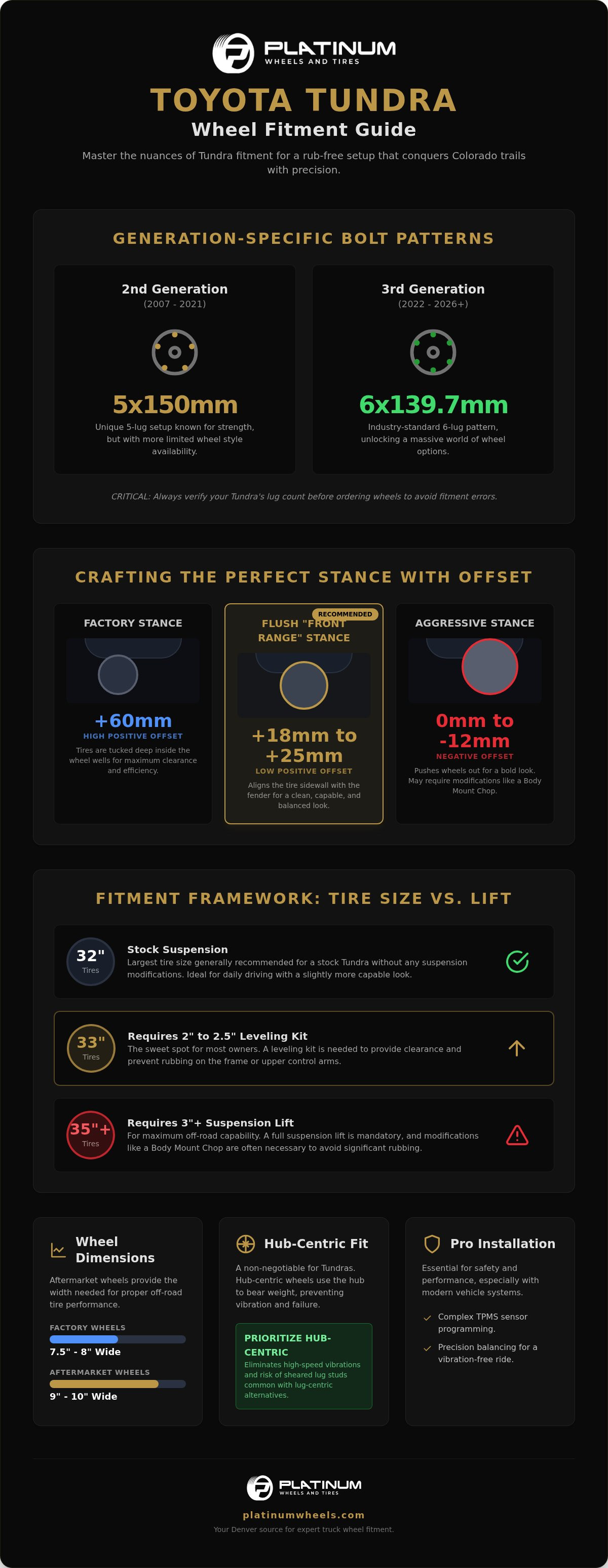
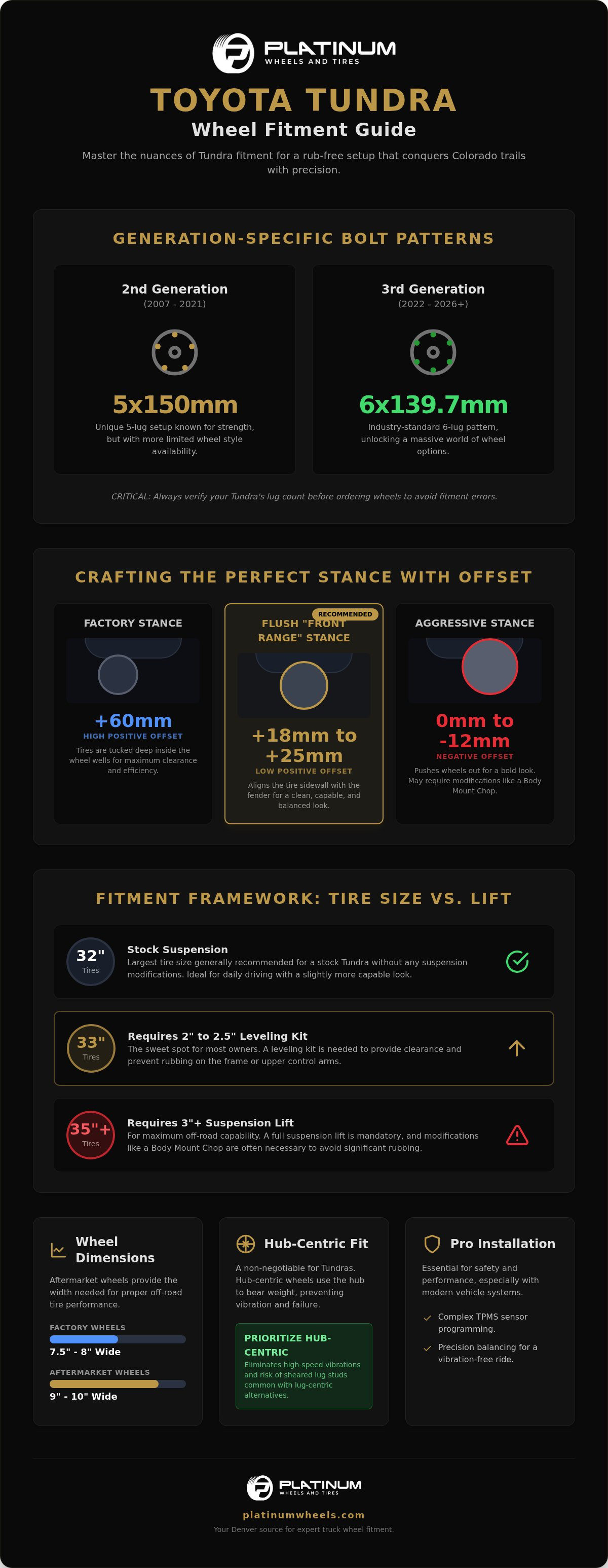
- Identify your specific generation to avoid fitment errors, as the bolt pattern shifted from 5x150mm on Gen 2 models to 6x139.7mm for 2022-2026 trucks.
- Achieve the perfect "Front Range stance" by selecting toyota tundra wheels with a +18mm to +25mm offset for a look that stays flush with your fenders.
- Match your tire choice to your lifestyle by opting for all-terrain rubber for I-70 winter reliability or mud-terrains for technical trails like Moab.
- Understand the clearance limits of your suspension, noting how a 2 to 2.5-inch leveling kit is often required to run 33-inch tires without frame rub.
- Prioritize professional installation to handle complex TPMS sensor programming and ensure precision balancing for a vibration-free ride on Colorado highways.
Understanding Toyota Tundra Wheel Specs by Generation
Picking the perfect set of toyota tundra wheels starts with a deep dive into the mechanical DNA of your truck. It isn't just about the finish or the brand; it's about ensuring your rig stays safe on the climb up Loveland Pass. For a heavy-duty truck that carries significant weight, hub-centric wheels are non-negotiable. These wheels use the hub's center bore to support the vehicle's weight, which eliminates the high-speed vibrations and sheared lug studs often caused by cheap, lug-centric alternatives. The Tundra bolt pattern shift is the most critical fitment factor in 2026.
The 5x150 vs. 6x139.7 Bolt Pattern Debate
Toyota made a massive engineering pivot between the second and third generations. If you're rocking a 2007-2021 Gen 2, you have a 5x150mm bolt pattern. This unique five-lug setup was legendary for its strength but notoriously difficult to find in a wide variety of styles. That changed with the 2022-2026 Gen 3 models, which shifted to the industry-standard 6x139.7mm pattern. This shift means your newer Tundra now shares a bolt pattern with the Tacoma, 4Runner, and even many Chevy or GMC trucks. It opens up a world of availability, but it also creates confusion for owners of older models. Always double-check your lug count before placing an order to avoid the headache of a wheel that won't mount.
Factory vs. Aftermarket Wheel Dimensions
Factory toyota tundra wheels are typically built for efficiency, often measuring 7.5 to 8 inches in width. While these work for daily commuting around Denver, they severely limit your ability to run wider off-road tires. Upgrading to a 9-inch or 10-inch wide rim allows the tire's contact patch to spread correctly, which is vital for traction on loose scree or deep snow. Beyond width, pay close attention to load ratings. A Tundra is a heavy vehicle, and when you add a bed full of gear or a trailer, you need wheels rated for at least 2,100 to 2,500 pounds each. Choosing a wheel with an insufficient load rating is a recipe for catastrophic failure on technical trails like those near Ouray. High-quality aftermarket options provide the peace of mind that your equipment can handle the torque and weight of a fully loaded Toyota rig.
Choosing the Right Offset and Backspacing for the Tundra Stance
Offset is often the most misunderstood specification when shopping for toyota tundra wheels, but it's the primary factor that dictates your truck's physical profile. Simply put, offset is the distance from the wheel's mounting surface to its actual centerline. For Tundra owners, this measurement determines whether your tires stay tucked safely under the fenders or poke out for a wide, desert-racer look. Finding the right balance is essential for both aesthetics and functionality on Colorado's diverse terrain.
For a clean, "flush" look that aligns the tire sidewall with the edge of the fender, a positive offset between +18mm and +25mm is the industry sweet spot. This setup provides a wider track than factory wheels without creating excessive stress on your wheel bearings. If you prefer a more aggressive, "Front Range stance," moving toward a 0mm or even a -12mm negative offset will push the wheels outward. While this looks bold, it increases the scrub radius, which can make the steering feel heavier during tight maneuvers in Denver parking garages.
Calculating the Stance: How Far Will Your Wheels Poke?
Visualizing your new stance requires comparing aftermarket specs to your factory setup. Most stock Tundra wheels feature a high positive offset, often around +60mm, which keeps the tires deep inside the wheel wells. When you switch to a +20mm wheel, you're effectively pushing the tire outward by 40mm, or roughly 1.5 inches. Pushing the wheels out further with a negative offset creates a wider footprint for off-road stability, but it also exposes your paint to road debris. Without mud flaps or flares, those aggressive wheels will fling rocks and mag-chloride slush directly onto your door panels. You can learn more about these measurements in our guide on how to find wheel offset to ensure your math is spot on before you buy.
Clearance Issues: Frame Rub and the Body Mount Chop
Aggressive offsets look great, but they often lead to the dreaded "frame rub." When you move the wheel further out, the tire swings in a wider arc as you turn the steering wheel. This often causes the tire to strike the body mount located behind the front wheel well, a problem frequently solved by a "body mount chop." Additionally, backspacing is critical for those upgrading to aftermarket Upper Control Arms (UCAs). Most high-performance UCAs are thicker than factory arms, requiring a wheel with less backspacing (typically 4.5 to 4.75 inches) to prevent the tire from rubbing against the suspension itself. If you're planning a build that involves both new suspension and toyota tundra wheels, checking these clearances at full steering lock is a vital step. If you're unsure which setup fits your specific build, our team can help you select the right custom truck wheels for your needs.
Best Tire Pairings for Tundra Wheels in Colorado
Choosing the right tires for your toyota tundra wheels is about more than just a beefy look; it's a safety decision for anyone driving the I-70 corridor. In Denver, the environment demands versatility. You need rubber that can handle a 90-degree summer day on the pavement and a sudden October blizzard in the High Country. While many owners focus on tire height, it's vital to remember that tire width is as important as height for Tundra wheel fitment. A tire that is too wide will rub against the frame or suspension components during tight turns, regardless of how much lift you have.
For most Colorado drivers, All-Terrain (AT) tires are the gold standard. They provide a quiet ride on the highway while offering enough "bite" for snowy commutes and moderate trails. If your weekends involve technical rock crawling in Moab or navigating the steep, muddy switchbacks near Ouray, Mud-Terrain (MT) tires are the better choice. However, always look for the Three-Peak Mountain Snowflake (3PMSF) symbol. This rating ensures your tires meet specific snow traction requirements, which is critical for staying compliant with Colorado's passenger vehicle traction laws during winter storms.
All-Terrain vs. Mud-Terrain for the Front Range
Road noise is a major consideration if you commute between Denver and Castle Rock daily. Mud-terrain tires feature large tread blocks that create a distinct hum at highway speeds, which can become tiring on long trips. All-terrain tires offer a much smoother, quieter experience and generally last longer on dry pavement. In 2026, we're seeing a massive surge in hybrid "rugged-terrain" tires. These options blend the aggressive sidewall of an MT with the refined tread pattern of an AT. You can dive deeper into the performance data by reading our guide on choosing the best all-terrain tires for your specific needs.
Wheel Finishes that Survive Colorado Salt and Magnesium Chloride
The chemicals used to de-ice Colorado roads are incredibly corrosive. Magnesium chloride and road salt can quickly ruin a set of custom rims if you don't choose the right finish. Matte black powder coating remains the top choice for durability because it hides small scratches and resists chemical pitting better than most. Machined finishes look sharp but require more frequent cleaning to prevent oxidation. Chrome is the most vulnerable; it often develops "pitting" or bubbling when exposed to winter slush for extended periods. To keep your wheels looking new, rinse them thoroughly after every storm and apply a protective sealant or ceramic coating to create a barrier against the elements.
Fitment Framework: Tire Sizes vs. Suspension Lift
Achieving the perfect balance between tire size and suspension height is where most Tundra builds succeed or fail. On a completely stock suspension, your options for toyota tundra wheels are limited by the physical dimensions of the factory wheel wells. You can safely run 32-inch tires, and some narrow 33-inch setups might fit without modification, but you'll likely experience rubbing at full steering lock or when the suspension compresses on a trail. To truly unlock the potential of your truck for Colorado off-roading, you need to address the clearance between the tire and the vehicle's body.
A leveling kit provides roughly 2 to 2.5 inches of front lift, which is the "sweet spot" for many Denver drivers. This modification is often enough to clear a true 33-inch tire while maintaining much of the factory ride quality. However, if your goal is to run 35-inch tires, a leveling kit is rarely enough. Properly fitting 35s typically requires a full lift kit of 3 to 6 inches. At this height, wheel offset becomes a critical safety factor; you must choose an offset that pushes the tire far enough away from the Upper Control Arms (UCAs) to prevent contact during articulation.
The Leveling Kit Advantage for Tundra Owners
Most Toyota trucks come from the factory with a "rake," meaning the front sits lower than the rear to account for heavy loads in the bed. A leveling kit corrects this aesthetic, giving your truck a more balanced, aggressive profile. It's the most cost-effective way to fit custom rims because it requires fewer component changes than a full suspension overhaul. You can explore the technical differences and performance impacts in our guide on leveling kit vs lift kit to decide which build suits your specific lifestyle.
Step-by-Step Fitment Verification
Before you commit to a new set of toyota tundra wheels, follow this framework to ensure a rub-free experience:
- Step 1: Determine your desired tire height. Decide if you're sticking with 33s for daily driving or stepping up to 35s for serious trail work.
- Step 2: Match tire width to rim width. Ensure your chosen tire is compatible with a rim width between 8.5 and 10 inches to maintain proper sidewall stability.
- Step 3: Choose offset to clear suspension. Verify that your offset provides enough backspacing to clear aftermarket UCAs if you've upgraded your suspension.
- Step 4: Confirm bolt pattern. Re-verify your truck's generation to ensure you're ordering the 5x150mm or 6x139.7mm pattern discussed earlier.
Getting these measurements right the first time saves you from the frustration of "trimming" your brand-new truck. If you're ready to transform your rig with a professional setup, check out our selection of lift kits and leveling kits to find the perfect foundation for your build.
Expert Tundra Wheel Installation in Denver
Investing in high-quality toyota tundra wheels is only half the battle. The real magic happens during the installation phase, where precision mounting and balancing ensure your truck performs as well as it looks. Unlike a ship-to-home model that leaves you searching for a shop that won't scratch your new rims, professional local installation provides peace of mind. We specialize in handling the oversized, heavy-duty setups that standard tire shops often struggle to balance correctly, ensuring your rig is ready for the rigors of the Rockies.
Choosing complete wheel and tire packages is the most efficient way to upgrade your vehicle. It reduces friction by ensuring every component is compatible from day one. We take care of the mounting, balancing, and sensor programming before the wheels ever touch your truck. This streamlined approach saves you time and guarantees that the technical offset and backspacing requirements we've discussed translate perfectly to your specific suspension setup without any surprises.
The Importance of TPMS and Balancing
Moving your old Tire Pressure Monitoring System (TPMS) sensors to new wheels is a common pitfall that often leads to the dreaded dashboard warning light. Sensors have a finite battery life, and the seals frequently fail during the transfer process. We recommend installing fresh sensors that are specifically programmed for the Tundra's unique communication system. You can find more troubleshooting tips in our TPMS sensor guide to help you avoid these common headaches. Beyond sensors, high-speed balancing is critical for heavy trucks. Large off-road tires have significant mass, and even a tiny imbalance will cause a violent shimmy at highway speeds. We use advanced equipment to ensure your ride is vibration-free, whether you're cruising through Aurora or climbing toward the Eisenhower Tunnel.
Visit Platinum Wheels for Your Tundra Build
We aren't just a retailer; we're your local partners in building a rig that handles the Front Range lifestyle. Serving Denver, Lakewood, and the entire Colorado Front Range, we take a consultative approach to every project. We help you navigate the technical nuances of bolt patterns and leveling kits to find the exact "Front Range stance" you're looking for. Don't settle for a generic setup when you can have a tailored fitment designed for Colorado's demanding terrain. Browse our custom wheel and tire packages today and let's get your Tundra trail-ready with professional expertise you can trust.
Build Your Ultimate Colorado Tundra Setup
Mastering the technical nuances of your truck ensures you can tackle any trail from Castle Rock to Ouray without the fear of frame rub. We've explored how the shift in bolt patterns across generations dictates your options and why finding the sweet spot for offset is the key to that aggressive Front Range stance. Selecting the right toyota tundra wheels is about balancing bold aesthetics with the mechanical precision required for heavy-duty towing and technical off-roading. It's a game of millimeters; getting it right means your rig will perform flawlessly on the pavement and the dirt.
As an authorized dealer for premium off-road brands, we specialize in the specific suspension and wheel fitment needs of Colorado truck owners. We've been serving the Denver Metro area and the Front Range with a commitment to expert craftsmanship and neighborly advice. Whether you're planning a mild leveling kit or a full suspension overhaul, we're here to help you dial in the perfect fitment. Upgrade Your Tundra at Platinum Wheels in Denver today. Your next mountain adventure is waiting. Make sure your truck is ready to lead the way.
Frequently Asked Questions
What is the bolt pattern for a 2026 Toyota Tundra?
The 2026 Toyota Tundra features a 6x139.7mm bolt pattern, which is a significant departure from the five-lug configuration found on older models. This shift aligns the Tundra with other popular off-road platforms like the Tacoma and 4Runner. It's vital to confirm this spec before ordering your toyota tundra wheels to ensure a perfect fit. Using the wrong pattern is impossible to correct without unsafe adapters, so stick to the factory six-lug standard for your build.
Can I fit 35-inch tires on my Tundra with just a leveling kit?
You generally cannot fit 35-inch tires on a Tundra with just a leveling kit without significant rubbing and body modification. While a 2.5-inch leveling kit creates room for 33-inch tires, 35s typically require a full suspension lift of at least 3 to 6 inches. Even with a lift, you'll need to carefully calculate your wheel offset to clear the frame and upper control arms. For most Denver drivers, 33s provide the best balance of looks and daily drivability.
Will aftermarket wheels void my Toyota Tundra warranty?
Installing aftermarket wheels won't automatically void your Toyota Tundra warranty thanks to the Magnuson-Moss Warranty Act. A dealership can only deny a warranty claim if they can prove that the specific aftermarket part caused the failure. For example, if your power window fails, your new wheels aren't to blame. However, if a suspension component wears prematurely due to an extreme negative offset, that specific repair might not be covered. Always choose high-quality components and professional installation.
What is the best offset for a flush look on a Toyota Tundra?
The best offset for a flush look on a Toyota Tundra is typically between +18mm and +25mm. This range pushes the tires outward just enough to align with the edge of the fenders without sticking out aggressively. It provides a wider stance than factory wheels while minimizing the risk of tires rubbing against the body mounts. If you prefer a wider look that pokes past the fenders, you'll need to move toward a 0mm or negative offset to achieve that poke.
Do I need new TPMS sensors when I buy new wheels?
You should install new TPMS sensors when purchasing a new wheel and tire package. While you can technically swap your old sensors, the rubber seals often fail during the transfer process, and the internal batteries have a limited lifespan. Starting with fresh sensors ensures your dashboard stays free of warning lights and your tire pressure remains accurately monitored. We program these sensors specifically for the Tundra's computer system to ensure seamless communication and peace of mind on the road.
What is the difference between hub-centric and lug-centric wheels for a Tundra?
Hub-centric wheels are designed so the center bore fits perfectly over the truck's hub, which supports the vehicle's weight. Lug-centric wheels rely entirely on the lug nuts to center the wheel and carry the load. For a heavy-duty truck like the Tundra, hub-centric wheels are essential. They eliminate the high-speed vibrations often found with lug-centric designs and reduce the stress on your wheel studs. Always prioritize hub-centric toyota tundra wheels for a smooth, safe ride through the mountains.
How much does it cost to have a leveling kit and wheels installed in Denver?
Installation costs for a leveling kit and wheels in Denver vary based on several technical factors. You aren't just paying for the mounting of tires; a professional setup includes high-speed balancing, TPMS programming, and a comprehensive four-wheel alignment. An alignment is non-negotiable after any suspension work to prevent premature tire wear. Because every truck build is unique, we recommend reaching out to discuss your specific goals and get an accurate estimate for your project's labor requirements.
Which wheel finish is best for Colorado winter driving?
A matte black powder-coated finish is the most durable option for Colorado's harsh winter driving conditions. This finish resists the corrosive effects of magnesium chloride and road salt much better than chrome or polished aluminum. Chrome is particularly prone to pitting and bubbling when exposed to winter slush for long periods. Powder coating provides a thick, protective barrier that stays looking sharp even after a full season of driving through heavy snow and chemical de-icers on the Front Range.