The Ultimate Wheel Tire Size Calculator Guide for Truck Owners (2026)
You just dropped over $1,500 on a fresh set of aggressive mud-terrains, but the second you crank the steering wheel, you hear that heart-sinking crunch of rubber against your fender. It's a nightmare scenario that happens when you rely on guesswork instead of a reliable wheel tire size calculator to verify your clearances. We understand the pressure of wanting that perfect, flush stance without turning your truck into a vibrating mess that can't handle a simple U-turn or a mountain trail.
This guide will show you how to master the math behind truck fitment so you can choose your next wheel and tire combo with total confidence. We'll break down the confusion between metric and imperial sizing, explain how offset actually changes your stance, and look at how bigger rubber affects your gearing on steep Colorado grades. You'll learn exactly how to use technical data to ensure your build clears the suspension and stays compliant with the 3/16-inch tread depth requirements of the Colorado Traction Law. Let's get your fitment dialed in right the first time.
Key Takeaways
- Learn how to decode tire sidewall markings and distinguish between P-Metric and LT-Metric ratings to ensure your truck has the proper load capacity.
- Master the conversion between metric and imperial measurements by using a wheel tire size calculator to compare factory specs against larger setups.
- Understand how wheel offset and backspacing work together to provide that aggressive "deep dish" look while maintaining suspension clearance.
- Identify the performance trade-offs of upsizing, including speedometer error and how larger diameters affect your truck's gearing on steep mountain grades.
- Discover why professional installation and techniques like the "NorCal Mod" are essential for achieving a rub-free fitment on specific Ford, Chevy, and Ram models.
Decoding the Sidewall: How to Read Your Tire Size
Look at the sidewall of any truck parked along the Front Range and you'll see a string of alphanumeric characters that looks like a secret code. Cracking this code is the first step you must take before you ever touch a wheel tire size calculator. These markings tell you exactly what the tire is capable of, from its physical dimensions to the maximum weight it can safely carry on a steep mountain pass. Section width is the measurement from sidewall to sidewall. Getting this number right ensures you have the footprint you need without pushing the tire too close to your suspension components.
The Anatomy of a Tire Code
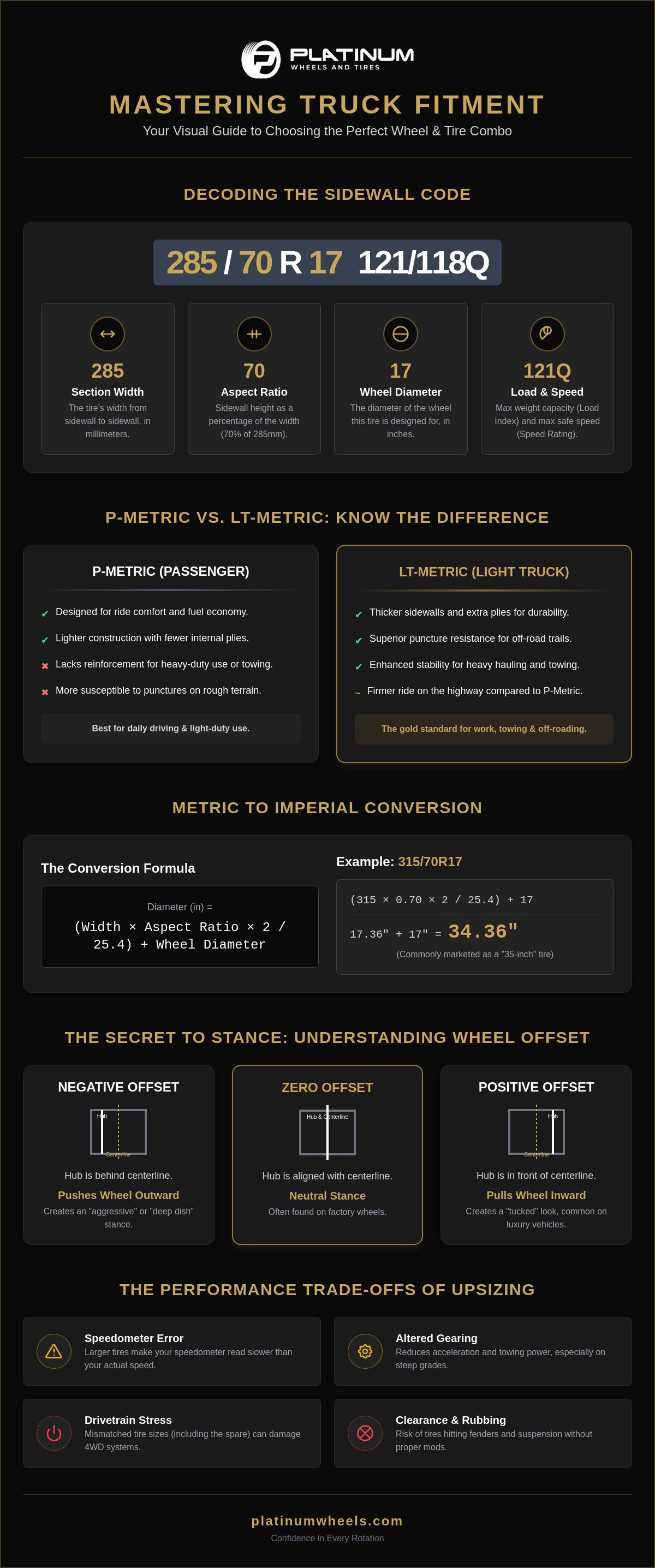
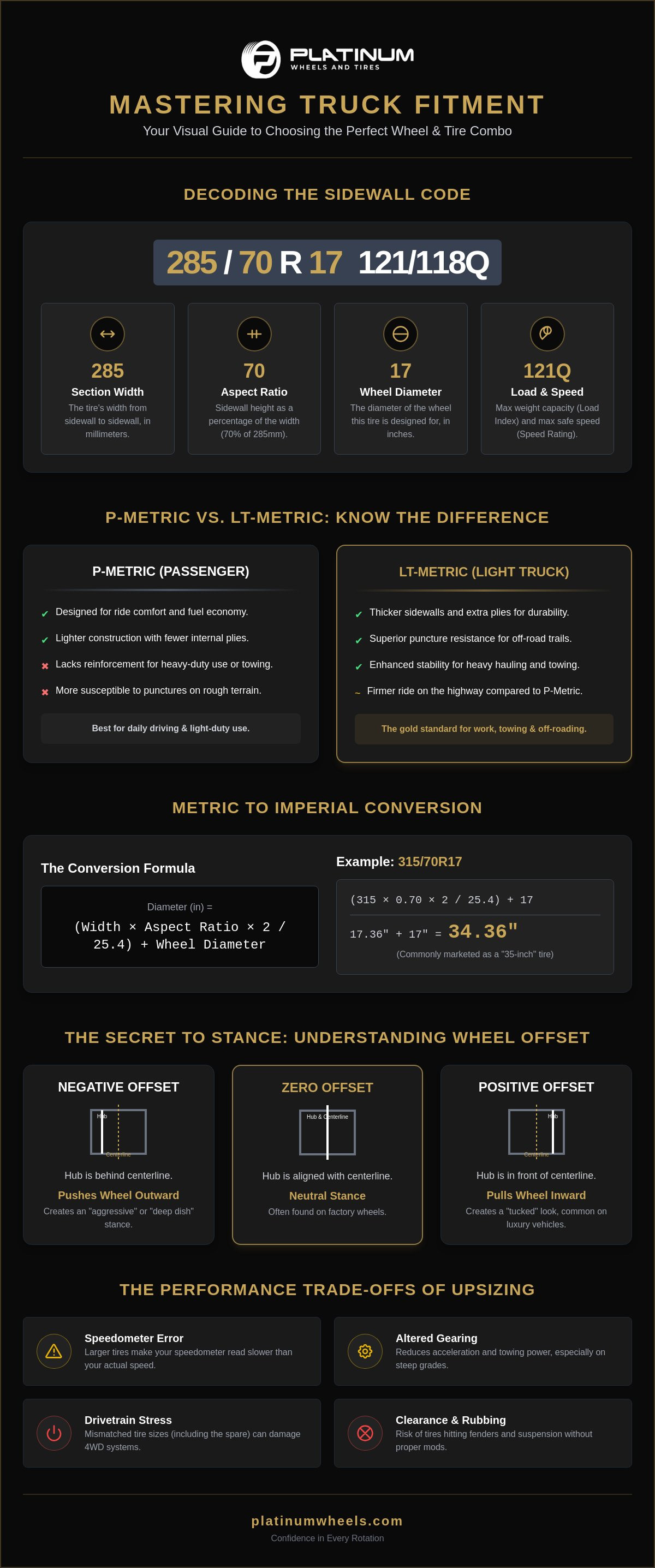
Take a common size like 285/70R17. The first number, 285, represents the width in millimeters. The second number, 70, is the aspect ratio. This is a percentage of the width rather than a fixed measurement, meaning the sidewall height is 70% of 285mm. The "R" stands for radial construction. This design dominates the market because it offers better heat dissipation and a more flexible sidewall than old bias-ply designs. You can explore the technical evolution of the Tire code system to see how these standards became universal. Finally, the 17 indicates the wheel diameter in inches, which is the only part of the metric code that uses imperial units.
LT-Metric vs. P-Metric for Trucks
Don't make the mistake of putting a P-Metric (Passenger) tire on a rig meant for serious work or play. P-Metric tires are designed for ride comfort and fuel economy, but they lack the internal reinforcement required for heavy-duty use. LT-Metric (Light Truck) tires are the gold standard for Colorado truck owners. They feature thicker sidewalls and extra plies to resist punctures on rocky trails. While an LT tire might feel slightly firmer on the highway, the trade-off in durability and towing stability is essential when you're hauling a trailer up a canyon. Using a wheel tire size calculator helps you see how switching between these types might affect your overall diameter and weight.
At the end of the size string, you'll find the load index and speed rating, such as 121/118Q. The load index is a numerical code that represents the maximum weight the tire can support. For off-road applications, pay close attention to this number; a higher index means the tire can handle the increased stress of airing down or carrying heavy gear. The speed rating letter indicates the maximum speed the tire can sustain safely. While you're unlikely to hit high speeds on a trail, a higher rating often suggests better overall construction and heat management during long highway hauls.
Metric vs. Imperial: Using a Wheel Tire Size Calculator Effectively
Choosing between metric and imperial sizing can feel like learning a second language on the fly. While most modern trucks roll off the lot with metric codes like 275/65R18, the aftermarket off-road world often speaks in "floatation" sizes measured in inches. Floatation sizes (inches) are standard for off-road tires because they emphasize total height and width for a better footprint on soft terrain. To bridge the gap between these two systems, you'll need a reliable wheel tire size calculator to ensure your new setup actually clears your wheel wells without a fight.
Converting Metric to Inches
If you're looking at a 315/70R17 tire and wondering if it qualifies as a 35-inch tire, you'll need to crunch some numbers. The standard formula for total tire diameter is: (Width x Aspect Ratio x 2 / 25.4) + Wheel Diameter. For that 315mm tire, the math looks like this: (315 x 0.70 x 2 / 25.4) + 17, which equals roughly 34.36 inches. It's a well-known industry reality that "35-inch" tires are rarely exactly 35 inches tall; most fall between 34.2 and 34.8 inches depending on the brand. For a faster way to verify these specs without the manual headache, using a tire height calculator provides instant results for any build you're planning.
Why Sizing Consistency Matters
Consistency isn't just about the aesthetic of your truck. It's about protecting your expensive drivetrain components. If you upgrade to a larger diameter but keep your factory-sized spare in the bed, you risk serious damage to your differential or 4WD system if you're ever forced to use it. Modern electronic lockers and traction control systems are incredibly sensitive to differences in wheel speed. Even a half-inch variance can trigger dash lights or cause mechanical binding on dry pavement. Always cross-reference your calculated math with the actual manufacturer specifications, as physical dimensions can vary between an all-terrain and a mud-terrain tire of the same listed size. Following NHTSA TireWise safety guidelines helps ensure your modifications remain safe for daily driving and heavy hauling across the Front Range. If you want to skip the math entirely, you can explore our pre-configured wheel and tire packages to find a setup that's already been tested for your specific rig.
Beyond the Numbers: Offset, Backspacing, and Clearance
A wheel tire size calculator is an excellent tool for understanding tire height, but it doesn't tell the whole story of how a setup actually fits your rig. While the math might say a 35-inch tire fits your wheel diameter, it can't predict if that tire will smash into your sway bar at full lock. Offset determines where the wheel sits in the wheel well. If you get this measurement wrong, you risk more than just an ugly stance; you risk mechanical interference that can shred a sidewall or snap a tie rod on a rough Colorado trail.
The Role of Wheel Offset
Wheel offset is the distance from the mounting surface to the wheel's true centerline. A negative offset pushes the wheel outward, away from the truck, which creates that aggressive "deep dish" look and a wider track. This is often necessary when you move to wider tires to keep the rubber from rubbing against the frame. However, pushing the wheels too far out can increase your scrub radius, leading to heavier steering and accelerated wear on your wheel bearings. To visualize how these changes impact your specific truck, you can use our wheel offset calculator to find the sweet spot between style and safety.
Backspacing and Suspension Clearance
Backspacing is measured from the mounting surface to the back edge of the wheel. It's the most critical measurement for ensuring your tires clear your suspension components, especially aftermarket upper control arms which are often thicker than factory parts. This measurement becomes even more vital when you are deciding between a leveling kit vs lift kit. A simple leveling kit might give you the height for a taller tire, but it won't change the suspension geometry enough to clear a wide tire with high backspacing.
Standards for these dimensions are set by The Tire and Rim Association to ensure compatibility across the industry. Even with these standards, every truck brand has its own quirks. A setup that clears easily on a Ram 1500 might require significant trimming on a GMC Sierra. When you're building a truck to handle the varied terrain of the Front Range, you need to account for how the tire moves when the suspension is fully compressed. Always verify your clearance in the driveway before you head out into the dirt.
Speedometer Error and Performance: The Real Cost of Upsizing
Every time you move up a tire size, you're fundamentally changing the physics of your truck. If you use a wheel tire size calculator to jump from a 31-inch factory tire to a 35-inch aftermarket setup, you're looking at a diameter increase of roughly 13%. This means when your speedometer shows 60 mph, you're actually traveling closer to 68 mph. That 8 mph gap is more than enough to land you a speeding ticket on I-25. Beyond the legal risks, larger rolling diameters increase your braking distance and put additional strain on your rotors, especially when descending steep mountain grades with a heavy load.
Don't overlook your tpms sensor setup during the swap. Changing tire volume and pressure requirements can trigger a permanent warning light if the sensors aren't properly synced or replaced for your 2026 model year truck. Maintaining these sensors is vital for safety, particularly given the Colorado Traction Law requirements for 3/16-inch tread depth during winter months. To get a setup that's already optimized for performance and clearance, shop our professional wheel and tire packages today.
Recalibrating Your Speedometer
Modern trucks rely on the ECU to manage everything from fuel maps to transmission behavior. When you change your tire diameter, the truck's computer still thinks it's turning the factory size. You'll need a programmer or flash tool to update the ECU with the new tire height. This isn't just about the speedometer; it's about your transmission. Larger tires change the shift points in automatic transmissions, which can lead to "gear hunting" or sluggish performance if the computer isn't recalibrated. You can verify your true speed by comparing your dash reading to a GPS-based speedometer app on a flat stretch of highway.
Gearing and Torque Loss
Adding larger tires increases rotational mass. Think of your new tires as heavy flywheels that your engine has to fight to get spinning. This added weight is why a truck on 35s can feel sluggish compared to its stock counterpart. If you're frequently commuting through the Denver foothills or towing up to the Eisenhower Tunnel, you'll feel this torque loss immediately. The engine has to work harder to maintain speed, which can cause your fuel economy to drop by several miles per gallon. If the performance drop is too significant, you may need to consider a re-gear to a higher ratio (like 4.56 or 4.88) to bring your engine back into its optimal power band. A wheel tire size calculator helps you determine exactly how much your effective gear ratio will change before you commit to the purchase.
Professional Fitment in Denver: Why Math Isn’t Everything
A wheel tire size calculator provides a solid theoretical foundation, but it cannot account for the physical nuances of your truck's wheel wells. While the math might suggest a specific 35-inch tire fits your rim, it won't tell you that a Chevy's squared-off fender arches are far less forgiving than the rounded openings on a Ford F-150. Every manufacturer uses different suspension geometries and liner materials that react uniquely when you push the limits of tire diameter. Relying solely on digital calculations often leads to unexpected rubbing during sharp turns or heavy compression.
For those chasing an aggressive stance, standard trimming techniques like the "NorCal Mod" are often necessary. This involves trimming or folding the metal at the back of the front wheel well to provide extra clearance for wide tires with negative offsets. When you are building a rig for the Front Range, you also have to consider the "ice factor." A tire that clears the fender by a quarter-inch in the summer will likely rip your plastic liner out once Colorado winter slush freezes into heavy blocks of ice inside your wheel wells. Choosing aftermarket wheel and tire packages from local experts ensures you have enough breathing room for seasonal buildup and off-road debris.
Real-World Clearance Issues
There is a massive difference between "street clearance" and "off-road articulation." You might be able to drive around a flat parking lot in Denver without a single sound, but the moment you take that truck onto a trail and the suspension flexes, that tire can slam into the top of the fender or the body mount. A wheel tire size calculator doesn't see your sway bars, brake lines, or upper control arms. Identifying rubbing at full lock is a task best handled by a professional eye that understands how a tire moves through its entire range of motion under load.
The Platinum Wheels Advantage
At Platinum Wheels, we verify your calculator results with decades of combined hands-on experience. We don't just mount tires; we ensure your setup is safe and optimized for the high-altitude demands of the Rockies. This includes performing high-speed road force balancing, which is essential for larger off-road tires to prevent steering wheel shimmy at highway speeds. Visit our experts in Aurora and Lakewood to discuss your build. We'll help you navigate the math and the metal to find a stance that looks incredible and performs flawlessly on every mountain pass.
Build Your Dream Truck with Confidence
Mastering the math behind your build is the only way to ensure your truck performs as well as it looks. By understanding how to read a sidewall and using a wheel tire size calculator to bridge the gap between metric and imperial sizing, you've taken the first step toward a rub-free fitment. Remember that while numbers provide the theory, real-world factors like wheel offset and suspension articulation determine how your rig actually handles a technical mountain trail or a snowy commute. Getting these details right saves you from the frustration of expensive mistakes and performance loss.
At Platinum Wheels, we've specialized in Denver truck fitment since 2026. Our team provides professional lift and leveling kit installations with deep expertise in leading brands like Nitto, Toyo, and Fuel Off-Road. We verify every calculation with hands-on experience to ensure your speedometer is accurate and your clearance is ready for the Rockies. Ready for a perfect fit? Contact Platinum Wheels in Denver for a custom quote today! We look forward to helping you get your rig dialed in and ready for the Front Range.
Frequently Asked Questions
Will a wheel tire size calculator tell me if my tires will rub?
A wheel tire size calculator provides the mathematical dimensions of a tire, but it cannot predict if your tires will rub against the fender or suspension. Rubbing depends on your truck's specific wheel well shape, suspension travel, and wheel offset. Digital tools are great for comparing sizes, but real-world fitment requires checking clearances at full steering lock and during suspension compression to avoid damage.
How much can I change my tire size without a lift kit?
Most modern trucks can handle a tire size increase of one to two inches in diameter without requiring a lift kit. For example, many stock rigs can move from a 31-inch to a 32-inch tire with zero issues. However, once you push past that two-inch mark, you'll likely experience rubbing on the frame. It's best to verify your specific model's clearance first.
What happens to my TPMS sensors if I change my wheel size?
Your TPMS sensors must be transferred to your new wheels or replaced with new sensors that are compatible with your truck's ECU. If you are upgrading to a 2026 model year truck, it is vital to verify that the sensors use the correct frequency to communicate with your dashboard. Failing to sync these properly will result in a persistent warning light and inaccurate pressure readings on your dash.
How do I calculate the height of a 285/70R17 tire?
To calculate the height of a 285/70R17 tire, you multiply the width (285) by the aspect ratio (0.70), multiply that by two, divide by 25.4 to convert to inches, and add the wheel diameter (17). This specific size works out to approximately 32.7 inches in total height. Using a wheel tire size calculator simplifies this math and allows you to compare it side-by-side with your factory specs for better fitment.
Does a wider tire affect my trucks performance in the snow?
Wider tires often perform worse in deep snow because they tend to "float" on top of the surface rather than cutting through to reach the pavement. For Colorado winters, a slightly narrower tire often provides better traction and compliance with the state's Traction Law. If you choose a wide setup, ensure the rubber compound is specifically rated for freezing temperatures and maintain at least 3/16-inch of tread depth for safety.
Can I put 35-inch tires on a stock F-150 with just a leveling kit?
You can fit 35-inch tires on a stock F-150 with a leveling kit, but it usually requires a wheel with a specific offset to avoid the crash bars. Most owners find that a +18 or +20 offset works best for this setup. While it looks great, be prepared for minor plastic trimming inside the wheel well to prevent rubbing when you're backing out of a driveway or turning sharply.
Why is my speedometer wrong after getting new wheels and tires?
Your speedometer is wrong because it calculates speed based on the number of tire rotations, and a larger diameter tire covers more ground with each turn. If you've increased your tire height by 10%, your speedometer will read roughly 10% slower than your actual speed. You'll need to use a programmer to update your truck's computer. It's a necessary update for safety.
What is the difference between wheel offset and backspacing?
Wheel offset is the distance from the mounting surface to the true centerline of the wheel, while backspacing is the distance from the mounting surface to the back edge of the rim. Offset determines where the tire sits in relation to the fender, but backspacing ensures your tire won't hit your suspension components. Both are essential for a perfect stance. Precision matters here.