How to Measure Wheel Offset: The Ultimate Guide for Truck Owners (2026)
You finally saved up for those deep-dish rims, bolted them on, and headed toward the local trails, only to hear the gut-wrenching sound of rubber shredding against your fender flares on the first sharp turn. It's a frustrating reality for many of the 70% of off-roaders who upgrade their wheels; especially when you realize that "looking cool" doesn't always mean "fitting right." If you're struggling to understand how to measure wheel offset without getting a headache, you aren't alone. Most truck owners find themselves caught between the confusion of backspacing and the fear of buying a custom set that simply doesn't clear the brake calipers or the bodywork.
We know you want an aggressive stance that performs as well on a weekend crawl as it does on the highway. This guide will help you master the technical math behind wheel fitment so your custom truck wheels look perfect and perform safely on Colorado's demanding terrain. You'll learn how to get a clear measurement in millimeters and understand exactly how these changes affect your truck's mechanical footprint. We'll walk through the specific tools needed to simulate fitment, ensuring your new setup stays within Colorado's legal height and tire protrusion limits while providing the confidence you need to order your next package.
Key Takeaways
- Identify the mechanical difference between positive and negative offset to achieve your ideal stance without risking fender rub on tight turns.
- Master the step-by-step process of how to measure wheel offset using simple tools like a straight edge and measuring tape before you commit to a purchase.
- Decode the relationship between backspacing and offset to ensure your new rims clear brake calipers and suspension components with professional precision.
- Protect your truck's longevity by calculating a fitment that prevents accelerated wear on wheel bearings and ball joints during rugged Colorado trail runs.
- Gain the technical confidence to order a custom wheel and tire package that balances aggressive aesthetics with local safety and legal requirements.
Understanding Wheel Offset: Positive, Negative, and Zero Explained
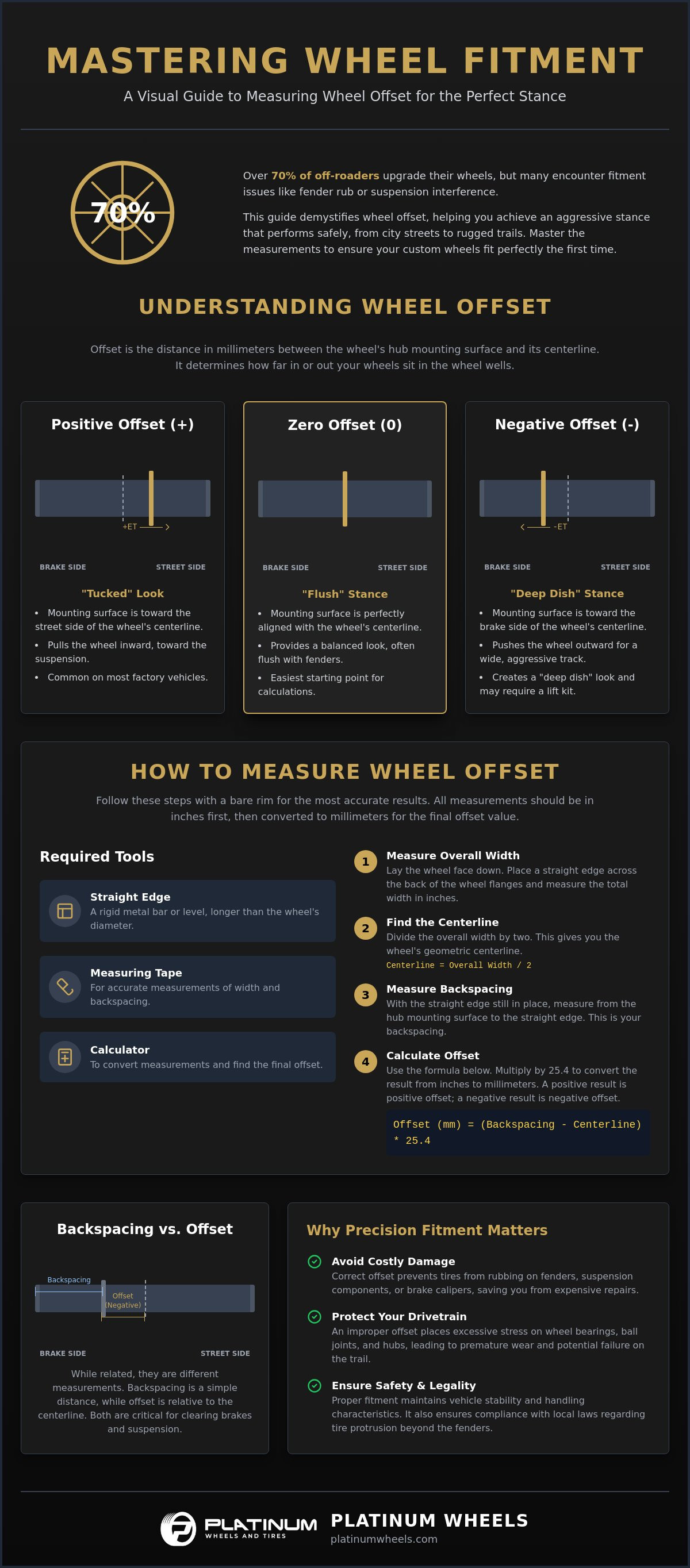
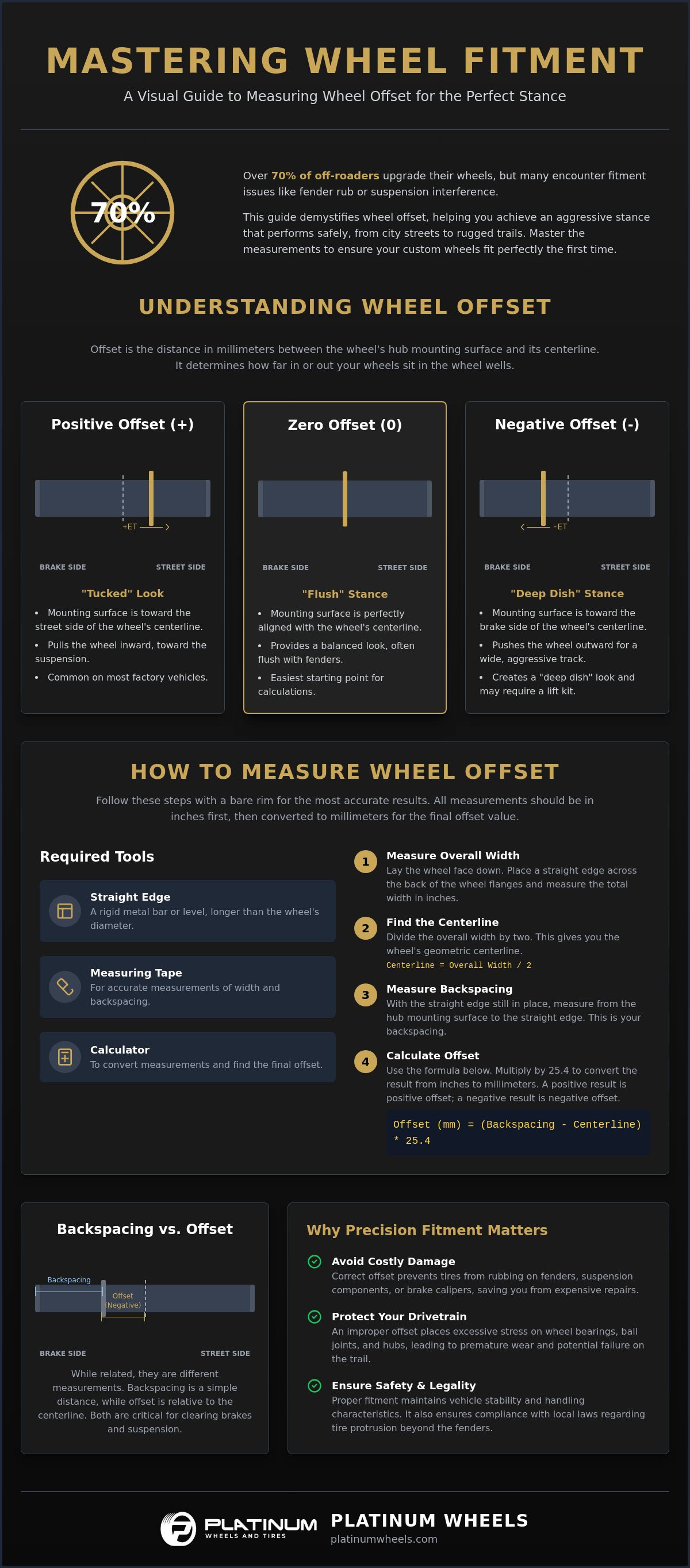
Offset isn't just a technical spec; it's the DNA of your truck's stance. It defines the distance between the hub mounting surface and the wheel's mathematical centerline. Getting this right is the difference between a truck that looks ready for a magazine cover and one that can't pull out of the driveway without crunching a fender. Even though we use inches for wheel diameter and width here in the States, offset is universally measured in millimeters. This metric precision allows for the fine-tuning required to clear massive brake calipers or avoid hitting suspension components. Understanding Wheel Offset is essential because it dictates where the tire sits in relation to the wheel well. If you are learning how to measure wheel offset, start by visualizing where that mounting plate sits inside the barrel.
Positive Offset: The "Tucked" Look
In a positive offset setup, the mounting surface sits toward the street side (front) of the wheel. This pulls the entire assembly inward toward the frame. Most modern stock trucks come from the factory with a high positive offset. This design helps with fuel efficiency and keeps road spray contained within the wheel wells. While this looks clean, pushing too far positive with wider tires often causes rubbing on inner suspension parts or steering knuckles. It's a common hurdle for owners trying to fit beefy all-terrain tires on factory rims without using spacers.
Negative Offset: The "Deep Dish" Stance
Negative offset moves the mounting surface toward the brake side (back) of the wheel. This pushes the wheel outward, creating that wide, aggressive track that off-roaders love. It provides more stability on uneven Colorado trails and allows for that "deep dish" aesthetic where the spokes are recessed far into the rim. Negative offset increases the "poke" of the tire beyond the fender. This often requires a lift kit or leveling kit to prevent the tire from catching the edge of the fender during suspension compression. It's the go-to choice for that wide-body, rugged look.
Zero Offset: The Perfect Balance
With zero offset, the hub mounting surface is perfectly aligned with the wheel's centerline. This is the "Goldilocks" zone for many leveled trucks in our community. It typically results in a flush look where the tire sits even with the fender flare. For enthusiasts learning how to measure wheel offset, zero offset is the easiest starting point for calculations because it splits the wheel width exactly in half. It offers a balanced look that provides enough clearance for most aftermarket suspension upgrades without the extreme leverage and stresses of a deep negative setup on your wheel bearings.
Tools and Preparation for Measuring Your Wheels at Home
Precision requires the right environment. Measuring offset isn't just about grabbing a tape measure; it's about data integrity. To learn how to measure wheel offset accurately, you need a workspace that eliminates variables. Start by gathering a rigid straight edge that's longer than your wheel diameter, a reliable measuring tape, and a calculator. You also need a wire brush. Scrubbing the hub mounting surface is a non-negotiable step. Even a millimeter of caked-on mud or corrosion can skew your numbers, leading to a fitment disaster later. A clean surface ensures your straight edge sits perfectly flush against the wheel's mounting plate.
Ideally, you should measure a bare rim. If you are measuring a wheel with a tire already mounted, you have to compensate for the tire's bulge. Place your straight edge across the tire sidewalls, but remember this adds width that isn't part of the actual wheel spec. This is where understanding The Crucial Difference Between Backspacing and Offset becomes vital. Your measurements will change based on where you place your reference points, and knowing how to adjust for the tire's "section width" is the only way to avoid buying rims that rub your control arms.
The "Straight Edge" Requirement
Use a metal level or a rigid steel bar for this task. A wooden yardstick might seem convenient, but wood can bow or warp, especially if it’s been sitting in a damp Colorado garage. Position your straight edge across the inboard flange of the rim. Ensure it sits flat against the metal lips, avoiding any areas with curb rash or bends. If your rim has significant lip damage, rotate the wheel and measure from a clean section to maintain accuracy. The goal is a perfectly horizontal reference line that doesn't wiggle when you apply pressure with the tape measure.
Safety and Vehicle Stability in the Driveway
Safety is paramount when you're working under a heavy rig. Park on a perfectly level concrete surface. Asphalt can get soft in the summer heat, and a jack can sink. If you're working during a typical Denver winter, clear every bit of ice and snow from your workspace. A slick driveway is a recipe for a sliding jack. Always use heavy-duty jack stands once the truck is in the air. Never rely on the floor jack alone while you're reaching behind the wheel. Use wheel chocks on the opposite end of the truck to prevent it from rolling while the weight is shifted.
If this process feels a bit too technical for a weekend DIY project, our team can help you select a pre-configured wheel and tire package that is guaranteed to fit your specific build without the guesswork.
How to Measure Wheel Offset: A Step-by-Step Guide
Now that your workspace is safe and your tools are ready, it's time to crunch the numbers. Many truck owners feel intimidated by the math, but the process is straightforward if you follow a logical sequence. The most important thing to remember is that you're looking for a specific relationship between the wheel's center and its mounting point. Accuracy here prevents your tires from rubbing against the frame or sticking out so far that they become a liability on narrow mountain passes. Follow these steps to learn how to measure wheel offset with professional precision.
Step 1: Finding Your Total Wheel Width
Lay your wheel flat on a clean surface with the back side facing up. Measure the total distance from the very front edge to the very back edge of the rim. A common mistake is using the "advertised width" found on the manufacturer's box. If you bought a 10-inch wide wheel, that number only measures the distance between the tire beads. The total width includes the thickness of the rim lips, which are usually about 0.5 inches per side. For a 10-inch wheel, your actual measurement from flange to flange will likely be 11 inches. Always measure the metal rim itself; never take this measurement from the tire sidewall, as the rubber bulge will give you a false reading.
Step 2: Calculating the Centerline
The centerline is the exact midpoint of the total rim width. This number acts as the "zero point" for all your subsequent offset math. To find it, simply take your total width from Step 1 and divide it by two. For example, if your 10-inch wide wheel has a total physical width of 11 inches, your centerline is exactly 5.5 inches. Keep this number handy, as it represents where the mounting surface would sit if the wheel had zero offset.
Step 3: Measuring Backspacing and Final Calculation
Place your straight edge across the back of the wheel. Measure the distance from the hub mounting pad (the part that touches the truck) up to the bottom of the straight edge. This measurement is your backspacing. To determine the offset, subtract the centerline from the backspacing. If your backspacing is 4.5 inches and your centerline is 5.5 inches, you have -1 inch of offset. Since the industry uses the metric system for this spec, multiply your result by 25.4 to convert it to millimeters. In this case, -1 inch becomes a -25.4mm offset.
Once you've mastered how to measure wheel offset, you can use that data to select the right tires for your build. If you're planning on running oversized rubber, check out our Tire Height Calculator: The Ultimate Guide to Truck Tire Fitment to ensure your new stance doesn't cause clearance issues when the suspension cycles. Precision in these early steps ensures your truck remains capable and safe on the road.
The Crucial Difference Between Backspacing and Offset
While they describe the same physical space, backspacing and offset are like two different languages for the same destination. Backspacing measures the total distance from the wheel's inboard edge to the mounting hub surface. It is an absolute linear measurement. Offset, however, is a relative calculation based on the wheel's centerline. If you've been practicing how to measure wheel offset, you've likely realized that changing the wheel width changes the offset, even if the backspacing stays exactly the same. Custom wheel manufacturers prioritize offset because it dictates the rim's face profile and design. To understand the industrial processes behind such specialized components, you can explore Contract Manufacturing and OEM Assembly Services. Suspension companies live by backspacing because they need to know if the rim will physically clear the steering knuckles and control arms. These two numbers work together to determine if your setup is mechanically sound.
Why Suspension Lifts Care About Backspacing
Most high-quality lift kits for Ford or Chevy trucks include beefier, oversized steering knuckles. These upgraded components take up more room inside the wheel barrel. If you have too much backspacing, the inner lip of your rim will grind against the knuckle or the upper control arm. This is why checking your specific lift kit manual is the first step before you start measuring. Many 6-inch lifts require a maximum backspacing of 4.5 or 5 inches to function safely. If you ignore this spec while learning how to measure wheel offset, even a perfectly measured offset won't save you from a mechanical failure on a rocky trail.
Why Aesthetics Care About Offset
Offset is the primary factor that dictates your truck's stance. It determines exactly how far the tire pokes out or tucks under the fender flare. Beyond just looks, offset impacts your scrub radius, which is the distance between the steering axis and the center of the tire’s contact patch. If you move too far into a deep negative offset, you'll feel more feedback through the steering wheel and increased difficulty when turning at low speeds. For a deep dive into how these choices affect your rig's performance in the Mile High City, check out our Custom Wheels and Rims: The Ultimate Denver Truck Owner’s Guide (2026). Once you understand these values, you can find your next set of off-road rims with total confidence.
Why Precision Fitment Matters for Colorado Off-Roading
"Close enough" is a dangerous phrase when you're 10,000 feet up a mountain pass. While a slight measurement error might go unnoticed in a flat parking lot, the Rocky Mountains will expose every flaw in your fitment. If you've spent time learning how to measure wheel offset, you know it's a game of millimeters. In Colorado, these tiny increments determine whether your truck survives a weekend in the backcountry or ends up on a flatbed. Precision isn't just about aesthetics; it's about mechanical survival on the trail.
Improper offset creates an unintended lever arm that puts massive lateral stress on your wheel bearings and ball joints. This leads to accelerated wear and expensive premature failures. When you're articulating your suspension on technical trails near Golden or Boulder, that precision becomes even more critical. A wheel that clears while sitting flat in your driveway might shred a fender flare or slice a sidewall the moment your suspension fully flexes over a rock. You need to account for the entire range of motion, not just the static stance.
Protecting Your Suspension on Rugged Terrain
Heavy mud-terrain tires already tax your steering components more than factory rubber. Adding the wrong offset amplifies this stress by changing the steering geometry. There's also the "poke" factor to consider. While an aggressive stance looks great, excessive tire protrusion is a magnet for road debris. On Colorado highways, tires that stick out too far will kick up rocks, sandblasting your own paint and potentially violating local regulations regarding fender coverage. For a truly healthy setup, ensure your electronics are as dialed in as your mechanicals by reviewing our TPMS Sensor Guide: Avoiding the Dash Light Headache in 2026.
Professional Fitment Services in Denver
At Platinum Wheels, we believe in doing it right the first time. We use specialized fitment tools that simulate the exact dimensions of your desired wheel and tire package before you commit to a purchase. This eliminates the guesswork and anxiety that often comes with learning how to measure wheel offset on your own. Seeing these packages in person at our local shop allows you to judge the stance and clearance with your own eyes before they are mounted to your rig.
If you're a resident of Denver, Aurora, or Lakewood, don't leave your fitment to chance. Stop by for a professional consultation. Our team will double-check your math, verify your clearance, and ensure your custom truck wheels are ready for the highest peaks and the toughest trails in the state.
Master Your Fitment Before Your Next Colorado Adventure
Building a truck that handles the rugged demands of the Front Range requires more than just picking a stylish set of rims. It requires a commitment to precision. By mastering how to measure wheel offset, you've taken the most important step in protecting your suspension and ensuring your rig is trail-ready. You now understand that the relationship between backspacing and the wheel centerline is the foundation of a safe, high-performance stance. This technical knowledge prevents the frustration of shredded fenders and the expense of premature bearing failure when you're miles away from the nearest paved road.
If you're ready to turn those measurements into reality, we're here to help. We specialize in Colorado-ready off-road setups and provide expert installation for all major truck brands. Located in the heart of the Front Range, our team understands the specific environmental demands of our local trails. Browse Our Custom Wheel and Tire Packages today to find a setup that balances aggressive aesthetics with mechanical integrity. Take the guesswork out of your build and get back to what matters most; exploring the high country with total confidence in your equipment.
Frequently Asked Questions
Can I measure wheel offset with the tires still on the rims?
You can measure wheel offset with tires mounted, but it requires extra steps to account for the tire's section width. Place your straight edge across the tire sidewalls and measure to the hub, then subtract the tire's bulge from the total width to find the rim's actual edge. For the most accurate data on how to measure wheel offset, we recommend measuring a bare rim whenever possible to eliminate the variables of rubber expansion.
Is a negative offset better for off-roading in Colorado?
Negative offset is popular for Colorado off-roading because it widens your truck's track, providing better stability on off-camber trails. This wider stance helps prevent rollovers on technical terrain, but it also increases the leverage on your wheel bearings. Balance is key; an extreme negative offset might look great, but it can make narrow, wooded trails more difficult to navigate without clipping trees or rocks during a weekend crawl.
How does wheel offset affect my truck’s TPMS sensors?
Wheel offset does not directly impact the functionality of your TPMS sensors, as they measure internal air pressure regardless of where the hub sits. However, the physical design of a high-offset wheel might require specific valve stem angles to ensure the sensor clears the brake caliper. Always verify that your new wheel and tire package includes compatible TPMS sensors that fit the specific barrel shape and depth of your chosen custom rims.
What happens if I choose the wrong offset for my lift kit?
Choosing the wrong offset can cause your tires to rub against the suspension's upper control arms or the frame during tight turns. This is especially common with lift kits that use oversized steering knuckles. If the offset is too high (positive), the wheel sits too far inward. If it's too low (negative), the tire might strike the fender flare or bumper when the suspension compresses on a rugged Colorado trail.
Why is wheel offset measured in millimeters instead of inches?
Millimeters are the global industry standard for offset because they allow for much finer adjustments than the imperial system. Since a single millimeter can be the difference between clearing a brake caliper and hitting it, the metric system provides the precision manufacturers need. Even on American trucks that use inches for wheel diameter, you'll still need to use metric math when learning how to measure wheel offset for aftermarket rims.
Do I need fender flares if I have a high negative offset?
You likely need fender flares if your tires extend beyond the bodywork, as Colorado law requires tires to be covered to prevent debris from hitting other vehicles. Beyond legal compliance, flares protect your truck's paint from the rocks and mud kicked up by an aggressive negative offset. Without them, your tires will act like sandblasters, peppering your door panels with gravel every time you leave the pavement for the mountains. For our Australian readers looking to protect their home's outdoor spaces from the elements, you can visit QLD Shade to find the best patio blind solutions for your deck or veranda.
Will changing my wheel offset void my vehicle warranty?
Changing your offset won't void your entire vehicle warranty, but a dealership may deny claims for related components like wheel bearings or ball joints. Under the Magnuson-Moss Warranty Act, a manufacturer must prove that the aftermarket modification directly caused the failure. Because extreme offsets increase stress on the drivetrain, it's a common point of contention during service visits for suspension-related issues or premature wear on steering components.
What is the difference between hub-centric and lug-centric wheels?
Hub-centric wheels rely on the center hole of the rim to fit perfectly over the axle hub, which supports the vehicle's weight. Lug-centric wheels use the tapered lug nuts to center the wheel on the studs. For heavy trucks and off-road use, hub-centric designs are superior because they reduce vibration and stress on the lug studs. This ensures a more stable connection during high-impact driving on the demanding terrain found throughout the Front Range.