Best Silverado Lift Kits for Denver Off-Roading
A Silverado lift isn't just about height; it's about calibrating suspension geometry to handle Colorado's diverse elevation and terrain changes. Many Denver truck owners crave that aggressive stance but hesitate because they don't want to sacrifice factory ride quality or deal with annoying tire rub on tight mountain trails. You've likely felt that tension between wanting a truck that dominates the off-road landscape and needing a daily driver that handles the commute on I-25 with precision. It's a common concern, and you're right to prioritize both performance and comfort before making a major modification.
In this guide, you'll master the technical and aesthetic choices of selecting a silverado lift kit to achieve the perfect balance of off-road capability and Denver street style. We'll demystify the confusion between leveling and lift kits while showing you how to clear 35-inch tires without compromising your suspension components. We are going to explore the best setups for the Front Range, ensuring your Chevy looks bold and performs reliably from the local job site to the remote trailhead. By the end, you'll have the confidence to choose a system that delivers a smooth ride and superior ground clearance.
Key Takeaways
- Learn how to balance off-road performance with factory ride quality by selecting a suspension system that respects your truck's original geometry.
- Identify the best silverado lift kit for your specific 1500 or Heavy Duty model to ensure perfect component fitment and reliable performance.
- Compare lift heights from 2 to 6 inches to find the ideal setup for clearing 35-inch tires while still fitting into Denver parking garages.
- Understand the relationship between wheel offsets, tire width, and steering feel to prevent rubbing on technical Colorado trails.
- See why professional installation and precision alignment are essential for maintaining safety and tire longevity across the Front Range.
Understanding Silverado Lift Kits: Performance vs. Aesthetics
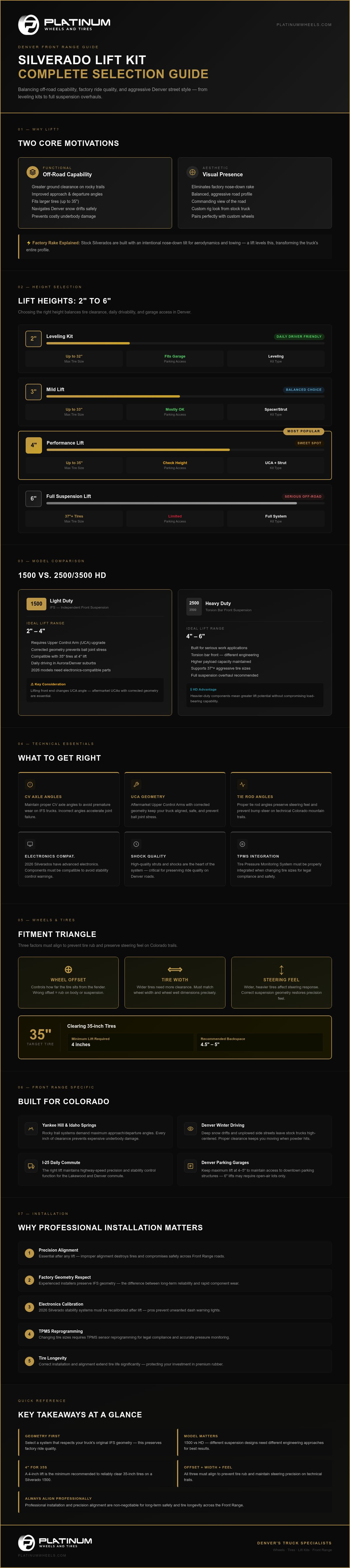
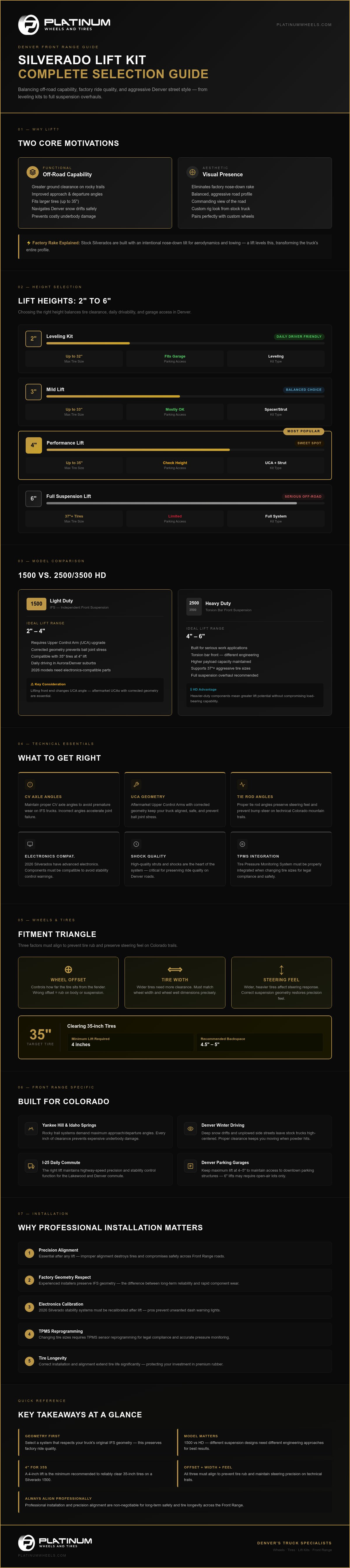
Choosing a silverado lift kit is the first step toward transforming your Chevy from a standard commuter into a mountain-ready machine. While the factory suspension is designed for general utility and comfort, it often leaves the truck with a nose-down factory rake. This intentional tilt helps with aerodynamics and towing, but it limits your ability to tackle rougher terrain or fit the aggressive tire setups required for serious exploring. A silverado lift kit is a suspension modification that increases frame height for off-road clearance.
The primary motivations for lifting your Silverado usually fall into two categories: functional capability and visual presence. On the functional side, you gain significant ground clearance and the ability to mount larger tires. From an aesthetic perspective, you achieve that commanding view of the road and a balanced, aggressive profile that stands out on Denver streets. It is about more than just looking tough; it is about making sure your truck can handle the diverse environments of the Front Range. Whether you are aiming for a subtle leveling or a full suspension overhaul, the goal is a cohesive build that performs as well as it looks.
Clearance for Colorado Trails
If you have ever driven up to Yankee Hill or explored the trails near Idaho Springs, you know that every inch of clearance matters. Extra height prevents expensive underbody damage on rocky trails by keeping your vitals away from jagged obstacles. Proper lift kits improve your approach and departure angles, allowing you to climb steep grades or exit deep washouts without scraping your bumpers. In Denver, this clearance is just as vital during winter. It helps you navigate deep snow drifts and unplowed side streets that leave stock trucks high-centered, ensuring you never get stuck when the powder starts to pile up.
The Aesthetic Evolution: From Work Truck to Custom Rig
Visually, the most immediate change is the removal of the factory rake. By leveling the front end with the rear, you eliminate the hunched-over work truck look. This simple shift changes the vehicle's entire profile, giving it a more purposeful and custom presence on the road. Achieving the Platinum look requires a balanced suspension setup that does not just add height, but maintains the truck's proportions. It turns a mass-produced vehicle into a personalized rig that reflects the rugged lifestyle of the Colorado outdoors. When paired with the right custom wheels and rims, your Silverado transitions from a standard utility vehicle into a statement of expert craftsmanship.
Suspension Options for Every Silverado Model
Not all Silverados are built the same; your suspension choice shouldn't be either. The light-duty 1500 and the heavy-duty 2500/3500 require different engineering approaches to achieve the best results. Every modern Silverado relies on Independent Front Suspension (IFS). This setup provides the smooth, car-like handling Chevy is known for, but it complicates the lifting process compared to old-school solid axle trucks. When you install a silverado lift kit, you must maintain proper CV axle and tie rod angles to avoid premature wear. High-quality struts and shocks aren't just accessories; they are the heart of the system that preserves your ride quality on the rough pavement of Lakewood and Denver.
Newer 2026 models continue to refine suspension geometry with advanced electronics and tighter tolerances. This means your lift components must be precisely engineered to avoid triggering dashboard warning lights or compromising stability control systems. Whether you're driving a brand-new rig or a seasoned high-mileage truck, selecting components that respect these factory specifications is the only way to ensure long-term reliability on the road.
Lifting the Silverado 1500
Most 1500 owners opt for 2-inch to 4-inch systems. These heights provide enough clearance for larger tires while keeping the truck practical for daily errands in Aurora. A critical detail many overlook is the Upper Control Arm (UCA). Lifting the front end changes the UCA angle, which can stress ball joints and limit suspension travel. Upgrading to aftermarket UCAs with corrected geometry ensures your truck stays aligned and safe. If you're unsure which height fits your garage and lifestyle, exploring professional wheel and tire packages can help you visualize the final stance of your build.
HD Solutions: 2500 and 3500 Upgrades
The HD series is built for serious work. These trucks often use torsion bar front suspensions, which require specialized re-indexed keys or full drop-bracket kits to gain height without ruining the ride. Components for these rigs are significantly beefier to handle massive towing and hauling loads. You don't want to sacrifice your truck's ability to pull a horse trailer or a camper just for an aggressive look. A properly designed silverado lift kit for the 2500 or 3500 platform maintains the heavy-duty spring rates and load capacities you rely on, ensuring your truck remains a capable workhorse from the job site to the high country.
Selecting the Right Lift Height: 2 to 6 Inches
Picking the right height for your silverado lift kit is a game of compromise between trail capability and urban utility. While a massive 6-inch lift looks undeniable on the road, it comes with practical trade-offs that every Colorado driver should consider. Taller lifts increase wind resistance, which naturally impacts fuel economy during long hauls up I-70. More importantly, you must measure your garage. Many residential garages in Lakewood and commercial decks in downtown Denver have clearances as low as 6 feet 8 inches. A 6-inch lift paired with 35-inch tires can easily push your Chevy past that limit, turning a simple parking maneuver into an expensive mistake.
For most Colorado truck owners, the 3 to 4-inch range is the sweet spot. This height provides enough room to clear 35-inch tires with minimal trimming while maintaining a center of gravity that feels stable on winding mountain passes. It offers a significant boost in ground clearance for rocky obstacles without making the truck feel cumbersome in traffic. Use the table below to compare how different heights impact your build's performance and tire fitment.
| Lift Height | Max Tire Size | Driveability Focus |
|---|---|---|
| 2-Inch (Level) | 33-inch | Daily Commuting & Light Trails |
| 3-4 Inch (Mid) | 35-inch | Balanced Off-Road & Street Stance |
| 6-Inch (Full) | 35-37 inch | Maximum Trail Clearance & Presence |
The 2-Inch Leveling Kit Solution
Deciding between a leveling kit vs lift kit is often the first hurdle for Silverado owners. A 2-inch leveling kit is a cost-effective way to fix the factory rake and fit 33-inch tires while retaining your factory shocks. It's the perfect choice if you want a cleaner look without a major mechanical overhaul. However, the gains are mostly aesthetic. You won't get the significant underbody clearance needed for technical rock crawling, and it lacks the aggressive "big truck" profile that a full silverado lift kit provides.
The 4-6 Inch Enthusiast Lifts
If your weekends involve exploring the deep backwoods of the High Country, a 4 to 6-inch lift is the enthusiast's choice. These systems are comprehensive, often requiring drop brackets for the differential and extended brake lines to accommodate the increased travel. This height is necessary if you plan to run 35-inch or 37-inch tires for maximum traction in deep snow or mud. Choose a 6-inch lift if you prioritize trail dominance and want the ultimate custom rig, but be prepared for the added responsibility of managing a much taller vehicle in tight urban spaces.
The Perfect Match: Wheels, Tires, and TPMS Integration
Installing a silverado lift kit is only half the battle. To truly finish the build and ensure your truck performs as well as it looks, you need custom wheels and rims that complement your new height. When you change your wheel width or tire size, you alter the scrub radius. This is the distance between the center of the tire's contact patch and the point where the steering axis intersects the ground. If this measurement gets too far out of spec, your steering can feel heavy or unpredictable on the highway. Don't overlook the electronics, either. A professional build includes tpms sensor recalibration so your dashboard stays clear of warning lights while you're exploring the Front Range.
Choosing the right offroad tires and wheels requires a holistic approach. You want a setup that provides maximum traction on rocky trails without creating a "rub" every time you turn into a parking spot. It's about precision fitment that respects the geometry of your new suspension. If you're ready to see how the right combination transforms your truck, you can browse our complete wheel and tire packages to find the perfect match for your Silverado.
Fitting 33s and 35s on Your Silverado
The "magic number" for fitment depends entirely on your lift height. If you're running a 2-inch level, 33-inch tires are generally the limit. Once you move into a 4-inch or 6-inch silverado lift kit, 35-inch tires become the gold standard for Colorado trail performance. These larger tires offer a massive footprint for airing down on technical terrain and provide the sidewall height needed to protect your rims from jagged rocks. Remember that tire width is just as important as height. A 12.5-inch wide tire might clear the top of the wheel well but could still rub the inner liner during a full-lock turn if the wheel offset isn't dialed in correctly.
Offset and Backspacing Essentials
Offset determines where the wheel sits relative to the hub. A positive offset keeps the tire tucked closer to the body, while a negative offset pushes the wheel outward for a wider, more aggressive stance. Backspacing is the measurement from the mounting surface to the back edge of the wheel. This is critical because if the backspacing is too deep, your tires will hit your control arms or struts. Achieving that perfect "flush" or "poke" look safely requires balancing these two measurements. We ensure your wheels have enough clearance to move through their full range of motion without making contact with your expensive suspension components.
Professional Silverado Lift Installation in Denver
A professional installation is non-negotiable when you're modifying a vehicle as heavy and complex as a modern Chevy. While the idea of a weekend project is tempting, a silverado lift kit fundamentally changes how your truck interacts with the road. At Platinum Wheels, we take a precision-first approach to every build. This includes a comprehensive suspension alignment and a rigorous torque-check of every bolt to ensure your truck handles predictably on I-25 or while climbing toward a high-altitude trailhead. We serve the entire Colorado Front Range, from the foothills of Boulder to the growing communities in Castle Rock, providing the expert craftsmanship your Silverado deserves.
Your journey doesn't end the moment you drive out of our shop. Proper post-installation care is vital for the longevity of your new components. We recommend a follow-up inspection after your first 500 miles of driving. Suspension parts naturally settle as they move through their range of motion, and a quick re-torque ensures that everything remains seated correctly. This proactive step prevents hardware from loosening and protects your investment before you head out for a heavy weekend of off-roading.
The Dangers of DIY Suspension Work
Attempting a suspension overhaul without professional tools often leads to improper geometry, which can trigger the dreaded 'death wobble' or cause your expensive tires to wear out prematurely. Newer Silverados feature complex electronic steering racks that require precise calibration after any height change. Without the right diagnostic equipment, you risk steering feedback issues or dashboard warning lights that are difficult to clear. Professional lifts and heavy-duty jacks are required to keep the frame stable and level during the process, ensuring that every component is seated without being under unnecessary tension.
Customizing Your Build at Platinum Wheels
Our process starts with a consultative approach. We listen to your specific goals for the truck before we ever turn a wrench. Whether you need a silverado lift kit for a rig that can navigate tight trails near Thorton or a daily driver that looks aggressive in Aurora, we help you select the right components for your lifestyle. We don't believe in high-pressure sales; we believe in being a trusted local advisor. Every final check we perform is designed to ensure your Silverado is ready for the I-70 climb or a remote weekend trail. You can trust our team to deliver a ready-to-drive experience that prioritizes your safety and your truck's performance.
Dominate the Front Range with Your Custom Silverado
Transforming your Chevy into a mountain-ready powerhouse requires more than just picking the tallest components. You've learned how to balance suspension geometry with the practical demands of Denver parking garages and high-altitude climbs. Whether you choose a subtle level for a cleaner profile or a full 6-inch silverado lift kit for maximum trail dominance, the secret lies in the details of wheel offset and professional calibration. A well-built truck doesn't just look aggressive; it provides the peace of mind needed to tackle the most remote Colorado trails without hesitation.
Our team specializes in truck and SUV suspension, ensuring every build handles the Front Range with precision. From complete wheel and tire packages with seamless TPMS integration to expert installation that keeps your ride smooth on I-25, we are here to guide your project from start to finish. Ready to elevate your rig? Schedule your Silverado lift kit consultation at Platinum Wheels today! We look forward to helping you build a truck that stands out in the city and performs flawlessly in the high country. See you out on the trails.
Frequently Asked Questions
Will a lift kit void my Chevy Silverado warranty?
A lift kit does not automatically void your entire vehicle warranty. Under the Magnuson-Moss Warranty Act, a manufacturer can only deny a warranty claim if they prove the aftermarket part caused the specific failure. If a suspension component fails because of the lift, that specific repair won't be covered, but your engine or electronics warranties remain intact. We recommend discussing your plans with your local Denver or Aurora Chevy dealer to understand their specific policies.
What is the difference between a leveling kit and a lift kit for a Silverado?
The primary difference lies in how they change your truck's stance and height. A leveling kit only raises the front end of your Silverado to match the rear, effectively removing the factory nose-down rake. In contrast, a silverado lift kit increases the height of both the front and rear of the vehicle. While leveling kits are great for aesthetics and 33-inch tires, full lift kits provide the ground clearance necessary for technical Colorado trails.
Can I fit 35-inch tires on a Silverado with just a leveling kit?
Fitting 35-inch tires on a Silverado with just a leveling kit usually requires significant trimming of the inner fender liners and potentially the metal NorCal tuck. Without these modifications, you will experience heavy rubbing when turning or during suspension compression on rough trails near Golden or Boulder. For a clean, rub-free fitment with 35-inch tires, we generally recommend moving up to a 4-inch or 6-inch suspension system that provides proper clearance.
How much does it cost to install a lift kit on a Silverado in Denver?
Installation costs vary based on the complexity of the kit and the specific model of your truck. A simple leveling kit requires less labor than a full 6-inch suspension system that involves drop brackets and differential spacers. Factors like professional alignment and TPMS sensor recalibration also influence the final investment. We focus on providing precise, high-standard craftsmanship for Denver owners, ensuring your truck is safe and trail-ready without the risks of a budget DIY job.
Does lifting my truck affect its towing capacity?
Lifting your truck does not technically change the manufacturer's rated towing capacity, but it does alter the towing dynamics. You will need a drop hitch to keep your trailer level, and the higher center of gravity can affect stability during high-wind drives on I-70. If you frequently haul heavy loads through the mountains, we suggest choosing a silverado lift kit designed for heavy-duty use to maintain your truck's original payload performance and handling characteristics.
How often should I have my lifted suspension inspected?
You should have your lifted suspension inspected approximately 500 miles after the initial installation to ensure every bolt remains torqued to specification. After that initial check, we recommend a professional inspection every 5,000 miles or during your regular oil change. If you frequently take your rig on technical trails near Castle Rock or Parker, a quick visual check of the bushings and shocks after every off-road excursion is a smart way to prevent premature wear.
Do I need to change my shocks if I install a leveling kit?
You don't always need to change your shocks with a basic leveling kit, as many systems use spacers that work with your factory hardware. However, upgrading to extended-travel shocks or adjustable struts can significantly improve your ride quality on the choppy pavement of Lakewood and Aurora. If your Silverado has high mileage, replacing the shocks during the installation is an efficient way to restore a smooth feel and improve off-road damping for your mountain adventures.
Will a lift kit make my Silverado ride rougher?
A high-quality lift kit should not make your Silverado ride rougher; in many cases, premium kits actually improve the suspension's ability to soak up bumps. The ride quality depends heavily on the shocks and spring rates included in the package. Budget kits that over-extend factory components often result in a stiff feel. By choosing a well-engineered silverado lift kit, you can maintain that smooth Chevy handling while gaining the aggressive look and clearance you desire.