Best GMC Sierra Tires for Denver Off-Roading & Snow
Does your GMC Sierra look like a beast in the driveway but feel like a liability when the snow starts dumping on I-70? Finding the right gmc sierra tires is about more than just picking a tread pattern; it’s about ensuring your truck remains a reliable daily driver while gaining the bite needed for Colorado trails. You likely want that aggressive, leveled stance, but you’re stuck weighing the technical trade-offs that come with heavier, oversized rubber.
We understand the hesitation. Between the confusion of metric sizing and the legitimate fear of tires rubbing your wheel wells, upgrading your fitment can feel like a gamble. You shouldn't have to sacrifice a quiet ride or fuel economy just to get the traction you need. We’re here to help you find the perfect setup, whether you’re running a stock suspension or a fresh leveling kit. This guide breaks down the top all-terrain and mud-terrain options specifically for the Front Range. We will show you how to master fitment charts, avoid clearance issues, and finally achieve that confident grip required for weekend mountain passes and Monday morning traffic alike.
Key Takeaways
- Learn how to decode complex metric tire sizing and choose between all-terrain or mud-terrain treads based on your daily Denver commute.
- Understand why a leveling kit is the essential gatekeeper for fitting 33-inch or 35-inch gmc sierra tires without the risk of wheel well rubbing.
- Identify why the 3PMSF (Three-Peak Mountain Snowflake) rating is a non-negotiable requirement for safe winter driving on I-70 and mountain passes.
- Discover the benefits of ready-to-drive wheel and tire packages that include professional balancing and essential TPMS sensor integration for your truck's electronics.
- Find the right balance between an aggressive, off-road stance and the durability needed to survive hot Colorado summer highways.
Upgrading Your GMC Sierra Tires: Beyond the Factory Fitment
GMC Sierras are engineered for power and presence, but the factory rubber often acts as a performance bottleneck for Colorado drivers. Most new trucks arrive with all-season tires designed for a generic, nationwide highway experience. These tires satisfy fuel economy targets, but they struggle when you're climbing toward a remote trailhead or braking on an icy Denver side street. Upgrading your gmc sierra tires allows you to unlock the full potential of your truck's suspension and drivetrain while preparing for the unpredictable weather of the Front Range.
Limitations of OEM Sierra Tires
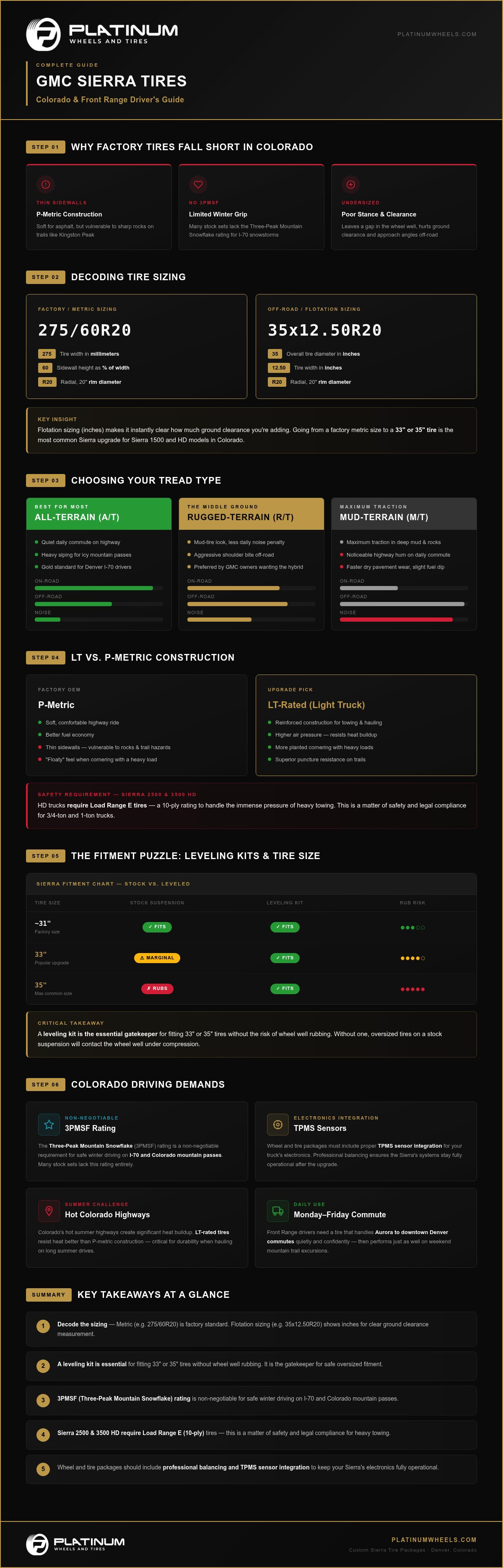
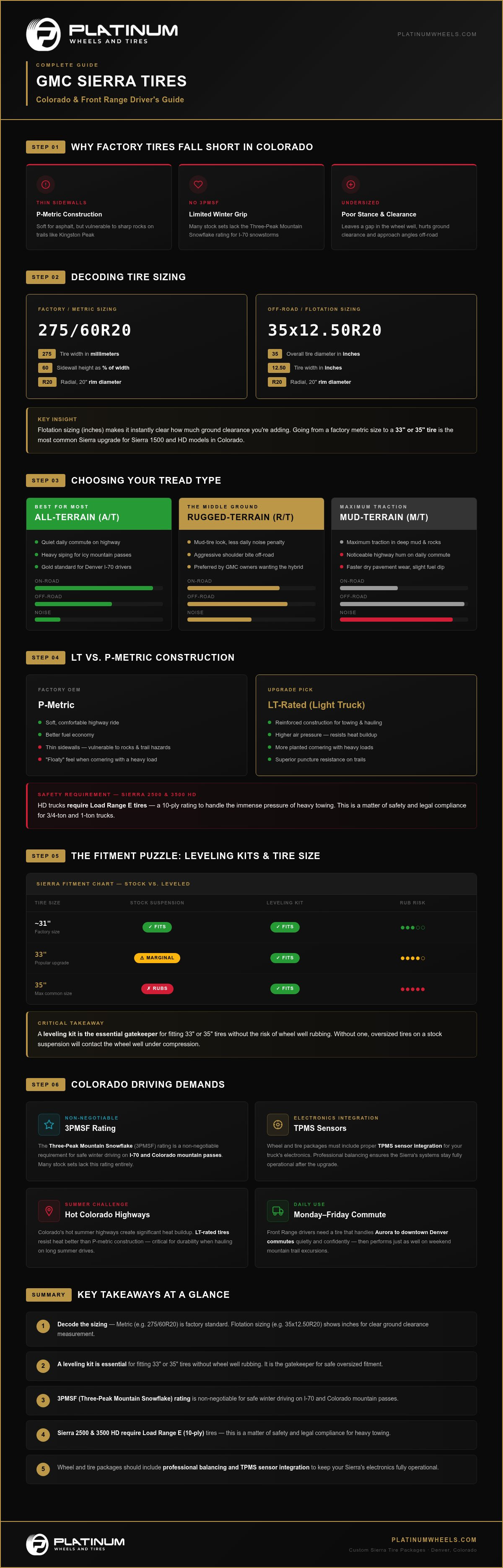
Factory tires are designed for the average driver, which rarely describes a Colorado truck owner. Most stock sets feature P-metric construction, which uses thinner sidewalls to keep the ride soft. While comfortable on smooth asphalt, these sidewalls are vulnerable to sharp rocks found on trails like Kingston Peak. Additionally, many stock sets lack the Three-Peak Mountain Snowflake (3PMSF) rating. This leaves you with limited winter grip during heavy I-70 snowstorms. From an aesthetic standpoint, factory tires often look undersized. They leave a distracting gap in the wheel well that doesn't match the Sierra’s bold, professional styling.
That undersized look is more than just a visual annoyance. It affects your truck's ground clearance and approach angles when you leave the pavement. By choosing a tire with a larger diameter and a more aggressive shoulder, you fill that wheel well and give your Sierra the authoritative stance it was meant to have from the factory.
Defining Your Sierra's Performance Mission
Before you commit to a new set, decide how you actually use your truck. Are you commuting from Aurora to downtown, or are you hunting for remote campsites every weekend? Choosing between different off-road tire types and tread patterns requires balancing your daily comfort with your weekend goals. All-Terrain (A/T) options are the gold standard for most, providing a quiet ride with enough bite for snow. Mud-Terrain (M/T) treads offer maximum traction in deep mud or rocks, but they come with increased road noise and a slight dip in fuel efficiency due to their heavier weight.
Swapping to Light Truck (LT-rated) tires is a game changer for those who tow trailers or haul heavy gear. This reinforced construction handles higher air pressures and resists heat buildup better than factory tires. Your Sierra will feel more planted and less floaty when cornering with a heavy load. While the extra weight of an LT tire can impact your fuel economy, the gain in stability and puncture resistance is a trade-off most Colorado owners are happy to make for the sake of reliability on the trail. Investing in high-quality gmc sierra tires ensures your truck remains a dependable partner, whether you're on the job site or exploring the Rockies.
Technical Specs: Decoding Sizes and Treads for the Sierra
Decoding the numbers on your sidewall is the first step toward a perfect build. Most factory gmc sierra tires utilize metric sizing, such as 275/60R20. The first number is the width in millimeters, while the second represents the sidewall height as a percentage of that width. When you transition to a more aggressive off-road setup, you'll often switch to flotation sizing, like 35x12.50R20. This measures the tire in inches, giving you a clear idea of how much ground clearance you're adding to your Sierra 1500 or HD model.
All-Terrain vs. Mud-Terrain for Colorado
Your choice in tread depends heavily on your weekly mileage and where you spend your weekends. All-Terrain (A/T) tires are the gold standard for Denver drivers who frequent I-70. They feature heavy siping, which provides the necessary grip on icy mountain passes while remaining quiet on the commute. Mud-Terrain (M/T) tires offer maximum traction for deep mud and unpacked snow, but they produce a noticeable hum on the highway and can wear faster on dry pavement. Rugged Terrain (R/T) tires serve as the middle ground between the civility of an A/T and the aggressive bite of an M/T. These hybrids have become the preferred choice for GMC owners who want the look of a mud tire without the daily noise penalty.
Load Ratings and Towing Safety
If you drive a Sierra 2500 or 3500 HD, your tire choice is a matter of safety and legal compliance. These 3/4-ton and 1-ton trucks require Load Range E tires, which feature a 10-ply rating to handle the immense pressure of heavy towing. Adhering to federal tire safety standards and ratings is essential to ensure your truck stays within its Gross Axle Weight Rating (GAWR). Proper inflation is equally critical; running too low on a heavy haul can lead to sidewall failure, while staying at the recommended PSI ensures your Sierra remains stable under load. If you're balancing a heavy camper with weekend trail runs, exploring a wheel and tire package ensures you get a setup that handles both missions safely.
The Fitment Puzzle: Leveling Kits and 33 to 35-Inch Tires
Choosing the right gmc sierra tires often leads to a single, burning question: how big can I go? On a stock Sierra 1500, you're generally limited to a 32.5 or 33-inch tire. While a narrow 33-inch tire might fit without modifications, the aggressive, wide-body look most Denver owners want usually requires more room. This is where a leveling kit becomes the essential gatekeeper. It raises the front of your truck to match the rear, providing the necessary clearance to run larger rubber without compromising your suspension geometry or ride quality.
Sierra Tire Size & Suspension Requirements
Understanding the relationship between lift height and tire diameter is critical to a clean build. If you're staying with stock suspension, you can typically run a 275/60R20 or a 285/50R22. However, moving up to a 2-inch leveling kit opens the door for true 33-inch setups, like a 33x12.50R20, with minimal risk. If your goal is to fit 35-inch tires comfortably, you'll need to look at a 3.5-inch lift kit or higher. Without that extra height, a 35-inch tire will almost certainly contact the frame or the back of the wheel well during full-lock turns or when the suspension compresses on a trail.
- Stock Height: Maxes out around 33 inches (narrow width).
- 2-Inch Level: Ideal for 33x11.50 or 33x12.50 with proper offset.
- 4-Inch Lift: The sweet spot for running 35-inch tires with full articulation.
Avoiding the 'Rub': Trimming and Offset
Rubbing usually occurs in two places on a Sierra: the inner plastic liner and the "mud flap" area at the rear of the front wheel well. To clear larger gmc sierra tires, some owners perform the "NorCal Mod," which involves minor trimming of the metal and plastic behind the liner to gain an extra inch of clearance. This is often necessary when you choose negative offset wheels. While a negative offset pushes the tire out for a wider stance, it also increases the "scrub radius," making the tire swing in a wider arc and increasing the likelihood of hitting the fender edges.
Wider tires, specifically the popular 12.50-inch width, require more careful planning than narrower "pizza cutter" styles. A wider tire needs more space to turn without hitting the upper control arms or the frame. Balancing the tire's width with the correct wheel offset is a technical science. We focus on a consultative approach to fitment, ensuring that your Sierra looks aggressive on the streets of Aurora but remains fully functional when you're navigating tight switchbacks in the Rockies.
Colorado Driving Demands: Best Sierra Tires for the Front Range
Denver driving isn't a one-size-fits-all scenario. You might be dealing with 95-degree heat on I-25 in July and a sudden blizzard on Vail Pass by October. Choosing the right gmc sierra tires means finding a rubber compound that doesn't melt on hot asphalt but remains pliable when the mercury drops. Colorado's pavement is notoriously abrasive. Tires with soft, dedicated winter compounds will shred quickly during a hot summer commute to Aurora or Castle Rock. Instead, look for all-terrain options that carry the Three-Peak Mountain Snowflake (3PMSF) rating. This symbol indicates the tire has passed specific traction tests on packed snow. It makes the tire far superior to the standard Mud and Snow (M+S) rating found on generic highway sets that often come on stock trucks.
Winter Performance on the I-70 Corridor
Traction on I-70 is a matter of safety and legal compliance during Traction Law activations. While M+S tires technically meet the minimum legal requirement, they often lack the advanced siping necessary for black ice. Siping refers to the tiny slits in the tread blocks that open up to "bite" into slippery surfaces. For Sierra owners who head to Copper Mountain or Winter Park every weekend, a tire with high-density siping is essential. It provides the lateral stability needed to keep your truck from sliding when you're navigating steep, winding descents in heavy weekend traffic. These specialized treads ensure you can brake with confidence even when the road surface is hidden under a layer of frozen slush.
Off-Road Durability: From Sand Dunes to Rocky Peaks
Colorado trails aren't just dirt paths. Areas like Boulder, Golden, and the San Juan Mountains are famous for sharp shale and jagged granite that can easily puncture a weak sidewall. Specialized off-road tires include stone ejectors, which are small ridges between the tread blocks that prevent "tire drilling." This occurs when stones get trapped and slowly work their way through the tire casing. Aggressive sidewall biters are essential for protecting your rims and providing extra traction when you've aired down your tires to crawl over rocky obstacles. These reinforced sidewalls give you the peace of mind to explore remote areas without worrying about a stray rock ending your trip early.
Spring in the Front Range brings a messy mix of slush and deep mud as the snowpack melts. You need a tread design with wide enough void ratios to self-clean effectively. If the tread fills with mud, your tire essentially becomes a slick, and you'll lose all forward momentum on the trail. We focus on matching your specific driving habits with tires that balance this trail toughness with the quiet highway manners you need for the office. If you're ready to upgrade your truck for the next season, explore our custom Sierra tire options to find a build that handles everything the Rockies throw your way.
The Platinum Wheels Advantage: Custom Sierra Tire Packages in Denver
Setting up your truck shouldn't feel like a science experiment. While picking out gmc sierra tires is exciting, the logistics of mounting, balancing, and ensuring electronics compatibility can quickly become overwhelming. Choosing a comprehensive wheel and tire package eliminates the frustration of coordinating multiple vendors. You receive a setup that is professionally assembled and ready for the road. This approach ensures that every component, from the rim width to the tire's load rating, works in harmony with your Sierra’s specific suspension geometry.
Modern GMC electronics are sophisticated, and your tire pressure monitoring system (TPMS) is no exception. We prioritize technical precision by utilizing TPMS sensors that are fully compatible with 2024-2026 Sierra models. This prevents annoying dashboard warnings and keeps your safety systems active. Beyond electronics, our high-speed balancing process is designed for the reality of Denver driving. We want your truck to feel as smooth at 75 mph on E-470 as it does crawling over a mountain pass. If you're aiming for a taller stance, our team provides expert guidance on selecting the right leveling kit to accommodate your new rubber without the risk of rubbing.
Precision Fitment for Your Truck
We don't just bolt things on and hope for the best. Our technicians measure and test for clearance throughout the full range of steering before your truck leaves our shop. This consultative approach is a hallmark of our local service. We encourage our neighbors in the Denver area to return for a quick retorque and pressure check after the first few hundred miles. It's a small step that ensures long-term safety and performance. We’re deeply embedded in the Colorado off-road lifestyle, and we treat every Sierra build like it's our own.
Ready-to-Drive Packages
Our packages are designed to be a true turn-key solution. Each set includes your chosen wheels, tires, TPMS sensors, and professional installation. We take the guesswork out of complex specifications like offset and backspacing, ensuring your gmc sierra tires sit exactly where they should. You don't have to worry about whether a 33-inch tire will clear your fenders; we’ve already done the math. Book your GMC Sierra fitment consultation at Platinum Wheels today!
Ready for the Front Range: Build Your Ultimate Sierra Setup
Selecting the right gmc sierra tires isn't just about an aggressive look; it's about building a truck that handles the specific demands of the Colorado landscape. You've seen how the right tread pattern keeps you safe on icy mountain passes while reinforced sidewalls protect you on rocky Front Range trails. By matching your tire choice with a professional leveling kit, you can achieve that authoritative stance without sacrificing reliability or daily comfort.
At Platinum Wheels, we take the guesswork out of the fitment puzzle. Our team of specialized Denver off-road fitment experts ensures your truck is trail-ready from the moment you leave our shop. From professional lift and leveling kit installation to complete TPMS-ready packages, we provide everything needed for a vibration-free, high-performance ride. Stop settling for factory limitations and start exploring the Rockies with total confidence.
Get a Custom GMC Sierra Wheel and Tire Quote today and let's get your truck ready for the next adventure.
Frequently Asked Questions
What is the biggest tire I can put on a stock GMC Sierra 1500?
On a stock GMC Sierra 1500, you can typically fit a tire up to 32.5 or 33 inches in diameter, such as a 275/60R20. While some narrow 33-inch setups might clear the wheel wells, wider options often cause issues at full steering lock. Sticking to these factory-adjacent sizes ensures you maintain clearance without needing suspension modifications. If you want a wider, more aggressive footprint, we recommend moving toward a leveling kit to avoid any contact with the inner plastic liners.
Do I need a leveling kit to run 33-inch tires on my Sierra?
You don't strictly need a leveling kit for every 33-inch setup, but it’s highly recommended for the best fitment. A narrow 33-inch tire might clear on stock suspension, but the popular 33x12.50 size will almost certainly rub without that extra two inches of front-end lift. Beyond just clearance, a leveling kit eliminates the factory "rake" and gives your Sierra a much more balanced and authoritative stance that matches the rugged Colorado landscape.
Will 35-inch tires rub on a GMC Sierra with a 2-inch level?
Yes, 35-inch tires will almost certainly rub on a GMC Sierra equipped with only a 2-inch leveling kit. To run 35s comfortably, you typically need at least a 3.5-inch or 4-inch lift kit to provide the necessary vertical and horizontal clearance. Some owners attempt to fit 35s with a level by performing significant metal trimming, but this often compromises the vehicle's aesthetics. A proper lift is the safest way to ensure full articulation on the trail.
What are the best all-terrain tires for Colorado snow and ice?
The best all-terrain tires for Denver winters are those that carry the Three-Peak Mountain Snowflake (3PMSF) symbol. This rating indicates the rubber compound remains flexible in sub-zero temperatures and features advanced siping to grip ice on I-70. Options that balance deep tread blocks for mud with high-density siping for frozen slush are ideal. These gmc sierra tires provide the necessary traction for weekend ski trips while remaining quiet enough for your daily commute through Aurora or Lakewood.
How do larger tires affect the gas mileage of a GMC Sierra?
Larger tires will typically cause a noticeable decrease in fuel economy, often ranging from one to three miles per gallon. This happens because heavier off-road tires increase the rotational mass your engine has to turn. Additionally, the increased rolling resistance of an aggressive tread pattern and the higher profile of the truck create more aerodynamic drag. While the trade-off in traction and style is worth it for many, it’s a factor to consider for long highway drives.
Do I need to recalibrate my speedometer after getting bigger tires?
You should recalibrate your speedometer whenever you move to a tire size that is significantly larger than factory equipment. Because a larger tire has a greater circumference, it travels further with every rotation, causing your speedometer to read slower than your actual speed. This can also affect your transmission's shift points and odometer accuracy. Using a simple handheld programmer or visiting a local specialist can sync your Sierra's computer with your new, larger tire diameter.
What is the difference between P-metric and LT tires for my truck?
P-metric tires are designed for standard passenger vehicles and offer a lighter, softer ride that prioritizes fuel economy. In contrast, LT (Light Truck) tires feature reinforced sidewalls and more internal plys, typically carrying a Load Range E rating. For Sierra owners in the Front Range who frequently tow trailers or navigate sharp, rocky trails in Golden or Boulder, LT tires are essential. They provide the puncture resistance and load-carrying capacity that P-metric tires simply can't match.
Why is my TPMS light on after installing new wheels and tires?
Your TPMS light is likely on because the vehicle's computer doesn't recognize the sensors in your new setup. This occurs if the original sensors weren't moved to the new rims or if the new sensors haven't been "relearned" to the truck's system. At Platinum Wheels, we include compatible TPMS sensors in our gmc sierra tires packages and handle the programming during installation. This ensures your safety systems remain active and your dashboard stays clear of annoying warning lights.