
Best Rugged Terrain Tires for Denver Off-Roading
Will rugged terrain tires give your truck more confidence on Colorado trails without making every Denver commute louder or less comfortable? That balance is the real question. A more aggressive tread may help on rocky or muddy routes, but it can also bring more road noise and different wet-road and wear trade-offs than an all-terrain tire.
If you split your time between pavement and weekend forest roads, you may want one setup that can handle both. The right choice depends on how often you leave pavement, the conditions you expect, and which trade-offs you’re willing to accept. For many Front Range drivers who spend most of their time on pavement, an all-terrain tire may be the more practical fit.
This guide compares rugged-terrain tires with all-terrain and mud-terrain options, and explains what to consider for Colorado’s changing conditions. You’ll also learn how to assess road noise, wet grip, and expected wear, plus which tire size, load rating, and wheel fitment details to confirm for your truck and routes.
Key Takeaways
- “Rugged-terrain” isn’t a universal tire standard. Compare tread design, construction, and manufacturer descriptions instead of relying on the label alone.
- Evaluate rugged terrain tires by how they balance pavement manners, loose-surface traction, noise, and your intended use.
- Match the tire category to your routine: daily pavement driving, regular trail access, or more specialized muddy terrain.
- Before choosing a size, confirm your vehicle details, load index, load range, speed rating, wheel compatibility, and manufacturer fitment guidance.
- Bring your current tire size and typical Colorado routes to a fitment discussion. Confirm mounting, balancing, TPMS needs, and wheel compatibility.
Rugged Terrain Tires: How They Fit in Colorado
“Rugged-terrain” isn’t a universally standardized tire category. The label often describes tires positioned between traditional all-terrain and mud-terrain designs, but manufacturers may use different terminology and specifications. Look at the tread pattern, construction, and manufacturer’s description instead of assuming the name guarantees a particular level of capability. This general overview of off-road tires explains how these designs are intended to work across varied surfaces.
Rugged-terrain tires generally aim for a more aggressive tread than many all-terrain tires, without the highly specialized focus of some mud-terrain tires. That positioning is a starting point, not a performance promise. Compare the specifications and intended use of each tire, since models with similar labels can differ in design and on-road behavior.
How rugged-terrain tires differ from all-terrain and mud-terrain tires
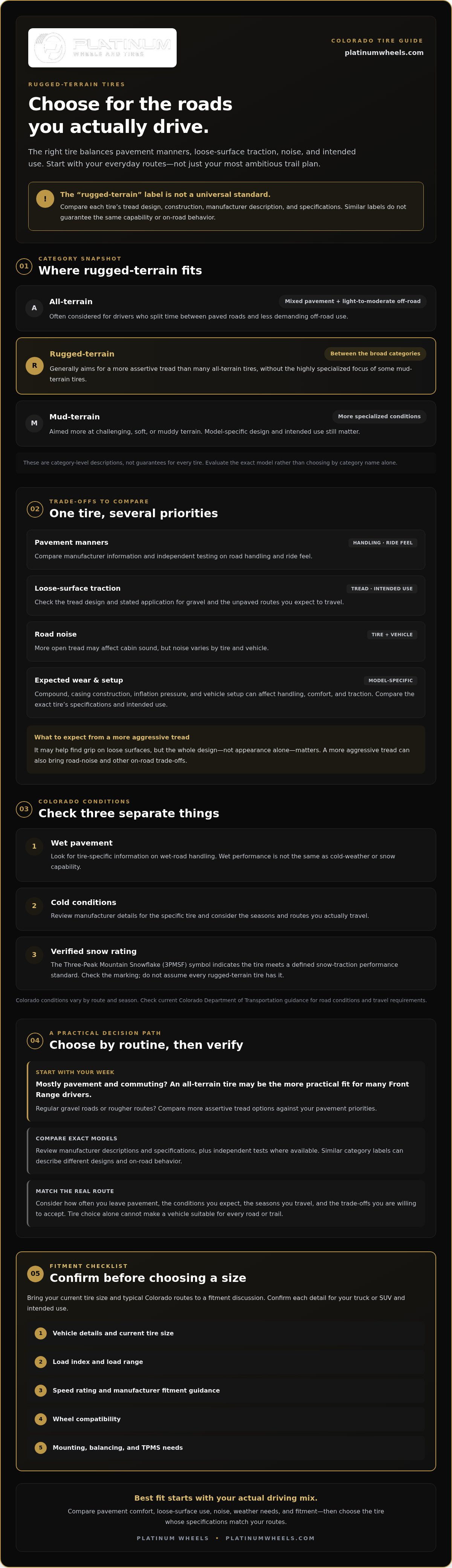
All-terrain designs are commonly considered for mixed pavement and light-to-moderate off-road use. Mud-terrain designs are aimed more at challenging, soft, or muddy conditions. Rugged-terrain options sit between those broad descriptions and often have a more assertive tread than an all-terrain tire. These are category-level distinctions, not rules that apply to every model.
Before deciding, review the manufacturer’s description and specifications for the exact tire. For a fuller look at category differences, see our Colorado all-terrain tire guide.
Which Colorado driving mix might suit a rugged-terrain tread?
Start with your ordinary week, not your most ambitious trail plan. If your truck or SUV spends nearly all its time commuting on paved streets and highways, consider whether a less aggressive option better fits that routine. If you regularly travel gravel roads or rougher routes, a more assertive tread may be worth comparing against your pavement priorities.
Think through the routes you actually drive, the seasons you travel, and how often your tires leave pavement. A tire choice alone can’t make a vehicle appropriate for every road or trail. Vehicle capability, conditions, and route requirements matter, too. Describe your typical use when comparing options, and verify that each tire’s intended application matches it.
What Performance Trade-Offs Should You Expect from Rugged Terrain Tires?
Rugged terrain tires may have tread designed for loose surfaces, but the label alone can’t predict how a tire will feel on Denver pavement or perform on a trail. Compare the specific tire’s design and manufacturer specifications. Compound, casing construction, inflation pressure, and vehicle setup can also affect handling, comfort, and traction.
| Factor | What to compare |
|---|---|
| Pavement manners | Look for manufacturer information and independent testing on road handling and ride feel. |
| Loose-surface traction | Consider the tread design and the tire’s stated intended use for gravel or other unpaved routes. |
| Noise | More open tread may affect cabin sound, but noise varies by tire and vehicle. |
| Intended use | Match the tire’s specifications to your balance of everyday driving and off-pavement travel. |
How tread pattern can affect pavement and trail driving
Open tread features may help a tire find grip on loose surfaces, though their effect depends on the whole design, not appearance alone. On pavement, tread pattern can influence noise and ride feel, but the category doesn’t guarantee a particular result. Check the manufacturer’s specifications and independent tests where available. For background on familiar category trade-offs, read J.D. Power’s guide to how rugged-terrain tires compare with all-terrain and mud-terrain options.
Are rugged-terrain tires suitable for Colorado weather?
Separate three questions: how a tire handles wet pavement, how it performs in cold conditions, and whether it has a verified snow rating. These capabilities aren’t interchangeable. The Three-Peak Mountain Snowflake (3PMSF) symbol indicates that a tire meets a defined snow-traction performance standard. Check the marking and manufacturer details for each tire rather than assuming every rugged-terrain option carries it.
Colorado conditions can change by route and season. Before heading out, check current Colorado Department of Transportation guidance for road conditions and travel requirements. Tread is only one part of the picture, alongside suitable pressure, the vehicle’s equipment, and careful route choices.
More aggressive tread isn’t automatically better for every driver. Weigh the surfaces you drive most against the tire-specific compromises, then confirm the tire and wheel match your vehicle. To consider a complete setup, explore tire and wheel options for Front Range driving.
How Do Rugged Terrain Tires Compare with All-Terrain and Mud-Terrain Options?
Choose based on the roads you drive most, not on which tire looks most capable. All-terrain, rugged-terrain, and mud-terrain labels can help narrow the field, but manufacturer terminology may overlap. Compare the exact tread design, specifications, and stated intended use before deciding. A category name alone can’t confirm how a tire will handle your commute or the surfaces you encounter off pavement.
| Option | May suit | What to weigh |
|---|---|---|
| All-terrain | Mostly paved driving with occasional gravel roads or maintained trails | Check the specific model’s road and off-road specifications. Designs vary. |
| Rugged-terrain | A mix of pavement and regular access to rougher routes | Review the tire’s intended use, tread design, and on-road information rather than assuming it’s a fixed middle ground. |
| Mud-terrain | Frequent travel on challenging loose or muddy surfaces | Confirm how the specific tire performs on pavement, including noise and road behavior. |
When all-terrain tires may be the more balanced choice
If most of your mileage is on city streets and highways, with occasional trips on gravel or maintained trails, compare all-terrain models closely before moving to a more aggressive tread. Check each candidate’s pavement and off-road specifications, along with any verified seasonal ratings you need. The category can be a useful starting point, but individual designs differ. For a broader look at options and fitment, see this Colorado off-road tires and wheels roundup.
When mud-terrain tires may better match the route
If you regularly tackle challenging muddy or loose surfaces, mud-terrain options may be worth comparing. Start with the conditions you actually encounter, then check the manufacturer’s stated intended use and specifications. Don’t assume every mud-terrain tire has the same pavement compromises. Review information for the exact model, especially if you’ll drive it daily. Likewise, rugged terrain tires aren’t automatically the right middle ground. Their suitability depends on the design and your priorities.
Use the category to narrow your search, then let your route and tire-specific evidence guide the final choice.
How to Choose and Fit Rugged Terrain Tires for Your Truck or SUV
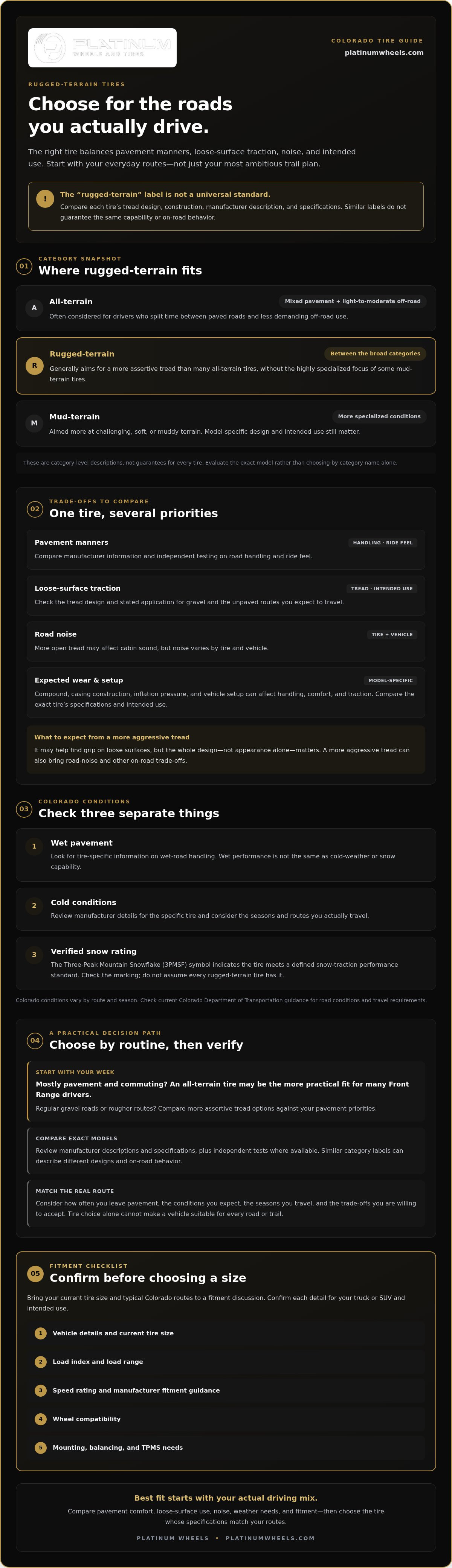
A tire that suits your route still needs to fit your vehicle correctly. Use this checklist to narrow your options, then verify the full tire-and-wheel combination before buying.
- Start with your vehicle details. Note the year, make, model, trim, drivetrain, and current tire size. Trim and existing modifications can affect fitment, so include those details when comparing options.
- Confirm the tire specifications. Check the load index, load range, and speed rating against your vehicle manufacturer’s requirements. Tire size markings identify dimensions and construction details, but actual measurements can vary among tire models with the same nominal size.
- Match the wheel. Verify that the tire is compatible with your wheel’s diameter and width. If you’re considering replacement wheels, check that the complete combination aligns with manufacturer fitment guidance.
- Check clearance before upsizing. Available space depends on vehicle configuration, wheel dimensions, and the tire’s actual measurements. Confirm fitment for your specific setup instead of assuming a larger size will clear.
- Plan for sensors and installation. Confirm whether TPMS sensors are needed or should be transferred when changing wheels. This TPMS sensor guide explains what to consider. For a complete wheel-and-tire package, ask how mounting, balancing, and sensor needs fit into the plan.
What tire specifications should you confirm before buying?
Use the size printed on your current tire as a reference, not as the only approval for a new setup. The load and speed specifications need to meet the vehicle manufacturer’s requirements, and the selected tire must suit the wheel. Share your vehicle details and proposed sizes with a qualified fitment professional to verify the combination before purchase.
Will a larger tire require suspension changes?
Not always. Tire size alone can’t answer the question. Clearance can vary with the vehicle’s trim, wheel dimensions, tire measurements, and existing suspension setup. Have the proposed combination checked for your specific vehicle before ordering. If a verified setup requires more clearance, a lift or leveling kit may be part of the plan. Don’t assume one is necessary or sufficient without confirming fitment.
Bring your vehicle information, current tire size, and intended driving use to a fitment discussion. Explore tire and wheel options for your vehicle as you plan a setup that meets its specifications.
Where to Get Rugged Terrain Tires Fitted in the Colorado Front Range
Choosing rugged terrain tires is only part of the setup. Before discussing options with a tire and wheel installer, gather your vehicle’s year, make, model, and trim, along with the size printed on your current tires. Be ready to describe your typical driving: daily pavement, gravel roads, maintained trails, or rougher routes. These details help focus the conversation on tires and wheels that fit both your vehicle and your actual use.
What to ask a tire and wheel installer
Bring your priorities, then ask for the proposed setup to be checked against them. A useful discussion should cover:
- How the tire’s stated intended use and specifications align with your pavement, gravel, and trail driving.
- Whether the tire and wheel combination meets your vehicle’s fitment requirements and has appropriate clearance.
- Whether TPMS sensors need to be added, transferred, or otherwise accounted for with replacement wheels.
- What installation work is included in the plan, such as mounting and balancing, and whether any additional fitment considerations apply.
- How claims about winter ratings or vehicle compatibility can be verified against manufacturer information.
Clear answers matter. If a tire’s fit, seasonal marking, or compatibility hasn’t been confirmed for your exact vehicle, ask for verification rather than relying on a general category label or a similar vehicle’s setup.
Plan a complete tire upgrade with Platinum Wheels
Platinum Wheels is a locally owned retailer and installer serving customers across the Colorado Front Range. Its offerings include all-terrain and mud-terrain tires, custom truck wheels and off-road rims, wheel-and-tire packages, and TPMS sensors. Professional lift-kit and leveling-kit installation is also available when appropriate for a verified setup. Ask which tire options fit your needs and vehicle, and confirm availability and fitment for the specific combination you’re considering.
A complete plan can help address compatibility questions before installation. Wheel-and-tire packages include professional tire mounting and balancing, and packages can include TPMS sensors. Share your vehicle details and common routes so recommendations can account for your priorities, wheel choice, and fitment requirements.
Ready to talk through the options? Talk with Platinum Wheels about your tire setup.
Choose a Setup That Fits Your Colorado Routes
The right tire choice starts with your real driving mix, not the most aggressive tread or boldest label. Compare manufacturer specifications for pavement, gravel, and trail use, then confirm tire size, load requirements, wheel compatibility, and clearance for your specific vehicle. Rugged terrain tires may suit some drivers, but the right fit depends on the routes you travel and the trade-offs you’re comfortable making.
A complete setup matters, too. Plan for wheels, fitment, and TPMS needs alongside the tires so there are fewer surprises before installation. Platinum Wheels is a locally owned and operated independent shop serving the Colorado Front Range. Its custom wheel-and-tire packages can include TPMS sensors and professional mounting and balancing.
Have your vehicle details, current tire size, and typical routes ready, then talk with Platinum Wheels about your tire setup. A fitment conversation can help you weigh your options and plan a setup suited to the way you drive. The right match can make your next Colorado trip feel that much more rewarding.
Frequently Asked Questions
Platinum Wheels serves drivers across the Colorado Front Range, including Denver, Aurora, Lakewood, Englewood, Wheat Ridge, Commerce City, Westminster, Thorton, Broomfield, Arvada, Golden, Littleton, Parker, Highlands Ranch, Castle Rock, Boulder, Fort Collins, and Colorado Springs.
What are rugged terrain tires?
Rugged terrain tires are generally positioned to balance off-pavement traction with regular-road use, but “rugged-terrain” isn’t a universal technical classification. Manufacturers may use the label differently, and it doesn’t define a fixed point between all-terrain and mud-terrain designs. Compare each tire’s tread pattern, ratings, and manufacturer description to understand its intended use. The specific model matters more than the category name alone.
Are rugged terrain tires good for daily driving?
They can suit daily driving, but it depends on the specific tire, your vehicle, and your tolerance for possible changes in noise, ride feel, and tread wear. Compare your paved mileage with how often you drive off pavement. Before choosing rugged terrain tires, review the model’s specifications and independent testing where available. Don’t assume every tire with this label will feel or wear the same on your commute.
Are rugged terrain tires good in Colorado snow?
Snow performance is separate from general off-road traction, so check the exact tire’s winter rating and manufacturer information. The Three-Peak Mountain Snowflake marking identifies tires that meet a defined snow-traction performance standard, but it doesn’t guarantee performance in every snow, ice, or road condition. Colorado weather and routes vary. Check current Colorado Department of Transportation guidance for your planned route and conditions, and choose equipment accordingly.
What is the difference between rugged terrain and all-terrain tires?
Rugged-terrain isn’t a universal technical classification, and manufacturers may use the term differently. Some designs are positioned as more aggressive than all-terrain tires, but compare the actual tread, intended use, ratings, and road-focused features for each candidate rather than relying on the label. For broader category guidance and Colorado-focused considerations, see our Colorado all-terrain tire guide.
Are rugged terrain tires louder than all-terrain tires?
Not necessarily. Noise depends on tread design, tire construction, vehicle, road surface, and speed. A more open or aggressive tread may affect road noise, but the rugged-terrain label alone can’t predict how loud a tire will be in your truck or SUV. Check model-specific manufacturer information and independent reviews. If possible, hear the tire in person or ask about its on-road character before deciding.
Can rugged terrain tires fit a stock truck or SUV?
They may fit, but compatibility depends on the vehicle’s original specifications, tire size, wheel dimensions, and available clearance. Confirm the tire’s load and speed ratings as well as physical fitment for your exact vehicle. Don’t assume a larger tire requires a lift or that it will fit without changes. Have the proposed tire-and-wheel combination verified before purchase, especially if the vehicle has non-stock parts.
How do I choose the right rugged terrain tire size?
Start with your vehicle’s approved tire specifications and the surfaces you expect to drive. The size must work with the wheel width, load requirements, available clearance, and any suspension changes. Don’t select a size based on appearance alone or without vehicle details. Ask a qualified fitment professional to verify the complete setup, particularly if you’re considering non-stock wheels or a tire size different from the vehicle’s approved specifications.