Best Ford Bronco Tires for Denver’s Off-Road Terrain
The factory rubber on your 2026 Ford Bronco might be fine for a quick grocery run, but it's often the only thing standing between you and the summit of a challenging Colorado pass. Choosing the right ford bronco tires is about more than just picking the biggest size that fits in the wheel well. You need a setup that can handle the sharp scree of the Rockies on Saturday while remaining quiet enough for the Monday morning commute on I-70. It's a delicate balance. Many local owners feel stuck between the fear of tire rubbing on stock suspension and the technical confusion of Sasquatch versus non-Sasquatch fitment.
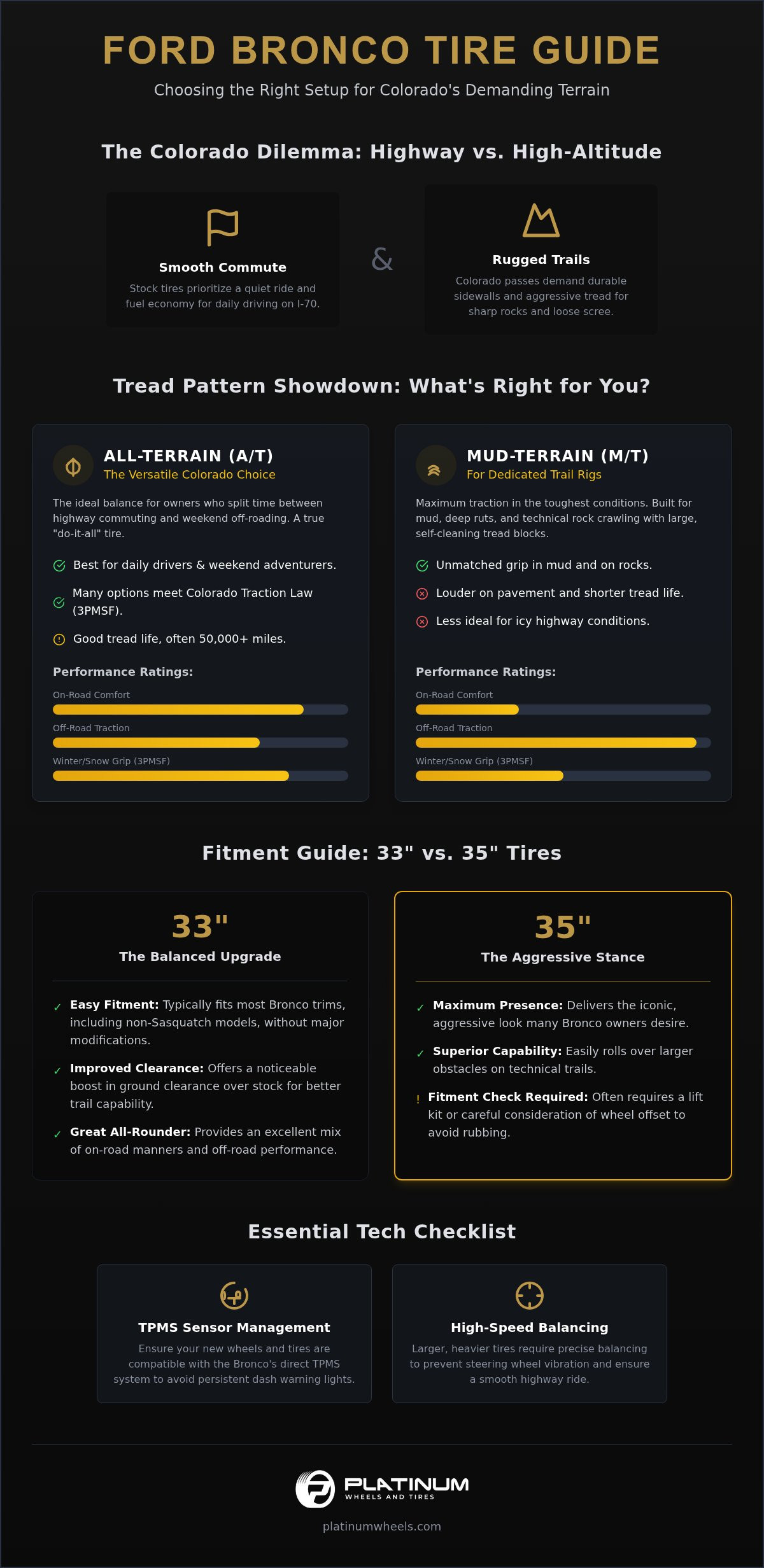
We agree that you shouldn't have to choose between an aggressive off-road stance and a smooth, professional ride. You'll discover the best tire setups to master Colorado’s rugged trails and highway commutes with total confidence. This guide breaks down the top tread patterns for our unique terrain, explains how to stay compliant with the Colorado Traction Law, and provides fitment secrets that avoid the dash light headache. We're diving into everything from 33 inch all-terrains to trail-ready 35s that keep your direct TPMS sensors functioning perfectly while providing the grip you need for the Front Range.
Key Takeaways
- Identify the clearance limits of your specific trim level to ensure your new setup doesn't cause rubbing on the trail.
- Compare All-Terrain and Mud-Terrain performance to find the perfect tread for both winter mountain passes and rocky summer climbs.
- Learn which ford bronco tires fit stock suspension and when you actually need to invest in a lift kit for safety.
- Manage your direct TPMS sensors and high-speed balancing correctly to avoid the dash light headache and steering wheel vibration.
- See how professional wheel and tire packages provide a turnkey solution designed for the unique terrain of the Colorado Front Range.
Understanding Ford Bronco Tire Specs: Stock vs. Upgraded
Ford designed the current Bronco with a massive spectrum of factory rubber, ranging from the modest 255/70R16 on the Base trim to the massive 37-inch rollers found on the Raptor. While these options provide a solid starting point, they are often designed to meet fuel economy targets and road noise standards that don't always align with the reality of Colorado's backcountry. The Sasquatch Package changed the game by proving that 35-inch ford bronco tires could be a factory standard, but many non-Sasquatch owners find themselves wondering how to close that gap without compromising safety or performance.
Decoding Your Bronco's Current Fitment
Start by reading the alphanumeric string on your sidewall. A Big Bend might roll on 255/75R17 tires, while a Badlands steps up to a 285/70R17. The most critical distinction for Denver drivers isn't just the diameter; it's the construction. Many stock tires are P-metric, which are lightweight and comfortable for highway cruising. However, if you plan on adding heavy steel bumpers, winches, or roof tents, you need LT-rated (Light Truck) tires. These offer higher load ratings and stiffer sidewalls that won't wallow under the weight of a fully geared-up overlanding rig. Understanding these off-road tire basics helps you choose a tire that supports your specific vehicle weight and driving style.
Why Stock Tires Often Fall Short in Colorado
The Rockies don't forgive weak rubber. Technical trails like Bill Moore Lake feature sharp shale and loose scree that can shred a standard passenger tire's sidewall in minutes. Street-biased stock tires prioritize a quiet ride on the pavement, but they lack the deep "biting edges" required to claw up a wet mountain pass or maintain traction during the spring thaw. Upgrading your ford bronco tires allows you to move away from these compromises. You can gain the durability of a 3-ply sidewall and the traction of an aggressive tread without sacrificing the precision your Bronco was built for.
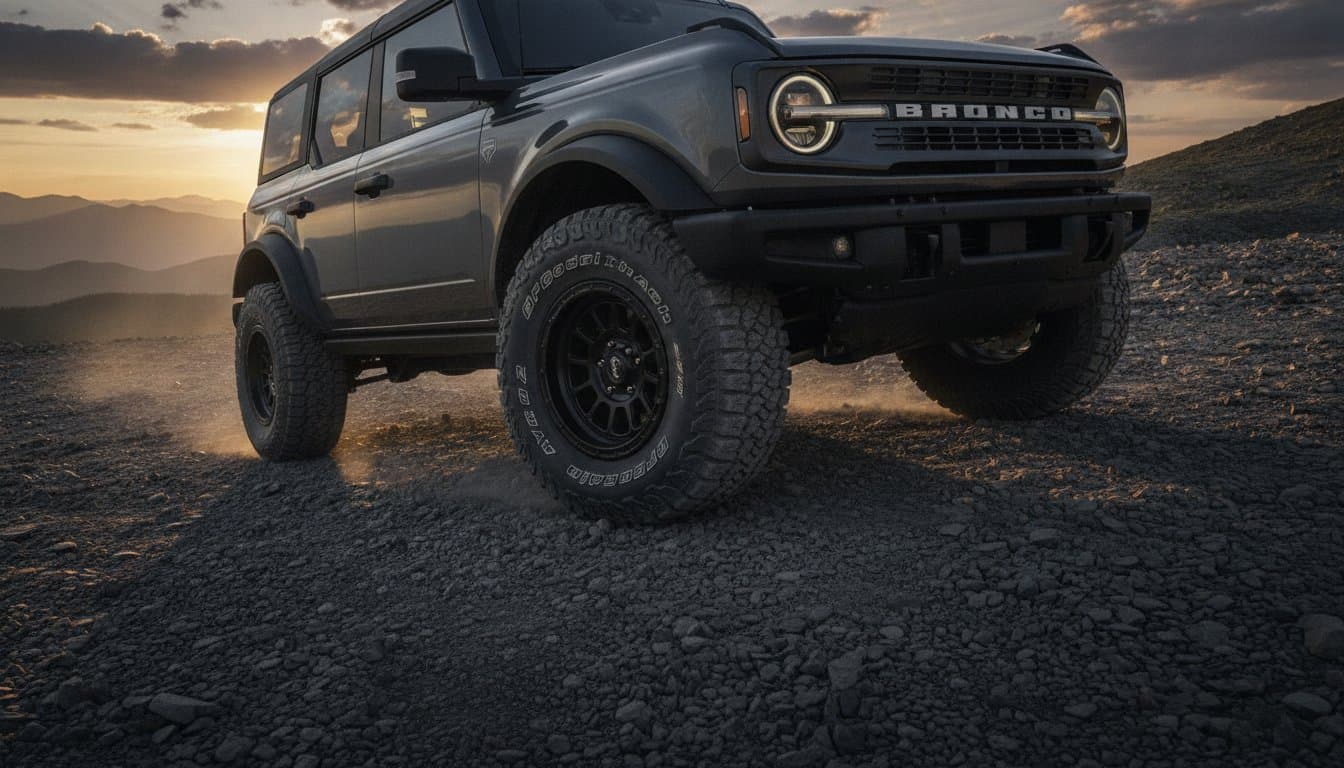
The "sweet spot" for most Front Range owners is often a 33-inch or 35-inch setup. A 33-inch tire typically fits most trims without major modifications, offering a boost in ground clearance. Stepping up to 35s provides that iconic aggressive stance and superior obstacle rollover, though it requires careful consideration of your Bronco's specific suspension and fender clearance. We focus on finding that perfect middle ground where your Bronco looks bold and performs flawlessly on every trail from Black Hawk to Moab.
Choosing the Best Tread Pattern for Colorado Terrain
Selecting the right tread pattern for your ford bronco tires depends entirely on where you spend most of your time. In Denver, many owners face the "dual-use" dilemma. You need a tire that doesn't scream on the highway but won't leave you stranded when the trail turns to loose scree. Understanding the nuances of choosing tires for any off-road terrain is vital for safety, especially when navigating the high-altitude passes of the Front Range.
All-Terrain: The Versatile Colorado Choice
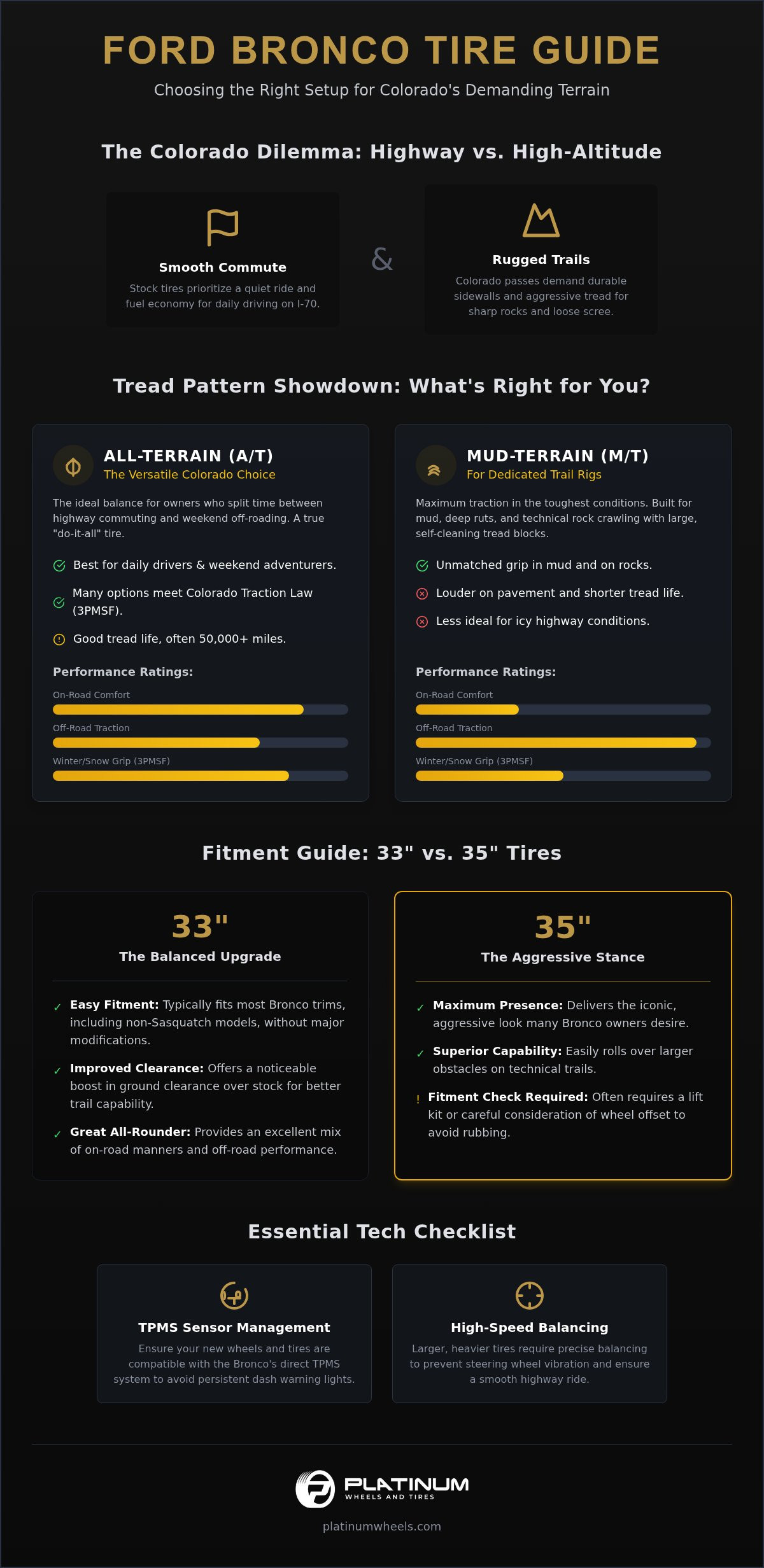
For the Bronco owner who spends weekdays on I-70 and weekends at 12,000 feet, All-Terrain (A/T) tires are the gold standard. These tires offer a balanced tread design that handles wet pavement and light snow with ease. If you're looking for year-round compliance, prioritize tires with the 3-Peak Mountain Snowflake (3PMSF) rating. This ensures you meet the Colorado Traction Law requirements, which mandate a 3/16-inch tread depth for the I-70 Mountain Corridor during the winter season.
Modern A/T options from brands like Nitto and Toyo have solved the old "highway hum" problem. You can enjoy a quiet cabin on the way to Vail while benefiting from a tread life that often reaches 50,000 miles or more. We often recommend choosing the best all-terrain tires for Colorado to maximize your investment without sacrificing ride quality.
Mud-Terrain and Rugged-Terrain: When to Go Aggressive
If your Bronco is a dedicated trail rig or you frequent technical routes during the "sticky" spring thaw, Mud-Terrain (M/T) tires are essential. Their massive, self-cleaning tread blocks are designed to eject mud and debris, maintaining grip where an A/T tire might turn into a slick. However, the trade-off is increased road noise and a shorter lifespan on hot asphalt.
This gap has led to the booming popularity of Rugged-Terrain (R/T) or "Hybrid" tires. These ford bronco tires combine the aggressive sidewall and shoulder lugs of an M/T with the tighter center-tread blocks of an A/T. It's the perfect setup for Denver drivers who want that bold, "Sasquatch-plus" look without the vibrating steering wheel on the drive home. Whether you need the maximum bite of a mud tire or the civility of a hybrid, we can help you find the right fit at Platinum Wheels.
The Fitment Guide: 33s, 35s, and the Lift Kit Question
The most common question we hear at our Denver shop is, "How big can I go without rubbing?" While the Sasquatch package made 35-inch ford bronco tires a factory standard, many owners with Big Bend or Outer Banks trims start with 32-inch rubber. Moving up requires a clear understanding of your vehicle's geometry. For most trims, 33-inch tires are the perfect "no-mod" upgrade. They provide a noticeable boost in ground clearance for trails like Switzerland Trail without requiring you to cut into your brand-new rig.
Stepping up to 35s is where things get technical for non-Sasquatch Broncos. To run 35s safely, you generally need to address the front crash bars and the factory rake. If you have the "Big Dog" dream of running 37s, prepare for a more involved build. Running 37s safely in the Rockies requires a significant lift, potential re-gearing to maintain highway performance, and clearancing work to ensure you don't shred your fenders when the suspension fully articulates on a rocky ledge. Understanding the difference between a leveling kit vs lift kit is the first step in deciding which path fits your budget and trail goals.
Leveling Kits: The Essential 35-Inch Companion
A leveling kit is often the most cost-effective way to fit 35-inch ford bronco tires on a non-Sasquatch model. Most Broncos come from the factory with a "rake," meaning the front sits lower than the rear. A professional leveling kit installation corrects this stance and provides the necessary clearance for the front crash bars. Removing or replacing these bars is a common modification, but it must be done correctly to maintain the vehicle's structural integrity. We always recommend a professional alignment immediately after installation to ensure your new tires wear evenly on the drive home to Aurora or Castle Rock.
Wheel Offset and Backspacing for Broncos
Tire size is only half the battle; wheel fitment is the other. If you keep your factory wheels, a wider tire might rub against the upper control arms during a full-lock turn. This is why many owners opt for aftermarket wheels with a slight negative offset. This pushes the wheel further out from the hub, creating a wider, more stable footprint. This "poke" doesn't just look aggressive. It provides the mechanical clearance needed for high-articulation off-roading. We focus on precision fitment to ensure your Bronco remains a capable, safe daily driver while looking like it belongs on a magazine cover.
Living with Your New Bronco Tires: Maintenance & Tech
Installing a fresh set of ford bronco tires is just the beginning of your journey. To protect your investment and ensure a smooth ride on the way to the trailhead, you need a proactive maintenance strategy. Heavy off-road tires present unique challenges, from increased rotational mass to sensitive electronic monitoring systems. Neglecting these details often leads to steering wheel vibrations or annoying alerts on your instrument cluster during your commute through Denver.
Avoiding the Dash Light Headache
The 2026 Bronco utilizes a direct TPMS system. This means each wheel contains a sensor that provides real-time pressure and temperature data. When you switch to a custom wheel and tire package, installing new TPMS sensors is the only way to avoid the persistent dash light headache. While some online forums suggest "quick fixes" or simply ignoring the light, professional programming ensures your safety systems function as intended. This is especially important when you air down for traction on rocky trails and need the system to monitor your return to highway pressures accurately.
Upgrading to larger diameters also affects your speedometer and shift points. A Bronco calibrated for 32-inch tires will read slow if you are actually rolling on 35s. We recommend professional recalibration. This keeps your odometer accurate and ensures your transmission maintains its factory shift logic, which is vital for climbing steep mountain grades without hunting for gears.
Performance in the Colorado Elements
Denver's climate is notorious for "four seasons in one day." These extreme temperature swings cause significant fluctuations in tire pressure. For every 10-degree drop in temperature, you can expect to lose about one PSI. At high altitudes, the pressure differential between the inside and outside of the tire changes. This makes regular checks essential before you head from the heat of the Front Range into the freezing mountain passes.
To maximize the lifespan of your aggressive tread, follow a strict maintenance schedule:
- High-Speed Balancing: Large, heavy tires require precision balancing to prevent highway vibrations. We use advanced equipment to ensure your 35s or 37s ride as smoothly as stock rubber.
- 5-Tire Rotation: Don't leave your full-size spare to rot on the tailgate. Including it in a 5-tire rotation pattern extends the life of your tread blocks by 20 percent and ensures the spare matches the diameter of your other tires.
- Winter Protection: Colorado road salt is brutal on aftermarket finishes. Regular cleaning is vital to prevent corrosion on your new rims and keep the rubber from drying out.
Don't let technical oversights ruin your driving experience. If you are ready for a professional setup that works right the first time, schedule your tire installation with Platinum Wheels today.
The Platinum Wheels Advantage for Denver Bronco Owners
Selecting the right ford bronco tires is a significant investment in your vehicle's capability. While national chains might offer bulk pricing, they often lack the technical nuance required for custom Colorado builds. At Platinum Wheels, we don't just sell rubber. We provide expert consultation to ensure your suspension and tires work in perfect harmony. Whether you are navigating the tight switchbacks near Black Hawk or cruising the open stretches of the Front Range, our team focuses on precision fitment that prioritizes both safety and performance.
Complete Wheel and Tire Packages
One of the most efficient ways to upgrade is through our comprehensive aftermarket wheel and tire packages. We handle the heavy lifting by providing ready-to-install solutions that include professional mounting, high-speed balancing, and TPMS sensor integration. This turnkey approach eliminates the "dash light headache" discussed earlier and ensures your speedometer remains accurate from the moment you leave our shop.
We offer access to the most respected offroad tires and wheels in the industry. Our technicians understand how to customize your look with the perfect wheel offset. We ensure your tires have the wide, stable stance you want without the risk of rubbing on your upper control arms or fenders. By choosing a complete package, you get a professionally vetted setup designed specifically for the unique demands of Denver and the surrounding mountain trails.
Your Trusted Local Denver Partner
As an independent shop deeply rooted in the local off-road community, we take pride in being more than just a retailer. We are enthusiasts who spend our weekends on the same trails you do. This first-hand experience allows us to offer better fitment advice for the specific shale, mud, and snow conditions found in the Rockies. We serve the entire metro area, from the trail-riding enthusiasts in Lakewood and Arvada to the daily commuters in Aurora.
Our commitment to transparency means we never use high-pressure sales tactics. Instead, we act as consultative advisors, helping you navigate the technical differences between 33s, 35s, and 37s. We value the discipline of seasoned technicians and the passion of the hobbyist, ensuring every Bronco that leaves our shop is trail-ready and highway-safe. If you are ready to transform your ride, Book your Bronco tire consultation at Platinum Wheels today!
Gear Up for Your Next Colorado Adventure
Mastering the trails around Denver requires a vehicle that's as versatile as the terrain. We've explored how the right ford bronco tires transform your driving experience, moving you from the limitations of factory rubber to a setup built for the Rockies. From selecting the perfect hybrid tread for the I-70 corridor to navigating the technical requirements of 35-inch fitment, your choices today define your confidence on the trail tomorrow. Remember that precision matters; proper balancing and TPMS integration are the secrets to a ride that's as smooth on the pavement as it is capable on the scree.
At Platinum Wheels, we specialize in truck and SUV suspension to ensure your rig is trail-ready without compromise. Our packages include professional Denver-based installation, high-speed balancing, and new TPMS sensors to keep your dash clear of alerts. Don't settle for a generic setup when you can have a custom solution designed for the Front Range. Upgrade Your Bronco Today: Shop Custom Wheel & Tire Packages and get ready to explore the backcountry with total peace of mind. We'll see you at the summit.
Frequently Asked Questions
What is the largest tire I can fit on a stock Ford Bronco without a lift?
For most non-Sasquatch trims, 33-inch tires are the largest size you can fit without a lift or major modifications. Specifically, a 285/70R17 is a popular choice that provides a wider stance and better clearance on the trail. While some owners attempt to fit larger rubber, 33s ensure you don't experience significant rubbing against the factory crash bars during tight turns or suspension articulation on rocky Colorado paths.
Will 35-inch tires fit on a non-Sasquatch Bronco?
Yes, but you'll typically need to install a leveling kit and remove the front crash bars to prevent interference. Unlike the Sasquatch package which includes a factory lift and wider flares, a standard Bronco needs these adjustments to clear 35-inch ford bronco tires safely. We also recommend checking your wheel offset to ensure the tires don't contact the upper control arms during technical maneuvers in the backcountry.
How much will larger tires affect my Bronco's gas mileage?
Expect to see a decrease of 1 to 3 miles per gallon when upgrading to larger, heavier tires. The increased rotational mass and rolling resistance require more energy to move, especially at Denver's high altitude where the engine already works harder. Choosing an All-Terrain tread instead of a heavy Mud-Terrain can help minimize this impact, but any significant jump in tire diameter will inevitably change your fuel efficiency.
Do I need to recalibrate my speedometer after getting bigger tires?
Recalibration is essential because larger tires change the distance your vehicle travels with every revolution. If you don't recalibrate, your speedometer will read slower than your actual speed, and your odometer will underreport your mileage. Professional programming ensures that your transmission shift points and safety systems, like traction control, receive accurate data. This is vital for maintaining factory performance and avoiding unnecessary wear on your drivetrain components.
What is the best tire for Colorado snow and off-roading?
The best choice for our region is a tire with the 3-Peak Mountain Snowflake (3PMSF) rating. This ensures the tire meets specific snow traction standards required by the I-70 Traction Law. Many ford bronco tires in the Rugged-Terrain or Hybrid category offer this rating, giving you the aggressive tread needed for summer mud and rocks while maintaining the specialized rubber compounds required for grip on icy winter mountain passes.
Why is my TPMS light on after getting new Bronco tires?
Your TPMS light is likely on because the sensors weren't transferred to your new wheels or they weren't properly programmed to the vehicle's computer. The 2026 Bronco uses a direct monitoring system with sensors inside each tire. If you purchased a new wheel and tire package without integrated sensors, the system can't detect a signal. We include professional sensor installation and programming in our packages to prevent this persistent dash light headache.
Should I get a leveling kit or a full lift kit for my Bronco?
A leveling kit is perfect if you want to fit 35-inch tires and fix the factory front-end rake on a budget. It's an ideal solution for daily drivers who hit the trails on weekends. However, if you plan on running 37-inch tires or tackling extreme rock crawling, a full lift kit is necessary. Lift kits provide significantly more ground clearance and suspension travel for the most demanding technical terrain in the Rockies.
How often should I rotate my mud-terrain tires?
Rotate your mud-terrain tires every 3,000 to 5,000 miles to ensure even treadwear. Aggressive lugs are prone to "cupping" or wearing at an angle if they stay in one position too long, which causes loud road noise and vibrations. We recommend a 5-tire rotation pattern that includes your full-size spare. This keeps all tires at the same diameter, which is critical for the health of your Bronco's 4WD system and drivetrain.