
Best Ferrari Tires in Denver: High-Performance Selection
Could the tire that delivers the sharpest response on a warm, dry road be the wrong choice for a cold Colorado morning? Ferrari tires influence more than grip: the right fitment helps preserve the handling, comfort, and confidence your car was engineered to deliver.
It’s natural to start with performance, but a tire choice has to match your specific Ferrari and the conditions you actually drive in. Model year, front and rear sizes, load and speed ratings, and manufacturer guidance all matter. A setup that works for one Ferrari may not be right for another.
This guide explains what vehicle-specific details to gather before comparing tires, then weighs performance priorities against Colorado’s changing weather, elevation, and road conditions. You’ll also learn how summer, all-season, and other seasonal choices can affect everyday usability, why pressure and tread checks deserve regular attention, and when uneven wear, damage, or age calls for professional inspection. With the right information, you can make a considered decision that suits both your Ferrari and the roads ahead.
Key Takeaways
- Start with your Ferrari’s exact model, year, trim, and axle-specific requirements before comparing tire options.
- Ferrari tires should balance your performance priorities with the weather and roads you drive most often in Colorado.
- Compare tire categories by grip, wet-weather confidence, comfort, noise, and seasonal usability rather than brand hype alone.
- Use a consistent inspection routine to spot pressure changes, uneven tread wear, and visible damage before they become bigger concerns.
- Follow vehicle manufacturer guidance to decide when tire age, wear, or damage warrants professional evaluation and replacement.
Ferrari Tires: Why Exact Fitment Matters Before You Compare Options
Start with the specification, not the brand or tread pattern. Tire fitment means more than finding rubber that fits the wheel: it accounts for dimensions, load capacity, speed rating, and the position each tire occupies on the vehicle. Fitment is matching every tire specification to the vehicle’s requirements, for each axle, rather than choosing by size alone.
Those details help preserve the balance between steering response, traction, ride comfort, and clearance. A tire with the wrong dimensions can alter how the car responds, while an unsuitable rating may not meet its requirements. The sidewall is useful for identifying what’s mounted now, but it shouldn’t be the only reference if tires have been changed before.
Which Ferrari details do you need before shopping for tires?
Write down the model, model year, and trim, then locate the vehicle-specific tire information in the owner’s manual and on the vehicle placard. Record the recommended front and rear specifications separately. Model, year, and trim can affect the approved setup, and some vehicles use different sizes on the front and rear axles. That staggered arrangement is intentional: don’t assume the front specification applies at the rear, or that four identical tires are correct.
Use the manual and placard as your baseline, not memory, an online listing for a similar Ferrari, or a size read from one tire. If the installed tires differ from the vehicle information, treat that as a reason to verify the correct setup against authoritative vehicle-specific documentation before comparing replacements.
What do Ferrari tire size and rating markings mean?
Consider 245/35R20 95Y as an illustrative tire marking, not a confirmed Ferrari fitment. The first number, 245, indicates the tire’s nominal width in millimeters. The 35 is the aspect ratio: the sidewall height is 35% of the width. “R” identifies radial construction, and 20 is the wheel diameter in inches. The 95 is the load index, a code tied to the tire’s rated load capacity. Y is the speed rating, a code for the tire’s rated speed capability under specified conditions.
Size and ratings answer different questions. Two tires can share the same width, profile, and wheel diameter yet have different load or speed ratings. A matching size alone therefore doesn’t establish complete compatibility. The meaning of the markings and the construction behind them are part of broader tire technology and types, but the vehicle’s own specification remains the deciding reference.
For any Ferrari-specific example, verify the exact size and ratings against authoritative documentation for that model year and trim. Don’t transfer a specification from a different version or axle. Once the full requirements are clear, you can compare tire categories and driving priorities without risking a mismatch at the starting line.
Ferrari Tire Types: Match Performance Priorities to Everyday Driving
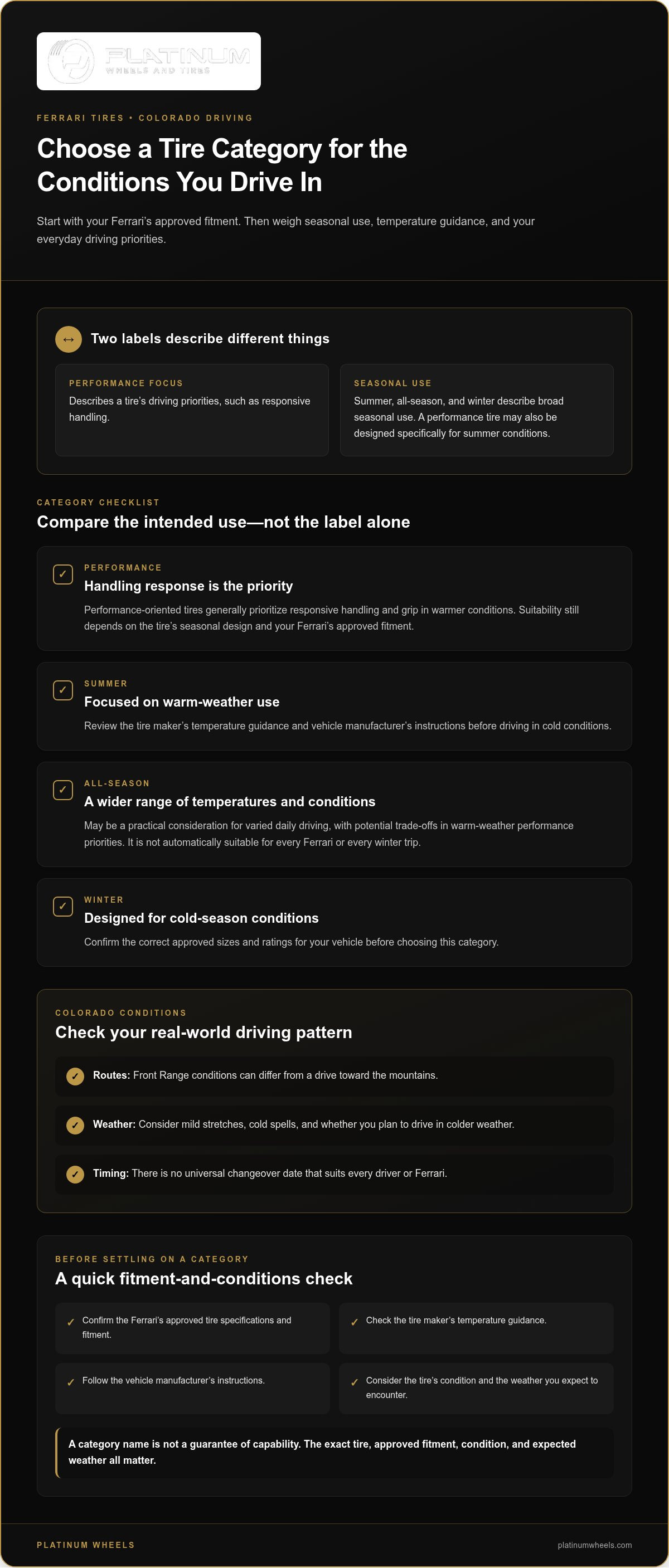
Once the vehicle’s required fitment is clear, compare tire categories by where and how you drive. A tire designed to deliver responsive handling in warm conditions may not be the most practical choice for a car that also faces cold mornings or mountain travel. The right tire category should reflect both the vehicle’s approved fitment and the driving conditions it will encounter.
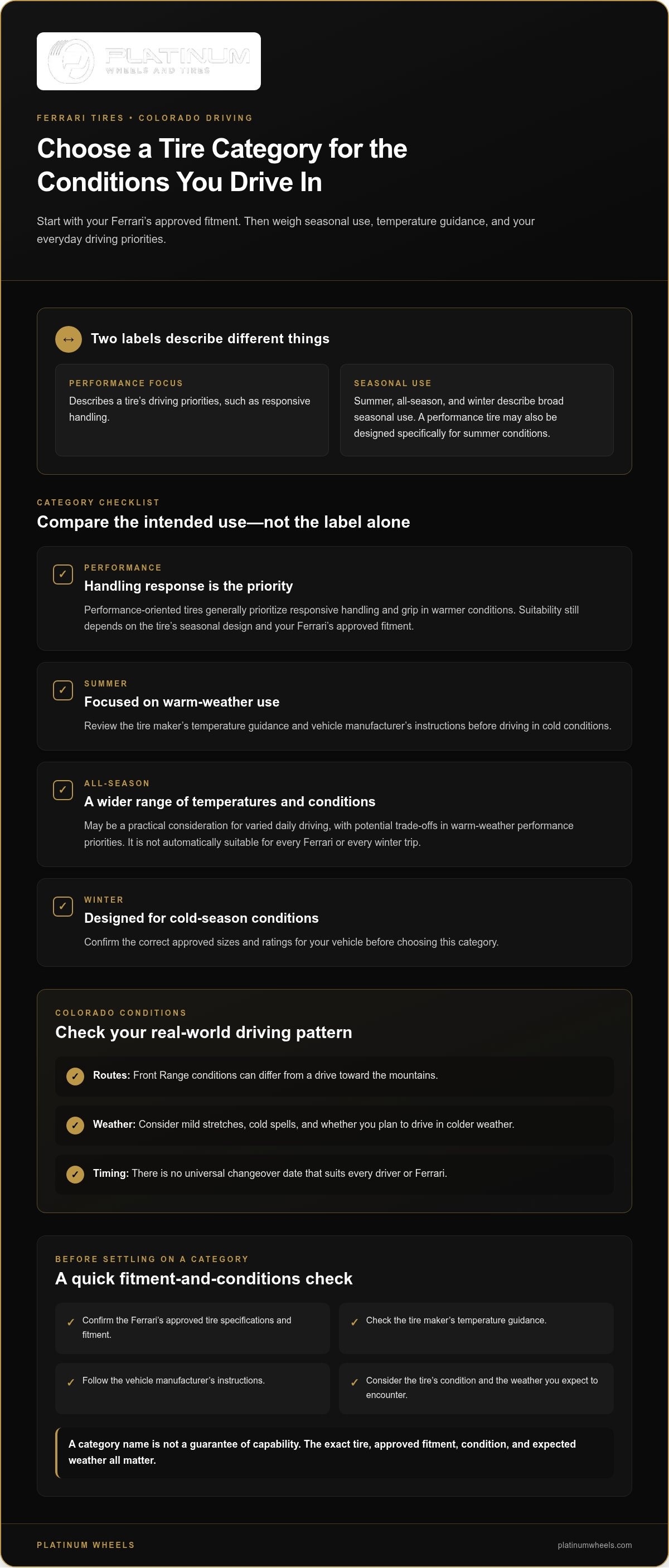
Performance describes a tire’s driving focus, while summer, all-season, and winter describe broad seasonal use. These labels can overlap: a performance tire may be designed specifically for summer conditions. Category availability and suitability depend on the exact Ferrari model, its approved specifications, and manufacturer instructions.
How do performance and summer tires differ from all-season tires?
Performance-oriented and summer tires generally prioritize responsive handling and grip in warmer conditions. All-season tires are designed for a wider range of temperatures and conditions, which can make them a practical consideration for varied daily driving. That broader range involves trade-offs, and an all-season option isn’t automatically suitable for every Ferrari or every winter trip.
Check the tire maker’s temperature guidance and the vehicle manufacturer’s instructions before choosing or driving in cold conditions. Don’t treat a category name as a guarantee of capability. The exact model, approved fitment, tread condition, and expected weather all matter.
| Category | Considerations |
|---|---|
| Performance | Prioritizes handling response; suitability depends on the tire’s seasonal design and vehicle fitment. |
| Summer | Focused on warm-weather use; review temperature limits and manufacturer guidance before cold-weather driving. |
| All-season | Offers broader seasonal usability, with potential trade-offs in warm-weather performance priorities. |
| Winter | Designed for cold-season conditions; confirm the correct approved sizes and ratings for the vehicle. |
When should Colorado Ferrari drivers consider seasonal tires?
Front Range weather can shift between mild stretches and cold spells, while a drive toward the mountains may bring different conditions from a city commute. Consider your regular routes, the season you plan to drive, and whether the car will be used in colder weather. A tire’s category matters, but so do its condition and the manufacturer’s temperature guidance.
There’s no universal changeover date that suits every driver or Ferrari. Instead, plan around the car’s use and the conditions you expect, then verify that the seasonal option meets the exact vehicle requirements. If a Ferrari is driven only in suitable weather and stored during colder periods, that use pattern may call for a different balance than year-round driving.
Before narrowing the options, weigh the trade-offs that matter most: warm-weather response, broader seasonal use, and the routes you actually travel. For general Colorado tire and wheel options, Platinum Wheels serves drivers across the Front Range; Ferrari-specific choices still depend on the vehicle’s approved fitment and guidance.
Ferrari Tire Comparisons: Resolve Fitment and Performance Trade-Offs
After confirming the vehicle’s required specifications, compare the options through three separate lenses: what the car requires, what conditions you’ll drive in, and what qualities matter most to you. Required dimensions and ratings aren’t preferences to trade away. Grip, comfort, noise, and seasonal usability are priorities to balance among tires that meet the vehicle’s requirements.
That distinction keeps a comparison grounded. A driver who mainly uses a Ferrari on warm, dry roads may value steering response differently from someone who also drives in rain or colder Front Range weather. Neither use pattern makes one tire universally right. Start with the approved fitment, then assess how the tire’s characteristics align with the route and season.
How should you compare grip, comfort, and wet-weather performance?
Tread design and rubber compound affect how a tire responds, and designs optimized for one set of conditions may involve trade-offs in another. Consider the whole driving experience rather than treating a single attribute as proof of overall superiority.
- Grip and response: Think about how directly you want the car to react during ordinary driving, and whether warm-weather performance is your main priority.
- Wet-weather confidence: Consider the rain you encounter and the tire’s condition. Tread wear can affect how the tire performs on wet roads, so compare manufacturer guidance and inspect the actual tires rather than relying on category labels alone.
- Comfort and noise: If the car sees longer drives or regular commuting, cabin comfort and road noise may matter more than they would for occasional drives focused on handling.
- Usable seasonal range: Match the tire’s intended conditions to the temperatures and routes you expect. A broad seasonal range can be useful, but it doesn’t automatically make an option suitable for every model or trip.
For example, a driver who values sharp response on dry roads might give warm-weather grip more weight, while someone using the car through changing conditions may prioritize a wider usable range and wet-road composure. In either case, compare only options that satisfy the vehicle’s documented requirements. Don’t infer stopping distances or wet performance from a label without manufacturer information or relevant testing.
Does Ferrari approval matter when selecting replacement tires?
Check the owner’s manual and vehicle-specific documentation for guidance on approved replacement tires, including whether the manufacturer calls for a particular approval marking. The requirement, if any, should be verified for the exact model and year. Don’t assume an informal code, retailer description, or marking seen on another Ferrari applies to your car.
Separate the evidence into three columns: confirmed vehicle requirements, your driving conditions, and personal preferences. A tire must first satisfy the documented requirements. Then compare the options for handling priorities, rain exposure, comfort, noise, and seasonal use. Ferrari tires aren’t a one-feature decision; this method makes trade-offs clearer without letting preference override fitment.
If the documentation is unclear or the marking’s meaning can’t be verified for the specific vehicle, avoid guessing. Use authoritative vehicle and tire-maker guidance to establish what applies before making the final comparison.
Ferrari Tire Maintenance: Inspect Pressure, Tread, and Damage
Make tire checks a repeatable part of caring for your Ferrari, not a response reserved for a dashboard warning. A walk-around can reveal changes that deserve attention, while pressure readings help you catch gradual loss. These checks are useful screening steps, not a substitute for a professional assessment when you spot damage or unusual wear.
What should you check during a Ferrari tire inspection?
Park safely on level ground and look over each tire, including the inside and outside sidewalls where visible. Use this simple sequence:
- Check pressure: Measure when the tires are cold, following the vehicle manufacturer’s specified procedure and pressure values. “Cold” and the correct measuring points should be understood according to the manual, not guessed from a generic chart.
- Scan the tread: Look for uneven wear, shallow areas, or visible objects embedded in the tread. Compare the inner, center, and outer portions rather than judging only from one spot.
- Inspect the sidewalls: Note cuts, bulges, cracking, or other visible changes. Check for damage after an impact or encounter with a road hazard.
- Notice handling changes: A new vibration, pulling sensation, or change in steering response is useful information to share during an assessment.
Uneven wear can point to an issue that merits closer inspection; the pattern alone doesn’t diagnose its cause. Record which tire is affected and describe any recent change in handling. If a tire has a bulge, a serious cut, or damage that makes it appear unsafe, stop in a safe place and arrange an assessment rather than continuing to drive on it. Don’t attempt a repair based only on a visual guess.
Follow the manual for the pressure-check procedure and use its specified values, including any differences between axles or driving conditions. Temperature and elevation changes can affect pressure readings, so a TPMS reading shouldn’t be treated as a fixed substitute for checking. Ferrari’s annual service includes a tire-pressure and tread-depth check, but follow the vehicle’s own maintenance guidance for your model.
What can a TPMS warning tell you?
A tire pressure monitoring system (TPMS) is an aid that alerts you to a pressure concern; it doesn’t show every kind of tire damage or replace manual checks. Treat a warning promptly. Follow the owner’s manual for safe next steps, and check the tires when it’s safe to do so. If a tire looks damaged or the warning persists, seek a professional assessment instead of assuming the alert can be reset and ignored.
For a straightforward explanation of monitoring alerts and related components, see this TPMS sensor guide. Keep a note of warnings, pressure readings, and visible wear to make any follow-up more useful. For general tire and wheel options across Colorado’s Front Range, explore Platinum Wheels’ tire and wheel options.
Replacing Ferrari Tires: Choose the Right Next Step
Replacement is easier to plan when you move from evidence to specifications, then to installation. A tire may need evaluation because of visible damage, wear, age, a persistent pressure warning, or a change in how the car handles. Don’t rely on tread appearance alone: Ferrari’s service manual recommends replacing tires every four years regardless of tread depth because the rubber compound ages. Follow the guidance for your specific vehicle and have uncertain conditions assessed.
What steps should you take before replacing Ferrari tires?
Use this sequence to build a clear replacement plan:
- Confirm the requirements. Check the owner’s manual and tire placard for the model-specific size, load and speed ratings, and front and rear fitments. Use vehicle documentation to verify any manufacturer guidance on replacement tires or approval markings.
- Record what you observe. Note tread wear patterns, visible damage, pressure readings or warnings, and any vibration, pulling, or change in steering response. These details help distinguish a straightforward wear concern from a condition that needs closer evaluation.
- Compare suitable candidates. Only compare tires that meet the documented requirements. Then weigh seasonal suitability against the routes and conditions you expect, along with priorities such as handling response, wet-weather confidence, comfort, and noise.
Uneven wear or a persistent handling change deserves evaluation rather than an assumption that new tires alone will solve the issue. Likewise, damage that looks serious calls for a safe stop and professional assessment. If the tire’s age is uncertain, use the vehicle manufacturer’s guidance instead of waiting for the tread to appear worn.
What should happen during tire replacement and installation?
Correct installation matters as much as selecting a compatible tire. Mounting should match the wheel and tire specifications, and balancing helps address wheel-and-tire imbalance that can contribute to vibration. Inflation should follow the vehicle manufacturer’s specified procedure and pressure values, not a generic setting or the maximum pressure printed on the tire sidewall.
Include the TPMS in the plan. The installer should inspect the system and handle any sensor-related service appropriate to the vehicle and installation. Afterward, follow the manual for pressure checks and any TPMS reset or relearn steps. Don’t ignore a warning that remains on, or assume a reset has corrected an underlying pressure problem.
Keep the records together: tire specifications, installation details, pressure readings, and any observations about wear or handling. That history can make future inspections and replacement decisions more straightforward. For Colorado drivers exploring general tire and wheel services, explore Platinum Wheels. Ferrari-specific replacement decisions should remain anchored to the individual vehicle’s documentation and manufacturer guidance.
Make Your Next Tire Decision With Confidence
Give your next decision a clear starting point: keep your Ferrari’s vehicle documentation and tire records together, and note the conditions you expect the car to face. That way, the requirements stay distinct from personal preferences, and comparisons of Ferrari tires can be grounded in the car’s needs rather than guesswork.
For general wheel and tire needs in Colorado, Platinum Wheels brings a locally owned, fitment-focused approach to the Front Range, along with professional wheel and tire installation experience. The right guidance starts with your specific requirements and the use you have in mind, without treating one setup as right for every vehicle.
Explore Platinum Wheels’ Colorado wheel and tire services and take your next step with confidence. A careful choice today can help make every future drive feel more considered.
Frequently Asked Questions
Can Ferrari tires be repaired after a puncture?
Sometimes, but a puncture doesn’t automatically qualify for a permanent repair. A tire professional needs to assess where the puncture is, what caused it, the tire’s condition, and the manufacturer’s repair guidance. A sealant or other temporary measure may help only as an emergency response, not as proof the tire is safe for continued use. If the tire looks compromised, stop somewhere safe, consult the vehicle manual, and arrange a qualified assessment.
Do Ferrari tires have an expiration date?
There isn’t one replacement date that applies to every Ferrari tire. Age is one factor, alongside storage conditions, use, visible condition, and the recommendations for the specific vehicle and tire. Look for the tire identification markings on the sidewall, then use the manual and tire-maker guidance to understand what they mean. A recorded manufacturing date can inform an inspection, but it doesn’t establish safety by itself.
Can you mix different tire brands on a Ferrari?
Mixing brands can change how tires respond, and it may conflict with vehicle or tire-maker guidance. The answer depends on the Ferrari’s model, axle arrangement, specified sizes, and why a replacement is needed. Before mixing, review the vehicle documentation and tire-maker recommendations for the exact setup. Matching tread depth alone doesn’t guarantee compatibility, so don’t treat it as a substitute for confirming the complete tire specifications.
Are Ferrari tires run-flat tires?
Not necessarily. Tire construction and emergency mobility provisions can vary by Ferrari model, model year, and original equipment. Check the vehicle documentation and the markings on the tires currently fitted instead of assuming run-flat technology is standard. Run-flat tires are a tire-construction feature; they’re different from carrying a repair kit or spare. Use model-specific documentation to establish what your car has and what replacement setup it requires.
How often should I check the pressure in Ferrari tires?
Follow your Ferrari’s manual for the checking procedure and specified pressure, since the correct values can vary by vehicle and axle. Pressure readings are most useful when the tires are cold, and temperature changes around Denver and the Front Range can affect them. Check before longer trips and respond promptly to TPMS warnings. Don’t rely on a universal schedule or a generic pressure figure in place of the vehicle’s instructions.
What does the DOT code on a Ferrari tire mean?
The tire identification code includes manufacturing information, with a date code on applicable tires. Look for the code on the sidewall; it may be easier to see on one side than the other. The date can help you discuss tire age during an inspection, but it can’t determine safety on its own. Pair it with the tire’s condition, history, and vehicle- and tire-maker guidance rather than judging by age alone.