
Performance Lamborghini Tires: Denver’s Elite Tire Service
The tire with the most aggressive tread isn’t automatically the right choice for your Lamborghini. Getting Lamborghini tires right starts with your exact model and year. Many models use staggered fitments, with different sizes front and rear, and an alternative that looks close may not preserve the car’s intended handling. Tire choice also needs to suit how and where you drive, from dry pavement to Colorado’s winter roads.
This guide explains how to identify the correct tire specification for your model, compare original-equipment tires with replacement options, and weigh performance, comfort, seasonal capability, and road use. You’ll learn how to interpret approved markings, why the prescribed front and rear sizes matter, and when dedicated winter tires are the safer choice for Colorado conditions. With the fitment details clear, you can compare options confidently and prioritize safety without losing sight of the driving experience your Lamborghini was engineered to deliver.
Key Takeaways
- Start with your Lamborghini’s exact model, year, trim, wheel setup, and axle position to narrow down the correct tire fitment.
- Learn how to read a tire sidewall so you can compare its key measurements with your vehicle’s specifications.
- Compare Lamborghini tires by fitment, intended driving conditions, and documented vehicle approvals, not just brand or tread style.
- Choose tires with Colorado’s changing weather in mind, while keeping the manufacturer’s fitment requirements as your guide.
- Follow a fitment-first plan to make a more confident replacement decision and know what details to inspect before choosing.
What Determines the Right Lamborghini Tires for Your Car?
Lamborghini tire choice depends on the exact vehicle specification. The model is only the starting point. Model year, trim, factory or approved wheel configuration, and the position of each tire can all shape the correct fitment. Two cars with the same model name may not share identical requirements, so don’t assume a size that fits one Urus or Huracán fits another.
Vehicle-specific tire fitment means the tire dimensions and specifications assigned to a particular vehicle configuration and axle position. Use the tire placard and owner’s manual as primary references, then consult official vehicle documentation for your exact model and configuration. These details let you compare replacement options with the car’s requirements rather than relying on appearance or a broad model-year search.
Why Lamborghini model and year matter
Urus and Huracán illustrate why checking the full vehicle identity matters. Each name covers different model years and configurations, and the required fit may vary with trim, wheel setup, or approved options. Matching the wheel diameter alone doesn’t establish compatibility. Before shopping, record the model year, trim, wheel size, and tire information shown on the vehicle. Verify those details against the owner’s manual, tire placard, or official documentation for that specific car.
What staggered Lamborghini tire fitment means
A staggered setup uses different tire specifications on the front and rear axles. This arrangement can reflect a vehicle’s design, but it doesn’t mean every Lamborghini has the same layout or that a wider rear tire is universally correct. Keep each tire on its specified axle and preserve the documented dimensions and other required specifications when replacing tires. Don’t treat the front and rear sizes as interchangeable.
Original equipment also has a history of model-specific choices. The Pirelli Cinturato tires on Lamborghini Miura offer a useful historical example of tires associated with a particular Lamborghini model. The practical lesson isn’t to carry an older specification forward. Identify the original or approved fitment for the exact car in front of you.
Before comparing replacement tires, make a simple fitment record:
- Model year and trim
- Front and rear tire specifications, recorded separately
- Wheel configuration and any approved options
- Relevant guidance from the placard, manual, and official vehicle documents
This information gives you a reliable baseline for reading tire markings and comparing replacement choices. Start with the complete vehicle specification, not a tire size copied from a different Lamborghini.
How to Read Lamborghini Tire Sizes and Original Specifications
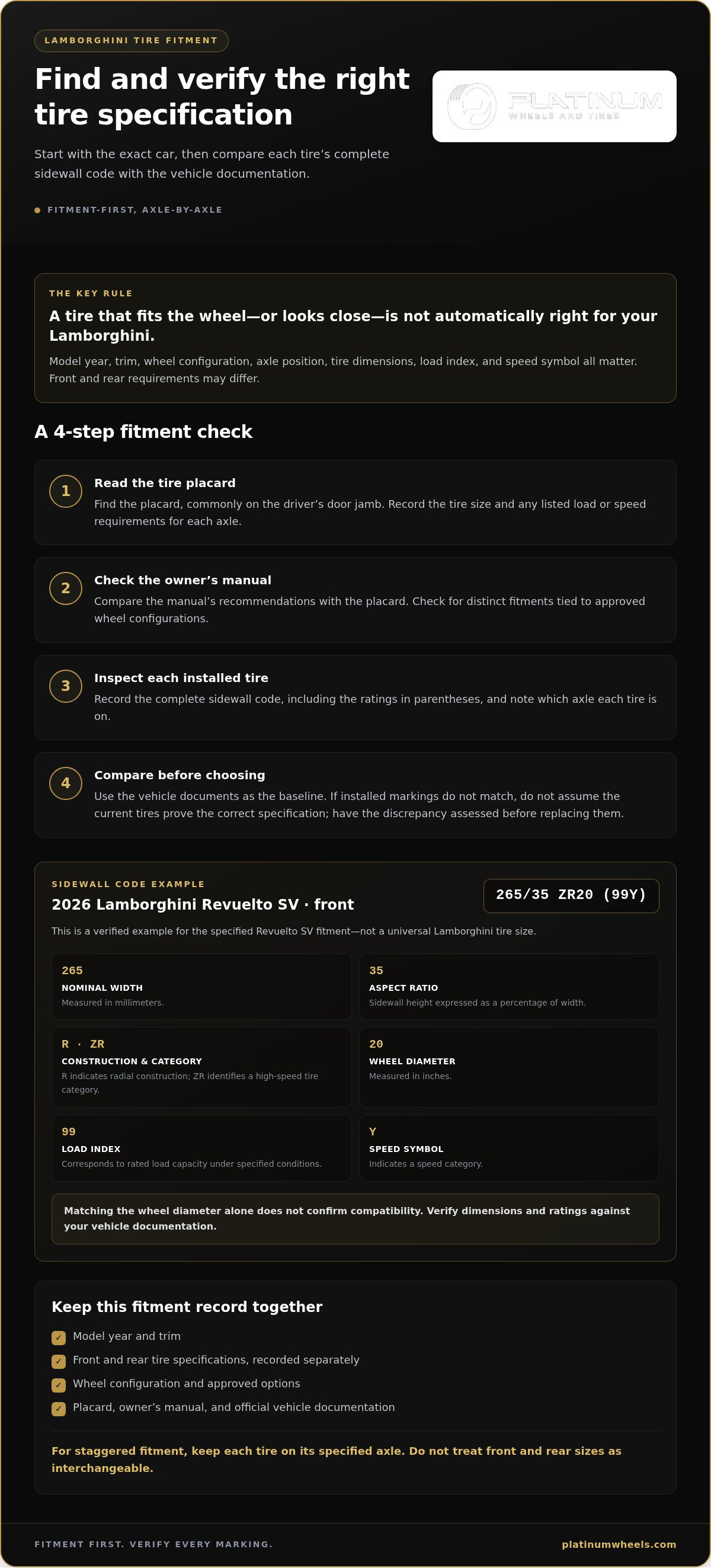
A tire sidewall is a useful identification tool, but it isn’t a substitute for your Lamborghini’s specified fitment. Read the full code, including the load index and speed symbol, then compare it with the vehicle’s documentation. A replacement tire fitting the wheel doesn’t, by itself, establish that the tire meets the car’s requirements.
How to understand the tire sidewall code
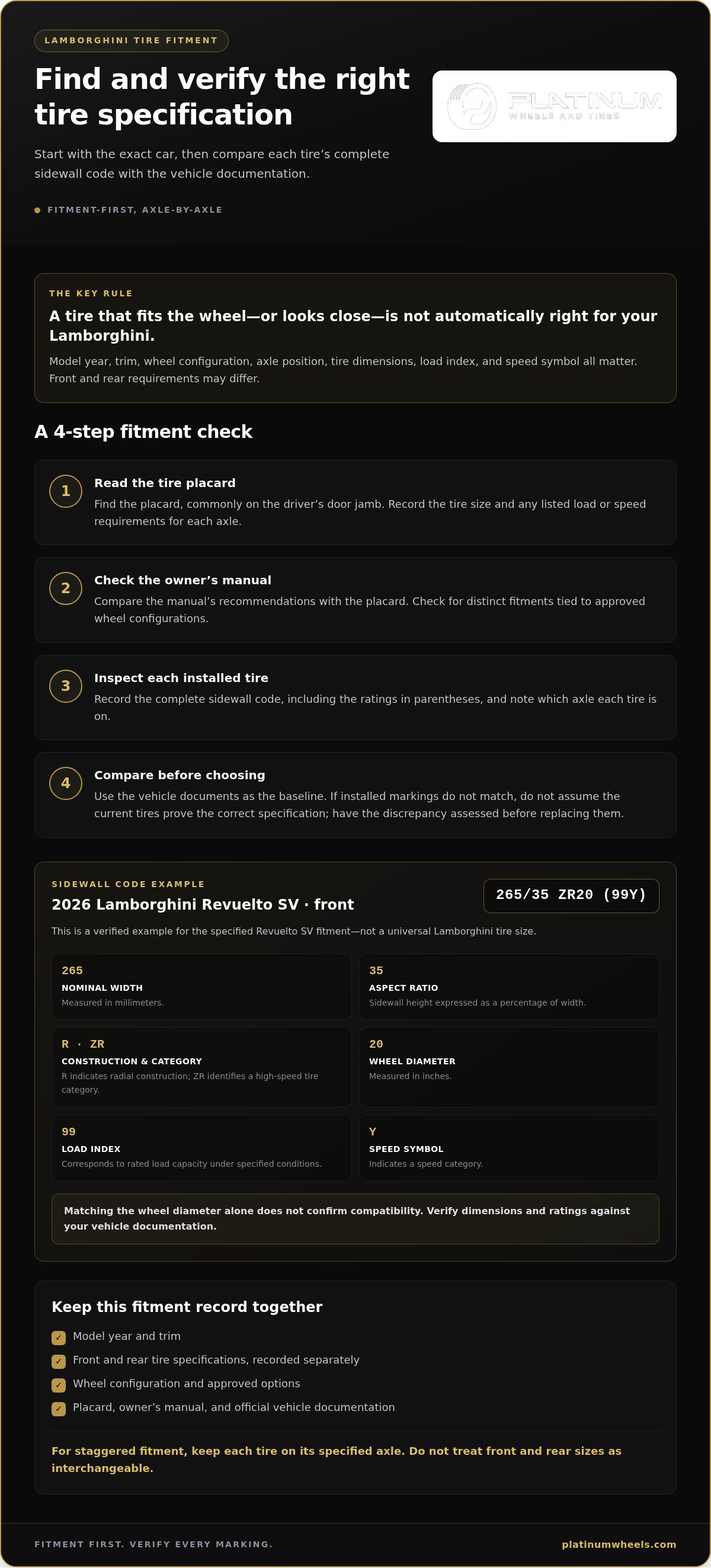
Verified example, not a universal Lamborghini size: the 2026 Lamborghini Revuelto SV uses a 265/35 ZR20 (99Y) tire at the front. In this code, 265 is the nominal width in millimeters; 35 is the aspect ratio, meaning the sidewall height is expressed as a percentage of the width; R indicates radial construction; and 20 is the wheel diameter in inches. The ZR marking identifies a high-speed tire category. This example applies to the specified Revuelto SV fitment, not every Lamborghini.
The parenthetical 99Y adds two important ratings. The load index, 99, corresponds to a tire’s rated load capacity under specified conditions. The speed symbol, Y, indicates a speed category. Don’t select either rating by guesswork. Check the vehicle documentation for the required values. The NHTSA’s tire safety guidance also explains tire safety information, but ratings and general safety labels don’t replace vehicle-specific fitment requirements.
A matching wheel diameter is only one part of the code. Width, sidewall profile, construction, load index, and speed symbol also matter. A tire marked for a 20-inch wheel isn’t automatically suitable just because your Lamborghini has 20-inch wheels.
Where to find your Lamborghini’s specified tire size
Start with the tire placard, commonly located on the driver’s door jamb, and the owner’s manual. Use the specifications for your exact model year and configuration, not a listing for a similar-looking car. If the vehicle has staggered fitment, record the front and rear requirements separately. Never assume one axle’s size belongs on the other.
- Read the placard. Note the tire size and any listed load or speed requirements for each axle.
- Check the owner’s manual. Compare its recommendations with the placard, including any distinct fitments for approved wheel configurations.
- Inspect the installed tires. Record each complete sidewall code, including the ratings in parentheses, and note which axle each tire is on.
- Compare before choosing. If the installed markings don’t match the vehicle documents, don’t treat the current tires as proof of the correct specification. Have the discrepancy assessed before replacing them.
Keep those details together before comparing replacement options. Colorado Front Range truck and SUV owners can use the same fitment-first approach when choosing a setup. Platinum Wheels’ wheel and tire packages include professional mounting and balancing.
Original-Equipment vs. Replacement Lamborghini Tires: What Should You Compare?
Original-equipment (OE) tires are selected for a particular vehicle specification. Replacement tires may offer different characteristics, but they still need to meet that car’s requirements. Don’t assume one brand or tire model suits every Lamborghini. Compare the complete fitment and ratings first, then consider how you drive and which tire characteristics matter most.
What original-equipment markings and approvals tell you
Some tires carry markings that identify a vehicle-maker-approved fitment, but those markings are meaningful only in the context of the specific tire and vehicle. For example, Bridgestone’s 2026 Revuelto SV OE tires have custom Lamborghini sidewall markings. That doesn’t mean every Lamborghini requires Bridgestone, or that branding alone proves compatibility. Check the tire’s full specification against your vehicle documentation.
| Comparison point | Verified information | What requires model-specific verification |
|---|---|---|
| OE tire partner | Bridgestone is the exclusive tire partner for the 2026 Revuelto SV; Pirelli developed bespoke P Zero tires for the 2026 Urus SE Tettonero Capsule. | The OE partner, tire model, and approved options for your exact model year, trim, and wheel configuration. |
| Sidewall markings | The cited Revuelto SV OE tires feature custom Lamborghini sidewall markings. | Whether an approval marking applies to your particular vehicle and tire specification. A logo or brand name alone isn’t enough. |
| Replacement fitment | OE tires are developed for specific vehicle applications. | Size, axle position, load index, speed rating, and any documented approval for the alternative. |
| Driving characteristics | Different tire designs can emphasize different uses and characteristics. | Expected comfort, wet-road response, noise, and tread life for the exact tire in the intended conditions. |
How driving priorities change the replacement comparison
For regular road use, weigh wet-road response, comfort, and noise alongside the required performance specifications. If you drive spiritedly on occasion, handling response may be a higher priority. Seasonal use calls for a tire suited to the expected temperature and road conditions. These priorities help narrow the comparison, but they don’t override approved vehicle fitment.
There are trade-offs. A tire focused on sharp response may feel firmer or produce more road noise. A design emphasizing comfort or tread life may deliver a different balance of steering feel and wet grip. Actual results depend on the tire and vehicle, so don’t treat a category label as a performance guarantee. Compare Lamborghini tires by exact size and ratings, documented approvals, intended use, and the manufacturer’s vehicle-specific guidance.
Use OE specifications as your reference point, not as a shortcut to assuming every replacement must carry the same brand. A suitable alternative still has to meet the vehicle’s requirements, including the correct front and rear fitments where they differ. Once compatibility is established, compare the characteristics that matter for your regular driving and seasonal plans.
How to Choose Lamborghini Tires for Colorado Roads and Weather
Colorado driving can shift from dry Front Range pavement to rain, cold mornings, or snow on a mountain route. Think through where and when you drive, then compare tire characteristics within your Lamborghini’s documented fitment. A route with changing elevation may bring different weather, but it doesn’t change the vehicle’s required tire specifications.
Seasonal suitability and approved fitment are separate checks: a tire suited to the weather still needs to meet your vehicle’s specifications. One tire choice may not optimize dry-road response, rain performance, comfort, tread life, and winter traction all at once. Decide which conditions matter most in your regular driving.
Match tire characteristics to your typical Colorado driving
Consider your routine before weighing tire categories. Daily Front Range driving may mean mostly dry roads with occasional rain or temperature swings. Mountain trips add the possibility of colder conditions and changing weather along the way. A performance tire may prioritize responsive handling in its intended conditions, while an all-season category is designed for a broader range of conditions. Neither label alone proves suitability for a particular Lamborghini or severe winter weather.
For Colorado winter conditions, dedicated winter tires are the safest option. High-performance all-season tires may be sufficient for AWD vehicles in light snow, but they aren’t a substitute for true winter tires in severe conditions. Compare the tire maker’s guidance and vehicle documentation with your expected use. Don’t assume an AWD system removes the need to consider tire capability.
Inspect tires before deciding on replacement
Look over the tires already on the car, but don’t treat their presence as proof they’re the correct fitment. Check for visible damage, uneven or low tread, signs of aging, and pressure that differs from the manufacturer’s guidance. Check tire pressure as directed by the vehicle maker rather than judging it by appearance alone. For more on pressure monitoring, consult the TPMS Sensor Guide.
Compare the installed tires with the vehicle’s specified sizes and axle positions. If the markings differ from the vehicle documentation, or damage makes the condition uncertain, have the discrepancy assessed before choosing replacements.
Use this checklist to organize the decision:
- Use: Note whether the car is driven mostly around the Front Range, on mountain routes, or in both settings.
- Season: Consider dry roads, rain, cold temperatures, light snow, and whether severe winter conditions are part of your plans.
- Storage: If you use separate seasonal tires, plan for suitable storage that protects them from damage and deterioration.
- Condition: Review tread, pressure, visible damage, and age, following manufacturer guidance.
- Fitment: Match every tire to the documented specification and correct axle position.
Colorado Front Range truck and SUV owners weighing tire choices for changing road conditions can explore Platinum Wheels’ tire offerings.
Make a Confident Tire Decision with a Fitment-First Plan
A clear decision comes from working in order: establish the vehicle’s required fitment, define the driving conditions, compare suitable options, then inspect the tires and related equipment. That sequence keeps brand preference or a seasonal need from distracting you from the specifications your vehicle requires. For Lamborghini tires, use Lamborghini’s documentation for the specific car as your reference throughout the process.
A final Lamborghini tire-fitment checklist
Before settling on a replacement, gather the information for the exact vehicle and compare it with the tire options under consideration. Keep front and rear requirements distinct if the car uses different specifications by axle. A complete check also considers tire condition and pressure-monitoring equipment, not just the size printed on the sidewall.
- Confirm the vehicle. Record model year, trim, wheel setup, and the documented tire specifications for the front and rear.
- Compare the full tire requirements. Check size, load index, speed rating, and any documented approval against the owner’s manual, placard, and official vehicle references.
- Define the use. Consider regular road use, spirited driving, seasonal conditions, and the balance of performance, comfort, and tread life you value.
- Inspect what’s installed. Look for damage, wear, aging, and pressure concerns. Compare each tire’s marking and axle position with the required fitment.
- Account for TPMS. Include the vehicle’s tire-pressure monitoring requirements in the replacement plan so the system remains part of the overall fitment decision.
If the tire markings and vehicle documents disagree, pause before treating the current setup as the correct one. A careful assessment can help identify whether the difference relates to the wheel configuration, a prior change, or another detail that needs resolving. Don’t substitute a size based only on appearance or a listing for a similar model.
How fitment expertise helps Colorado truck and SUV owners
The same fitment-first discipline matters for trucks and SUVs, where tire dimensions, wheel choice, intended use, and TPMS all need to work together. A wheel-and-tire package brings those choices into one coordinated setup, while proper mounting and balancing help complete the package. For additional planning, use the guide to aftermarket wheel and tire packages alongside your vehicle’s specifications.
Platinum Wheels serves Colorado Front Range truck and SUV owners with wheel-and-tire offerings, including professional mounting and balancing. When planning a setup, keep your vehicle details and driving priorities at hand so the tire and wheel choices work together.
Explore Platinum Wheels’ tire and wheel services for truck and SUV options across the Colorado Front Range.
Make Your Next Tire Choice with Confidence
Before you buy, turn your vehicle documentation into a clear reference you can use to compare options. That step helps keep a strong preference for a particular tire or seasonal feature from overshadowing compatibility. The best choice is the one that fits your exact vehicle and supports the way you plan to drive. For Lamborghini tires, follow the specifications and approvals documented for your model rather than assuming a setup carries across the lineup.
Platinum Wheels serves Colorado Front Range truck and SUV owners as a locally owned and operated shop. Its wheel-and-tire packages include professional mounting and balancing, with TPMS sensors available as part of the package. For your truck or SUV, compare tire and wheel options against your vehicle’s fitment and intended use.
Explore Platinum Wheels’ tire and wheel services for trucks and SUVs and plan your next vehicle setup with a clear fitment reference.
Frequently Asked Questions
What tires does a Lamborghini use?
The tire specification depends on the exact model, year, and wheel configuration. For example, Bridgestone supplies the 2026 Revuelto SV with a model-specific tire lineup that includes road, track-oriented, and winter options. The 2026 Urus SE uses bespoke Pirelli tires, with a dedicated winter option also available. These examples aren’t interchangeable recommendations. Check your vehicle’s documentation for its approved tire choices before selecting replacements.
Are Lamborghini tires different at the front and rear?
They can be. A staggered setup uses different specifications on the front and rear axles, and some Lamborghini configurations use this arrangement. That difference can also affect tire rotation: a tire may not be suitable for moving to another axle, even if it fits a wheel. Follow the vehicle’s maintenance guidance for rotation and replacement rather than assuming all four tires share the same dimensions.
Can I put different tires on my Lamborghini?
You can consider an alternative only if it meets the vehicle’s documented requirements for size, load capacity, speed rating, and applicable approval. A different brand or model isn’t automatically unsuitable, but a similar-looking tire isn’t proof of compatibility either. Mixing tire types or models can change how the car responds, so keep tires matched as directed by the owner’s manual and vehicle-specific tire guidance.
How do I find the correct tire size for my Lamborghini?
Use the tire placard and owner’s manual as your starting references, then compare them with official information for your car’s model year and configuration. Check the complete sidewall code on each axle, not just the wheel diameter. If the installed tires disagree with the vehicle documents, don’t assume the current setup is correct. Have the discrepancy assessed before ordering replacements.
Do Lamborghini tires need to be replaced as a complete set?
Not automatically. The decision depends on the condition of the other tires, the vehicle’s replacement guidance, and whether a matching tire can be fitted without creating an unsuitable difference in wear or specification. Start by checking all four tires for damage and tread wear, then compare their sizes and ratings by axle. Follow Lamborghini’s instructions for your specific vehicle before replacing one tire, an axle pair, or the full set.
Are all-season tires suitable for a Lamborghini in Colorado?
They may suit some driving patterns, but all-season tires aren’t a universal answer for Colorado weather. High-performance all-season tires may be sufficient for AWD vehicles in light snow, while dedicated winter tires are the safer choice in severe winter conditions. Consider your car’s approved fitment, typical routes, and expected weather. An all-season label alone doesn’t establish that a tire is approved for your Lamborghini.
Does changing Lamborghini tires affect the TPMS?
Changing tires doesn’t automatically mean the TPMS needs replacement, but the sensors and system should be considered during the work. Sensors may need to be handled carefully during tire service, and a reset or relearn procedure may depend on the vehicle. Follow the owner’s manual if a warning remains after installation. For truck and SUV wheel-and-tire packages across Denver, Aurora, Lakewood, Englewood, Wheat Ridge, Commerce City, Westminster, Thorton, Broomfield, Arvada, Golden, Littleton, Parker, Highlands Ranch, Castle Rock, Boulder, Fort Collins, and Colorado Springs, contact Platinum Wheels.