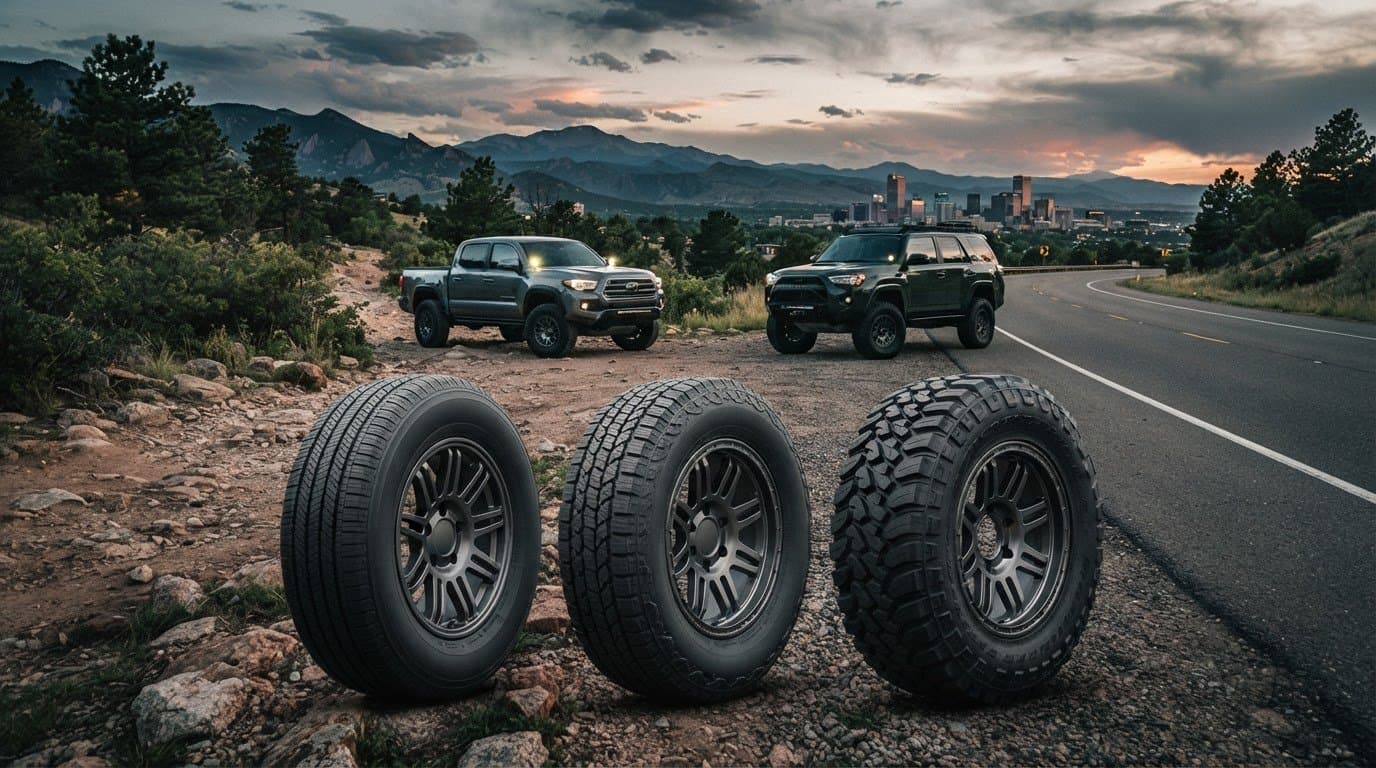
Best Toyo Tires for Denver Driving & Off-Roading
The most aggressive Toyo tire isn’t automatically the best choice for your truck or SUV. For Denver driving, a tire suited to regular commutes and occasional dirt roads may make more sense than one designed for demanding off-road use. Toyo tires span highway, all-terrain, and mud-terrain categories, each balancing pavement use and trail capability differently.
Similar-sounding product names can make it tempting to choose by appearance, especially when a trail-ready tread catches your eye. But the right match depends on how and where you drive, along with your vehicle’s specifications. This guide compares the main categories and explains what to consider before changing tire size.
We’ll connect those choices to Denver and Colorado Front Range driving, then cover the vehicle and tire details that matter for fitment. Platinum Wheels, a Denver-owned and operated wheel and tire shop, offers a Free Wheel & Tire Fitment Consultation to help you consider your vehicle, tire size, and intended use together.
Key Takeaways
- Choose among Toyo tires by matching the tire category to your regular driving, not just the tread’s appearance.
- Start with your vehicle and full tire size. Find the size on the tire sidewall or your vehicle information label.
- Compare all-terrain, mud-terrain, and highway-oriented tires based on where you drive most, from city streets to trails.
- For Denver and Colorado Front Range routes, consider the weather and road conditions you encounter on your typical trips.
- Use Platinum Wheels’ Free Wheel & Tire Fitment Consultation to discuss your vehicle, tire size, and intended use. Air, Wheel Test Fitment, Quick Alignment Check, Rim/Tire/Package/Shipping Quote, TPMS Programming, and Quick-Check Alignment are also free.
What Are Toyo Tires? Start with the Right Tire Category
Toyo tires are a range of tires designed for different vehicle types and driving uses. The lineup includes options for paved roads, mixed pavement and dirt, demanding off-road terrain, and performance-focused street driving. The brand name alone doesn’t tell you whether a tire suits your vehicle or routine. Category, size, load requirements, and intended conditions all matter.
A tire category describes the intended balance of road use, driving conditions, and tread design. That’s a more useful starting point than choosing by brand or appearance. Toyo’s history, products, and global operations are summarized in the Toyo Tires Wikipedia overview. The category comparisons below help translate broad labels into everyday decisions.
How Do Toyo Tire Categories Differ?
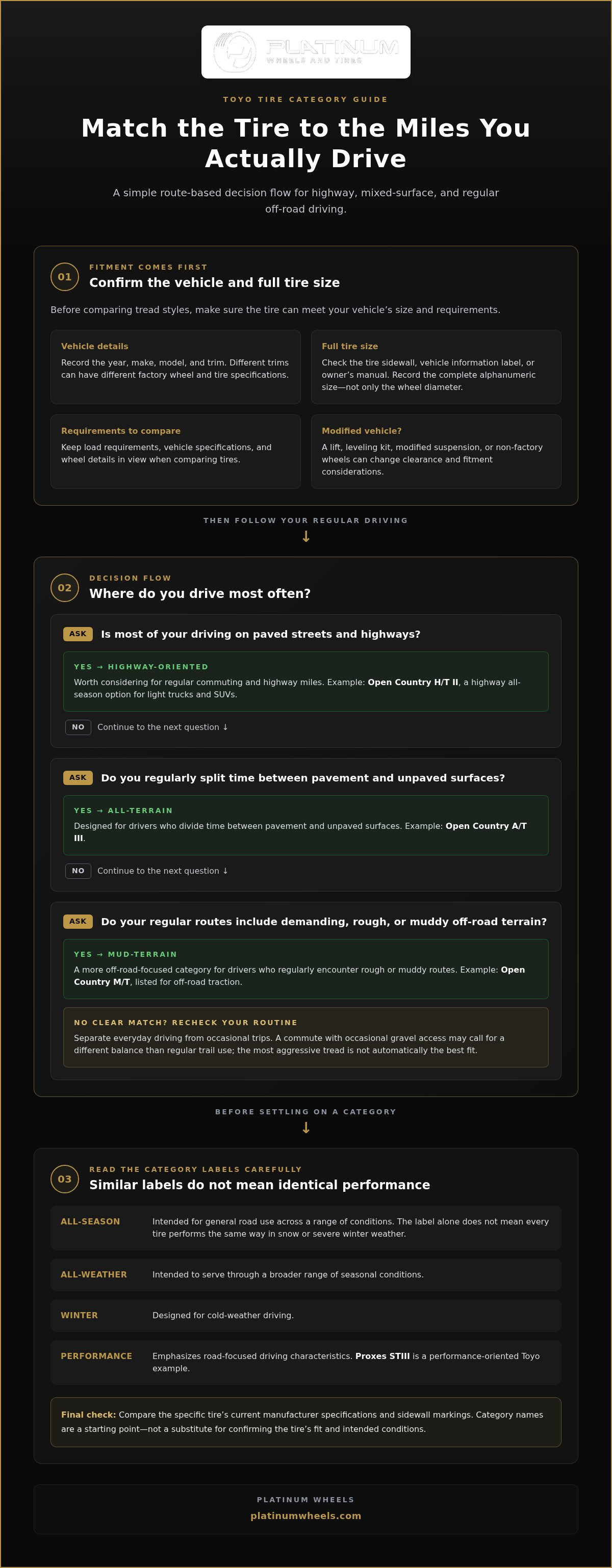
Highway-oriented tires are designed for paved-road driving, making them worth considering for regular commuting and highway miles. All-season tires are also intended for general road use across a range of conditions, but “all-season” doesn’t mean every tire performs the same way in snow or severe winter weather. Check the specific tire’s markings and specifications rather than relying on the label alone.
All-terrain tires are aimed at drivers who split time between pavement and unpaved surfaces. Mud-terrain tires are more off-road-focused, for drivers who regularly encounter rough or muddy routes. Neither category is automatically the right choice for every trail or commute. Match the tire’s intended use and road manners to your priorities.
Winter tires are designed for cold-weather driving, while all-weather tires are intended to serve through a broader range of seasonal conditions. Performance tires emphasize road-focused driving characteristics. These are general category descriptions, so compare the manufacturer’s current specifications and sidewall markings for the exact tire you’re considering.
Which Vehicles Does the Toyo Lineup Cover?
Toyo’s product examples include tires for passenger cars, SUVs, and light trucks, with specific lines aimed at different uses. For light trucks and SUVs, examples include the Open Country H/T II for highway all-season use, Open Country A/T III for all-terrain use, and Open Country M/T for off-road traction. The Proxes STIII is a performance-oriented example.
Start with your vehicle, not a model name. A tire must match the vehicle’s approved size and requirements, and a familiar product line may not come in a suitable fitment for every vehicle. Find the current tire size on the sidewall or vehicle information label, then use it alongside your typical driving conditions to narrow the category. If you’re considering a different size, evaluate fitment rather than guessing.
How to Choose Toyo Tires for Your Vehicle and Driving Habits
A clear selection process keeps you from getting distracted by a tire’s name or appearance before confirming that it fits. Start with the vehicle’s approved size and intended use. Work through these steps, then compare options that meet your vehicle’s requirements and your driving priorities.
- Identify your vehicle. Record its year, make, model, and trim. Trim matters because versions of the same vehicle can have different factory wheel and tire specifications.
- Confirm the current tire size. Read the alphanumeric size printed on the tire sidewall, or check the vehicle information label, commonly found on the driver’s door jamb. The owner’s manual may also list approved sizes. Record the full size, not just the wheel diameter.
- Define your main use. Rank your typical driving, such as commuting, highway travel, mountain routes, gravel roads, or off-road trails. Separate routine conditions from occasional trips.
- Compare categories and fitment. Use your driving priorities to narrow the category, then compare candidate tire specifications with your vehicle’s requirements. The U.S. Tire Manufacturers Association also provides general information about tire selection and care.
What Vehicle and Tire Details Should You Gather?
Keep your vehicle information, full tire size, and wheel details together while comparing Toyo tires. Wheel diameter is only one part of the tire size. Load requirements and vehicle specifications also affect whether a tire is appropriate. Factory wheels and suspension provide a starting reference, but modifications can change clearance and fitment considerations.
If your vehicle has a lift or leveling kit, modified suspension, or non-factory wheels, don’t assume the original tire size tells the whole story. A fitment assessment can account for those changes and help connect the tire choice to your vehicle. Platinum Wheels’ Free Wheel & Tire Fitment Consultation gives you a practical way to review those details before settling on a size.
How Should You Match a Toyo Tire to Your Driving?
Put your most frequent driving conditions first. A Denver-area driver who spends most days on paved streets and highways, with occasional gravel access roads, may need a different balance than someone who regularly travels rough trails. Consider road comfort, seasonal use, tread style, and intended terrain together rather than treating any one feature as decisive.
For a mix of pavement and gravel, compare all-terrain options. For regular off-road use, consider whether a more aggressive category better reflects your routes. Highway-oriented tires may be a closer match for predominantly paved driving. If Colorado conditions and all-terrain choices are central to your decision, the Colorado all-terrain tire guide adds a local perspective. Rank your routes, then use fitment guidance to narrow your options.
Toyo All-Terrain, Mud-Terrain, and Highway Tires Compared
These categories serve different driving patterns, so no single option is right for every Denver truck or SUV. Consider how often you leave paved roads, the terrain you encounter, and how much of your driving is routine commuting. Then compare your needs with the manufacturer’s current description and the tire’s fitment requirements, not the tread pattern alone.
| Category | Intended use | Typical driver | Key decision |
|---|---|---|---|
| All-terrain | A mix of paved roads and unpaved surfaces | Someone who commutes but also travels gravel roads or occasional trails | Does your regular driving justify a tire designed for mixed surfaces? |
| Mud-terrain | Off-road terrain, including routes where maximum off-road traction is the priority | A driver who frequently takes a light truck off pavement or to demanding work sites | Is off-road use frequent enough to make this category a practical match? |
| Highway | Primarily paved roads and highway travel | A commuter or road-trip driver who rarely needs trail-focused tread | Does your driving happen mostly on pavement? |
When Does an All-Terrain Toyo Tire Make Sense?
An all-terrain tire may suit a driver who spends most days on pavement but also uses gravel access roads or occasional trails. Toyo’s Open Country A/T III is an all-terrain example for trucks, CUVs, and SUVs. That category label describes its broad purpose, not whether it fits a particular vehicle. Tread appearance can’t confirm size, load suitability, or clearance.
How Do Mud-Terrain and Highway Tires Differ?
Toyo describes the Open Country M/T as an off-road, maximum-traction tire designed for light trucks. The Open Country H/T II, by contrast, is a highway all-season tire for light trucks and SUVs. These manufacturer descriptions clarify the categories, but your routes and vehicle determine which type to consider.
For mostly paved commuting, highway-oriented options align with the surface you use most. Frequent trail or work-site driving may point toward a more off-road-focused category. Consider the difference between your everyday route and your occasional adventure. Choosing for rare conditions can mean prioritizing a use that isn’t central to your routine. Compare current manufacturer specifications, tire size, load requirements, and vehicle fitment before narrowing your shortlist of toyo tires.
Drivers weighing trail use against wheel and tire fitment can explore this Colorado off-road tire and wheel guide for additional perspective. The goal is to choose a category that makes sense for your actual driving and a tire that suits your vehicle.
Choosing Toyo Tires for Denver and Colorado Road Conditions
Denver-area driving can mean city streets in the morning, highway miles by afternoon, and a mountain or gravel route on the weekend. Those trips place different demands on a tire. Rather than choosing for the most dramatic road you might encounter, consider which conditions are part of your routine and which are occasional. No tire removes the need to adjust to changing weather, road surfaces, and driving conditions.
For a useful comparison, weigh pavement time, seasonal needs, and how often you travel beyond maintained roads. A tread pattern that looks ready for a trail doesn’t establish that the tire fits your vehicle or suits your typical routes. Check current manufacturer descriptions and specifications for the exact tire, especially for model-specific claims about seasonal or terrain performance.
What Should Front Range Drivers Consider Across Seasons?
Start with your routes. Do you mainly drive around town and on highways, or regularly travel into the mountains during winter? All-season, all-weather, and winter are distinct tire categories, but manufacturer terminology and specifications matter. Don’t assume an all-season tire has the same intended use as an all-weather or winter tire. Review the tire’s current description, markings, and seasonal guidance before comparing options.
Colorado weather can change, and conditions on a mountain route may differ from those in Denver. Base your choice on the trips you actually make, and remember that tire selection alone can’t make every road condition safe. Don’t treat a category label as a blanket promise of winter performance. Confirm the details for the specific tire.
What Changes When You Drive Mountain Roads or Trails?
Occasional gravel access is different from frequent off-road travel. If you mostly drive on pavement and rarely encounter gravel, decide whether a road-focused category still fits your priorities. Regular trail use or work on rougher surfaces may lead you to compare more aggressive tread categories. Let the frequency and type of off-pavement driving guide your decision, not appearance alone.
For Colorado drivers, one trip might include a paved highway followed by gravel, while another may involve sustained trail use. Those are different use cases. Compare the manufacturer’s stated intended use and fitment details. Don’t assume a category guarantees a particular level of grip, braking, or durability. Check any climate or model-specific performance statement against current manufacturer information.
Road-focused tread may make sense if you spend most of your time on pavement. Its intended use aligns with a primarily paved-road routine, but it may not suit someone who frequently drives off-road.
More aggressive tread may better reflect regular trail or rough-surface driving. Its off-road-oriented purpose may be unnecessary if you drive almost entirely on city streets and highways. Compare specifications and vehicle fitment before deciding.
To connect your routes, vehicle, and tire fitment, use Platinum Wheels’ Free Wheel & Tire Fitment Consultation to narrow down suitable options.
Get Toyo Tire Fitment Help in Denver and Plan Your Next Step
Once you’ve narrowed down a tire category, connect it to your specific vehicle. Platinum Wheels’ Free Wheel & Tire Fitment Consultation brings together vehicle details, current tire size, wheel setup, and intended driving use. That helps turn your research about Toyo tires into a practical fitment plan rather than a choice based only on a product name or tread appearance.
What Happens During a Free Tire Fitment Consultation?
Bring your vehicle’s year, make, model, and trim, along with the tire size shown on the sidewall or vehicle information label. Describe how you drive, including regular commuting, mountain travel, gravel roads, or off-road use. The team can discuss those details with you and help connect your priorities with tire size and fitment considerations.
If you’re considering different wheels, the free Wheel Test Fitment can help assess how a wheel and tire setup fits your vehicle. Other free services include Air, Quick Alignment Check, Rim/Tire/Package/Shipping Quote, TPMS Programming, and Quick-Check Alignment. These options help you consider fitment and related details as part of your tire decision, not as an afterthought.
How Can Denver Drivers Move from Research to Installation?
Keep the process straightforward:
- Gather your details. Have your vehicle information, current tire size, and any wheel or suspension changes ready.
- Discuss your driving. Describe your most common routes and the surfaces you encounter so the category reflects your actual use.
- Review fitment and options. Use the consultation to work through tire size and vehicle fitment before selecting a suitable tire.
- Plan installation. Once your choice is set, arrange tire installation and any related alignment or TPMS service.
Most tire installations are completed the same day. Installing a set of four tires typically takes 45 minutes to 1 hour. If you’re also having alignment or TPMS service, plan for 1.5 to 2 hours. Platinum Wheels offers transparent pricing, with no hidden fees and no surprise charges, so you can understand the plan before moving ahead.
For Denver and Colorado Front Range drivers, a fitment conversation can turn a broad category comparison into a decision grounded in your vehicle and routes. Get a free fitment consultation and take the next step toward a tire setup that suits your needs.
Make Your Next Tire Choice with Confidence
Your next step isn’t picking the most aggressive tread or the most familiar name. It’s turning your driving priorities into a setup that fits your vehicle. When comparing toyo tires, base your shortlist on the routes you drive and the fitment details that determine whether an option suits your vehicle.
Platinum Wheels is Denver-owned and operated, with 158 five-star Google reviews and a 4.9-star rating. Its Free Wheel & Tire Fitment Consultation and Wheel Test Fitment help connect tire research with practical fitment considerations. Same-day installation is available for most installations, with transparent pricing and no hidden fees or surprise charges.
Bring your vehicle details and the kind of driving you want your tires to support. Get a free Wheel & Tire Fitment Consultation and take the next step toward a tire setup suited to your Colorado driving.
Frequently Asked Questions
Is Toyo a good tire brand?
Toyo can be a suitable choice, but the right fit depends on the specific tire, your vehicle, and how you drive. Compare the tire’s intended category and current manufacturer specifications with your vehicle’s requirements rather than relying on brand reputation alone. A mostly paved commute and frequent off-road trips call for different priorities. Match the tire to your regular routes and expected conditions.
What are Toyo Open Country tires designed for?
Open Country is a Toyo product family with models intended for different uses, not a single tire type. The family includes examples described for highway, all-terrain, and off-road driving. Check the manufacturer’s current description for the specific model, then compare its listed specifications with your vehicle’s fitment requirements. Don’t assume every Open Country tire is an all-terrain option just because the family name is the same.
Are Toyo all-terrain tires good for daily driving?
They may suit daily driving, depending on the model, vehicle, route, and your priorities. A driver who mainly commutes on paved streets but occasionally uses gravel roads may want a different balance than someone who regularly drives off pavement. Review the manufacturer’s specifications for the exact tire and consider how its intended use matches your routine. Don’t assume a category label guarantees a particular noise level, tread life, fuel economy, or handling result.
Can I put Toyo tires on any vehicle?
No. A tire must match your vehicle’s approved size and required specifications; the brand alone doesn’t establish compatibility. Gather your vehicle’s year, make, model, trim, and current tire size before comparing options. Wheel or suspension changes can affect fitment, so the factory size may not answer every question on a modified vehicle. A professional assessment can help account for your vehicle’s setup and intended use.
Are Toyo all-season tires suitable for Colorado winters?
Suitability depends on the exact tire designation, your route, and the conditions you drive in. All-season, all-weather, and winter tires are different categories, so use the manufacturer’s current terminology and specifications rather than treating the labels as interchangeable. A tire can’t guarantee winter safety or replace careful driving. Consider how often your routine includes winter conditions, then review the specific tire’s stated use and markings for your vehicle.
How do I choose the right Toyo tire size?
Read the full size printed on your current tire’s sidewall, then compare it with the vehicle information label and your vehicle’s required specifications. Don’t rely on wheel diameter alone; the full size and other requirements matter. Changes to wheels or suspension can affect fitment, so the factory size may not answer every question on a modified vehicle. Get a professional fitment assessment if the details don’t line up clearly.
Where can I get Toyo tire fitment help in Denver?
Platinum Wheels is a Denver-owned and operated shop serving Denver, Aurora, Lakewood, Englewood, Wheat Ridge, Commerce City, Westminster, Thorton, Thornton, Northglenn, Broomfield, Brighton, Henderson, Dupont, Arvada, Golden, Evergreen, Conifer, Morrison, Indian Hills, Kittredge, Idledale, Pine, Buffalo Creek, Bailey, Littleton, Centennial, Highlands Ranch, Parker, Castle Rock, Castle Pines, Lone Tree, Sedalia, Louviers, Franktown, Larkspur, Elizabeth, Elbert, Kiowa, Boulder, Longmont, Louisville, Lafayette, Erie, Lyons, Nederland, Eldorado Springs, Allenspark, Fort Collins, Loveland, Greeley, Windsor, Johnstown, Berthoud, Timnath, Severance, Mead, Firestone, Frederick, Dacono, Evans, Fort Lupton, Estes Park, Platteville, Idaho Springs, Georgetown, Empire, Dumont, Black Hawk, Central City, Silver Plume, Breckenridge, Keystone, Frisco, Silverthorne, Winter Park, and Colorado Springs. Its free Wheel & Tire Fitment Consultation and Wheel Test Fitment help assess vehicle details, size, and intended use. Same-day installation is available for most installations. A set of four tires typically takes 45 minutes to 1 hour, or 1.5 to 2 hours with alignment or TPMS service.