When to Replace Tires: The Ultimate 2026 Truck Owner’s Safety Checklist
What if your current tread depth is the only thing standing between a safe weekend in Vail and a $500 fine on I-70? It is a question every local driver faces as the seasons shift. You likely understand the stress of white-knuckling the steering wheel while towing a heavy load through a mountain storm. It's an exhausting experience, and often the best solution for peace of mind is upgrading truck tires before the first snowflake hits the pavement.
The fear of a blowout or a loss of traction shouldn't be part of your weekend plans. We'll help you navigate the 2026 Colorado Traction Law requirements, including the critical 3/16-inch tread depth rule. This guide provides a clear checklist to identify tire wear and determine if your current rubber can handle the ice. You'll gain the knowledge to choose between a standard replacement or a performance upgrade that fits your lifestyle. Let's ensure your truck is ready for every mile of the high country.
Key Takeaways
- Learn to spot Colorado-specific damage like "weather checking" from intense UV exposure and dangerous sidewall bulges before they cause a highway blowout.
- Master the 3-step tread audit using a dedicated gauge or the penny test to ensure you stay compliant with the 3/16-inch Colorado Traction Law requirement.
- Understand how Denver's extreme temperature swings and road salts accelerate rubber degradation, making the DOT date code just as important as your mileage.
- Evaluate your specific driving habits to decide if upgrading truck tires to an all-terrain or mud-terrain set is the right move for your weekend adventures.
- Gain the confidence to navigate icy I-70 mountain passes with a verified safety checklist that prioritizes your truck's integrity and your peace of mind.
Visual Warning Signs: Is It Time to Replace Tires on Your Truck?
Colorado roads are brutal on rubber. Between jagged mountain rocks and the searing Mile High sun, your tires endure a constant beating. Before you head up I-70 for a weekend haul, take five minutes to walk around your rig. A visual inspection is your first line of defense against a roadside disaster. You don't need to be a master technician to spot the red flags that suggest your truck's connection to the pavement is failing.
Identifying Sidewall Damage and UV Rot
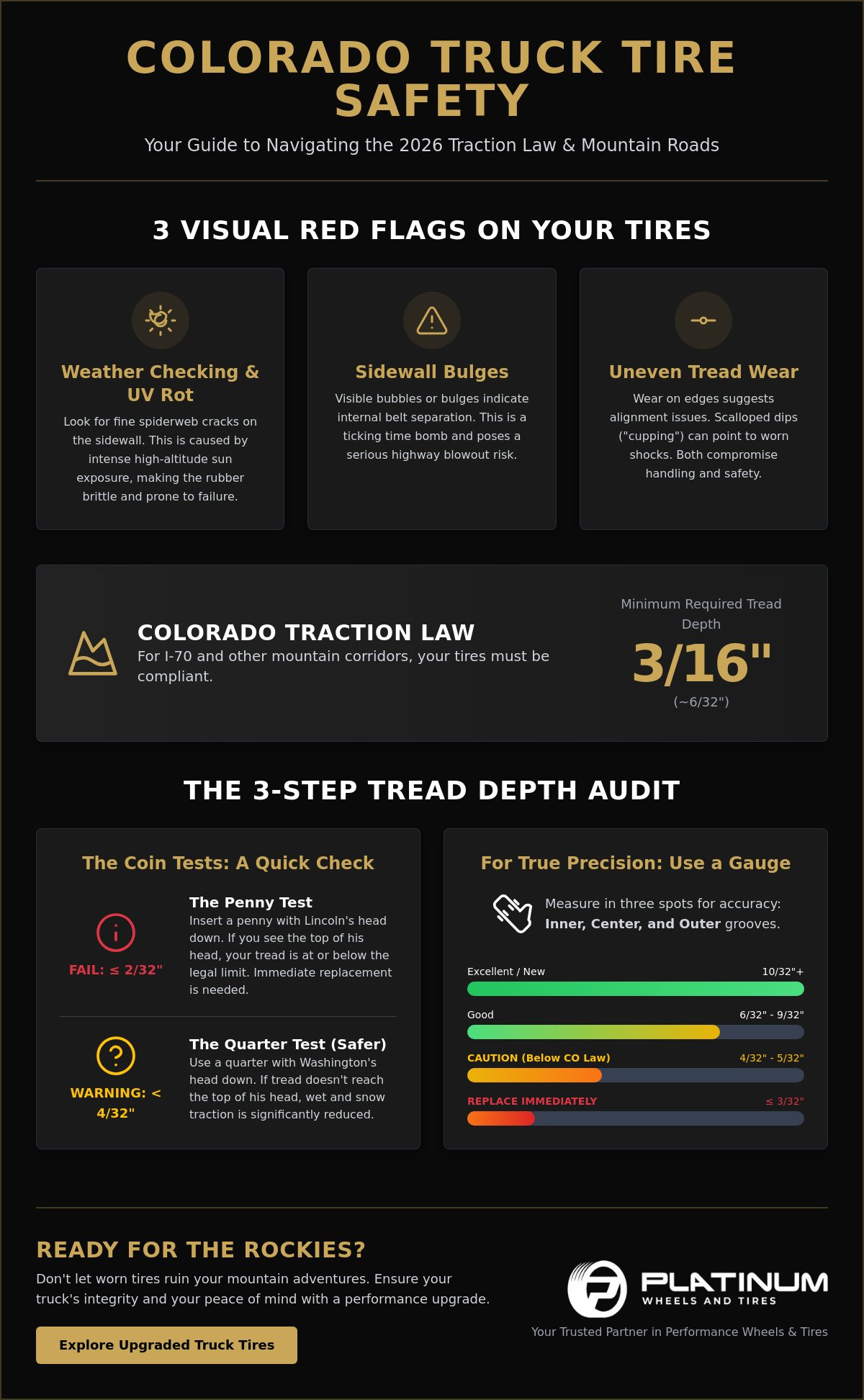
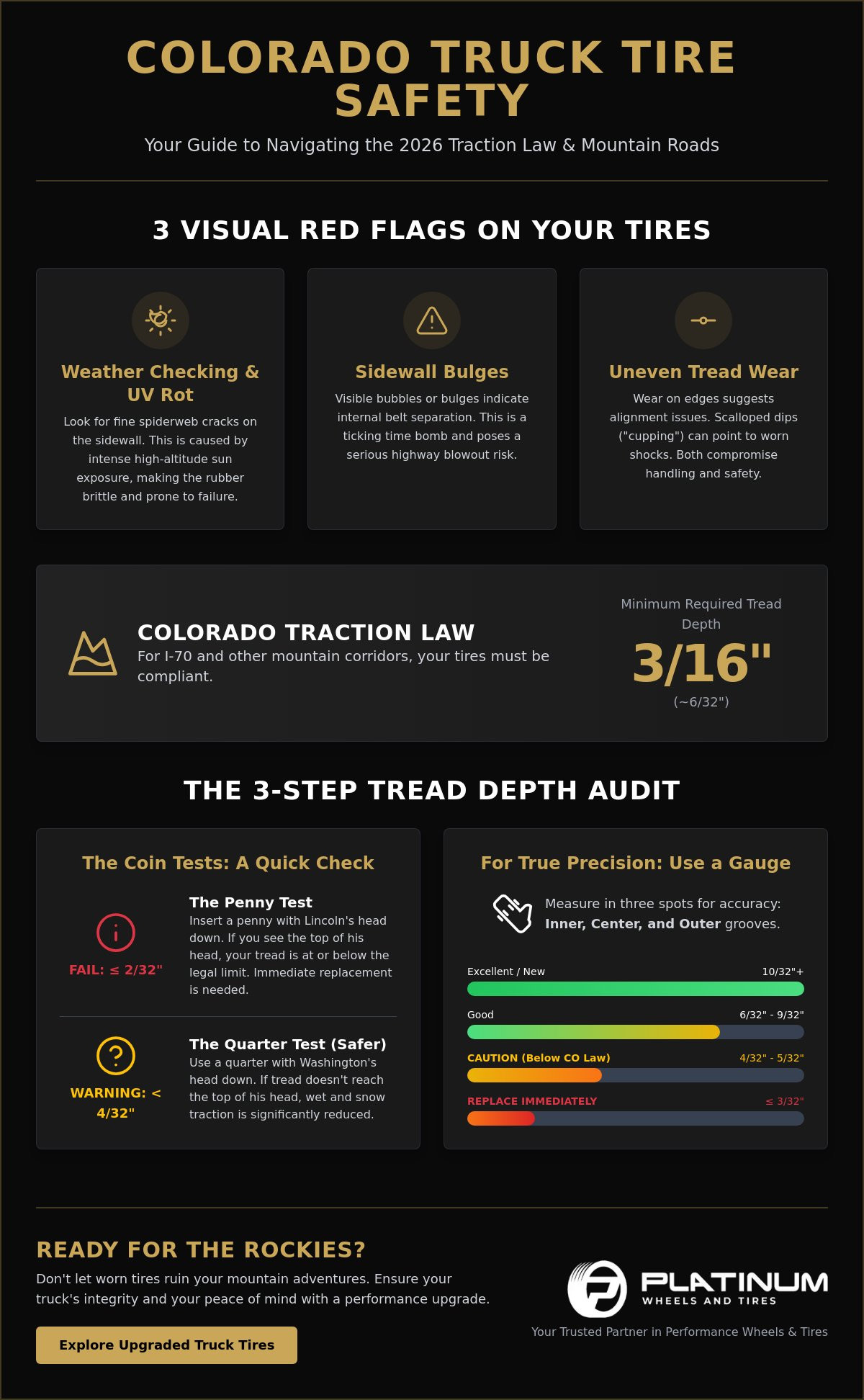
High-altitude living means your truck sits closer to the sun's intense rays. This leads to "weather checking," which appears as tiny spiderweb cracks across the sidewall. These cracks aren't just cosmetic. They indicate that the protective oils in the rubber have evaporated, leaving the tire brittle and prone to failure. If you spot these, it's a non-negotiable sign that you're due for a replacement. Even more dangerous are "bubbles" or visible bulges. These signify internal belt separation. Driving on a bubbled tire is like holding a ticking time bomb, especially at high speeds on I-25. Consistent Tire maintenance and safety checks can catch these issues before they lead to a dangerous blowout.
Spotting Uneven Tread Wear Patterns
Your tread tells a story about your truck's alignment and suspension health. If you notice the inner or outer edges wearing down faster than the center, your alignment is likely out of spec. Heavy-duty vehicles frequently suffer from "cupping," which looks like scalloped dips or "hills and valleys" in the rubber. This usually points toward worn-out shocks or struts that are failing to keep the tire firmly on the pavement. You should know that simply rotating your tires won't fix a tire that has already developed a permanent wear pattern. Once the damage is set, the tire's performance is compromised, and the noise it generates will only get louder.
When these visual red flags appear, many owners start the process of upgrading truck tires to a more durable all-terrain or mud-terrain option. This move often provides better resistance to the specific UV rot and debris hazards we face in the Rockies. Finally, look for the wear bars. These are small rubber bridges located between the tread blocks. If the tread is flush with these bars, you've reached the legal limit. Pay attention to how the truck feels, too. Unusual vibrations or a rhythmic thumping noise while cruising the Front Range are often the first signs of internal failure that you can't see yet. Choosing to focus on upgrading truck tires now can prevent a costly emergency later.
Measuring Tread Depth: The 3-Step Practical Audit
Precision is everything. Relying on a quick glance to judge your remaining tread is a gamble that rarely pays off on Colorado's steep mountain grades. You need hard data before deciding if you're simply replacing a worn set or upgrading truck tires for better off-road performance. A thorough audit ensures you aren't leaving safety to chance when hauling heavy loads through the Front Range. Grab a few coins and a dedicated gauge to get started.
The Penny Test vs. The Quarter Test
The penny test is the most common DIY method for a reason. Insert a penny into the tread groove with Lincoln's head upside down. If you can see the very top of his head, your tread is at or below 2/32 of an inch. The 2/32-inch mark represents the universal legal limit for tire compliance, serving as a final warning that your vehicle's safety is at risk. However, for those of us living in the Rockies, this standard is often too low. Upgrading truck tires becomes a priority long before you hit that legal floor to maintain control on icy passes.
The quarter test offers a much safer buffer for local drivers. If the tread doesn't reach the top of Washington's head, you have less than 4/32 of an inch remaining. This is the critical threshold where wet-weather traction and snow-shedding capabilities begin to drop off sharply. Following NHTSA tire safety guidelines helps you understand how these measurements directly impact your stopping distance on slick or slushy surfaces.
Using a Tread Depth Gauge Correctly
For a truly accurate reading, invest in a dedicated tread depth gauge. These tools are inexpensive and available at most local auto parts stores in both analog and digital formats. They provide a precise measurement in 32nds of an inch, removing the guesswork from your safety check. To get a complete picture of your tire health, you must measure in three distinct areas:
- The center groove
- The inner shoulder
- The outer shoulder
Consistency across the tire width is key. If the center is significantly more worn than the shoulders, your tires are likely over-inflated. Conversely, worn shoulders often suggest under-inflation or an alignment issue. While a new all-terrain tire might start with 10/32 or 12/32 of an inch, once you hit that 4/32 "replacement zone," your off-road grip is severely compromised. If your audit reveals uneven wear or dangerously low numbers, it's the perfect time to browse our latest new tires to restore your truck's capability and your peace of mind.
The Colorado Factor: How Denver Weather Affects Tire Life
Denver weather is a silent killer for truck tires. One day it is 65 degrees and sunny in the city; the next, you are facing a sub-zero blizzard on the way to Silverthorne. These extreme temperature swings on the Front Range cause the rubber in your tires to expand and contract rapidly. Over time, this constant thermal cycling breaks down the chemical bonds in the rubber compound, leading to premature aging. Even if your truck spends most of its time parked, the environment is actively working against you.
Beyond the temperature, the actual terrain of the Rockies introduces physical hazards that most highway tires aren't built to handle. If you frequent the trails near Central City or tackle rocky access roads, you've likely seen "chunking." This occurs when sharp granite or shale literally tears small pieces of the tread blocks away. This damage creates uneven surface contact and can lead to annoying vibrations at highway speeds. For many local drivers, upgrading truck tires to a set with a reinforced, cut-and-chip resistant compound is the only way to survive a full season of mountain adventures.
Rubber Hardening and Winter Safety
When the mercury drops, the rubber in standard tires begins to lose its flexibility. A tire that is soft and grippy in July can turn into a hard, sliding hockey puck by January. This hardening effect is why tread depth alone doesn't tell the whole story of your safety. You can perform a simple "fingernail test" to check your rubber's health. Press your fingernail firmly into one of the tread blocks. If the rubber feels rock-hard and doesn't allow for a slight indentation, it has lost its ability to conform to the road surface. If your current set has reached this stage, consider Choosing the Best All-Terrain Tires for Colorado: The Complete 2026 Guide to find a compound designed for sub-freezing performance.
Magnesium Chloride and Road Salt Exposure
Road maintenance crews in Colorado rely heavily on magnesium chloride and road salt to keep the mountain passes open. While these chemicals are essential for traction, they are incredibly corrosive. These salts dry out the rubber, accelerating the "weather checking" we discussed earlier. They also wreak havoc on your TPMS sensors, often leading to corrosion that causes slow leaks around the valve stem. Following NHTSA tire safety guidelines is a great start, but local experts recommend an extra step: wash your wheels and tires thoroughly after every trip into the mountains. This simple habit removes the chemical residue that eats away at your investment. If your tires are already several years old, they are even more susceptible to this chemical damage, making upgrading truck tires a smart move before the next heavy winter hits.
Age vs. Mileage: The Hidden Expiration Date
Tread depth isn't the only metric that matters for your safety. Many truck owners in the Front Range assume that if they have plenty of rubber left, they are good to go. This is a dangerous misconception. Tires are perishable products with a functional shelf life of 6 to 10 years, regardless of how many miles you've driven. Rubber is a complex organic compound that begins to degrade the moment it leaves the factory. If your truck spends most of its time in a driveway or you only use it for occasional weekend hauls, your tires might age out long before they wear out.
Decoding the DOT Date Stamp
Flip your flashlight on and look at the inner or outer sidewall. You are looking for a series of characters beginning with "DOT." The final four digits of this sequence tell the story of the tire's birth. For example, a code of 2426 means the tire was manufactured during the 24th week of 2026. The last two digits represent the year of manufacture for your how to read tire size knowledge. Always verify this code, even when purchasing from large retailers. Some "new" tires have actually sat in a climate-controlled warehouse for three years before hitting the shelf. This "New Old Stock" already has a shortened lifespan before it even touches the asphalt.
The Dangers of Dry Rot and Brittleness
Rubber stays flexible thanks to specialized internal oils. As these oils evaporate over time, the tire becomes brittle, a process often called dry rot. You might see micro-cracks in the tread grooves or along the sidewall. This structural decay increases the risk of tread separation, especially during high-speed mountain descents where heat builds up quickly. If your tires are pushing the 8-year mark, they are likely losing their structural integrity. This is the ideal time for upgrading truck tires to a modern set that offers better heat resistance and durability.
Don't forget the spare tire tucked under your truck bed. It is often the most neglected and dangerous piece of equipment on a vehicle. Many owners are shocked to find a 12-year-old factory spare when they finally need it on the side of the highway. If your current set is nearing its expiration date, consider upgrading truck tires to ensure every wheel on your rig is reliable. If you're ready to swap out your aged rubber for something more dependable, browse our current wheel and tire packages to find a fresh, high-performance fitment for your truck.
Upgrading Truck Tires: Choosing the Right Set for 2026
You've completed the audit. You've checked your date codes and measured your tread. Now comes the pivotal decision: do you stick with the status quo or start upgrading truck tires to match your actual driving habits? In Colorado, your tires are your most important safety feature, especially when the weather turns on a dime. Choosing the right set requires an honest assessment of your weekly routine. If 90% of your miles are spent commuting on I-25 but you spend every third weekend hunting or skiing, your needs differ wildly from a dedicated trail rig that rarely sees pavement. Just as you wouldn't hit the slopes without the right gear from a specialist like Avalanche Pro Shop at avalancheshop.com, your vehicle needs the right equipment to get you there safely.
All-Terrain vs. Mud-Terrain for the Front Range
All-terrain tires remain the gold standard for most Denver drivers. They provide a relatively quiet highway ride while maintaining enough biting edges to handle slushy mountain passes. However, if your weekends involve deep mud or jagged rock crawling near Moab or the San Juans, mud terrain tires offer superior self-cleaning tread designs and aggressive sidewall protection. These tires are built to take a beating that would shred a standard highway tire in minutes.
You must also consider load ratings. Trucks require much stiffer sidewalls than passenger cars to handle the weight of the vehicle and its cargo. An E-rated tire is often necessary for towing heavy trailers to prevent "tire squirm" and dangerous overheating. We also specialize in ensuring your new rubber clears your specific lift or leveling kit without rubbing. Consulting with a local expert prevents the headache of buying a premium set of tires that don't actually fit your vehicle's geometry or suspension travel.
The Platinum Wheels Installation Difference
At Platinum Wheels, we focus exclusively on truck and SUV fitment. We understand that mounting oversized tires requires precision and specialized equipment to avoid damaging expensive custom rims. Our technicians are enthusiasts who speak your language and understand the specific demands of the Rockies. Every new tire package we install includes a comprehensive tpms sensor check to ensure your safety systems are communicating perfectly with your new equipment. We don't just slap rubber on a rim; we ensure the entire system is synced and balanced for the long haul.
We are your neighbors who drive the same canyons and passes you do. Our methodical process ensures your truck is balanced perfectly for high-speed highway stability and reliable trail grip. If you are still on the fence about the state of your current set, let us take a look. Visit Platinum Wheels in Denver for a professional tire health audit today! Ensuring your rig is ready for the 2026 season starts with a thorough check of your current equipment. Choosing to focus on upgrading truck tires now is the best way to guarantee your peace of mind every time you head into the high country.
Gear Up for Your Next Colorado Adventure
Your truck's safety depends on more than just a quick glance at the tread. We've explored how to identify the subtle signs of dry rot, decode DOT date stamps, and meet the strict 3/16-inch tread depth requirements of the Colorado Traction Law. Staying ahead of these wear markers ensures you never find yourself sliding on an icy mountain pass or dealing with a preventable blowout while towing. When your current set reaches its limit, upgrading truck tires becomes an investment in your vehicle's performance and your family's safety.
At Platinum Wheels, we are a locally owned and operated business in the Colorado Front Range. We provide expert fitment for Denver's top truck brands and use specialized equipment for off-road mounting and balancing. If you're ready to enhance your rig's capability with a fresh set of rubber, Browse our Custom Wheel and Tire Packages to find the perfect match for your lifestyle. Drive with confidence knowing your rig is ready for whatever the Rockies throw your way.
Frequently Asked Questions
How often should I really replace tires on my truck?
Most manufacturers recommend replacing tires every 6 to 10 years regardless of how much tread is left. However, Colorado's intense UV rays and temperature swings often cause rubber to become brittle sooner. You should have your tires inspected annually once they reach five years of age. If you frequently tow heavy loads or drive off-road, you might find your tread wears down to unsafe levels in just 3 or 4 years.
Is it okay to replace just two tires instead of all four on a 4x4?
You should always replace all four tires at the same time on a four-wheel-drive vehicle. Mismatched tire diameters, even by a small fraction of an inch, can cause significant strain on your truck's transfer case and center differential. This leads to mechanical binding and expensive drivetrain repairs over time. If you must replace only two, ensure they are the exact same brand and model as the others to minimize diameter differences.
What is the legal minimum tread depth for trucks in Colorado?
The legal minimum tread depth under the Colorado Traction Law is 3/16-inch for all-wheel and four-wheel drive vehicles. This requirement is strictly enforced on the I-70 Mountain Corridor from September through May. While the standard federal limit is 2/32-inch, failing to meet the Colorado-specific 3/16-inch rule can result in a $100 fine. If your lack of traction causes a lane closure, those fines can increase to over $650 including surcharges.
Do all-terrain tires wear out faster than standard highway tires?
All-terrain tires generally have a shorter lifespan than highway tires because they use softer rubber compounds designed for off-road grip. While a standard highway tire might last 60,000 miles, many aggressive all-terrain models are rated for closer to 40,000 or 50,000 miles. Frequent driving on sharp mountain rocks or hot asphalt will accelerate this wear. Regular rotations every 5,000 miles are the best way to ensure they wear evenly and last longer.
Can I drive on tires that have small sidewall cracks?
Driving on tires with visible sidewall cracks is dangerous and indicates that the rubber is failing structurally. These cracks, often caused by "weather checking" from high-altitude sun exposure, mean the internal oils have evaporated. This brittleness significantly increases the risk of a sudden blowout at highway speeds on I-25. If you spot any cracking, it's a clear sign that upgrading truck tires is necessary to maintain your safety on the road.
How much does it cost to replace a full set of truck tires in Denver?
The cost of a full set varies based on your truck's wheel size, required load rating, and the type of tread you choose. Premium mud-terrain or oversized tires for heavy-duty rigs represent a larger investment than standard all-season options. You should also factor in the cost of professional mounting, balancing, and tire disposal fees. Choosing upgrading truck tires that match your specific driving habits ensures you get the best performance and longevity for your money.
What happens if I don’t replace my TPMS sensors with my new tires?
Reusing old TPMS sensors often leads to slow air leaks and system failures shortly after your new tires are installed. The rubber seals and valve cores degrade over time, especially when exposed to corrosive magnesium chloride on winter roads. Most sensor batteries are designed to last about 7 to 10 years. Replacing them during a tire swap prevents the annoyance of a "service TPMS" light appearing a few months down the road.
How can I make my new truck tires last longer in Colorado?
Consistent maintenance is the secret to getting the most miles out of your tires in the Rockies. Rotate your tires every 5,000 miles and check your alignment after any heavy off-road excursion or hitting a deep Denver pothole. Wash your wheels and tires frequently during the winter to remove corrosive road salts. Finally, check your tire pressure monthly; the Front Range’s extreme temperature drops can cause significant pressure fluctuations that lead to uneven wear.