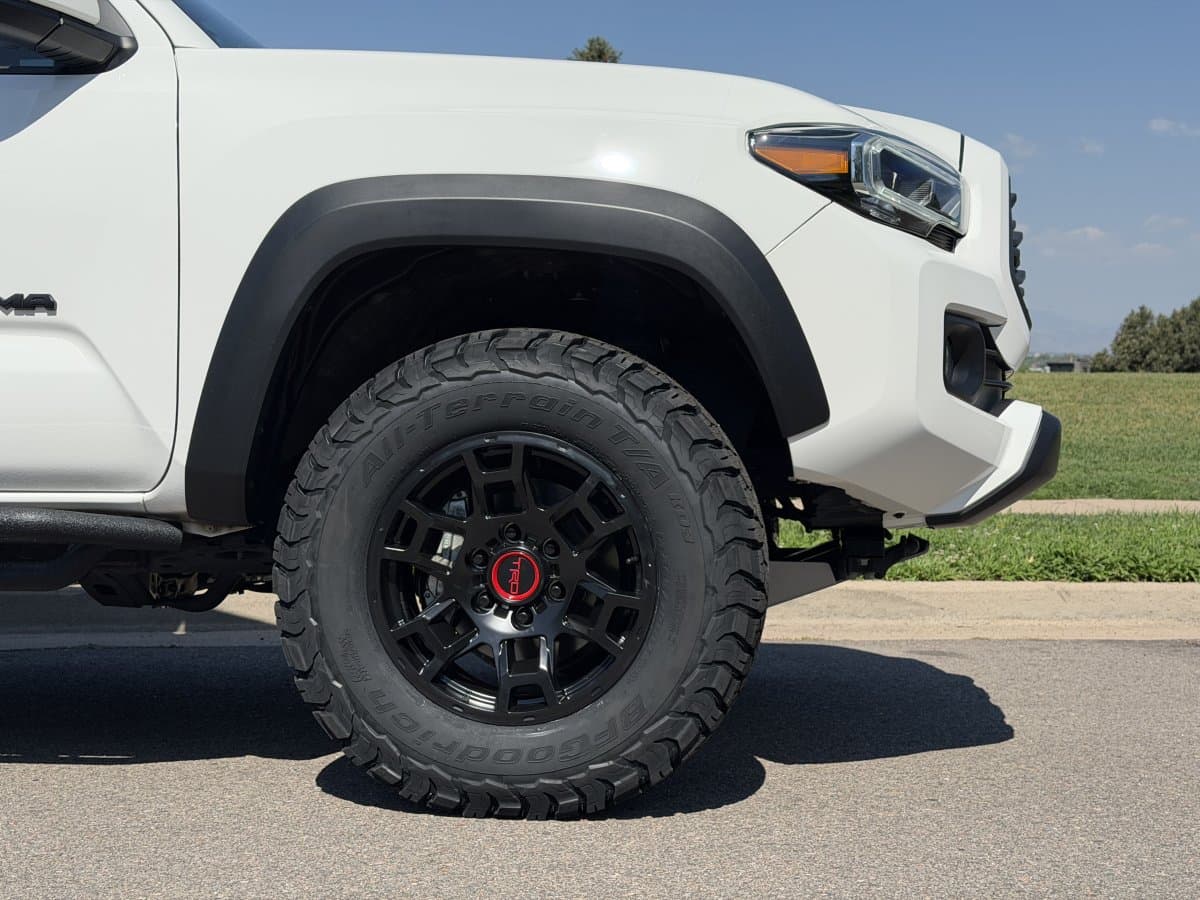
How to Read Tire Size: A Simple Truck Owner’s Guide for 2026
The numbers on your sidewall are the only thing standing between a successful mountain haul and a mandatory fine under Colorado's 2026 Traction Law. If you're staring at your tires and seeing a confusing jumble like 35x12.50R18 or 285/70R17, you aren't alone. Most truck owners agree that learning how to read tire size shouldn't require a degree in engineering, yet the mix of millimeters, percentages, and inches feels designed to keep you guessing. It's stressful to wonder if a new set of mud-terrain tires will rub your wheel wells or if they can actually handle a heavy trailer on a steep grade.
Master these numbers today so you can shop for your next set of rims and tires with total confidence. This guide breaks down the critical differences between metric and flotation sizing while explaining why load ratings are more important than ever for local safety. You'll learn to decipher any sidewall quickly, ensuring your truck maintains the 3/16-inch tread depth required for the high-altitude passes. Use this professional expertise to turn that confusing code into a clear roadmap for your rig's performance and peace of mind.
Key Takeaways
- Locate your specific tire data quickly by comparing the information on your sidewall with the manufacturer's recommendations found on the driver-side door placard.
- Master how to read tire size by deciphering the complex mix of metric millimeters and flotation inches commonly used on heavy-duty trucks and SUVs.
- Protect your rig by identifying the load index and speed ratings required to handle the weight of mountain towing and high-altitude driving.
- Explore the mechanics of "plus sizing" and learn when a leveling kit or lift kit is necessary to accommodate larger 35-inch tires.
- Ensure your vehicle remains compliant with local traction laws by understanding how tread depth and winter ratings interact with your tire's size specifications.
Locating Your Tire Size: Where to Find the Data
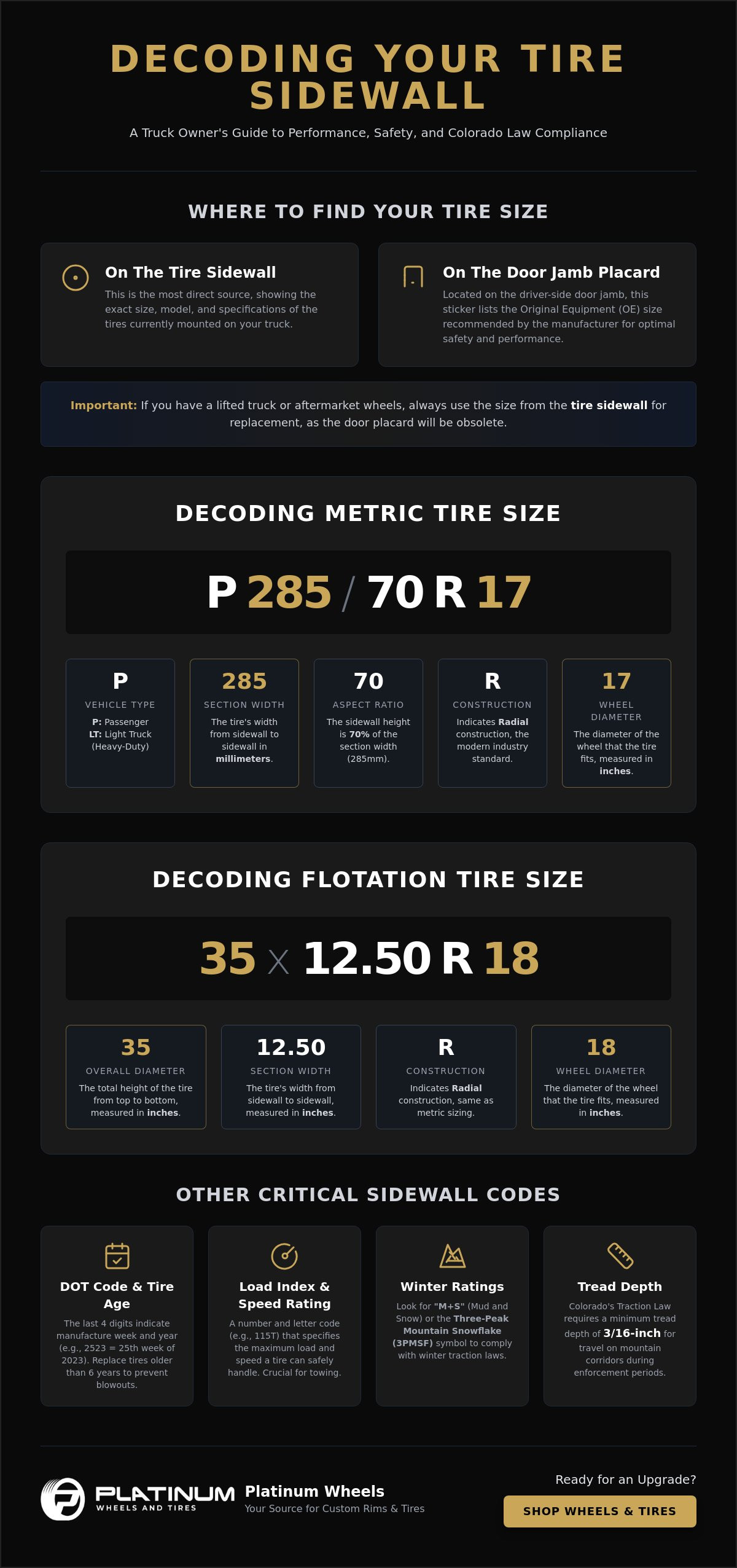
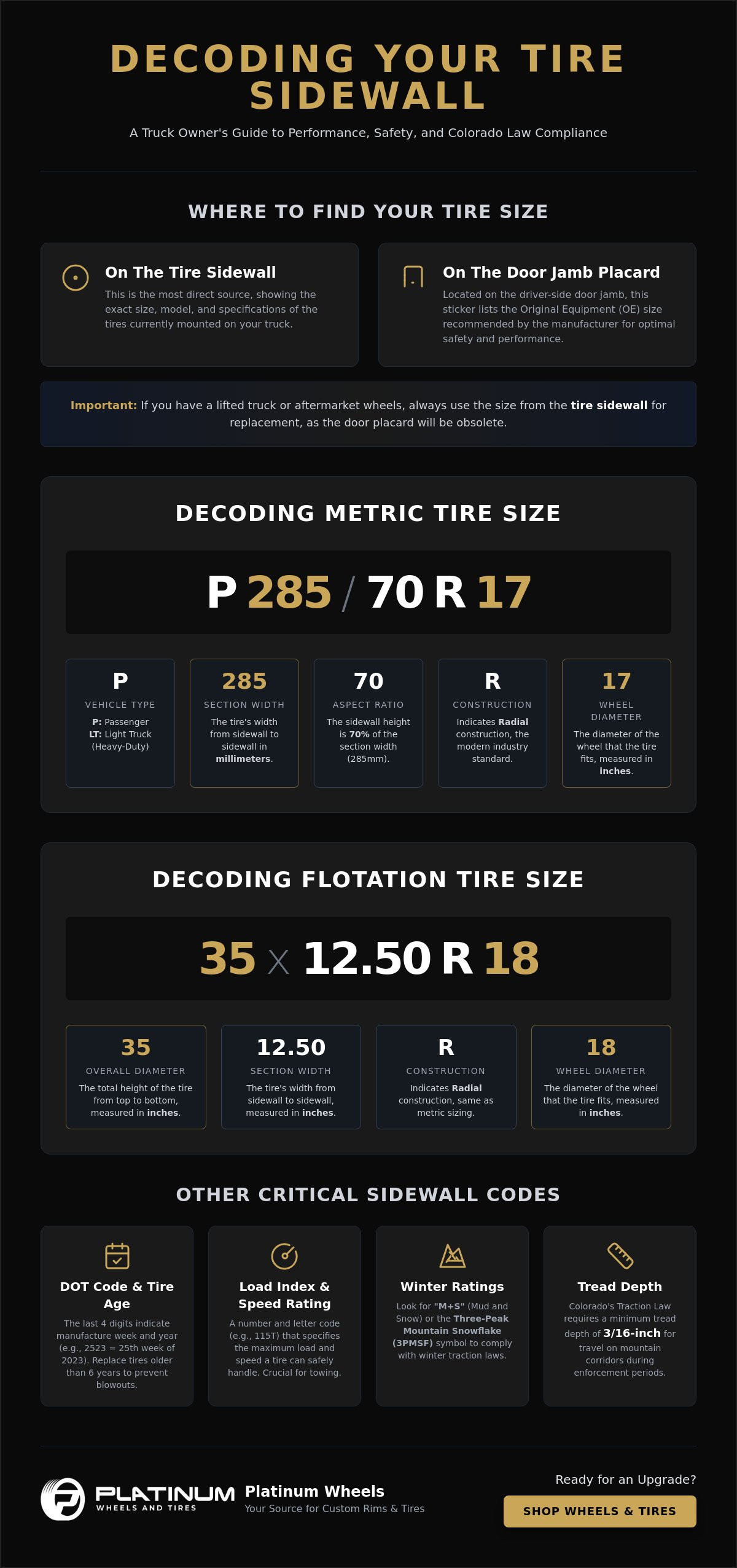
Before you can master how to read tire size, you need to know where the most accurate data lives on your rig. Your truck actually provides two different answers to this question, and knowing which one to trust depends on how you've modified your vehicle. The most immediate source is the tire sidewall itself. This raised lettering tells you exactly what is currently mounted to your rims. However, every truck also has a factory-issued door placard, usually found on the driver-side door jamb. This sticker lists the original equipment (OE) size and the manufacturer's recommended cold inflation pressure. If you've misplaced your owner's manual, this placard is your best fallback for finding the specs your truck was born with.
It's very common for these two sources to disagree. If you bought a used truck here in Colorado, there is a high probability the previous owner swapped the stock wheels for something more aggressive. Aftermarket upgrades like wider all-terrain tires or larger custom rims will render the door placard's size information obsolete. To get a detailed breakdown of how these alphanumeric strings are constructed across different brands, you can consult Wikipedia's guide to tire codes, which explains the international standards for these markings. Understanding these differences is the first step in ensuring your next set of tires fits perfectly without rubbing.
The Sidewall vs. The Door Jamb
Compare the wheel diameter listed on your door jamb, often 17 or 18 inches, with the number following the "R" on your tire sidewall. If they don't match, a previous owner likely changed the wheel size. While the door placard is the gold standard for maintaining factory safety and fuel economy, you should ignore it the moment you install a lift or leveling kit. When you move to a 35-inch tire, you're prioritizing off-road clearance and traction over the manufacturer's original highway-focused parameters. Learning how to read tire size directly from the rubber ensures you buy replacements that match your current modifications rather than a factory setup that no longer exists.
Reading the Tire "Birth Certificate"
Every tire has a "birth certificate" known as the DOT code. Look for a string starting with "DOT" followed by a series of characters; the final four digits are the most important. The first two digits represent the week of manufacture, and the last two are the year. In our region, intense sun and temperature swings accelerate rubber degradation. We recommend replacing tires older than six years, even if they have plenty of tread left, to avoid blowouts on rocky trails. While checking the age, also look for the "M+S" (Mud and Snow) or the Three-Peak Mountain Snowflake symbol. These markings are vital for staying legal on the I-70 Mountain Corridor during winter enforcement periods.
Decoding the Metric Sidewall: What the Numbers Mean
Metric sizing is the global standard for identifying tire dimensions. If you're looking at a string like P265/70R17, you're seeing a unique blend of metric and imperial measurements. The first letter identifies the vehicle class. A "P" indicates a passenger vehicle tire, designed for lighter loads and maximum ride comfort. For those driving heavy-duty pickups or SUVs frequently venturing into the Rockies, you'll likely see "LT" for Light Truck. This prefix is the first thing to check when learning how to read tire size because it defines the tire's structural DNA.
The three-digit number following the prefix is the section width in millimeters. In our example, 265mm is the distance from sidewall to sidewall. Following the slash is the aspect ratio. Finally, the "R" stands for radial construction, which is the industry standard for almost every vehicle on the road today. The last number represents the wheel diameter in inches. It's a bit of a mathematical puzzle, but once you break it down, it becomes second nature for any enthusiast.
The Math of Aspect Ratio
The aspect ratio is often the most misunderstood part of the sidewall. It isn't a direct measurement in inches or millimeters; it's a percentage. If your tire is a 285/70R17, the sidewall height is 70 percent of the 285mm width. A higher aspect ratio, like a 75 series, provides more "meat" or rubber between the rim and the road. This extra cushioning is essential for absorbing impacts on jagged Denver mountain trails. While a taller sidewall improves off-road comfort, it can lead to more "sway" during high-speed highway cornering. Finding the right balance is key to a capable rig.
LT-Metric vs. P-Metric
We often get asked why some tires are significantly heavier than others of the same size. The answer lies in the ply rating. Platinum Wheels recommends LT-rated tires for anyone planning on heavy-duty towing or serious rock crawling. These tires feature thicker sidewalls and more internal steel or nylon belts to handle increased pressure and weight. You might also encounter "Euro-metric" sizes that have no prefix at all. These generally follow passenger tire standards but may have slightly different load capacities. If you're ready to upgrade to a more durable set, you can browse our latest all-terrain and mud-terrain tires to find the perfect match for your truck's needs.
Flotation Sizing: Reading Tire Sizes for Off-Road Trucks
While metric strings are standard for most vehicles, off-road enthusiasts and heavy-duty truck owners often prefer flotation sizing. This system is designed for clarity. It uses inches for every dimension, making it much easier to visualize how a tire will look and fit on your rig. If you've ever heard someone brag about their "35s," they're using flotation logic. Learning how to read tire size in this format is essential if you plan on building a capable trail machine. The format typically looks like this: 35x12.50R20.
In this example, the first number (35) represents the total height of the tire in inches. The second number (12.50) is the section width, or the footprint, also measured in inches. The final number (20) is the wheel diameter. This straightforward approach removes the need for the complex percentages found in metric aspect ratios. It allows you to know exactly how much ground clearance you're gaining. For most modern truck builds, there are three primary benchmarks you should know:
- 33-inch tires: The "safe" upgrade. These usually fit with a simple leveling kit and offer a beefier look without major trimming.
- 35-inch tires: The industry standard for off-roading. These provide excellent clearance but almost always require a lift kit for proper fitment.
- 37-inch tires: Serious territory. These are built for deep mud and rock crawling but demand significant suspension and gearing modifications.
Flotation vs. Metric Comparison
You might wonder why both systems exist. It often comes down to the manufacturer's target audience. A 315/70R17 metric tire is nearly identical in physical size to a 35x12.50R17 flotation tire. However, knowing your total height in inches provides a psychological benefit when calculating obstacle clearance on a technical trail. Most Ford, Chevy, and RAM pickups coming off the lot use metric sizes, but the moment you step into the world of specialized mud-terrain rubber, flotation sizes become the dominant language.
Sizing for the Colorado Trail
When you move to a wider flotation tire, like a 12.50-inch or 13.50-inch footprint, you can't just slap them on any rim. These wider profiles often lead to "rubbing" against the frame or suspension components at a full steering lock. This is where wheel geometry becomes critical. You'll need to understand how to find wheel offset to ensure your new tires poke out far enough to clear the internal components. Mastering how to read tire size is only half the battle; ensuring that width has the room to breathe is what keeps your truck functional on the tight switchbacks of the Rockies.
Beyond the Numbers: Load Index and Speed Ratings
Understanding how to read tire size involves more than just measuring the rubber. Once you've mastered the physical dimensions, you must look at the service description. This is the alphanumeric code found at the very end of the tire size string, such as 121/118Q. The number represents the load index, which tells you the maximum weight a single tire can carry when fully inflated. The letter is the speed rating, indicating the maximum sustained speed the tire can handle safely. For Colorado drivers, these figures are just as vital as the tread pattern when you're navigating steep grades or unpredictable mountain weather.
Modern vehicles rely on TPMS sensors to monitor the air pressure that supports these ratings. If your pressure drops, your load capacity drops with it, creating a dangerous situation during a high-altitude haul. It's a precise ecosystem where the right tire choice keeps your rig stable and your family safe. If you're ready to upgrade to a setup that can actually handle your lifestyle, explore our heavy-duty tire packages today.
Towing in the Rockies: Load Range Matters
For anyone driving a 3/4 ton or 1-ton pickup, Load Range E is the non-negotiable standard. While Load Range C or D might offer a softer ride on city streets, they lack the internal reinforcement needed for heavy towing. "E" rated tires are built with a 10-ply equivalent construction, providing a stiffer sidewall that resists bulging under pressure. High altitude and summer heat create a challenging environment for your rubber. As you descend a mountain pass, your brakes generate immense heat that transfers to your wheels and tires. A higher load range provides the structural integrity to withstand these temperature spikes without compromising performance.
Speed Ratings on the Highway
Safe highway driving on I-70 requires a realistic look at your tire's speed rating. Most aggressive off-road tires carry lower speed ratings like Q (99 mph), R (106 mph), or S (112 mph). While you likely aren't hitting those speeds on a trail, the rating reflects the tire's ability to dissipate heat at cruising speeds. Look for the service description on the sidewall to find these details. In a "121/118Q" rating, the 121 refers to the load capacity when used as a single tire, while 118 refers to a dual-rear-wheel setup. Balancing that aggressive mud-terrain look with a safe speed rating ensures you don't experience a structural failure during a long trek across the state.
Upgrading Your Size: Fitment and Clearance in Denver
Once you've mastered how to read tire size, the natural next step for many Colorado truck owners is sizing up. Moving to a larger tire is the most effective way to gain ground clearance for the trail, but it requires more than just picking a bigger number off a shelf. You must consider the "Plus Sizing" concept. This involves increasing your wheel diameter while maintaining the same overall tire height to achieve a more modern, aggressive look without changing your vehicle's geometry. However, if your goal is a taller stance, you'll need to account for the physical space inside your wheel wells.
Fitting a set of 35-inch tires usually requires a leveling kit vs lift kit to prevent the rubber from catching on your bumper or fender liners. Beyond the physical fit, remember that larger tires change your effective gear ratio. Because a taller tire travels further with each revolution, your speedometer will read slower than your actual speed, and your truck may feel less "punchy" when accelerating up steep mountain passes. Consulting with an expert ensures your rig remains both capable and safe on the road.
Will It Fit? The Clearance Checklist
Measure your wheel well space at full steering lock before committing to a new size. Even if a tire fits while you're parked in a flat driveway, it might rub when the suspension compresses over a rock or a pothole. Upgrading to heavier all terrain tires also impacts your fuel economy and braking distance due to the increased unsprung weight. Precision is everything here. Professional mounting and balancing are critical for oversized tires to prevent the vibrations that often plague modified trucks at highway speeds. We use high-end equipment to ensure your balance is perfect the first time.
The Platinum Wheels Advantage
We provide expert fitment advice specifically for the unique demands of Denver, Aurora, and the Front Range. Our team understands how to read tire size from a performance perspective, helping you choose custom wheel and tire packages that match your truck's specific suspension setup. We don't just sell rubber; we provide a complete solution that includes professional installation of TPMS sensors and suspension kits. Whether you're building a dedicated rock crawler or a reliable daily driver that can handle a weekend at the dunes, we ensure your fitment is spot on. Stop by our shop to see how we can transform your rig with precision and local expertise.
Ready Your Rig for the High Country
Mastering how to read tire size is about more than just numbers; it's about having the confidence to tackle any Colorado trail. You now have the tools to decipher complex metric strings and flotation measurements, ensuring your next set of rubber provides the clearance and load capacity your truck demands. Whether you're towing a trailer over a steep mountain pass or navigating deep snow, choosing a tire with the correct load index and speed rating is essential for your safety and peace of mind.
At Platinum Wheels, we specialize in the specific fitment needs of our local community. As an authorized dealer for industry leaders like Nitto, Toyo, and Fuel Wheels, we understand how to balance aggressive styling with technical precision. Our team is ready to help with expert suspension and leveling kit installations to ensure your new setup fits perfectly without compromise. Browse our Custom Wheel and Tire Packages at Platinum Wheels to find the perfect combination of performance and durability. Your next adventure is waiting, and we're here to help you get there with a rig that's built to last.
Frequently Asked Questions
What do the three numbers in a tire size mean?
The three numbers in a metric tire size represent the section width, the aspect ratio, and the wheel diameter. For example, in a 275/65R18 tire, the 275 is the width in millimeters, while the 65 is the aspect ratio, which is the sidewall height as a percentage of the width. The 18 indicates the rim size in inches. Learning how to read tire size starts with mastering these three specific figures.
How do I know if my tires are 33s or 35s?
Identify if your tires are 33s or 35s by checking for flotation markings like 35x12.50R20. In this format, the first number is the total height in inches. If you see metric numbers like 285/70R17, you likely have a 33-inch tire. A 315/70R17 or a 35x12.50R17 is considered a true 35. Knowing your total height is vital for choosing the right leveling kit or lift kit for proper clearance.
What is the difference between P-metric and LT-metric tires?
P-metric tires are designed for passenger cars and light-duty crossovers, focusing on a quiet ride and fuel efficiency. LT-metric tires are built for light trucks and SUVs that face tougher conditions. LT tires have thicker sidewalls and more internal plies to handle heavy towing, hauling, or off-road rocky trails in the Rockies. Always choose the LT prefix if you frequently carry heavy gear or venture away from paved roads for better durability.
Can I put larger tires on my truck without a lift kit?
You can sometimes fit slightly larger tires without a lift kit, but a leveling kit is usually necessary to prevent rubbing. Most trucks can accommodate a one-inch increase over the factory size with no issues. However, if you want to jump from a stock 31-inch tire to a 35-inch mud-terrain tire, you will need a suspension lift. This ensures the tires have enough room to cycle through their full range of motion without damage.
How does tire size affect my gas mileage?
Larger tires generally decrease your gas mileage because they are heavier and create more rolling resistance. The extra weight requires your engine to work harder to rotate the wheels, especially during acceleration. Taller tires also change your gear ratio, which can affect engine efficiency at highway speeds. If you upgrade to aggressive mud-terrain tires, expect a noticeable drop in MPG compared to your original factory-spec all-season tires.
What does the R stand for in tire size?
The R in a tire size stands for radial construction, which is the industry standard for modern vehicles. Radial tires are built with internal cords that run perpendicular to the direction of travel. This design allows the sidewall to flex while keeping the tread flat on the road, providing better grip and a smoother ride. It is almost certain that any tire you buy for your truck today will be a radial rather than an old-fashioned bias-ply.
Why does my truck have two different tire sizes listed?
Your truck may have two different sizes listed if a previous owner installed an aftermarket wheel and tire package. The door placard reflects the original factory specifications, while the sidewall shows what is currently mounted. Some heavy-duty trucks also use a staggered setup, though this is rare for off-road rigs. When you are learning how to read tire size for a new set, always go by what is currently on the rim to ensure a proper fit.
How do I read the tire pressure on the sidewall?
Read the tire pressure on the sidewall by looking for the Max Press marking, but do not use this for daily driving. This number indicates the maximum air pressure the tire can safely hold at its maximum load capacity. For your truck's ideal daily pressure, check the placard on the driver-side door jamb instead. Using the sidewall's maximum pressure on an empty truck will result in a bouncy ride and premature wear in the center of the tread.