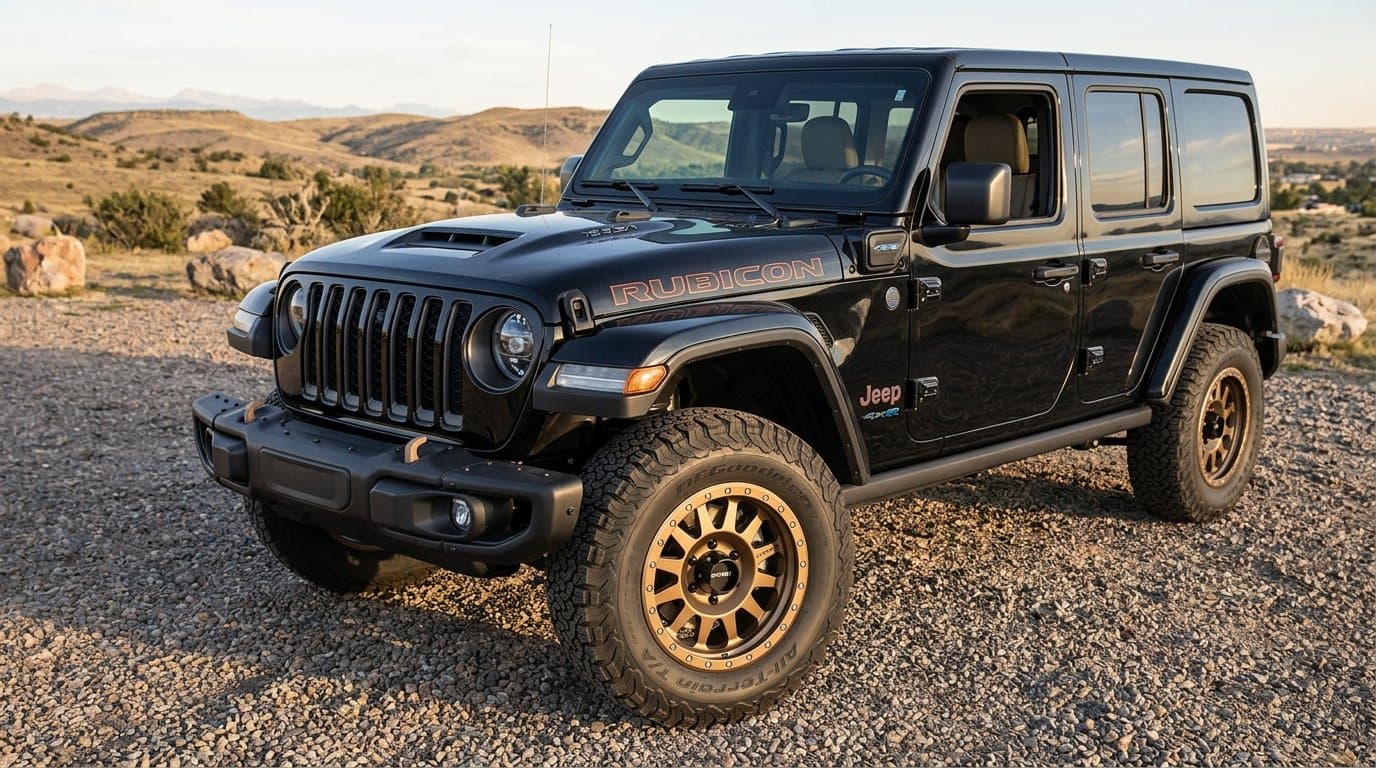
Top Jeep Rubicon Wheels for Denver Off-Road Trails
The biggest wheel isn’t automatically the best upgrade for a Jeep Rubicon. Jeep wheel listings span 15 to 24 inches, but diameter alone doesn’t determine fitment. The right jeep rubicon wheels also need a compatible bolt pattern and offset, plus a wheel-and-tire combination suited to your setup.
It’s easy to focus on appearance first; bronze, black, polished and other finishes can change a Rubicon’s look. But OEM replacements, replica wheels and aftermarket options differ in more than style, so it pays to understand how each choice affects fitment, pricing and availability before deciding.
This guide compares wheel types, explains which bolt-pattern details matter and outlines what to consider when choosing jeep rubicon wheels for Denver-area trails. You’ll also learn how wheel size, offset and tire pairing affect fitment, so you can narrow your options with a clearer sense of what works for your vehicle.
Key Takeaways
- Compare OEM, replica and aftermarket options by construction, style and the fitment details that matter for your Rubicon.
- Use the bolt pattern, wheel width and offset together to narrow down compatible choices.
- Understand how tire pairing and vehicle setup shape fitment support for Denver-area trail use.
- See how Platinum Wheels’ wheel-and-tire packages can bring wheel selection and tire choice together.
Aftermarket, replica, and OEM Jeep wheels
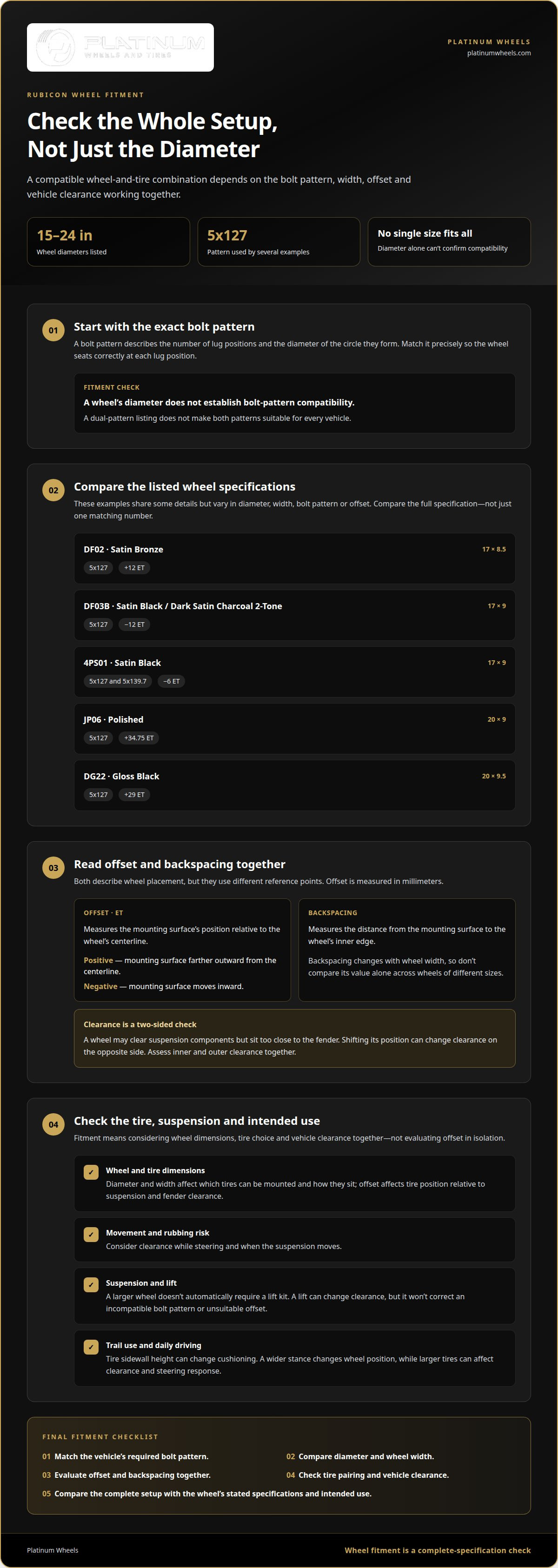
OEM wheels are factory-style replacements, while replica wheels echo an original design. Aftermarket wheels offer alternative designs, sizes and finishes. Jeep wheel listings range from 15 to 24 inches, so diameter alone won’t determine whether a wheel suits your Rubicon. Compare construction, load rating, width, offset and bolt pattern together before choosing.
Use your priorities to narrow the field. An OEM-style replacement keeps the look close to the original; a replica offers a similar visual direction. An aftermarket design can change the appearance more noticeably. For example, a 17x8.5 DF02 Satin Bronze wheel has a different width and finish from a 17x9 DF03B Satin Black wheel with Dark Satin Charcoal 2-Tone finish. Those differences matter alongside fitment.
There isn’t one best wheel material or finish for every Rubicon. Aluminum-alloy wheels offer a broad range of styles, while steel can suit a utility-focused build. Choose based on your intended use, wheel specifications and preferred upkeep. Satin bronze, satin black and polished finishes illustrate how appearance varies; the DF02, DF03B and JP06 listings show those options.
Wheel spacers move the wheel outward and add another hardware interface. That can change clearance at the fender and suspension, and incorrect spacer or fastener fit can create installation problems. Treat spacers as part of the complete wheel fitment, not as a shortcut for a mismatched offset. For example, the DF02’s +12 ET and DF03B’s -12 ET represent different wheel positions.
Before selecting jeep rubicon wheels, match the wheel to the vehicle’s bolt pattern, width, offset and tire setup. Then compare the intended trail use with the wheel’s stated specifications. A bold finish can shape the build, but it can’t replace correct fitment. The next section explains the bolt-pattern details behind options such as the DF02 and DF03B.
Bolt patterns
Jeep wheel listings cover diameters from 15 to 24 inches, but that range doesn’t mean every size fits every Wrangler Rubicon. The examples here include several wheels with a 5x127 bolt pattern. Fitment also depends on wheel width, offset, tire choice and the vehicle’s configuration.
A bolt pattern combines the number of lug positions with the diameter of the circle they form. A bolt pattern describes the arrangement of a wheel’s lug positions and the circle they form. Match that pattern precisely: the wheel must seat correctly at each lug position. A wheel’s diameter alone can’t establish bolt-pattern compatibility.
Compare these listed examples to see how specifications vary:
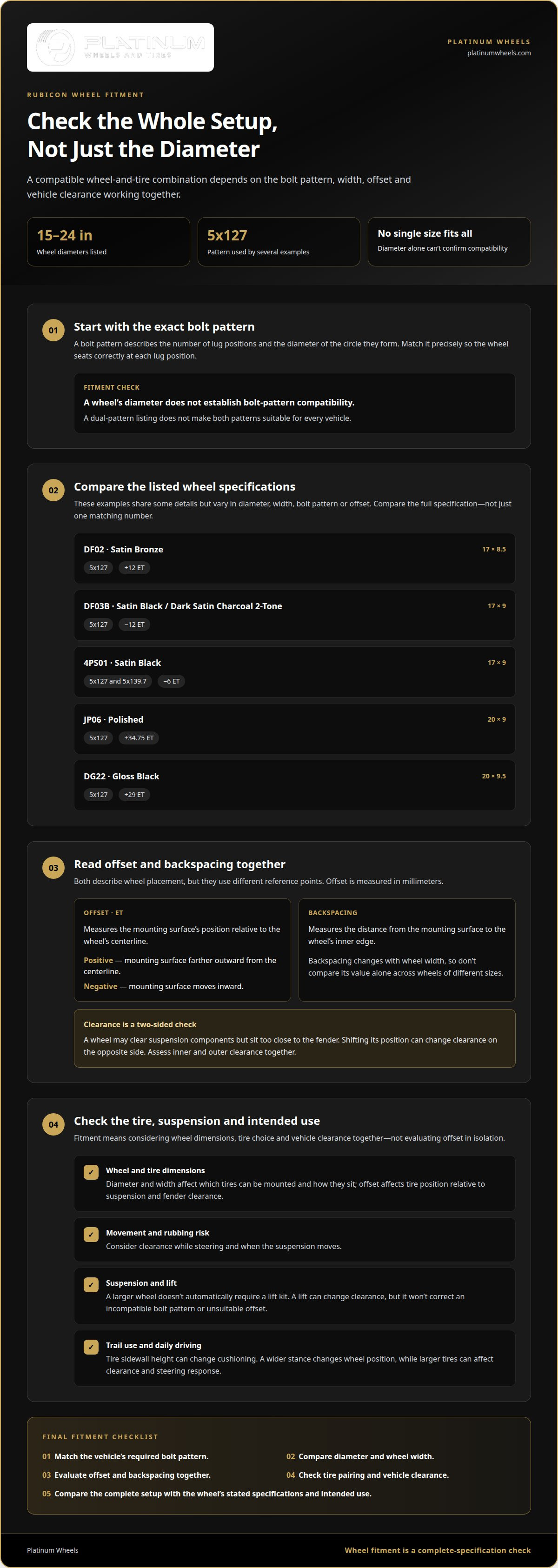
- The 17x8.5 DF02 Satin Bronze has a 5x127 pattern and +12 ET offset.
- The 17x9 DF03B Satin Black, Dark Satin Charcoal 2-Tone, uses 5x127 and -12 ET.
- The 17x9 4PS01 Satin Black lists both 5x127 and 5x139.7, with -6 ET.
- The 20x9 JP06 Polished uses 5x127 and +34.75 ET.
- The 20x9.5 DG22 Gloss Black uses 5x127 and +29 ET.
Those examples show why bolt pattern isn’t the only specification to compare. The 17x9 DF03B and 20x9 JP06 share 5x127, yet their width, diameter and offset differ. ET describes offset in millimeters; positive and negative values position the wheel differently relative to its mounting surface. That affects how the wheel sits, so evaluate the complete specification rather than matching one number.
For a Rubicon, the practical answer is to start with the vehicle’s required bolt pattern, then assess diameter, width and offset as a set. A listing’s 15-to-24-inch range describes available wheel diameters, not a universal fit range. A dual-pattern listing such as the 4PS01 also doesn’t make both patterns suitable for every vehicle. Use the exact wheel specifications when narrowing choices.
Fitment support
Fitment means considering wheel dimensions, tire choice and vehicle clearance together. For a Rubicon, assess the complete setup, not offset alone.
Offset and Backspacing
There’s no single offset or backspacing value that suits every Jeep Rubicon. The right combination depends on wheel width, tire dimensions, suspension setup and how far you want the wheels to sit from the vehicle.
Offset measures the mounting surface’s position relative to the wheel’s centerline. Backspacing measures the distance from that mounting surface to the wheel’s inner edge. Both describe wheel placement, but use different reference points.
Start with the exact wheel width and offset, then assess inner and outer clearance. Positive offset places the mounting surface farther outward from the wheel centerline; negative offset moves it inward. Backspacing changes with wheel width, so don’t compare its value alone across wheels of different sizes.
For example, a wheel may clear suspension components but sit too close to the fender. A different offset can shift its position, but also changes clearance on the opposite side. Consider wheel width, offset and backspacing as a connected set.
Tire Fitment, Handling, and Ride Quality
Wheel diameter and width affect which tires can be mounted and how they sit. Offset determines the tire’s position relative to suspension and fender clearance. Together, these dimensions influence rubbing risk while steering or when the suspension moves.
A larger wheel doesn’t automatically require a lift kit. Tire dimensions, wheel placement and available clearance through the vehicle’s movement all matter. A lift can change clearance, but it won’t correct an incompatible bolt pattern or unsuitable offset.
Wheel and tire choices also affect driving feel. Changing tire sidewall height can alter how much cushioning the tire provides. A wider stance changes wheel position, while larger tires can affect clearance and steering response. Evaluate the complete wheel-and-tire combination for both trail use and daily driving.
Fitment planning should account for your Rubicon’s suspension, planned tire size and intended use. Consider these details together before choosing wheels; a lift isn’t automatically required.
Jeep wheel prices and availability
Wheel selection and pricing depend on design, diameter, finish and fitment. Compare exact specifications, not just product photos.
Wheel Pricing
Price comparisons make sense only between wheels with similar specifications. A 17x8.5 DF02 Satin Bronze and a 20x9 JP06 Polished differ in diameter, width and finish, so they aren’t direct equivalents. Look at the wheel’s size, construction, design and fitment details together before judging value.
Distinguish a single-wheel listing from a complete set or wheel-and-tire package, and compare the same components. On a Rubicon, finish and wheel size can affect your options, while tire pairing adds another consideration. Focus on matching specifications and purchase contents.
Wheel Availability
A Jeep wheel collection lists 152 results, spanning different sizes, finishes and specifications. That count gives a sense of catalog breadth, not a guarantee that every exact configuration is immediately in stock. A 5x127 wheel in a particular finish may have different availability from another size or offset.
Use the complete specification to narrow the options: diameter, width, bolt pattern, offset and finish. Then compare the resulting listings for the exact configuration. For example, the 17x9 DF03B Satin Black and 17x9 4PS01 Satin Black share a diameter and width, but differ in bolt patterns and offset.
Build a shortlist around fitment, then compare like-for-like listings. That keeps finish preferences from overshadowing the specifications your Rubicon needs. If you’re choosing tires too, assess the wheel-and-tire combination together rather than as separate purchases.
Explore wheel-and-tire package options to bring the selection together.
Platinum Wheels: Wheel & Tire Packages
Platinum Wheels offers wheel-and-tire packages for Rubicon owners choosing both components together. A package keeps the decision focused on the complete setup, including wheel specifications, tire type and intended use on Denver-area trails.
For a trail-focused build, compare custom truck wheels and off-road rims with all-terrain or mud-terrain tires. If changing stance or clearance is part of your plan, Platinum Wheels also offers lift kits and leveling kits. The right combination depends on your fitment priorities and how you use your Rubicon, not appearance alone.
Bring your preferred wheel style, tire choice and vehicle setup to a free Wheel & Tire Fitment Consultation at Platinum Wheels. Discuss wheel-and-tire options for your Rubicon and get a free wheel test fitment.
Build a Rubicon setup around your next drive
Let the way you use your Rubicon guide the final choice. A trail-focused build and a vehicle used mainly on pavement may call for different wheel and tire priorities. Decide what matters most, then choose wheels, tires and suspension components to work as one setup. This connects appearance to real-world use instead of letting one design detail drive the decision.
Platinum Wheels offers custom truck wheels and off-road rims, all-terrain and mud-terrain tires, and wheel-and-tire packages. A free Wheel & Tire Fitment Consultation can help focus your selection on your Rubicon and how you use it. The best jeep rubicon wheels for your build are the ones that suit your priorities and work with the complete setup.
Contact Platinum Wheels about fitment and take the next step toward a setup that feels right for your adventures.
Frequently Asked Questions
Which aftermarket wheels fit a Jeep Rubicon without spacers or modifications?
Aftermarket wheels can fit without spacers or modifications when their specifications match your specific Rubicon and clear surrounding components. Compare bolt pattern, wheel width, offset, brake clearance and tire dimensions as one setup. A vehicle label in a listing alone doesn’t establish fit. Two wheels with the same bolt pattern, for example, can position tires differently because their widths and offsets differ.
How much do OEM and aftermarket Jeep Rubicon wheels cost?
Prices depend on the exact wheel, including its type, size, finish and design. OEM replacements, replicas and aftermarket options aren’t directly comparable unless their specifications and purchase contents match. A wheel-only listing also differs from a complete wheel-and-tire package. To compare meaningfully, identify the fitment you need, then evaluate listings with the same configuration and included components.
How do I measure Jeep Rubicon wheel bolt pattern, offset, and backspacing?
Use a bolt-pattern gauge or wheel specification to identify the lug pattern. A five-lug layout can be misread if you measure only between neighboring studs. Offset is measured from the wheel’s centerline to its mounting surface; backspacing is measured from that surface to the inner wheel edge. Record each value separately, since neither measurement can substitute for the other.
Can Jeep Rubicon wheels fit other Jeep Wrangler trims or models?
Sometimes, but a shared Wrangler name doesn’t guarantee compatible fitment. Compare the receiving vehicle’s bolt pattern, wheel width, offset, brake clearance and intended tire dimensions with the wheel specifications. A wheel may attach but sit too far inward or outward for that vehicle’s setup. Check fitment for each trim and model, especially if tires or suspension have changed. For builders blending modern parts with vintage platforms, resources on how to restomod a classic car offer practical guidance on coordinating suspension, brakes, and wheel fitment.
What are the best wheel materials and finishes for a Jeep Rubicon?
There’s no single best material or finish for every Rubicon. Aluminum-alloy wheels offer a broad range of styles, while steel can suit a utility-focused build. Choose based on intended use, specifications and preferred upkeep. Satin bronze, satin black and polished are examples of available finishes.