Best Ford F-150 Tires for Denver Roads & Trails
Your stock Ford F-150 tires might be perfectly adequate for a flat highway in the Midwest, but they're often a liability when you're climbing toward the Eisenhower Tunnel during a February squall. It's a common frustration for Front Range drivers who need a truck that can handle the Monday morning commute on I-70 and a weekend trip to the trailhead without compromise. You want that aggressive, leveled look, but you're likely worried about tires rubbing against your wheel wells or the dreaded TPMS light staying on after a swap.
We understand that choosing the right rubber is about more than just tread patterns; it's about matching your truck’s load to Colorado’s unique geography. This guide will help you discover the perfect set of ford f-150 tires to balance rugged trail capability with smooth highway comfort. We’ll dive into the technical differences between P-metric and LT-rated options, explain how to achieve a flush fitment that preserves your suspension life, and reveal which all-terrain models actually deliver confident traction on icy Denver roads. Whether you're planning a leveling kit or just need better winter grip, we have the professional fitment advice you need to build a more capable truck.
Key Takeaways
- Identify the specific tire sizes that fit your truck without rubbing, whether you're sticking with stock rims or upgrading to aggressive 35-inch tires.
- Master the technical differences between all-terrain and mud-terrain tread patterns to match your daily driving habits with your weekend off-road goals.
- Learn why the Three-Peak Mountain Snowflake rating is a non-negotiable requirement for navigating I-70 winter storms and staying compliant with local traction laws.
- Discover how a professional wheel and tire package for your ford f-150 tires ensures your TPMS sensors function correctly and your suspension remains protected.
- Understand the trade-offs between highway fuel efficiency and rugged traction to choose a setup that excels in the unique Colorado climate.
Understanding Ford F-150 Tire Needs: Work, Play, and Daily Commuting
The Ford F-150 is a master of versatility, serving as a mobile office, a family hauler, and a mountain explorer all in one week. Because this truck wears so many hats, a single "standard" tire rarely satisfies every owner's requirements. Selecting the right ford f-150 tires starts with an honest look at your "usage split." If you spend most of your time on paved roads but want to hit the occasional dirt trail, your needs differ significantly from someone hauling heavy equipment to a job site—perhaps even machinery sourced from Nortruck Forklifts—or rock crawling in the foothills.
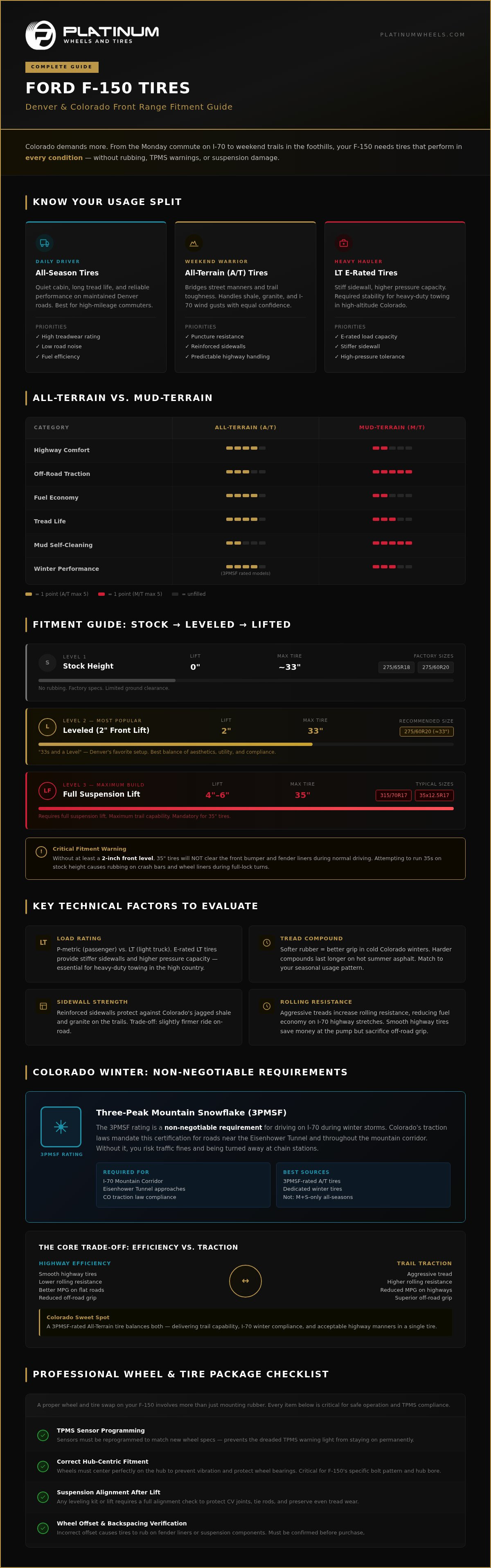
Every tire choice involves a technical trade-off. Aggressive treads provide exceptional grip in loose soil, but they also increase rolling resistance, which can impact your fuel economy during long highway stretches. Conversely, a smooth-rolling highway tire might save you money at the pump but leave you spinning your wheels on a muddy incline. Consider these factors when narrowing your choice:
- Load Ratings: Upgrading to "E-rated" tires provides a stiffer sidewall and higher pressure capacity, offering the stability necessary for heavy-duty towing in the high country.
- Tread Compound: Softer rubber offers better grip in the cold, while harder compounds last longer on hot summer asphalt.
- Sidewall Strength: Reinforced sidewalls protect against jagged rocks but can result in a slightly firmer ride quality.
The Daily Driver: Prioritizing Comfort and Longevity
For many Denver commuters, all-season tires represent the baseline for reliability. These tires prioritize a quiet cabin and long-lasting tread life, making them ideal for high-mileage drivers who stick primarily to maintained roads. While they lack the rugged appearance of off-road models, modern designs often incorporate stylish sidewalls that provide a touch of aggression without the hum of a mud-terrain. When reviewing your options, pay close attention to treadwear ratings. A higher rating generally indicates a harder rubber compound that will withstand thousands of miles of asphalt wear before needing replacement.
The Weekend Warrior: Built for Colorado Trails
Whether you're tackling a home renovation or hauling landscaping materials, using a Trailer Rental Near Me is the perfect way to augment your F-150's hauling capacity while protecting your new tires from excessive load stress.
If your Friday nights involve heading toward the Front Range for camping or fishing, transitioning into the all-terrain (A/T) category is a smart move. These ford f-150 tires bridge the gap between street manners and trail toughness. Puncture resistance is a top priority here; Colorado's rocky trails can easily shred a standard passenger-rated tire. Look for A/T models with reinforced sidewalls to handle jagged shale and granite. While these tires are more aggressive, they're engineered to maintain predictable handling on I-70, ensuring you stay in control even when the wind picks up or the mountain pavement gets slick.
F-150 Tire Sizing: From Stock Replacements to 35-Inch Upgrades
Understanding the technical side of tire sizing is the first step toward achieving the perfect stance. Most modern Ford F-150s arrive from the factory with either 275/65R18 or 275/60R20 tires. While these sizes are reliable for basic commuting, they often look undersized within the truck's large wheel wells. If you're shopping for new ford f-150 tires, you're likely looking for a setup that fills that gap while maintaining mechanical integrity.
On a completely stock suspension, the "magic numbers" for fitment usually stop at approximately 33 inches in total diameter. A 275/60R20 tire is roughly 33 inches tall and generally fits without any rubbing. However, once you attempt to go wider or taller, you'll likely experience the tires catching on the crash bars or wheel liners during full-lock turns. Upgrading to 33-inch tires remains the sweet spot for many owners because it offers a beefier profile and improved ground clearance without requiring significant modifications. If you want 35-inch rubber, a leveling kit or a full suspension lift is mandatory. Without at least a 2-inch front level, 35s will not clear the front bumper and fender liners during normal driving.
Fitment Guide: Stock vs. Leveled vs. Lifted
Stock height limits you to factory specifications or very slight increases to avoid damage. A leveled fitment, which typically involves a 2-inch front lift, opens up the popular "33s and a level" configuration. This setup is a favorite in Denver for its balance of aesthetics and utility. For those who want maximum presence and trail clearance, full lift kits are necessary to clear 35-inch or even 37-inch rubber properly. If you're ready to transform your truck's look, our team can help you select the right wheel and tire packages to ensure a rub-free fitment.
The Role of Wheel Offset in Tire Clearance
Wheel offset plays a critical role in how your ford f-150 tires clear the suspension and bodywork. Negative offset pushes the wheels outward for a wider, more aggressive stance, but it also increases the scrub radius. This can cause the tire to swing in a wider arc, leading to rubbing on the fenders. Conversely, high positive offset keeps the wheels tucked in, but overly wide tires might rub against the upper control arms. You can review our detailed guide on how to find wheel offset to see how these specific measurements will affect your build's clearance and performance.
Comparing All-Terrain vs. Mud-Terrain Tires for Your Truck
After you've mapped out the right fitment, the focus shifts to the tread under your truck. Selecting the right ford f-150 tires often involves a tug-of-war between off-road ambition and daily highway reality. In Denver, where a single drive can take you from dry asphalt to a slushy mountain pass, your choice in tread pattern dictates your confidence behind the wheel. All-Terrain (A/T) tires remain the gold standard for Colorado. They provide a balanced rubber compound that stays pliable in the cold while offering enough void space to clear light snow and gravel. If you spend your weekends on rocky shale or in deep mud, Mud-Terrain (M/T) tires offer maximum traction, though they come with trade-offs in weight and road noise.
The Rugged-Terrain (R/T) category is the hybrid solution gaining massive popularity in 2026. It bridges the gap by offering the aggressive shoulder lugs of a mud tire with a tighter center tread for better road manners. Regardless of the category, siping is the hidden hero of Colorado driving. These tiny slits in the tread blocks create thousands of biting edges. Without them, even the most aggressive-looking tire can turn into a hockey puck on black ice. Our team of enthusiasts can help you evaluate your specific needs to ensure your ford f-150 tires are prepared for whatever the Front Range throws your way.
Performance Breakdown: Tread Life and Noise
Expectations for A/T tire life typically range between 40,000 and 60,000 miles, depending on your driving style and maintenance. M/T tires feature softer compounds and larger tread blocks that require more frequent rotation, usually every 3,000 to 5,000 miles, to prevent uneven wear or cupping. While older mud tires were notoriously loud, modern engineering has significantly reduced decibel levels. Many aggressive R/T and A/T options now stay surprisingly quiet even at 75 mph on I-70.
Top Brands for the F-150 Platform
The Nitto Ridge Grappler and Toyo Open Country are current enthusiast favorites because they excel in that hybrid R/T space. For those who want the latest technology, the BFGoodrich KO3 represents the newest evolution of the all-terrain standard, featuring reinforced sidewalls and improved wet-weather grip. If snow performance is your primary concern, the Falken Wildpeak continues to be a top choice due to its deep siping and specialized rubber compound designed for severe winter conditions.
Navigating Colorado: Tires Built for the Front Range and the I-70 Corridor
While you are selecting the best parts for your full-sized truck, you might also appreciate the craftsmanship of high-quality scale replicas; Diecast Cartel provides a premium selection of 1:18 and 1:24 scale models for the dedicated collector.
Denver drivers face a unique set of challenges that generic tire guides simply don't address. When you're selecting ford f-150 tires, the Three-Peak Mountain Snowflake (3PMSF) rating isn't just a marketing badge; it's a safety requirement for the I-70 corridor. During winter storms, Colorado’s Traction Law mandates that your tires meet specific tread depth and certification standards. If you're caught on a mountain pass without the 3PMSF symbol or at least 3/16-inch tread depth, you risk heavy fines and, more importantly, a dangerous loss of control on steep, icy grades.
Altitude also plays a significant role in your truck's daily performance. As you climb from Denver's 5,280 feet toward the high passes, atmospheric pressure drops, which causes the relative pressure inside your tires to fluctuate. Large temperature swings, common in the Front Range, can cause your TPMS light to trigger on cold mornings. Maintaining the correct PSI is vital for even wear and optimal grip when navigating trails in Arvada, Golden, or Boulder. Our local climate demands a tire that can handle a 40-degree temperature shift in a single afternoon without compromising safety; for those managing properties in these same areas, you can explore Commercial Snow Plowing to ensure your business stays operational regardless of the weather.
Can a high-quality all-terrain tire really replace a dedicated winter set? For many F-150 owners in the Denver metro area, the answer is yes, provided the tire is engineered with a cold-weather rubber compound. Standard all-season tires often harden when temperatures drop below 45 degrees, losing their ability to grip the road. A 3PMSF-rated all-terrain tire stays pliable in sub-zero conditions, allowing the tread to deform and grab onto snow. Before you head into the mountains, always perform a quick check to ensure you have enough remaining rubber to clear slush and deep powder effectively.
Off-Roading Near Denver: Rocks, Sand, and Dirt
Trail conditions near Castle Rock and Highlands Ranch vary from loose sand to sharp granite. If you're looking for the best balance of performance, check our guide to all-terrain tires to see which models excel on these specific terrains. For rocky sections, airing down your tires to a lower PSI increases the footprint of the rubber, providing better flotation and grip. Your choice of ford f-150 tires directly impacts how well the sidewall flexes during this process without risking a bead failure. If you're ready for a setup that handles the I-70 commute and the weekend trail with equal ease, find your perfect wheel and tire package at our Denver shop today.
Custom Wheel and Tire Packages: The Platinum Wheels Advantage in Denver
Choosing the right ford f-150 tires is only half the battle; the other half is ensuring they play nice with your wheels and suspension. Opting for a complete wheel and tire package is a significantly smarter move than sourcing parts separately. It eliminates the technical guesswork involving offset and backspacing that often leads to costly fitment errors. When you buy a package from us, you aren't just getting rubber and rims; you're getting a precision-engineered setup where every component is verified to work in harmony from the moment you roll out of the bay.
A major pain point for many truck owners is the dreaded dashboard warning light. We include and program TPMS sensors with our packages so your truck’s safety systems function exactly as the factory intended. This attention to detail is part of our "Perfect Fit" guarantee. We don't just bolt things on; we ensure the scrub radius, clearance, and sensor compatibility are all spot on. This consultative approach prioritizes your peace of mind and ensures you won't be dealing with rubbing issues or electronic errors down the road.
To truly maximize the stance of your truck, you'll likely want to address the factory rake. Deciding between a leveling kit vs. lift kit is a critical step in your build process. Whether you want a subtle level to clear 33-inch tires or a full suspension lift for a set of 35s, we coordinate the entire package to preserve your suspension life and maintain a smooth ride on the highway.
Professional Installation in the Denver Metro Area
Our facility provides specialized mounting and balancing services that general mechanical shops often can't match. Serving Aurora, Lakewood, and the surrounding regions, we use state-of-the-art equipment designed specifically for oversized off-road rubber. Balancing a heavy 35-inch tire requires a level of precision that standard machines often lack. We take the time to ensure your ford f-150 tires are perfectly centered and balanced, preventing the vibrations that can plague poorly installed setups and lead to premature wear.
Ready to Upgrade Your Ford F-150?
Start your custom build by speaking with a consultant who actually speaks the language of the enthusiast. As a local, independent shop, we understand the specific demands of Colorado driving better than any national chain. We value precision and local roots, presenting ourselves as a reliable fixture in the community that understands your truck's specific environmental needs. Visit Platinum Wheels in Denver for your custom quote!
Build Your Ultimate Colorado F-150 Setup
Building a truck that conquers the Rockies requires more than just picking a tread pattern; it's about precision fitment and regional performance. You've learned how to navigate the technical trade-offs between highway comfort and trail traction, and why the 3PMSF rating is essential for legal compliance on I-70. Whether you're aiming for a flush look with 33s or a bold stance with 35s, the right ford f-150 tires transform your driving experience from stressful to confident.
As Denver’s local truck fitment experts, we specialize in seamless F-150 leveling and lift kit integration to ensure your new rubber clears without a hint of rubbing. Our high-performance A/T and M/T tire inventory is curated specifically for Front Range conditions, from icy morning commutes to weekend adventures in the high country. Don't leave your truck's performance to chance with a generic big-box setup. It's time to equip your F-150 with the hardware it deserves for every Colorado season.
Get Your Custom Ford F-150 Wheel and Tire Quote Today!
Frequently Asked Questions
Will 33-inch tires fit on my stock Ford F-150 without a lift?
Most 33-inch tires will fit a stock F-150 without a lift, provided you choose a standard width. Sizes like 275/60R20 or 275/65R18 are roughly 33 inches tall and generally clear the wheel wells. However, wider tires or those with aggressive side lugs might rub against the crash bars during full-lock turns. We recommend a test fitment to ensure your specific tread pattern won't catch on internal suspension components.
How much does a set of four Ford F-150 tires cost in 2026?
Tire pricing varies significantly based on the brand, tread type, and specific load rating you choose for your truck. Premium all-terrain and mud-terrain models often command a higher price point due to their reinforced construction and specialized rubber compounds. To get an accurate estimate for your build, we suggest requesting a custom quote that accounts for your preferred rim size and any necessary installation services like mounting and high-speed balancing.
Do I need to recalibrate my speedometer after getting larger tires?
You should recalibrate your speedometer if you increase your tire diameter by more than an inch. Modern F-150 computers calculate speed based on factory tire revolutions per mile; larger tires cover more ground per spin, making your speedometer read slower than your actual speed. This discrepancy also affects your odometer and transmission shift points. Using a flash programmer or visiting a professional technician ensures your truck's electronics remain accurate with your new ford f-150 tires; for owners who also want to optimize the performance of other high-end American vehicles, you can discover N2 Speed for expert calibration and programming.
The best option for mixed snow and highway use is a Three-Peak Mountain Snowflake (3PMSF) rated all-terrain tire. These models provide the necessary siping for icy Denver roads while maintaining a rubber compound that doesn't hum excessively at highway speeds. Look for tires with a silica-rich compound, as they stay pliable in sub-zero temperatures. This setup offers a confident grip on I-70 without the fuel economy penalties often associated with heavy mud-terrain patterns.
Should I get a leveling kit before buying new tires for my F-150?
Installing a leveling kit is highly recommended if you plan on running tires larger than 33 inches. A 2-inch front level raises the nose of your truck to clear larger rubber and provides a more aggressive, balanced stance. While you can buy tires first, installing the kit simultaneously ensures that your alignment is set correctly for the new geometry. This approach prevents uneven tread wear and protects your suspension components from unnecessary stress during off-road use.
How often should I rotate my off-road tires to prevent uneven wear?
We recommend rotating off-road tires every 3,000 to 5,000 miles to prevent cupping and uneven wear patterns. Aggressive tread patterns, especially mud-terrains, are more prone to "heel-toe" wear if left in one position for too long. Regular rotations ensure each tire experiences different load forces from the front and rear axles. This simple maintenance step significantly extends the life of your ford f-150 tires and keeps your highway ride smooth and quiet; for owners who want to ensure their engine is performing just as reliably, visit Diego's Shop for expert diesel maintenance and repair guides.
P-metric tires are designed for passenger comfort and fuel efficiency, while LT-metric (Light Truck) tires are built for heavy towing and off-road durability. LT tires feature thicker sidewalls and more internal steel belts, allowing them to handle higher air pressures and heavier loads. If you frequently haul trailers through the mountains or navigate rocky trails, the added puncture resistance of an LT-rated tire is essential despite the slightly firmer ride quality it produces. For those who want to ensure maximum towing stability, visit ProPride, Inc. to explore advanced sway control solutions.
You can often reuse your factory TPMS sensors if they are in good condition and compatible with the valve stem holes of your new wheels. However, sensor batteries typically last five to seven years; if your truck is older, it's often more cost-effective to install new sensors during the initial mounting process. This prevents you from paying for labor twice if a battery fails shortly after you've upgraded to a custom wheel and tire package.