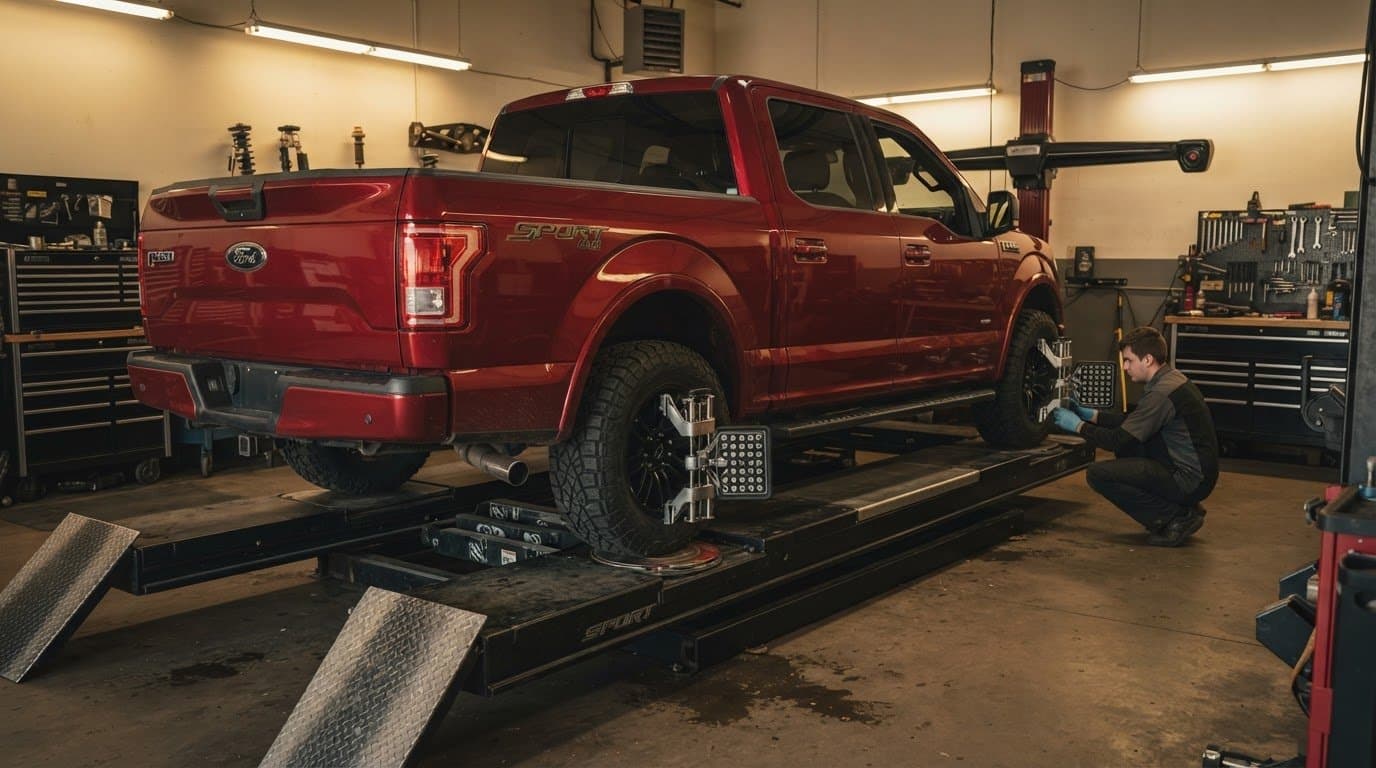
F-150 Leveling Kits: Best Options for Denver Truck Owners
A level stance is only half the job; alignment matters too. A 2.00-inch leveling kit offers subtle stance correction and room for moderately larger tires, while a 2.50-inch option provides more stance correction and tire clearance. Choosing a leveling kit for an F-150 also means planning an alignment recheck 500-1,000 miles after installation, as components may settle. The right leveling kit for your F-150 depends on the stance and tire fitment you want.
If you want a more even front-to-rear profile or are considering larger tires, the right setup depends on your truck and fitment goals. This guide explains how lift height changes stance and clearance, and why alignment deserves attention after installation.
We’ll also cover what affects tire fitment, what installation involves, and how to choose a setup for driving around Denver. That will help you weigh the visual change against everyday comfort and understand the next steps.
Key Takeaways
- Match the leveling height to the stance you want, rather than choosing the tallest option by default.
- Plan tire fitment around the full wheel-and-tire setup, since clearance is about more than tire height alone.
- Choose between a leveling kit and a lift kit based on the change you want to your truck’s overall ride height and profile.
- Account for post-installation alignment in your plan so the F-150 is ready for everyday Denver driving.
Leveling-kit lift heights and stance correction
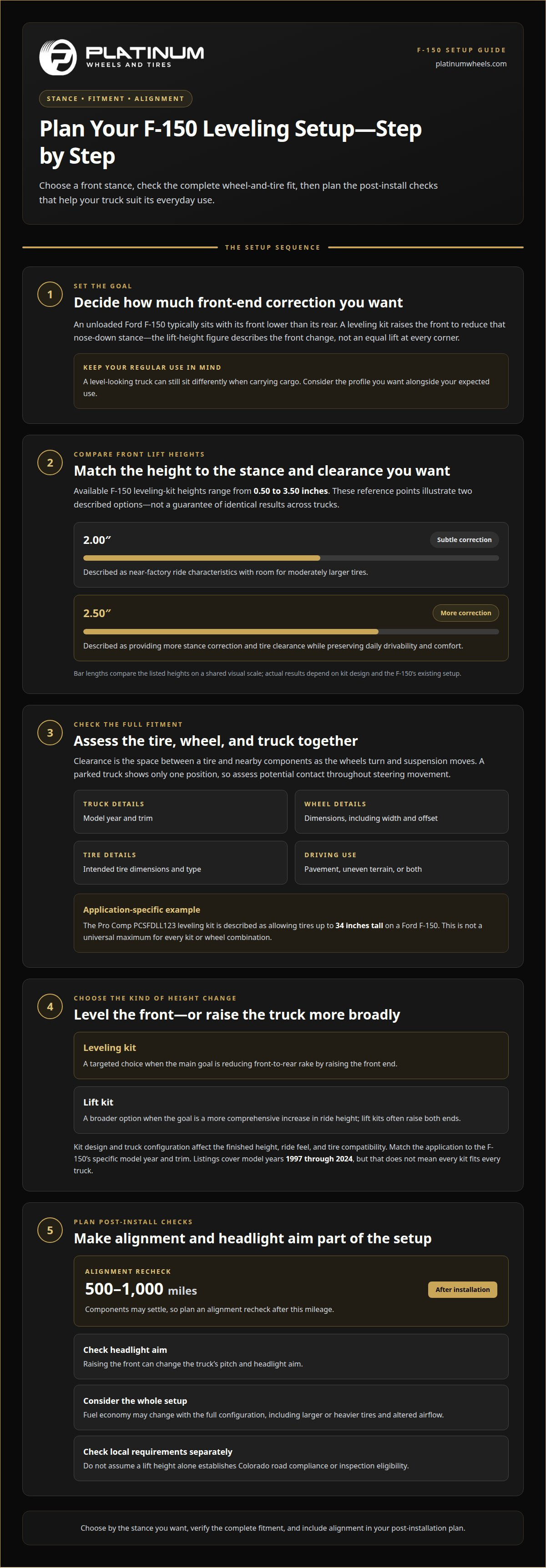
A Ford F-150 typically sits with its front lower than its rear when unloaded. An F-150 leveling kit raises the front to reduce that nose-down stance, but the lift-height figure describes the front change, not an equal lift at every corner. That distinction helps set expectations: a level-looking truck can still sit differently when carrying cargo. Choose a target profile with your regular use in mind.
A 2.00-inch F-150 leveling kit is described as providing subtle stance correction, near-factory ride characteristics, and room for moderately larger tires. A 2.50-inch F-150 leveling kit provides more stance correction and tire clearance while preserving daily drivability and comfort. These descriptions offer useful comparison points, not a guarantee of identical results across trucks. Kit design and the F-150’s existing setup also affect the final stance.
Available F-150 kit heights range from 0.50 inch to 3.50 inches. That range lets owners consider smaller adjustments as well as a more pronounced front lift. For example, a driver prioritizing a restrained appearance might consider the 2.00-inch reference point. An owner seeking more front clearance might weigh the 2.50-inch option. A taller listed height changes the front profile further, so weigh appearance, tire choice, and daily use together.
For an F-150 leveling kit, Colorado road compliance is a separate consideration from choosing a height. Don’t assume a particular lift height alone establishes whether a modified truck meets applicable state requirements or inspection rules.
Raising the front can change the truck’s pitch and headlight aim, so have the aim checked after installation. Fuel economy may also change with the full setup, including larger or heavier tires and altered airflow. The result depends on your truck’s configuration, not just the leveling height. Keep these factors in mind when choosing a kit for Denver driving.
Tire clearance and larger tire fitment
A tire’s fit depends on more than lift height. Check the F-150’s model year, trim, wheel dimensions, and intended tire together when assessing clearance.
Tire Clearance
Clearance is the space between a tire and nearby components as the wheels turn and the suspension moves. A parked truck shows only one position, so it can’t reveal every potential contact point. Consider tire diameter, wheel width, and offset together, since they affect where the tire sits. Good fitment takes the complete wheel-and-tire combination into account throughout steering movement.
For a Denver F-150, consider the truck’s actual driving use, including pavement and uneven terrain. Clearance should suit the way the vehicle will be driven, not just its appearance in a driveway.
Larger Tire Fitment
The Pro Comp PCSFDLL123 leveling kit is described as allowing tires up to 34 inches tall on a Ford F-150. That application-specific figure isn’t a universal maximum for every F-150 leveling kit or wheel combination. Tire dimensions and wheel position matter, so evaluate the exact setup together instead of treating the kit’s lift height as the only fitment factor.
For example, a similar lift height doesn’t mean another kit will provide the same tire clearance. If you’re selecting all-terrain and mud-terrain tires, include the intended wheel dimensions when planning the fit.
Model-Year and Trim Compatibility
F-150 leveling-kit listings cover model years 1997 through 2024, but that span doesn’t mean every kit applies to every truck. Model year and trim are essential fitment details because configurations differ. Match the kit’s application to the specific Ford F-150 rather than relying on the model name alone.
Apply the same care to tire selection. Trim, wheel dimensions, and kit compatibility work together to determine fit, so don’t assume a setup from another F-150 will transfer directly.
Leveling kit vs lift kit for an F-150: what are the differences?
For a Ford F-150, a leveling kit focuses on reducing the front-to-rear rake by raising the front end. A lift kit changes the truck’s overall ride height more broadly, often raising both ends. The exact components and result depend on the kit design. Start with the profile you want, then consider how that change fits your daily driving and truck use.
A leveling setup can suit an F-150 owner who wants a more even appearance without pursuing a taller overall stance. A broader lift may better match plans for greater ground clearance or a more pronounced raised profile. Neither label alone tells you the finished height, ride feel, or tire compatibility. Those depend on the specific kit and the truck’s configuration.
Think through a Denver use case before choosing. An F-150 used mainly for commuting and occasional dirt roads has different priorities from a truck regularly used on rougher terrain. Consider entry and exit, parking structures, expected cargo, and the look you want. Then compare kits by their intended changes, included components, and fitment for your model year and trim.
- Choose a leveling kit when your main goal is front-end stance correction.
- Consider a lift kit when you want a more comprehensive increase in ride height.
- Compare the full setup when wheel changes or larger tires are part of the plan.
These are selection guidelines, not guarantees about how every F-150 will look or drive. A truck’s existing suspension and configuration influence the result. For example, the same kit can produce a different visual outcome on two differently equipped F-150s. Match the kit’s application to your truck, and keep tire fitment and post-installation alignment in the overall plan.
The right choice depends on how much you want to change. If you’re looking for a front-focused stance adjustment, a leveling kit is the targeted option. If you want to raise the whole truck, compare lift-kit designs. Deciding between these goals first makes your wheel and tire fitment choices more straightforward.
How to install a leveling kit on a Ford F-150?
Installation on a Ford F-150 starts with matching the kit to the truck’s model year and configuration. The process then moves from inspecting the front suspension to fitting the kit and restoring alignment.
- Confirm the application. The installer matches the kit instructions to the F-150’s model year and setup. Kit design determines which components are replaced or repositioned, so the installation follows that specific design.
- Inspect and prepare the front suspension. Before fitting parts, the installer checks the relevant suspension components and identifies any condition that could affect installation. This establishes a clear baseline for the work.
- Install the leveling components. The installer follows the kit’s instructions to fit its parts and reassemble the front suspension. The exact sequence varies by kit, so there isn’t one universal procedure for every F-150.
- Set alignment and review fitment. After installation, the truck receives a wheel alignment. The installer also checks the resulting stance and tire clearance as part of the finished setup.
Alignment is an important step after installation because changing the front suspension height can affect wheel angles. Correct alignment helps the truck track as intended and helps prevent uneven tire wear associated with misalignment. It also provides a baseline before the suspension settles through normal driving.
Plan a follow-up alignment recheck 500-1,000 miles after installation. Components may settle during that period, which can affect alignment. This later check complements the alignment performed after the kit is installed; it doesn’t replace it.
Keep the kit instructions and the F-150’s application details tied to the work from start to finish. If you’re planning this change, schedule your leveling kit installation as part of a complete setup that includes alignment and fitment review.
Platinum Wheels: Lift Kits & Leveling Kits
Platinum Wheels offers lift-kit and leveling-kit installation for F-150 owners choosing between a front-focused stance change and a taller overall profile. Turn to the team when you’re ready to match that goal with a kit and plan how it works with your truck’s intended wheel and tire setup.
For a coordinated setup, consider custom truck wheels and off-road rims, all-terrain and mud-terrain tires, or a complete wheel-and-tire package. Looking at these options together helps you match the stance, tire fitment, and wheel selection instead of making each decision in isolation.
Bring your F-150’s model year, trim, and preferred look into the discussion. Contact Platinum Wheels to talk through your leveling-kit plans.
Build a Setup That Fits Your F-150
Use your next step to shape a complete truck setup, not just a change in front-end height. Before choosing a leveling kit for your F-150, think about what you want the finished truck to do and look like across everyday Denver driving and your off-road plans. A clear priority helps guide the conversation around wheel style, tire type, and the overall package.
Platinum Wheels offers custom truck wheels and off-road rims, all-terrain and mud-terrain tires, and wheel-and-tire packages. These options can help connect the stance you’re after with the tire and wheel choices that complete the build. Bring your goals and F-150 details to the discussion, then consider the setup as a whole.
Contact Platinum Wheels about your F-150 setup to talk through the direction you have in mind. A thoughtful plan puts you on the road toward a truck that feels personal and ready for your next drive.
Frequently Asked Questions
What does a leveling kit do on an F-150?
A leveling kit raises the front of an F-150 to reduce its factory nose-down stance. The change can make the truck’s profile look more even and create additional room for a tire setup. For example, an owner focused on appearance may choose a modest front adjustment, while someone planning different tires should consider clearance and wheel fitment together.
What leveling kit sizes fit different F-150 model years and trims?
Fit depends on the kit’s vehicle application, including the F-150’s model year and trim. A kit designed for one configuration shouldn’t be assumed to fit another just because both trucks are F-150s. Before selecting a setup, match the specific year and trim to the kit application, then account for existing wheels and tires, which influence the overall fit.
How much does an F-150 leveling kit cost, including installation?
The total depends on the selected kit, its application to your F-150, and the work involved in installation. Tire or wheel changes can also affect the scope of a complete build. Compare the setup as a whole rather than treating the kit alone as the full project. Platinum Wheels handles lift-kit and leveling-kit installation, but no kit or installation price is stated here.
What size tires fit an F-150 with a leveling kit without rubbing?
There isn’t one tire size that fits every leveled F-150 without rubbing. The result depends on the kit, tire dimensions, wheel width and offset, and the truck’s configuration. For example, a tire may clear while driving straight but contact nearby components during a tight turn. Evaluate the complete wheel-and-tire combination through steering movement, not just its parked appearance.
Does an F-150 leveling kit affect ride quality, handling, or towing?
It can change how the truck feels because raising the front alters its suspension position and stance. The result depends on the kit design, tire and wheel choices, and the truck’s use. A daily-driven F-150 and one that regularly tows have different priorities. Consider ride comfort, steering response, and the truck’s loaded stance together when choosing a setup.
Can a leveling kit cause alignment, suspension, or warranty issues on an F-150?
A leveling kit changes front suspension geometry, so installation should include an alignment and attention to component fit. Incorrect alignment can contribute to uneven tire wear or steering concerns. The modification may also raise warranty questions about affected parts; the Magnuson-Moss Warranty Act is relevant to how an F-150 modification may affect warranty coverage. Keep the kit application and installation details available for your records.